The Science Behind Sibling Closeness in Singapore Childcare Settings
Will My Children Be Close? The Question Singapore Parents Rarely Ask Out Loud
There is a question that lives quietly beneath the surface of every decision Singapore parents make about childcare. It is not about curriculum or credentials. It is not about schedules or costs. It is simpler and more tender than that.
It is this: Will my children be close?
When a family welcomes a second child, or when a firstborn begins spending their days in someone else’s care, parents feel something they often struggle to name. There is hope—deep and fierce—that their children will grow up to be allies. That the sibling bond will be a source of comfort, a lifelong anchor, a connection that holds meaning across decades.
And alongside that hope, there is a shadow. A quiet worry that shared care might create rivalry instead of closeness. That children who spend their days in the same room might grow up as strangers. That the very arrangement designed to help them might somehow distance them from each other.
This is the tension that most childcare conversations never touch. We talk endlessly about individual development—how children learn, grow, and thrive as individuals. But the sibling relationship, one of the most significant bonds a child will ever form, remains largely invisible in how we discuss and design early care. Parents navigate this terrain without maps, relying on instinct where they deserve guidance.
The Hidden Sibling Curriculum: What Quality Care Actually Teaches
When children share a caregiver, they share something far more profound than supervision. They share a reference point—a common world in which their earliest social experiences are shaped. In quality childcare, this shared world becomes a curriculum of its own. It is what can be thought of as the hidden sibling curriculum, and it operates in ways that are both visible and quietly profound.
Consider what happens when two children who trust their caregiver begin to trust each other. A secure child is a curious child. A child who feels safe enough to explore is a child who can turn that attention outward—toward another person, toward a brother or sister who is learning the same lessons of safety and connection.
In an attuned care environment, children watch each other. They watch how their sibling responds to a caregiver’s voice, to a gentle redirection, to a moment of frustration followed by comfort. They learn through modeling that big feelings pass. That relationships recover. That another person can be a source of joy rather than threat.
Co-Regulation: Learning to Read Each Other
When siblings learn to read each other’s emotional cues in a setting where their own emotions have been witnessed and responded to, they develop what researchers call dyadic capacity—the ability to attune to another person, to adjust, to respond with sensitivity. This capacity, once formed, travels with them. It shapes how they play together, how they fight, and how they make up. It is the foundation of a sibling relationship that can weather the ordinary storms of family life.
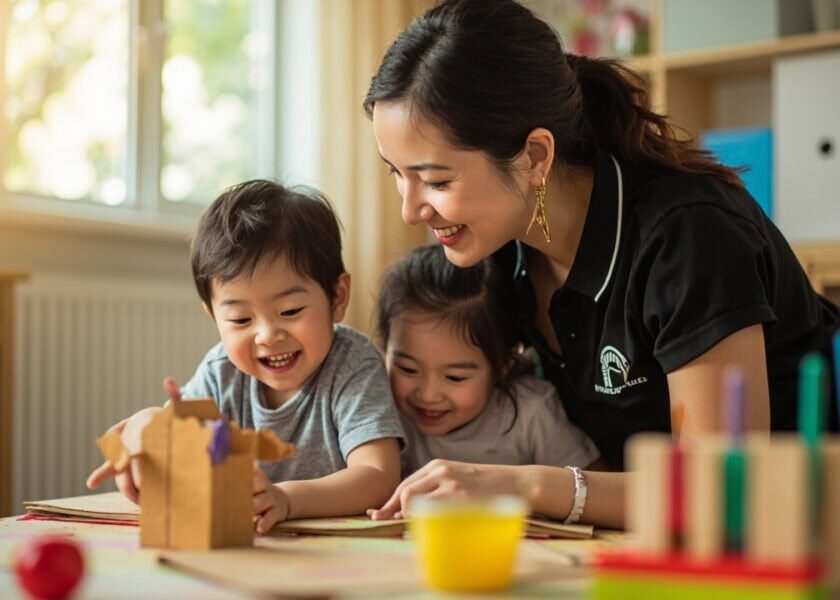
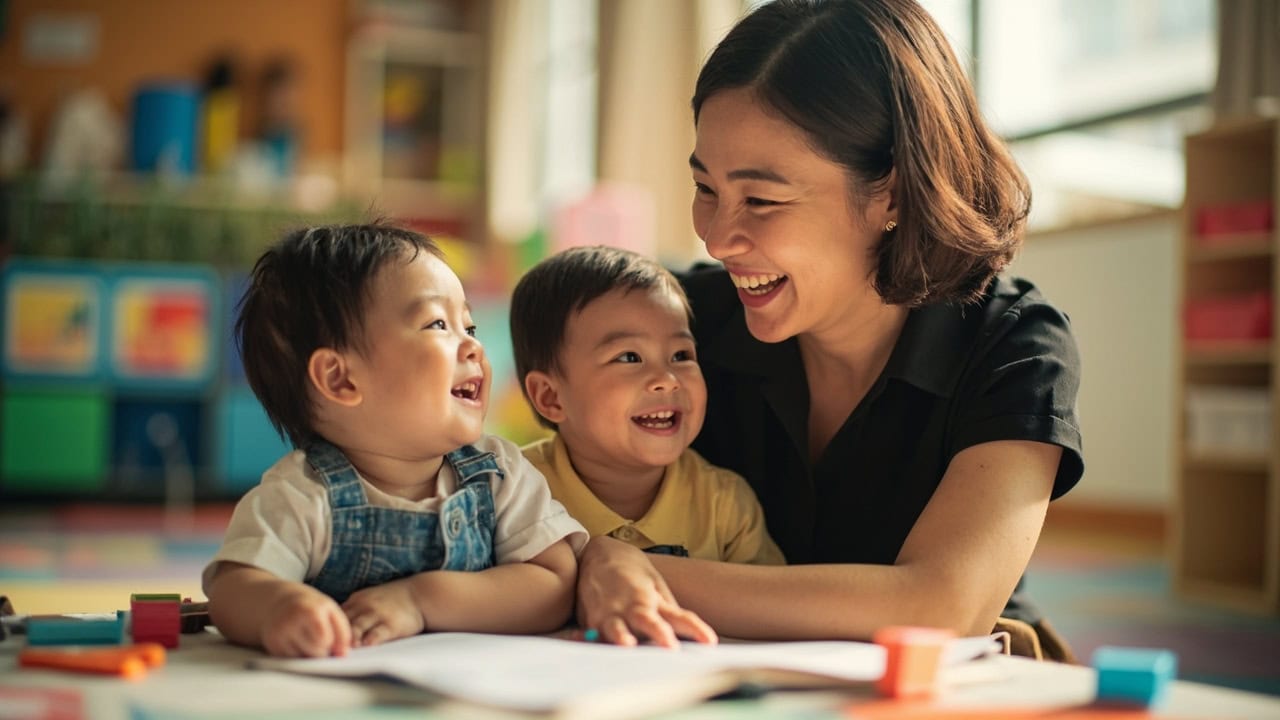
In quality childcare, parallel play becomes cooperative play. Two children who might ignore each other at home, or compete for attention, begin to discover each other in the shared space of care. They build towers together. They negotiate over toys with a caregiver nearby who does not intervene but holds the safety of the room. They learn the rhythm of each other’s play—the way one child likes to lead and another prefers to follow, the way a younger sibling gazes at an older one with something close to admiration, the way an older child begins to show off, not with cruelty, but with the pure joy of being seen and imitated.
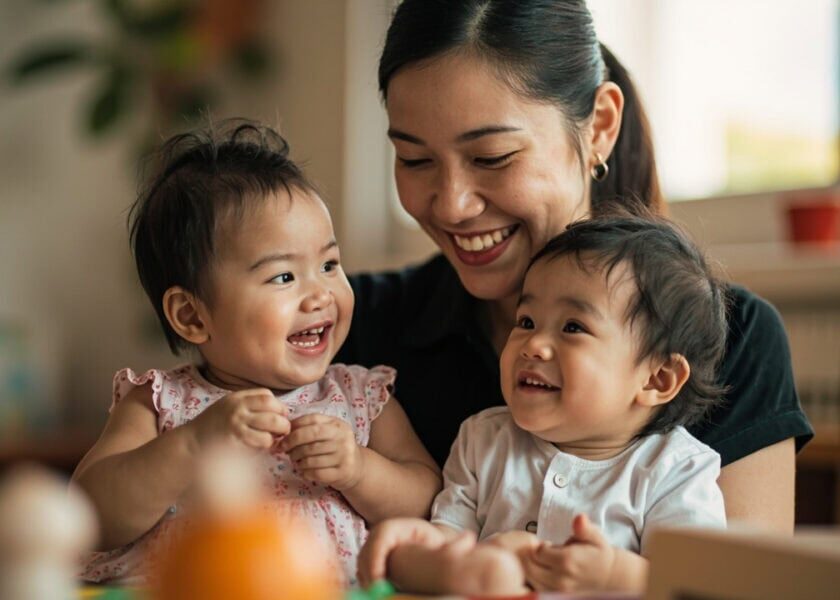
In Singapore’s home-based childcare settings, these moments unfold naturally. Small group sizes mean caregivers notice the small but significant—the way an older child’s expression shifts when a younger sibling enters the room, the way play unfolds between children who know each other’s rhythms. These are not managed interactions. They are witnessed ones, and that witnessing matters.
The Firstborn’s Transition: What the Family Gains
There is a moment in every family that expands when the firstborn’s world shifts. It happens differently in every household, but the emotional texture is familiar. A child who has been the center of attention suddenly finds that attention divided. A child who has had a caregiver’s complete focus now shares that focus with a new, demanding, endlessly fascinating addition to the family.
Parents worry about this transition. They should. It matters.
But here is what gets lost in that worry: the firstborn does not only lose in this transition. The family system gains. In quality childcare, this gaining is made visible.
When a second child enters a care relationship that is already established, something remarkable can happen. The firstborn becomes a guide—not the caregiver, but a bridge. Someone who knows the routines, the language, the unwritten rules of this world that the new arrival does not yet understand.
A child of two or three can show a baby where the water cups are kept. They can demonstrate how to sit on the mat for circle time. They can offer comfort that, though imperfect, comes from a place of genuine connection rather than obligation.
In attuned care environments, caregivers understand this dynamic. They do not sideline the firstborn; they elevate them. They recognize that the older sibling’s role is not diminished by the addition but actually enriched. The child who was once the newest member of the care family becomes a veteran, a mentor, a source of pride.
And the younger sibling, watching this confident figure navigate the world of care, begins to understand something essential: I belong here because my brother or sister belongs here. We belong together.
What Quality Childminding Actually Looks Like
For parents researching infant care in Singapore, it helps to understand what separates a care environment that supports sibling bonds from one that merely supervises children. The difference lies not in the activities on offer, but in how adults respond to children’s emotional lives.
Quality childminding means:
- Small group sizes — enough to allow genuine attention to each child’s emotional state, not just their physical needs
- Attuned caregivers — adults who notice when a child’s frustration is escalating and help them find words before it becomes a full conflict with a sibling
- Consistent relationships — the same caregiver day after day, which means siblings and their carer build a shared language and routine together
- A home-like setting — spaces where children can move freely, explore together, and discover each other without the rigidity of institutional schedules
- Non-intrusive observation — a caregiver who holds the safety of the room without stepping into every minor negotiation between siblings
Parents in Singapore also rightly ask about cost and trust. Quality care should be accessible—and Singapore has thoughtfully provided tools like the Child Development Account and Baby Bonus to support families at moments like this. Trust, however, is built on transparency: open communication, regular updates, and where applicable, measures that allow parents to feel connected to their children’s day rather than distant from it.
In settings where these elements come together, children learn that conflict is not the end of connection. They learn that repair is always possible. They learn that another person’s presence can expand their world rather than shrink it. These are the lessons that travel home with children, and that parents can build on once they understand what has been happening in care.
How EduNanny Singapore Approaches Sibling Relationship Development
At EduNanny Singapore, this understanding shapes everything we do. As part of the ECDA Childminding Pilot, we offer a home-based pathway alongside our community and centre-based options—a model designed around something we believe is essential: that infants and young children need environments where they are truly seen.
Our home-based approach allows us to offer something rare—a ratio of up to one caregiver to three infants, in a setting that feels like home rather than institution. This is not a convenience feature. It is a philosophy made tangible.
It means that when two siblings are in our care, each child receives the attention that makes co-regulation possible, that makes parallel play evolve into cooperative play, that makes the hidden sibling curriculum a reality rather than a hope.
A skilled caregiver notices when a younger child imitates an older one and amplifies that moment with gentle encouragement. A skilled caregiver gives an older child the words to express frustration at a younger one rather than letting that frustration calcify into resentment. A skilled caregiver creates a micro-culture in which siblinghood is valued, practiced, and deepened.
This is what we mean when we say that EduNanny Singapore understands the whole family system. We are not just caring for children. We are caring for the relationships between children—the bonds that will shape how they move through the world long after their years in our care are over.
What Parents Can Do to Strengthen Sibling Bonds at Home
Quality childcare builds a foundation. But there are things parents can do at home to reinforce and nurture the sibling bond that care has helped develop.
Talk about the care relationship at home. Ask your children about their day with a sibling in it. Who did your brother play with today? Who sat next to your sister at snack time? These questions may seem small, but they signal something significant: that what happens in care matters to you, that the sibling bond formed there is worth your attention, that you are invested in what they are building together.
Create unstructured time together. Siblings need time without a parent in the middle—time to negotiate, to cooperate, to bore each other, to make up, to discover what it feels like to be allied rather than competing. You do not need to orchestrate this. You need only to step back and let it happen. A twenty-minute window each day where children are in the same room without structured activity can do more for their relationship than many planned outings.
Resist the urge to arbitrate every conflict. When siblings fight—and they will, because siblings are human and conflict is part of every human relationship—resist stepping in immediately. A child who learns that conflict with a sibling can be navigated, that repair is possible, that love survives disagreement has learned something essential about relationship. This is what quality childcare teaches, and it travels home with children like a gift. Your role is not to eliminate conflict but to model that conflict does not end connection.
The Sibling Bond Is Not Luck. It Is Built.
Let us return to that quiet question.
Will my children be close?
It is the question that lives beneath the decisions Singapore parents make every day—the choice of childcare, the addition of a second or third child, the countless small surrenders and compromises that family life requires. It is a question that deserves a real answer, not reassurance without substance, not promises without foundation.
The answer is this: The sibling bond is not luck. It is not something that happens to some families and not to others. It is built, day by day, in environments where children feel safe enough to turn toward each other, where they are seen and responded to, where they learn that another person can be a source of joy and comfort and shared meaning.
Quality childcare does not guarantee that siblings will be close. Nothing can guarantee that. But it creates the conditions in which that bond can flourish—in which children learn, in the earliest and most formative years, what it means to be brothers and sisters.
At EduNanny Singapore, we take this responsibility seriously. We understand that when we care for your children, we are also caring for the relationship between them. Every shared meal, every moment of parallel play becoming cooperative play, every instance where an older sibling shows a younger one the way—these are threads in a bond that will outlast childhood.
This is why we do what we do. Not just to give parents peace of mind, but to give children something they carry with them always: the knowledge that they are not alone, that there is another person in this world who shares their earliest world, who knows the same songs, the same caregiver, the same rhythms of care that made childhood feel safe.
That knowledge is a gift. And it is one that the right childcare can help you give.
If you are a parent in Singapore thinking about childcare for one child—or already navigating care for two—we would welcome a conversation. There are no obligations, only questions answered and options explored. Every family deserves to understand what their childcare choices actually mean for the relationship between their children.
We believe the bonds children form in the earliest years matter. That is the foundation we work from.
EduNanny Singapore is part of the ECDA Childminding Pilot, offering home-based, community, and centre-based childcare options designed around the whole family. Learn more about our approach.