The Science and Art of Secure Attachment for Singapore Working Parents
The Moment Every Working Parent Knows
There is a moment familiar to almost every parent who has returned to work. You place your child into someone else’s arms for the first time. Your hands let go before your heart is ready. You look back at the doorway, and your child reaches toward you.
In that reaching is everything you fear: that you are choosing your career over your child’s need for you. That in this moment of separation, you are failing them in some quiet, irreversible way.
You are not failing. And understanding why is one of the most important things you can know as a parent making decisions about your child’s early years.
The Counterintuitive Truth About Secure Attachment
The fear you carry — that leaving your child in quality care means they will feel abandoned or disconnected — is understandable. It is also, in most cases, not true.
In fact, the opposite may be true.
The moment when you hand your child to a trusted caregiver is not a failure. It is a beginning. It is the first moment of trust between your child and the world beyond your home. And when that trust is earned and kept, it becomes the most powerful gift your child will ever receive.
What Children Actually Need to Flourish
There is a kind of child who walks confidently into new rooms. Who waves goodbye at the gate without tears, then turns back to the adventure waiting inside. Who explores boldly, asks questions freely, and returns to tell you about the caterpillar she found.
She does not love you less because of this. She loves you so well that she trusts the world is safe.
This child was not born braver than others. She was built this way — brick by brick, day by day — by the adults around her who showed her, again and again, that she was secure. That she had a place to return to. That someone knew her.
This is what attachment scientists call a secure base. And it is the most powerful gift you can give your child.
The Science of Secure Attachment
The concept comes from the groundbreaking work of psychologist John Bowlby, and it has been studied and refined over decades of research.
A secure base is not just a warm and loving environment — though it includes that. It is something more specific: the consistent, responsive, attuned presence of caregivers who meet a child’s needs reliably enough that the child comes to believe, in her bones, that the world is a trustworthy place.
- When an infant cries, someone comes — not eventually, not sometimes, but predictably and with care.
- The infant learns that her voice matters. That her needs create action. That she is not alone in the universe, shouting into a void.
- She is building the architecture of trust, and that architecture will determine how she relates to people, to challenges, to the world itself for the rest of her life.
Here is the counterintuitive finding that surprises many parents: a child can develop a secure base not only with a parent, but with quality caregivers. Not instead of the parent bond — never instead — but alongside it, and in ways that actually strengthen the child’s overall sense of security.
What happens is something more like the opposite of what parents fear: she develops a broader, more flexible capacity for trust. She learns that love is not confined to one pair of arms. She develops what researchers call a “secure internal working model” — a deep, felt understanding that people are reliable, that relationships are safe, that she can venture out and still come home.
This is why children in quality childcare often show stronger independence, not weaker. It is why they may be more comfortable with other adults, more curious in new situations, more resilient when challenges arise. They have been held enough — truly held — that they have learned how to hold themselves.
Being Kept vs. Being Held: The Difference That Matters
I want to pause on that phrase, because I think it matters more than anything else in this article.
Being kept is not the same as being held.
| Being Kept | Being Held |
|---|---|
| Physical needs are met | Emotional needs are met |
| Basic safety ensured | Your face is watched, your rhythms learned |
| Feeding happens on schedule | Tiredness noticed before overtiredness; hunger noticed before frenzy |
| Supervised | Seen and known |
| Adequate childcare | Extraordinary childcare |
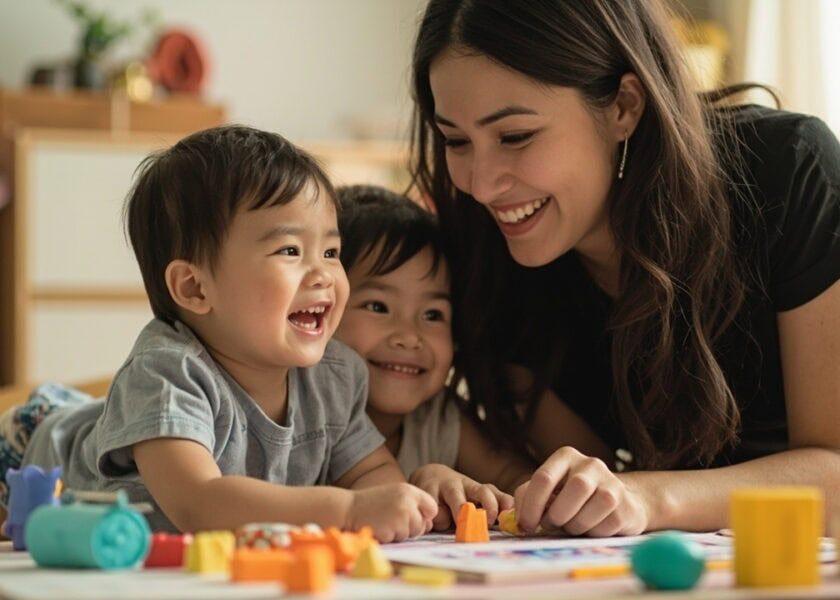
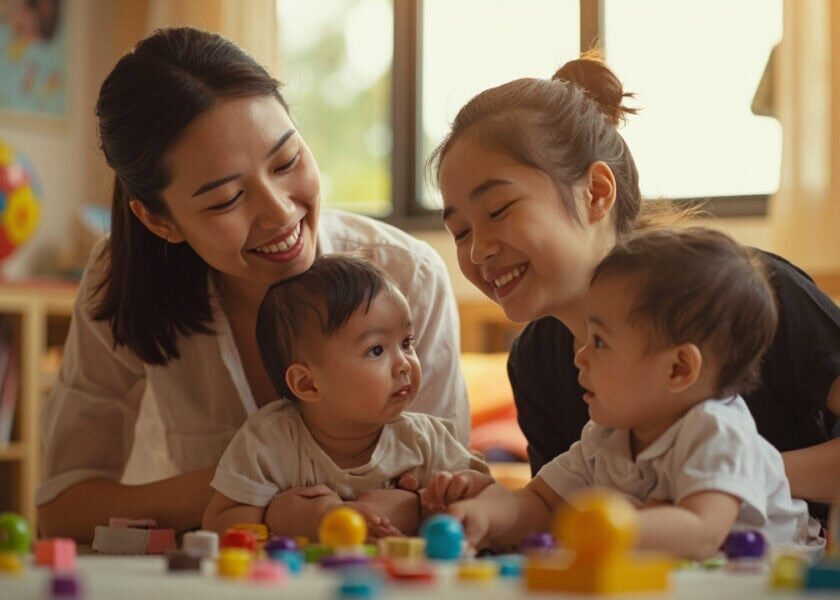
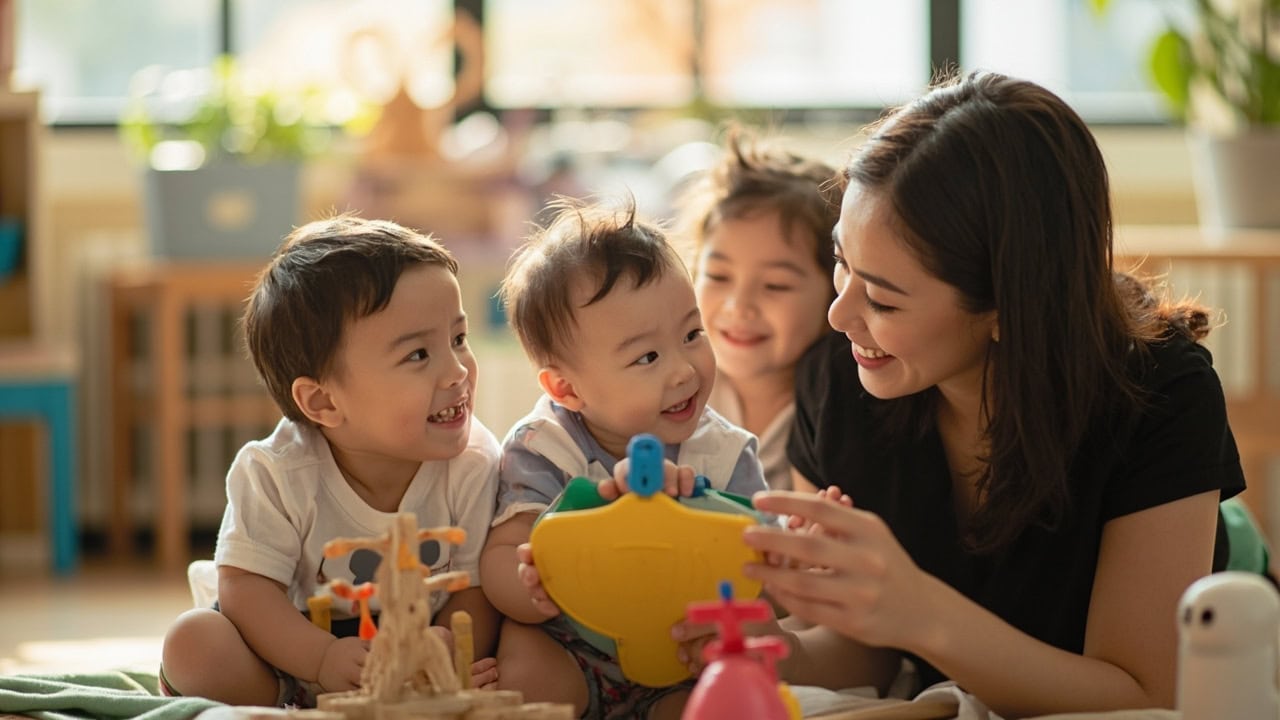
Being held means someone is paying attention to your child’s face. Learning her rhythms. Noticing when she is starting to feel shy before she has retreated entirely. Responding to who she is, not just to what she needs in the moment.
This is the difference that separates adequate childcare from extraordinary childcare. This is what separates a place where your child is supervised from a place where your child is known.
Will My Child Love Me Less?
You may be wondering: if my child forms a strong bond with her caregiver, will that bond take the place of my bond with her? Will she love me less?
The research says no. Secure attachment to a caregiver does not replace parental attachment. It supplements it.
In most cases, children who have quality attachments to both parents and caregivers show no difference in attachment security to their parents compared to children raised exclusively by parents. What they show, in many studies, is greater overall security — a broader base from which to explore and grow.
When parents see their child thriving in quality care, something shifts. The guilt that so many parents carry — that quiet, corrosive worry that they are somehow failing their child by working — begins to soften.
When they see their child running to greet the caregiver in the morning, not shrinking away; when they hear about their child’s day and see the joy in her face; when they realize that another adult loves their child too and is helping to build the person she is becoming — they feel relief.
And that relief is good for them, and it is good for their child. Because children are exquisitely attuned to our emotions. When we are anxious, they feel it. When we are at peace, they feel that too.
What This Means for Singapore Parents
For parents in Singapore, this distinction is not academic. It is everything.
You are not choosing childcare in a vacuum. You are making this choice in one of the most demanding parenting environments in the world.
You may be navigating dual-career households, extended family at a distance, the high cost of living, the pressure to return to work not just because you want to but because you need to. You may be managing parents and in-laws who have their own ideas about how children should be raised. You may be the first generation of Singaporeans raising small children without the village that previous generations took for granted.
And on top of all of that, you are expected to make the right choice for your child’s future — a choice that feels, in some moments, like it will define everything.
I do not want to add to that pressure. I want to add to your clarity.
What Quality Childcare Actually Looks Like
When children are placed in environments of consistent, attuned, responsive care — when the ratios allow for genuine attention, when caregivers are trained not just in safety but in emotional attunement, when the environment is structured around the child’s developmental needs — those children thrive.
Here are the markers that research has shown matter most:
- Caregiver-to-child ratios. Lower ratios mean more individual attention. When your child looks up, there should be someone who sees her. Her cues — the subtle shifts in mood, the early signs of hunger or fatigue — should be noticed and responded to, not in crisis, but in care.
- Attunement, not just supervision. Caregivers should be trained to read faces. To listen not just to cries but to the quieter communications that come before crying. To understand that every interaction is an opportunity to build security — or erode it.
- Consistency. Children need predictability. Seeing the same faces, following the same rhythms, knowing what comes next — this is not rigidity. This is the architecture of trust being built, day by day.
- Transparency. When you know what is happening in your child’s day, you can relax. And when you relax, your child feels it. The security you feel at home extends outward.
- Communication. Regular updates, photographs, notes about what your child ate and how she slept and what she discovered — these are not luxuries. They are the connective tissue between your home and your child’s world outside it.
A Practical Guide for Evaluating Infant Care in Singapore
If you are researching infant care or childminding in Singapore, here is what to look for:
- Observe the caregiver-child interactions. Do caregivers get down to the child’s level? Do they respond to the child’s cues, not just her cries? Do you see warmth and attunement, or just supervision?
- Ask about ratios. How many children per caregiver? Lower numbers mean more individual attention.
- Ask about training. Are caregivers trained in attunement, not just safety and first aid? Do they understand attachment science?
- Look for consistency. Will your child see the same faces each day, or a rotating cast of strangers?
- Assess transparency. How will you know what your child’s day was like? What communication systems are in place?
- Trust your instincts. You know your child. You know when someone truly sees her. Trust that knowledge.
What Is Required of You, Too
Choosing quality childcare requires something of you, as well:
- Trust the process. Allow your child to form these bonds, rather than guarding against them.
- See the caregiver not as an intrusion on your relationship with your child, but as a partner in her development.
- Stay attached during your time together. Play, read, listen, look into her eyes, tell her she is loved. Presence, even in limited quantities, is powerful.
- Remember: your child does not need you to be there every moment. She needs you to be there in the moments that matter — and to trust that, in your absence, she is being held by people who will keep her safe, teach her new things, and love her alongside you.
How EduNanny Singapore Approaches Quality Childminding
At EduNanny Singapore, our approach is built within the ECDA Childminding Pilot — a framework designed to ensure quality, safety, and developmental appropriateness.
We operate on a principle that guides everything we do: we are not simply a childcare service. We are, in the truest sense of the word, a secure base — a place where your child is not just kept but held.
Our caregiver ratios allow for genuine individual attention. Our caregivers are trained not only in the practical elements of infant care — the feeding, the soothing, the safe sleep practices, the developmental milestones — but in the more subtle art of attunement. They understand that every interaction is an opportunity to build security, and they take that responsibility seriously.
Where deployed, our CCTV measures mean you can see what is happening in your child’s day. Our communication practices mean you receive regular updates — photographs, notes about what your child ate and how she slept and what she discovered and who she played with and what made her laugh.
Where applicable, you can use your child’s CDA and Baby Bonus to offset costs. Monday to Friday care blocks are structured to fit working parents’ lives. These are not incidental details. They are the practical architecture that makes it possible for you to choose quality — and to choose it without constant financial anxiety adding to your already considerable load.
Singapore is not one place but many — East and West, HDB heartlands and private estates, different languages and different traditions. What we offer is not a Western model imposed on Singapore families. It is a model built on universal principles of child development — because a baby in Bedok and a baby in Tiong Bahru needs the same security, the same attunement, the same consistent love — adapted to the realities and values of Singapore family life.
Choosing a Secure Foundation for Your Child’s Life
What do you want for your child? Not in the abstract — not the answers you give at parties or the things you wrote in your birth plan before you understood what you were really asking for. What do you actually want, in your bones, for the person your child is becoming?
I suspect, if you are like the parents I have worked with over the years, that you want a child who is confident. Who can walk into a new school and introduce herself without fear. Who can try new things and fail and try again. Who can form friendships and navigate disagreements and recover from heartbreak. Who can, one day, leave you — because that is what children are supposed to do — and build a life of her own, secure in the knowledge that she is loved, and capable, and not alone.
That child is not built by luck. She is built by years of being held. By consistent presence. By attunement. By the slow, patient work of showing a small person that the world is safe, that people are good, that she is worthy of care.
You cannot build that alone. No parent can. It takes a village — or at least, a trusted extension of your family. It takes caregivers who are trained and intentional and present. It takes a system designed to support not just your child’s safety, but her emotional architecture.
Choosing quality childcare is not a compromise. It is not an apology for being a working parent. It is an active, intentional choice to build a secure base for your child — a base that may include not just your arms, but other arms that are safe, other voices that are warm, other hearts that are engaged in your child’s wellbeing.
The moment when you placed your child in someone else’s arms — that moment was not a failure. It was a beginning. It was the first moment of trust, not just between you and your caregiver, but between your child and the world beyond your home.
That trust, when it is earned and kept, will become the most powerful gift your child ever receives.
We would be honored to help you give it to her.
If you are considering childminding or infant care in Singapore and would like to learn more about how EduNanny Singapore can support your family, we invite you to reach out. Let us show you what quality care looks like — and help you build the secure base your child deserves.
Learn more about who we are and what we offer.