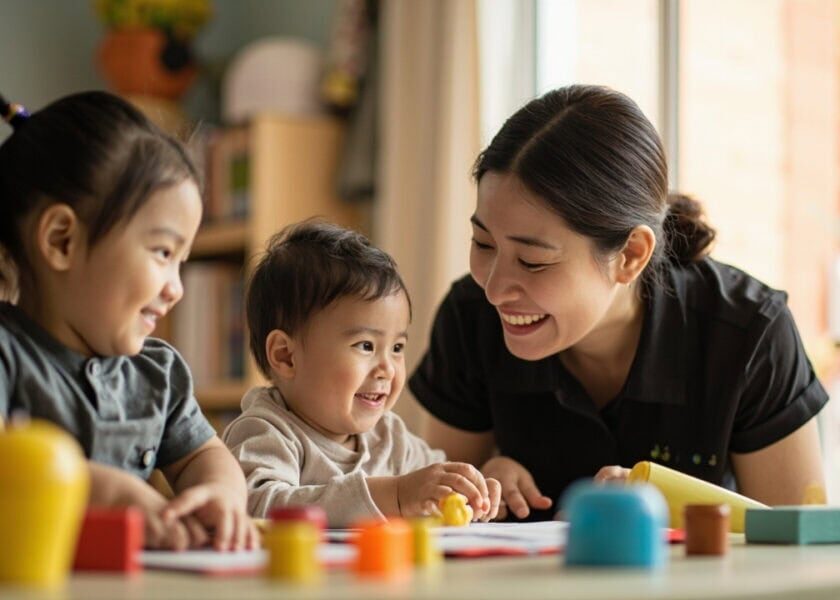
The Rich Inner World of Your Child at Childcare
What Is Your Child Actually Living Through When You Are Not in the Room?
It is evening in a Singapore home. The commute is done, the door has closed behind you, and your child is on the floor with a toy truck or sitting at the table with a bowl of porridge. In this moment — between the handover at the gate and the quiet of your own living room — you find yourself wondering something you cannot quite name.
You chose this. You researched, you visited, you trusted your instincts and the programme. Yet beneath the satisfaction of having made a good decision, there is this quieter question, this undercurrent that does not go away no matter how many reassuring updates you receive or how smoothly the mornings have been going.
The question is not whether childcare is good in general. You know that. The question is: what is actually happening in there? What is my child living through when I am not in the room?
This is not an anxious question. It is a human one. It is the question of every parent who loves their child and cannot be in two places at once.
The Hours Apart: What Your Child Is Actually Living Through
Understanding what your child is experiencing is not a luxury. It is the foundation of every decision you will ever make about who cares for your child — and the thing that allows you to rest in the knowledge that the hours apart are not hours lost.
The Morning Separation
Let us begin with the moment that parents often describe as the hardest: the morning handover. You hand your child to a caregiver, or you walk together into a centre, and there is that brief flash of uncertainty — in your child, in you, sometimes in both at once.
What happens next in a quality care environment is remarkable, though it happens quietly and quickly, so quietly that it might look like nothing to an outsider. The child takes in the environment. They read the faces of the adults. They sense the tone of the room. And if the environment is warm, consistent, and well-prepared, something begins to shift within them — a quiet recalibration that tells them, this is a place where I can be.
The separation does not become unimportant, but it becomes manageable. And then, over days and weeks, it becomes the beginning of something else entirely: trust built through experience, not just words.
The child learns, through repetition and consistency, that you always come back. That the caregiver responds when they are hungry or tired or upset. That the environment holds them even when you are not in it. This is the earliest lesson in the reliability of the world, and it is learned not from explanation but from the accumulated experience of being consistently cared for in a consistent place.
Social Competence: Learning Through Small Moments
Here is what many parents do not see, because it happens in the texture of ordinary afternoons rather than in dramatic moments.
Your child is playing near another child, and a dispute arises over a toy. In an adult-centred environment, an adult might intervene quickly, solve the problem, and move on. In quality group care, something different happens. The trained caregiver observes. They are present, they are ready to step in if needed, but they give the children a moment — just a moment — to work it out.
And in that moment, your child is doing something enormously complex:
- Reading another child’s face and trying to understand intent.
- Feeling their own frustration and learning that it can be tolerated.
- Discovering that another person has needs too.
- Practising language as a tool to solve problems.
- Finding that it is possible to feel angry and still act with some measure of control.
This is social competence. It is not taught through a lesson. It is built through dozens of such small moments, accumulated over months, until a child who once cried at every conflict begins to find their way through with growing confidence.
Your Child’s Emotional World During the Day
There is another dimension to this that parents often worry about without knowing what to call it. It is the child’s emotional life during the day — not just the big feelings, the tears and tantrums, but the quieter interior world of their experience.
When your child is at quality childcare, they are not just being minded. They are feeling things. They are noticing things. They are sometimes overwhelmed by the noise or the size of the room, and they are sometimes delighted in ways that surprise even them.
They are experiencing the particular pleasure of sustained collaborative play with a peer that could not happen at home because there was no-one of the right age and temperament in the house. They are feeling the satisfaction of mastering a puzzle or building something tall or learning a song. These experiences are shaping them, and the quality of care determines whether they add up to a sense of safety and growth, or a sense of mere accommodation.
This is the difference between supervision and genuine care. Supervision means your child is safe, fed, and occupied — that matters, and it is the baseline. But genuine care means that someone is watching not just what your child is doing but what they are experiencing. Someone is noticing when a child is withdrawn and thinking about why. Someone is noticing when a child is about to make a developmental leap and creating conditions to support it. Someone is holding the child’s emotional experience with the same seriousness and tenderness that you do.
Your Child as an Active Agent
Children, even infants, are active agents in their own development. They choose. They experiment. They test boundaries not because they are difficult, but because that is how they learn where the edges of the world are.
In quality care, these preferences are noticed and honoured:
- A child who always chooses the drawing corner is telling you something about their aesthetic sense.
- A child who gravitates toward the block area is telling you about their spatial thinking and interest in structure.
- A child who watches other children before joining in is showing you their observational style of learning.
When you pick your child up at the end of the day, they are not the same child who left you in the morning. They have lived a full day in their own world, and they carry something home with them — not just a stain on their shirt or a story they cannot quite tell you, but something emotional, something developmental.
Some children arrive home buzzing with energy from stimulation and social contact. Some arrive quiet and need time to land before they can re-engage. Some become clingier than usual because the day was big and they need to refill their tank of closeness with you. These are not signs that something is wrong. They are signs that the day happened, that it mattered, and that your child is processing it in their own way.
Signs That Quality Care Is Working
Not just safe. Not just pleasant. But genuinely good for your child’s development.
You know it partly by watching what we have just described — the clinginess that eases, the disputes that become more navigable, the play that becomes richer and more social over time.
You know it by the quality of your child’s engagement with the world, not just during childcare years but in the years that follow:
- The ease they begin to find in social situations.
- The flexibility they show when plans change.
- The resilience they display when things go wrong.
These are not things you can measure in a daily report. They are things that unfold over months and years, and they are the real evidence of whether quality care is doing what it should.
What Quality Childminding Looks Like in Singapore
When you are evaluating infant care options, here is what to look for:
- Consistency of caregiver: Your child should have a primary caregiver they see regularly, not a rotating cast of strangers.
- Appropriate ratios: In infant care, fewer children per adult means more attention, more observation, and more responsiveness to your child’s individual needs.
- Observation over intervention: Caregivers who watch before they act, who support rather than solve, who give children room to learn through experience.
- Two-way communication: Updates that tell you not just what happened but how your child seemed — what delighted them, what challenged them, what they are working on.
- Environment as teacher: Spaces that are safe but not sterile, stimulating but not overwhelming, designed for how children actually play and learn.
- Partnership with parents: A programme that wants to know what is happening at home and is willing to share what is happening in care — so both environments can work together.
We understand that affordability matters. The pilot fee structures have been designed with this in mind, and families can access support through CDA and Baby Bonus schemes where applicable. Quality care should be available not just to families who can pay a premium, but to every family who needs it — because the developmental stakes are too high for access to be determined by postcode or income.
How EduNanny Approaches the Work of Caring for Your Child
EduNanny by BUTLER is built on this understanding. It is not just a philosophical position for us. It is the operating principle behind every decision we make about how we structure care, how we train our caregivers, and how we communicate with parents.
ECDA Childminding Pilot Participation
EduNanny participates in the ECDA Childminding Pilot, and this matters because it means our programme is aligned with national standards for quality childminding. It means we are part of a deliberate, thoughtful effort to expand what quality childcare looks like in Singapore — not just in centres, but in homes and community settings where children can be held in smaller, more intimate groups.
The pilot recognises something that developmental science has long understood: that the ratio of caregiver to child, the consistency of the caregiver, and the warmth of the environment are not luxuries. They are the conditions that make everything else possible.
What One-to-Three Ratios Actually Mean
When we speak about up to one-to-three infant ratios, we are not just describing a number. We are describing the difference between a child being seen and a child being overseen.
In a smaller group with a consistent caregiver, your child is not one face in a crowd. They are a person whose preferences, rhythms, and developmental journey are known and attended to. This is not an accident of our programme design. It is the point of it.
What This Looks Like in Practice
It looks like caregivers who are trained not just in safety and routine, but in observation — in the discipline of watching a child carefully enough to understand what they are communicating through behaviour, through play, through the things they are drawn to and the things they resist.
It looks like communication with parents that goes beyond the transactional — not just what they ate and how long they slept, but what they seemed delighted by, what they worked hard at, what they might need more support with at home.
Where deployed, it includes measures like transparency tools and observation records that allow parents to feel genuinely connected to their child’s experience even during the hours apart.
Home-Based and Centre-Based Pathways
EduNanny offers both home-based and centre-based pathways, because we know that different families have different needs and that the right setting for one child may not be the right setting for another. What we care about is that whatever pathway a family chooses, the quality of the experience is consistent — warm, attentive, developmentally rich, and aligned with the understanding we have been describing.
Addressing Your Real Concerns
“How do I know my child is actually okay?”
Look at the trajectory over weeks and months, not individual days. A single difficult drop-off means little in the context of a pattern of growing ease. Watch for increasing comfort with the routine, growing engagement with peers, and the gradual easing of separation anxiety into something more like anticipation.
“What if my child seems tired or overwhelmed after childcare?”
This is not a warning sign. It is often a sign that the day was rich — that your child was engaged, challenged, and processing. Children who arrive home spent from a day of real experience are not children who have been merely occupied. They are children who have been growing. What matters is that the tiredness eases with rest, food, and your presence — and that over time, the recovery gets faster.
“Will my child miss me?”
Yes. That is natural, and it means your bond is strong. But in quality care, your child learns something important alongside missing you: that missing someone and enjoying the present moment are not contradictions. That they can hold both — love for you and engagement with where they are. That is not a lesser love. It is a more complex one, and it is part of what you want for your child.
“Can quality care really match what I provide at home?”
It does not need to match what you provide at home. It cannot, and should not try to. What quality care provides is different — complementary. The peer who cannot exist in your household. The problem to solve that stretches your child beyond where they are comfortable. The challenge that builds capability. The other adult who is trained to hold their feelings while they learn to hold them themselves. These are not replacements for your love. They are additions to it.
The Hours You Are Apart Are Hours Lived
The promise we make to you is not that childcare will be easy, or that separation will never be hard, or that every day will be perfect. We know better than to make those promises because we know children, and children are not perfect, and neither is any environment that includes them.
What we promise is this:
- That we are watching your child with the same attention you would give them.
- That we are understanding their experience as something real, meaningful, and worthy of our best efforts.
- That every day, in small ways and large ones, we are doing the work of helping them grow — not just into children who are ready for school, but into children who are ready for life.
We promise that your child is not just being cared for. They are being seen.
The next time you pick your child up, watch them. Not just for the bruise on their knee or the smile on their face, but for the person they are becoming in your arms. That person has been shaped by you — by your love, your values, your presence at home. But they have also been shaped by the hours apart — by the peers they played with, the problems they solved, the feelings they learned to name, the caregiver who held them when they were tired and the room that felt, after a while, like a place they belonged.
That is what quality childcare gives your child. Not a substitute for your love. Not a lesser version of your attention. A complement to it — a whole other dimension of experience that, when it is good, adds depth and richness and capability to the person your child is becoming.
Begin the Conversation
EduNanny by BUTLER is here to walk this path with you — not just as a service, but as partners in your child’s earliest years. If you are exploring infant care or childminding options in Singapore and would like to understand how EduNanny approaches the work of caring for your child from the inside out, we would be glad to hear from you.
You are welcome to reach out to us to learn more about our programme, ask your questions, and explore whether we might be the right fit for your family.
Your child is living a rich, meaningful experience in quality care. Let us help you understand it.
To learn more about EduNanny, visit edunanny.com or read about who we are.