The Real Indicator of Quality Childcare That Tours Cannot Show
“`html
What No Tour Reveals: The Hidden Indicator of Quality
The childcare industry has given you tours and checklists. Credentials, accreditations, curriculum frameworks. Ratios and square footage and sleeping arrangements. These things matter—but they are not the thing that matters most.
There is a hidden indicator of quality that no tour reveals and no brochure captures. It is the relationship between your child and the person who cares for them—the specific, irreplaceable bond that forms or fails to form over time.
Why This Matters So Deeply
In the first years of life, children are not simply growing bodies and developing minds. They are building the architecture of their inner worlds—the template for every relationship they will ever have.
Psychologist John Bowlby understood this when he coined the term attachment, and decades of research have confirmed what he intuited: children who experience consistent, warm, responsive caregiving develop a sense of security that becomes the foundation for confidence, emotional regulation, and the ability to connect with others.
Consider what this means in a childcare context. Your child is spending hours each day with another person. That person is not a credential or a facility. That person is a human being who, over time, becomes either a source of comfort and consistency—or simply a stranger who provides supervision.
The difference is not determined by the quality of the toys or the elegance of the environment. It is determined by the presence or absence of a secure attachment.
What Secure Attachment Looks Like in Childcare
Secure attachment looks like something you may have observed without recognizing its significance. It looks like:
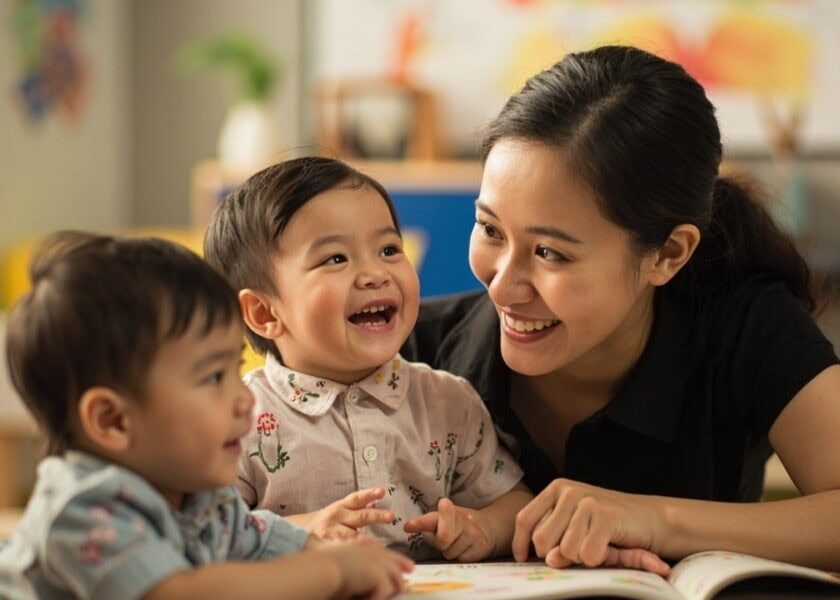
- A child who is genuinely glad to see their caregiver—not simply tolerating them, but greeting them with ease
- A child who can be soothed when upset—who has learned through experience that their caregiver will respond to distress with comfort
- A child who checks in with their caregiver before exploring—who looks back, who seeks proximity, who trusts that the familiar presence will remain
Secure attachment also looks like something subtler: a child who has learned to trust the world because a specific person taught them it was trustworthy. This is what attachment researchers call the secure base—the knowledge that someone is there for you, that you can venture out and return, that you are held even when you cannot see the arms that hold you.
A child with a secure base is not merely supervised. They are accompanied.
Reading the Signs at Pickup
You can read the quality of attachment in your child’s behavior when you arrive. A child who runs to you with joy is not showing you that they prefer you to their caregiver—that is natural and expected.
What is more revealing is what happens in the transition:
- A child who waves goodbye with ease
- A child who mentions their caregiver’s name with warmth
- A child who settles quickly when arriving, because they have learned that this place, this person, is safe
The security you feel with your own child is built partly from the security they feel with the person who cares for them when you are apart. This is not a comfort that should make parents feel replaced. It is a complement to your bond. When your child has a secure attachment to their caregiver, they are not choosing someone else over you. They are building a second anchor—another person who has earned their trust, another relationship that teaches them what consistency and warmth feel like.
How to Read Caregiver Responsiveness
The signs of genuine responsiveness are there, if you know where to look.
Notice What Caregivers Notice
During pickups or in communications with your childcare provider, notice how the caregiver speaks about your child. A caregiver who is genuinely attached will notice things—not just that your child had a good day, but that they favored a particular book, that they seemed proud of a new skill, that they were quieter than usual.
This specificity is the fingerprint of attentiveness. It tells you that your child is seen as an individual, not as one of many to be managed.
Observe the Child-Caregiver Dynamic
Notice how your child responds to the caregiver during transitions:
- When you arrive and your child is content in the caregiver’s presence, not distressed or withdrawn—that is information
- When your child reaches for the caregiver for help, or seeks them out for comfort without panic—that is information too
The child is telling you, in the only language they know, who they trust.
Questions That Reveal Philosophy
Ask caregivers not just what they do when a child is upset, but what they believe children need when they are distressed. Ask how they think about building trust with a child who is new to their care. Ask what they hope a child will feel when they are with them.
Listen not for rehearsed answers but for the values that surface in how they speak about very young children. These questions will not yield perfect responses—caregiving is not a performance. But they will give you a window into whether the person in front of you sees your child as a person to be known, or simply a responsibility to be managed.
Partnering with Your Child’s Caregiver
Once you have found a caregiver who demonstrates genuine responsiveness, your role shifts. You become a partner in nurturing that relationship, not a competitor with it.
Bridging Two Worlds
This means communicating with your caregiver not just about schedules and health, but about your child’s life outside of their time together:
- Share things happening at home that might affect your child’s mood
- Tell them about a new word your child learned
- Mention a transition at home
- Tell them about a book they have been asking to read repeatedly
When you bridge the two worlds of your child’s life, you help the caregiver understand your child more deeply—and you signal that you value what happens in those hours as genuinely important.
Projecting Confidence
It also means respecting the caregiver’s role without anxiety or defensiveness. Some parents feel guilty about time apart and unconsciously undermine the relationship by questioning it, expressing doubt in front of the child, or treating the caregiver as an obstacle rather than an ally.
This is understandable, but it is not helpful. Your child needs to know that the adults in their life trust each other. When you project confidence in your caregiver, you teach your child that this person is safe. That teaching is one of the most valuable gifts you can give.
Why Continuity Matters More Than Parents Realize
The research here is consistent: young children need stable, consistent caregiving relationships to develop the security that will support them throughout their lives.
A child who experiences multiple caregiver changes in their earliest years is not simply inconvenienced. They are building templates for trust that will be affected by inconsistency.
This is why, when families ask us what matters most in choosing childcare, we often say: continuity first. The most beautiful environment, the most sophisticated curriculum, the most prestigious credentials—all of it becomes meaningful only if it rests on a foundation of consistent, warm, responsive care from a person your child knows and trusts.
How EduNanny Approaches Caregiver-Child Bonds
Our participation in the ECDA Childminding Pilot reflects a commitment to something deeper than flexible scheduling or convenient location. It reflects our belief that the relationship between a child and their caregiver is not incidental to quality childcare—it is the foundation of it.
Designed for Genuine Attunement
When a child is placed with a caregiver through EduNanny, our intention is that they remain together long enough to build something real.
The low ratios we maintain—one caregiver to up to three infants in our home-based pathway—are not simply a compliance measure. They are a design choice that creates the conditions for genuine attunement. A caregiver who knows three children deeply can respond to each of them in ways that a caregiver responsible for many more simply cannot. Attention is finite. When it is divided too many ways, something is lost.
Communication as a Necessity
We also believe that communication is not a luxury—it is a necessity. Parents cannot observe what happens during the day, and that uncertainty can be its own form of strain.
We address this through regular updates, through the transparency of our practices, and through measures such as CCTV where deployed—not to suggest distrust, but to bridge the gap between what parents need to know and what they are able to see. When parents receive genuine information about their child’s day, they can participate more fully in the relationship with their caregiver, and they can carry that knowledge into their evenings at home.
Practical Support for Families in Singapore
We know that for many families in Singapore, the practical dimensions of childcare—cost, subsidies, scheduling—require careful navigation.
EduNanny is structured to be affordable within the pilot fee frameworks, and we ensure that eligible subsidies, including CDA and Baby Bonus, can be applied where relevant. Monday-to-Friday care blocks are designed to align with the realities of working parents, not to add complexity. These are not secondary concerns. They are part of how we make it possible for families to access the kind of care their children deserve.
The Peace That Comes from Choosing Well
Here is what we have seen, in the families who have walked through our doors and trusted us with this most important work.
When a child has a secure bond with their caregiver, something shifts:
- The morning goodbye becomes less fraught—not because it is easy to leave your child, but because you trust where they are going and who they are going to
- The evening pickup becomes richer—not because you are relieved the day is over, but because you can see, in your child’s ease, that they have been held well
- The child becomes more available for play, for learning, for connection—because they are not spending their emotional energy managing anxiety or distress
And you, as a parent, can be present with them in the evenings in a way that feels whole rather than fragmented, because you are not carrying the weight of worry about the hours you were apart.
This is what secure attachment gives you. Not the absence of separation—separation is a reality of modern life, and parents in Singapore know this perhaps more acutely than most.
It gives you the confidence that your child is not merely supervised during those hours, but accompanied. It gives you the peace that comes not from certainty, but from trust—trust that you have chosen well, that your child is known, that the person holding your child is holding them the way you would hold them if you were there.
That peace is not naive. It is earned.
We do not believe that EduNanny is the right choice for every family, and we would not claim that our structure alone guarantees what we are talking about today. What we believe is that the quality of your child’s care depends most fundamentally on one thing: whether your child has a caregiver who is genuinely attuned to them, who responds with warmth and consistency, who becomes, over time, a person your child trusts.
That relationship is the standard. Everything else—the curriculum, the environment, the credentials—serves that relationship or it does not.
The Gift You Are Giving
Your child will not remember the credentials of their first caregiver. They will not remember the square footage of the room where they spent their mornings.
What they will remember—what will shape them in ways that no curriculum can—is whether they felt safe. Whether they were held. Whether someone looked at them and saw them, truly saw them,, and responded with love.
That is the gift you are giving your child when you choose their care with this in mind. Not just supervision. Not just education. Presence. The gift of a person who shows up, again and again, until showing up becomes trust, and trust becomes the foundation for everything that comes after.
We would be honored to walk that path with you.
If you are a parent in Singapore exploring infant care or childminding options, we invite you to schedule a conversation with our team to explore whether our approach feels right for your family. You can also learn more about our values and approach or visit the EduNanny homepage to see how we structure care around the caregiver-child bond.
“`