The Quiet Truth About What Makes Children School-Ready
What Primary 1 Teachers Actually Look For
In the first weeks of a new school year, experienced P1 teachers in Singapore can identify within days which children will navigate Primary 1 successfully and which will struggle. They are not testing reading levels or counting sight words. They are watching something else entirely.
They are watching which children can sit still and attend when the teacher speaks—not because they have been trained to, but because they have learned, over years of responsive care, that listening is rewarding and that the adult in the room is worth attending to.
They are watching which children can manage their own disappointment when they do not get the answer right, who can tolerate the discomfort of not knowing, who can recover from frustration and try again.
They are watching which children approach new and unfamiliar tasks with curiosity rather than anxiety, who are willing to guess and explore and make mistakes because they have learned that mistakes are information and not failure.
They are watching which children can read the room, can sense when a classmate is upset, can wait their turn, can ask for help, can give help.
These are not soft skills. These are not optional extras. These are the skills that determine whether a child can learn at all, and whether the academic content that schools deliver will actually stick.
The Three Capacities That Actually Determine Readiness
What teachers observe in those first days is really about three interconnected capacities that children either arrive with or without: self-regulation, curiosity, and relational confidence.
Self-Regulation
This is the ability to manage one’s own emotional and physiological state—to tolerate frustration, to modulate excitement, to calm oneself when agitated. A self-regulated child can sit through a forty-minute lesson even though sitting still is hard. A self-regulated child can experience the embarrassment of getting an answer wrong and remain present and available to try again.
Self-regulation is not inborn. It is built through thousands of experiences, beginning in infancy, where a caregiver notices a child’s distress, responds with warmth and attunement, and helps the child move from dysregulation back to calm. Each time this happens, the child learns something profound: that overwhelming feelings pass, that there is a way back to equilibrium, that the adult in the room can be trusted to help.
Over years, this accumulates into an internal capacity that the child carries into the classroom. No worksheet teaches this. No enrichment class builds this. Only responsive, consistent, emotionally intelligent caregiving builds this, one successful attunement at a time.
Curiosity
Genuine, undimmed curiosity is one of the most precious resources a child can carry into school, and also one of the most fragile. Children are born curious—every infant is a scientist, testing hypotheses about how the world works, reaching for the unexpected, investigating the unknown with fierce determination.
But curiosity can be dulled. It can be overshadowed by anxiety, by the fear of being wrong, by the message that learning is about performance and not exploration. Quality developmental care protects and nourishes curiosity by giving children the freedom to investigate, the safety to ask questions without fear, and the experience of learning as something joyful rather than evaluative.
A curious child does not need to be motivated to learn. Motivation is built in. What a curious child needs is access to interesting things to be curious about, and adults who encourage and extend their investigations.
Relational Confidence
The ability to trust adults, to seek help when needed, to form friendships, to navigate the social complexity of a classroom—Singapore’s school environment, even at Primary 1, is intensely social.
Children who have experienced consistent, warm, responsive caregiving arrive at school with an expectation that adults will help them, that teachers are trustworthy, that asking for assistance is normal and safe. This makes them available for the full range of learning experiences that school offers.
The Science Behind What Actually Creates School Readiness
Here is what decades of research has been saying, in language that has somehow failed to reach the living rooms and parenting forums where Singapore parents are making their decisions.
A landmark study from the Harvard Center on the Developing Child describes executive function—the capacity to regulate attention, manage impulses, and pursue goals—as the foundational capability that underlies all learning. Longitudinal studies tracking children from early childhood into adolescence consistently show that social-emotional competencies in the early years predict academic outcomes far more reliably than early academic knowledge.
Children who arrive at school with self-regulation, social confidence, and genuine curiosity do not merely survive Primary 1. They develop momentum. They compound. Year after year, the gap between them and their peers who were academically prepped but emotionally underprepared tends to widen, not narrow.
A review published in the journal Developmental Review synthesised decades of attachment research and concluded that children with secure attachment histories demonstrate superior academic performance, more positive attitudes toward school, better social competence, and lower rates of behavioural problems throughout their school years.
Responsive caregiving activates the neural pathways in the prefrontal cortex that govern executive function. The secure attachment formed through consistent, warm caregiving shapes the architecture of the developing brain in ways that have lifelong consequences for emotional regulation, stress management, and social functioning. This architecture is built primarily through the quality of caregiving relationships in the first five years of life.
School Survival vs. True Readiness
A useful distinction Singapore parents rarely encounter: the difference between school survival and school readiness.
A child who has been academically drilled may survive the first weeks of Primary 1. They may already know how to read some words, how to write their name, how to count. But if they lack self-regulation, they will struggle to sit through lessons. If they lack curiosity, they will disengage when the material becomes unfamiliar. If they lack relational confidence, they will find it difficult to ask for help when they need it.
Academic knowledge is like teaching someone to swim by explaining the theory of buoyancy. They may know every fact about swimming, but when the water rises to their chin, none of it serves them.
A child who arrives capable of learning—who is curious, self-regulated, and relationally confident—may not know as many words on day one. But they are positioned to learn. Over the weeks and months of Primary 1, as the curriculum unfolds and the demands increase, they will absorb what is taught with a capacity that the academically prepped but emotionally underprepared child simply cannot match.
What Quality Developmental Childcare Actually Looks Like
So what does quality developmental childcare do that enrichment classes and worksheets cannot?
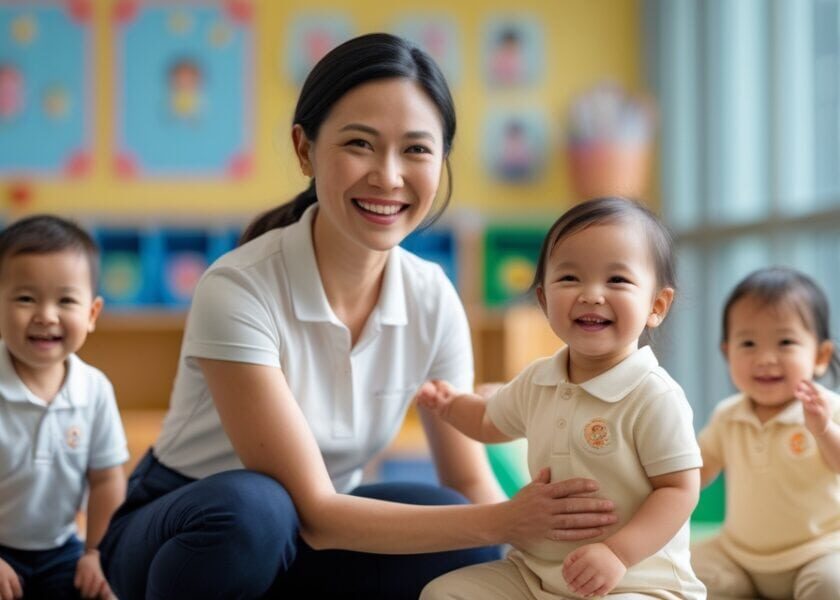
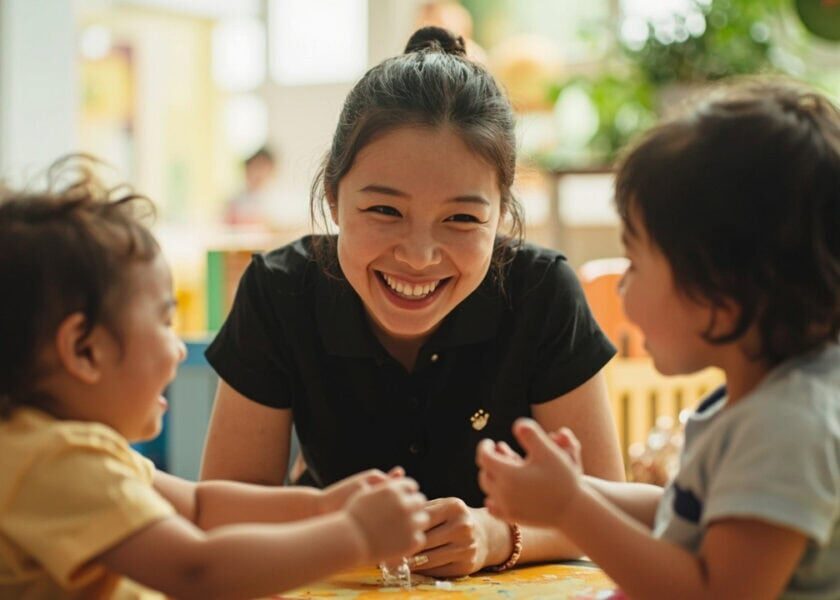
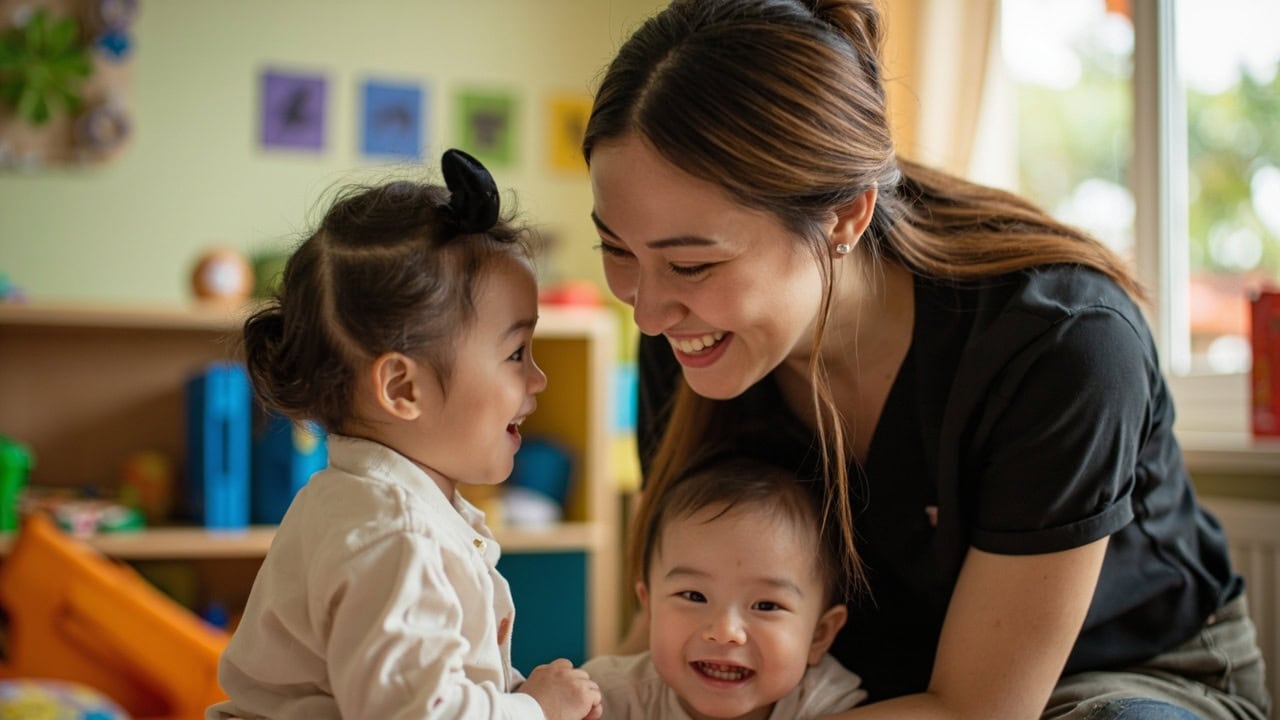
It creates an environment where a child is known. Where a child’s emotional states are met with understanding. Where the rhythm of the day is predictable and safe. Where play is allowed to be rich, exploratory, and free from the anxiety of evaluation.
In this environment:
- Self-regulation is built through the experience of being helped to regulate—again and again, day after day, in the small moments of frustration, excitement, and overwhelm.
- Curiosity is preserved through the freedom to explore without consequences, through adults who respond to questions with enthusiasm rather than impatience.
- Relational confidence is established through the accumulated experience of being cared for by adults who are genuinely present and genuinely attuned.
This is built in the everyday moments, the daily rhythms, the ordinary interactions that make up a child’s life. Not in enrichment classes. Not in academic drills. In the quality of attention a caregiver brings to a child’s emotional world, day after day after day.
Evaluating Your Childcare: The Real Readiness Indicators
Parents sometimes ask how they can tell whether their childcare arrangement is actually building readiness. The indicators are not hard to identify, but they are not the ones most parenting advice focuses on.
You are not looking for whether your child can recite their alphabet or count to twenty. You are looking for:
- Whether your child is curious about the world—whether they ask questions, investigate new things, approach the unfamiliar with openness
- Whether they approach new situations with openness rather than fear
- Whether they can name and manage their own emotions
- Whether they have at least one or two adults outside the immediate family who clearly care about them
- Whether they can play independently and imaginatively for extended periods
- Whether they are capable of sustained attention on something that interests them
These are the readiness indicators. These are what P1 teachers will notice. These are what will carry your child through Primary 1 and beyond.
Your Role as a Readiness Partner
Readiness is not built by caregivers alone, and it is not built by parents alone. It is built in the space between them—in the communication, the shared understanding, the consistent approach to the child’s emotional world.
When parents and caregivers are genuinely aligned, children feel the security of a unified, coherent environment. They know that the adults in their life are coordinating on their behalf, that their needs are held and understood across contexts.
Quality developmental childcare offers not just care for your child, but a partnership with you. Transparent communication, shared observation, consistent approach—all of these serve the child whose readiness you are building together.
Addressing the Concerns Singapore Parents Actually Have
“Will my child fall behind children who have attended enrichment classes?”
For the first few weeks, perhaps. But research consistently shows that the academic advantage from early drilling tends to fade within the first year of Primary 1, while the advantage from emotional readiness compounds over time. Your child may not recite their alphabet on day one. But they will learn to read with curiosity and confidence, and that makes all the difference.
“The school mentioned expectations at the open house. What if my child cannot meet them?”
Primary 1 teachers are not expecting four-year-olds to arrive knowing the curriculum. They are watching for readiness—the capacity to attend, to regulate, to engage. A child who is emotionally ready will meet academic expectations because they are capable of learning. A child who has been drilled but cannot manage their own emotions will struggle, regardless of what they know.
“What about the cost? Is this affordable?”
The EduNanny by BUTLER model operates within the ECDA Childminding Pilot, with fee structures designed to be accessible. Families can use their Child Development Account and Baby Bonus funds to offset costs. Monday to Friday care blocks provide the consistency that children’s development requires.
The EduNanny Approach: Built Around What Actually Works
EduNanny Singapore was founded to offer parents a different kind of option—not an option that dismisses their legitimate anxiety about Primary 1, but an option that addresses it with more precision and more wisdom than the standard enrichment model.
EduNanny by BUTLER operates within the ECDA Childminder Pilot, offering home-based and community-based pathways that prioritise exactly the developmental care that builds the readiness that matters. With infant ratios of up to one to three, EduNanny’s childminders can provide the responsive, attentive care that each child needs.
The low ratios are not a logistical feature. They are the condition that makes genuine attunement possible—the daily, moment-by-moment responsiveness that builds self-regulation, preserves curiosity, and establishes relational confidence.
Because parents need to trust the arrangement, EduNanny maintains transparent communication and, where deployed, CCTV measures that give families visibility into their child’s daily experience. This is not about surveillance. It is about partnership. When parents can see what is happening in their child’s day, they can participate more fully in the ongoing work of building readiness. They can extend the learning at home, reinforce the emotional vocabulary, support the caregiver’s observations with their own.
The children who arrive at school whole—self-regulated, curious, relationally confident—do not merely survive Primary 1. They grow through it.
- The child who arrived socially confident finds it easier to form study groups, to ask teachers for clarification, to collaborate on projects.
- The child who arrived curious finds that learning feels like an adventure rather than an obligation.
- The child who arrived with self-regulation can manage the inevitable disappointments and frustrations of school without becoming dysregulated or giving up.
This capacity, once established, compounds. Year after year, the child who arrived ready continues to grow—not because they knew more, but because they were capable of learning more.
A Hopeful Truth for Singapore Parents
There is something profoundly hopeful in this reframing for Singapore parents who are sitting in that quiet moment—the weekend afternoon when the research begins and the anxiety surfaces.
The readiness that matters is not something that requires expensive enrichment classes or academic drilling. It is something that can be built, day by day, in the ordinary moments of responsive caregiving, through play and connection and the patient work of helping a child learn to manage their own inner world.
It is available to every family that has access to quality developmental care. It does not require privilege or private tutors or years of Kumon. It requires consistency, warmth, attention, and an understanding of what actually prepares children for school.
Your child does not need more worksheets before Primary 1. Your child needs to arrive at Primary 1 whole.
And that readiness, built with patience and warmth and intention in these precious early years, will carry them through the years ahead with momentum, with joy, and with the quiet assurance that they are exactly ready for whatever comes next.
Ready to Explore What This Looks Like in Practice?
If you are a parent in Singapore researching infant care or childminding, and you want to understand how quality developmental care can build the readiness that actually lasts, we invite you to connect with EduNanny Singapore.
Your child’s Primary 1 self is being built right now, in the everyday moments you may not even notice. Let us help you make those moments count.
EduNanny by BUTLER is an ECDA Childminder Pilot operator offering home-based and community-based developmental childcare for infants and young children across Singapore. Learn more about our approach to school readiness.