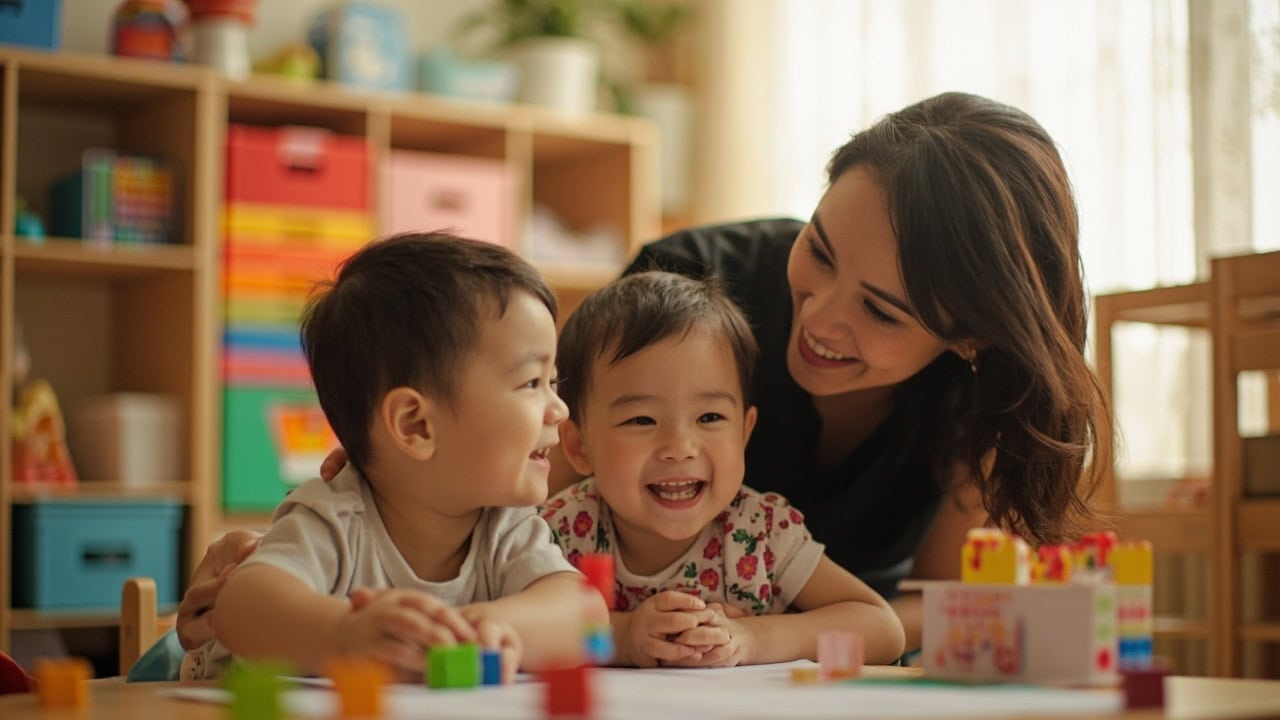
The Quiet Signs Your Child Is Thriving in Childcare
The Milestones That Matter: Understanding Your Child’s Development in Quality Childcare
There is a particular moment that many Singapore parents will recognise, even if they cannot quite name it. You pick up your child after a long day apart. They are different. Not dramatically so — nothing that would alarm a grandparent or prompt a call to the clinic. But something has shifted.
Perhaps your two-year-old is using a word you have not taught them, a small and unexpected word that they pronounce with surprising clarity. Perhaps your infant reaches for you differently, more purposefully, with a grip that feels steadier, more intentional. Perhaps there is a question in their eyes that was not there last week, a curiosity that seems to have deepened overnight.
You notice these changes. You treasure them. But sometimes, in the quiet moments, you wonder: where did this come from? Was it something we did at home? Was it the time spent at childcare? And — the question that sits just beneath the surface — is whatever we have chosen actually working?
This is not doubt born of distrust. Singapore parents are some of the most invested, most attentive caregivers in the world. You read. You compare. You ask questions late at night when sleep feels secondary to doing the right thing by your child. The uncertainty I am describing is not a lack of commitment. It is the natural consequence of loving your child deeply and wanting to understand the story of their growth.
Quick Summary: What Development Actually Looks Like in Quality Childcare
- Language growth comes from responsive back-and-forth interaction, not just hearing words
- Motor skills develop through daily opportunities to move, explore, and practice
- Social-emotional intelligence is built through peer interaction and caregiver attunement
- Cognitive curiosity thrives in environments that welcome questions and exploration
- Developmental domains work together like instruments in an orchestra — when one grows, others follow
That is exactly what this article is about: how quality childcare writes that story, and how you, as a parent, are already reading its most important chapters.
Why Development Is More Than a Checklist
When we speak about child development, we often use the language of milestones — those well-worn markers that paediatricians and parenting books love to list. First words. First steps. The ability to stack blocks, share toys, follow simple instructions.
These milestones matter. They are useful guideposts. But they can also create an unintentional frame that makes development feel like a checklist rather than a journey. And that framing, while understandable, misses something essential about how children actually grow.
Child development unfolds across several distinct but deeply interconnected domains: language and communication, motor skills, social-emotional intelligence, and cognitive curiosity. Each grows in its own way, on its own timeline, supported by different experiences and different kinds of interaction. When development is healthy, all of these domains move forward together — like instruments in an orchestra, each contributing to a larger harmony.
Supervision keeps a child safe. It ensures they are fed, rested, and protected. That matters enormously. But quality childcare — the kind that systematically observes, supports, and documents growth across every developmental domain — does something more. It notices the subtle ways your child is changing and creates the conditions for those changes to flourish.
How Quality Childcare Supports Growth Across Every Domain
Language and Communication: More Than Hearing Words
Language development in young children is not simply a matter of hearing words. It grows through responsive interaction — through the back-and-forth of conversation, even when that conversation is made up of babbles and gestures and shared gazes.
When a trained caregiver narrates an infant’s world, pausing to listen for responses, echoing a babbled sound with enthusiasm, building on a toddler’s attempt to name something they see — that caregiver is doing essential neurological work. They are building the neural pathways that support language for life.
Caregivers are not simply speaking at children. They are engaging in what developmental psychologists call serve-and-return interaction — the natural rhythm of communication that mirrors the way young minds learn best. They follow the child’s lead, naming what the child is looking at, responding to the child’s sounds as though they were the most interesting words in the world, expanding on early phrases with gentle elaboration.
Consider what this looks like in practice: a caregiver notices your child pointing at a bird on the playground and says, “Yes, that’s a bird. The bird is singing. Can you hear the bird?” Repetition. Context. Joy in the exchange. These are the ingredients of language growth, and quality childcare provides them systematically throughout the day.
Motor Skills: Movement as Development
Motor development is sometimes overlooked in conversations about developmental support, but it underlies so much of what children learn to do.
Gross motor skills involve the large movements: crawling, walking, running, climbing, managing stairs. Fine motor skills involve precision: the ability to grasp small objects, to use a spoon, to eventually hold a crayon and make marks on paper.
Both matter, and both develop through opportunities to move, explore, and practice. In quality childcare settings, movement is not an afterthought. It is woven into the architecture of the day: time for children to crawl and climb on developmentally appropriate equipment, opportunities to practice the pincer grasp, outdoor time, messy play, and sensory experiences that invite children to reach, stretch, push, pull, and balance.
When you notice your child navigating a playground obstacle with greater confidence, or successfully feeding themselves with growing independence, you are witnessing motor development that has been quietly supported by hundreds of small moments throughout their day at childcare.
Social-Emotional Intelligence: The Invisible Domain
Social-emotional intelligence is perhaps the most invisible domain of all, which makes it both the most important to understand and the easiest to underestimate.
Young children are not born knowing how to manage big feelings, share space with others, or read the emotions of the people around them. These capacities develop over time, through experience, and through the patient guidance of adults who model what emotional regulation looks like.
In a quality childcare environment, caregivers do not simply intervene when children fight over toys. They guide children through the experience of frustration, helping them name what they feel and offering words for the experience. They model calm. They create what child development experts call a co-regulatory relationship — a connection through which a child learns, over time, how to settle themselves because they have seen it done with warmth and consistency.
Peer interaction also plays a vital role here. Children in childcare learn to navigate social dynamics that simply cannot be replicated at home — the dynamics of sharing attention, taking turns, understanding that other children have needs and feelings too. These are not lessons that can be taught through explanation alone. They must be lived, with a skilled adult nearby to guide and support.
What you might observe at home after months of quality childcare is a child who surprises you with their awareness of others, their vocabulary for emotions, their willingness to try again after a disappointment. These are not personality traits that your child either has or does not have. They are capacities that have been cultivated through intentional social-emotional support.
Cognitive Curiosity: The Love of Discovery
Young children are natural scientists. They drop things to see what happens. They ask why, repeatedly and with genuine urgency. They take things apart, mix things together, and test the limits of every situation they encounter.
This drive to understand the world is one of the most precious qualities a child possesses, and it is also one of the most responsive to environment. Quality childcare does not simply provide activities and call it learning. It creates what educators call a learning environment — a space that is rich with possibility, where materials are chosen deliberately to invite exploration, where questions are welcomed rather than dismissed, and where the pace respects the child’s natural curiosity rather than rushing past it toward predetermined outcomes.
A child who asks “why is the sky blue?” deserves an adult who takes the question seriously, even if the answer must be simplified. A child who wants to know what happens when water and sand are mixed deserves the time and space to discover it. These are not distractions from learning. They are learning, in its most authentic form.
The Foundation: Attention, Ratios, and Responsive Care
In conversations about childcare, the number of caregivers to children often goes unsaid — treated as an administrative detail rather than what it truly is: the foundation of everything else.
A ratio of up to one to three infants means that every child receives genuine attention. Not the hurried, divided attention that becomes necessary when one adult is responsible for too many small lives, but the present, attuned attention that allows a caregiver to notice the small shifts that signal growth, or struggle, or the need for comfort.
This is not an abstract ideal. It is a practical reality that shapes every interaction. When your infant is in a setting with a one-to-three ratio, they are not waiting their turn to be held. They are not becoming resigned to crying without response. They are receiving the consistent, nurturing presence that their developing brain needs in order to feel secure.
And security, research consistently shows, is the platform upon which all other development is built.
What Quality Looks Like in Practice
Understanding developmental domains is valuable, but what does this look like when you are researching childcare for your own family? Here are the indicators that matter most:
- Caregivers who observe and narrate: Notice whether staff describe what children are doing rather than just supervising. “She’s working on stacking those rings” tells you a caregiver is tracking development.
- Responsive interaction: Watch for back-and-forth communication between caregiver and child — not just instructions, but genuine conversation at the child’s level.
- Movement opportunities throughout the day: Quality care includes more than outdoor time. Look for indoor play spaces that encourage crawling, climbing, and fine motor exploration.
- Emotional vocabulary in action: Do caregivers help children name feelings? Do you hear phrases like “I can see you’re feeling frustrated” or “Can you tell your friend how that made you feel”?
- Documentation and sharing: Ask how developmental progress is communicated to parents. Is it regular? Is it specific?
The changes you notice when you pick up your child at the end of the day — the new words, the steadier movements, the bigger feelings they can name, the questions they ask — these are not random. They are the visible surface of deep, systematic growth that has been supported throughout their hours at childcare.
This reframes something essential about the relationship between home and childcare. They are not separate worlds. They are two parts of a connected whole: the love and security your child feels at home creates the foundation for their willingness to explore and learn at childcare, and the developmental support your child receives at childcare shows up as changes you can see and celebrate at home.
The Truth About Affordability
For many families in Singapore, there is a practical dimension to this conversation that deserves honest acknowledgment: the question of affordability and access.
Excellent care should not be a privilege reserved for families with significant financial resources. Within quality childcare frameworks, fees are designed to be accessible. Many families can use the Child Development Account and Baby Bonus funds for which they are eligible, reducing the financial burden without sacrificing quality.
Consistent Monday to Friday care blocks provide the rhythm that children need for steady development, while respecting the rhythms of family life. This is not simply a matter of convenience. It is a matter of equity.
Every child deserves access to care that supports their growth — not just their supervision, but their development.
The Story That Unfolds Every Day
There is a quiet uncertainty that many Singapore parents carry. It is the uncertainty of loving deeply while not fully understanding the story of your child’s growth. You notice changes. You marvel at them. But you may not have the framework to connect those changes to what is happening throughout the day, in the hours when you are apart.
My hope is that this article has offered some of that framework. Not a rigid checklist. Not a new set of benchmarks to worry about. Just a deeper understanding of what development actually looks like when it is supported with intention — across language and communication, motor skills, social-emotional intelligence, and cognitive curiosity.
Quality childcare is not a black box. It is not an unknown variable that you must trust blindly. It is a systematic, observable, documentable process — one that follows the science of child development, responds to the unique needs of each individual child, and creates the conditions for growth across every domain.
You are already seeing the evidence of that growth. Your child is the evidence. The new words they say. The confident way they climb. The way they look at you and name what they feel. The questions they ask about the world.
These are not coincidences. These are milestones that matter — the milestones your child is reaching because someone, somewhere, is paying attention. Because someone has created the environment where language grows, where movement is encouraged, where emotions can be named and managed, where curiosity is treated as the gift it is.
Your child is growing. Every day, in ways both large and small. And you are not missing any of it. You are right there — receiving the evidence, celebrating the milestones, and participating in a story that began long before today and will continue long after.
If you are researching infant care or childminding options in Singapore, we would be glad to share more about how EduNanny supports developmental growth across every domain — with warmth, intention, and a deep respect for the trust you are placing in us.
Every child’s story of growth deserves to be seen, supported, and celebrated. We would be honoured to walk alongside you in yours.
Explore EduNanny’s infant care and childminding options →