The Quiet Shift That Changes How You See Your Child
Understanding the Distance You Feel
Let us be honest about what this distance feels like. It is not dramatic. It does not announce itself. It is the quiet wondering that surfaces when your child falls asleep in the car and you replay the morning drop-off. It is the slightly vague answer you get when you ask, “What did she do today?” and the caregiver says, “She had a good day.”
It is the photo that arrives—an image of your child at play—but the uncertainty about what that image represents in the larger story of your child’s growth.
This distance is not imaginary. It is structural. In many childcare settings, the ratio of caregivers to children makes sustained observation genuinely difficult. When one adult is responsible for multiple young children at once, the demands of keeping them safe, fed, and comfortable leave little room for the kind of quiet, attentive noticing that reveals how a child is truly growing.
As a result, parents are often left with fragments. A cute anecdote. A photo. A reassurance. But not a language. Not a way of understanding what you are looking at when you see your child changing.
Here is what many parents discover: that feeling of distance does not go away on its own. It requires intention. It requires a caregiver who is trained not just to keep children safe and comfortable, but to observe, document, and understand developmental progress across every domain.
What Quality Childcare Actually Looks Like
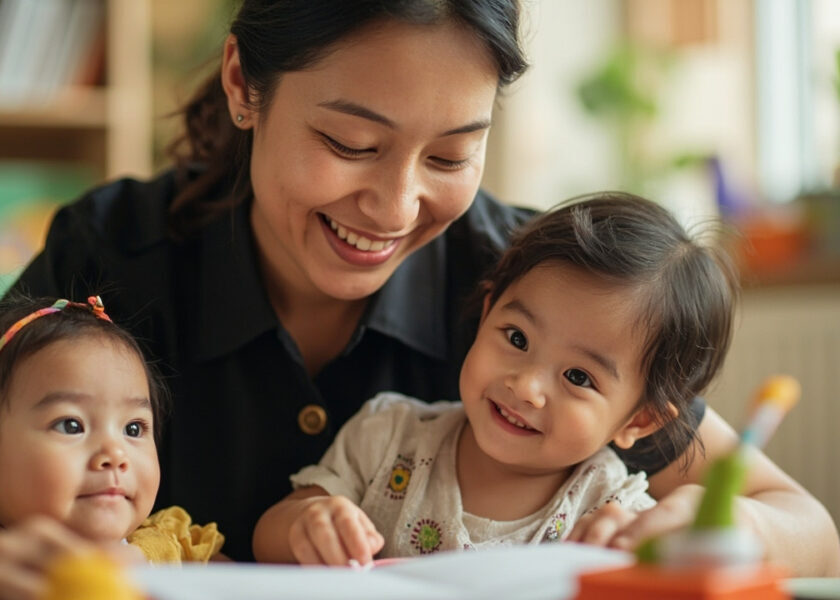
When we talk about developmental partnership, we mean something specific. Quality childcare is not a place where your child goes and something happens to them while they are there, hidden behind doors. Growth is a conversation—a continuous, collaborative exchange between caregivers and parents.
Consider what this looks like in practice. A caregiver trained in developmental observation does not simply supervise. They notice. They track. They document.
They see what happens when an infant reaches for a toy and misses, tries again, and succeeds. They notice the micro-expressions of a baby beginning to understand cause and effect—that shaking a rattle makes noise, that dropping something brings a response. They track the subtle social cues of a toddler learning to read another child’s face, to offer a toy, to navigate the first stirrings of sharing and conflict.
These are not grand events. They are quiet ones. And quiet events require quiet attention.
In many childcare settings, this kind of attention is simply not possible. Caregivers are stretched thin. Ratios are high. The work of caring for multiple young children at once is demanding in ways that leave little room for sustained noticing.
But when ratios allow for genuine observation—when a caregiver can focus on one infant, or two, or at most three—something changes. The caregiver becomes an observer of your child’s growth, not just a supervisor. And that observation, shared thoughtfully with you, becomes a bridge. It becomes the shared language that transforms you from an external observer into an active, confident participant in your child’s development.
Trust, Transparency, and the Caregiver’s Role
When you leave your child in someone’s care, you are making yourself vulnerable. You cannot be there. You cannot see everything. And the not-knowing can create a low-grade anxiety that sits beneath the surface of your daily routine.
This is normal. It is human. And it is one of the reasons transparency matters.
Where childminding arrangements include communication measures, parents should have insight into their child’s day. Where arrangements include additional assurance measures such as cameras, these can provide an additional layer of confidence.
But these tools are supports, not solutions. The real foundation of trust is not surveillance. It is relationship. It is the caregiver who knows your child’s temperament, who notices when something is off, who communicates with you not just what happened but what it means. Trust is built through consistent, competent, caring presence over time.
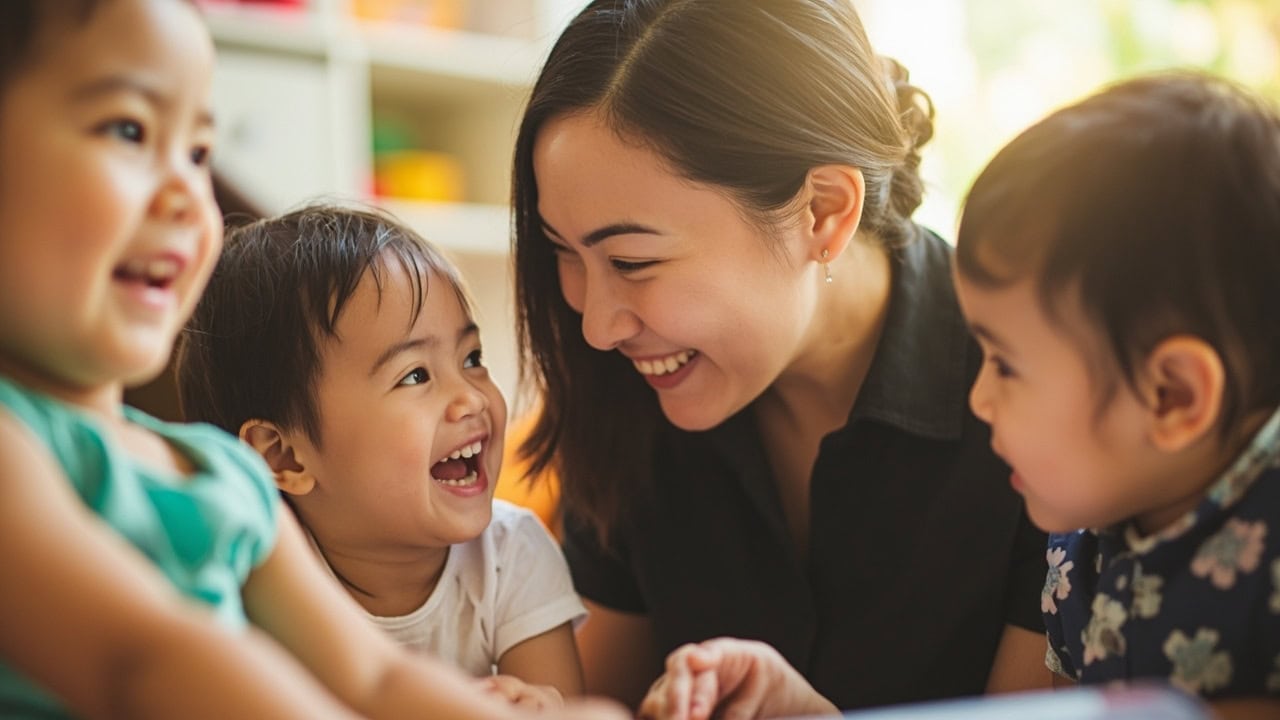
The caregivers in a quality childminding network are not just watching your child. They are observing, nurturing, documenting, and partnering with you in the profound work of raising a human being. When you trust a caregiver with your child, you are trusting them with something sacred. That trust should be met with professionalism, skill, and genuine care.
Understanding Developmental Domains
To become a confident observer of your own child, you need a framework. You need to understand the domains of development so that when you see your child changing, you have words for what you are witnessing.
Social Development: Learning to See Others
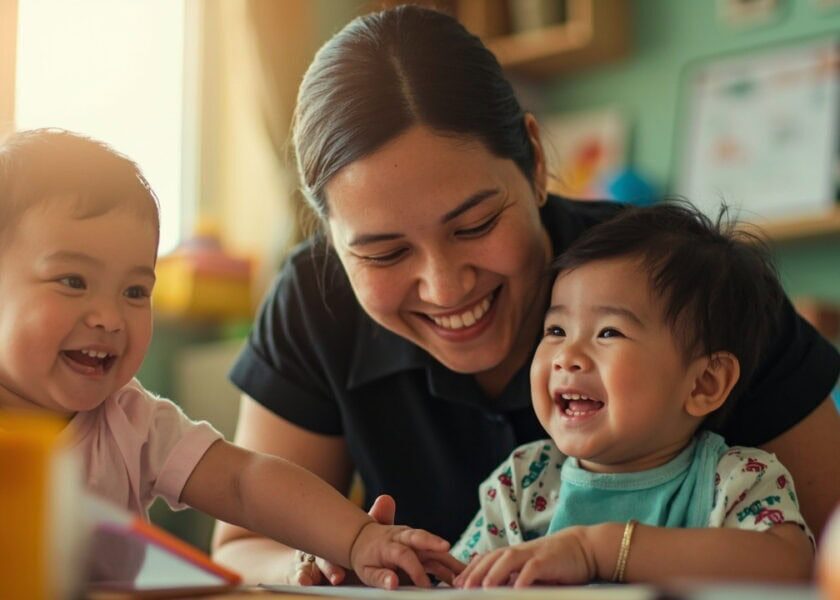
Social development in the early years shows up in ways that are small but profound. Watch how your child relates to other children in care. Does she show awareness of them? Does she imitate their actions, offer a toy, or respond when another child is distressed?
These are not just cute behaviors. They are the earliest forms of social competence—the ability to see others as separate beings with their own feelings and intentions.
In quality care, caregivers create opportunities for these social moments to happen. They gently support children when conflict arises over a toy, when emotions run high, when a toddler is learning that another child has needs too. You may notice your child coming home with new social awareness: more turn-taking, more interest in other children, a growing ability to navigate small social challenges.
Emotional Development: Building the Capacity to Calm
Emotional development is often the most invisible domain, and also the most important. When a child is in an environment where their emotions are met with consistency and calm, they begin to build something essential: the capacity to regulate themselves.
You may notice this at home as your child becomes better at calming down after a setback, or showing more variety in how they express feelings. A caregiver who is attuned to emotional development will not just manage behavior. They will help children name emotions, model regulation strategies, and create a sense of security that allows big feelings to be safe.
When your toddler returns home and can tell you, “I felt angry because Aiden took my truck,” instead of simply crying or hitting—that is emotional development in action.
Cognitive Development: Curiosity, Problem-Solving, and Language
Cognitive development in the early years is not about flash cards or academic acceleration. It is about the quality of a child’s thinking. It is about curiosity—does your child ask questions, explore new textures, test out ideas? It is about problem-solving—does your child try different approaches when something does not work?
It is about language development—does your child listen with attention, understand more than they say, begin to put words together with growing complexity?
In quality care, these cognitive moments are noticed and built upon. A caregiver who understands development will offer just the right level of challenge—not too easy, not too hard—to stretch a child’s thinking.
Motor Development: Building Capacity Through Movement
Motor development, both gross and fine, is often the first place parents notice change because it is easier to observe than the other domains. But quality care extends motor development intentionally.
It creates space for running, climbing, and big body play that builds coordination and strength. It offers fine motor activities—pouring, threading, using utensils, manipulating small objects—that prepare children for the demands of writing and self-care.
When you see your child handling a spoon with new confidence, pouring their own water, or navigating a staircase with growing independence, you are seeing motor development. And if your caregiver is sharing those observations with you, you can reinforce those skills at home.
Why Development Is Integrated, Not Separate
Here is the critical piece that many parents miss: these domains do not operate in isolation. Your child is not developing socially over here and cognitively over there.
Development is integrated. A child who is emotionally secure is more curious. A child who has strong fine motor control has more tools for exploring and communicating. A child who is socially attuned has richer experiences to think about.
This integration is what quality care nurtures. It is why a holistic approach—one that does not privilege academics over play, or compliance over curiosity—is so important in the early years.
When you see your child changed in the best way, you are often seeing the result of growth across multiple domains simultaneously. The child who can now sit and focus on a book for longer has emotional regulation, cognitive engagement, and emerging physical stillness working together. The child who can now share a toy has social awareness, emotional regulation, and the cognitive ability to understand another’s perspective developing in tandem.
A Concrete Example: Reading Your Child’s Growth
Let me give you a concrete example of how this shared language works.
Imagine your child has been in quality care for a few months. One evening, she picks up a crayon and, for the first time, holds it with purpose. She does not scribble randomly. She makes marks that follow a direction. She is proud of this. She shows you.
What you may not realize is that this small moment connects to a chain of development. It connects to fine motor control that has been strengthening through play—perhaps in the way your child manipulated objects, turned pages, picked up small items. It connects to cognitive understanding that marks on a page can represent something. It connects to the social-emotional confidence to try something new and share it.
In quality care, a caregiver would have seen the early stages of that development. They would have noticed the growing intentionality. They would have created opportunities for that development to advance. And when they share that observation with you—not just that your child had a good day, but that your child has been working on precision grip and is now transferring that skill—you gain something invaluable.
You gain the ability to see your child’s crayon marks as a milestone rather than a coincidence. You gain the ability to support that development at home, to provide materials and encouragement that extend what is already happening.
This is what we mean by a shared language. It is not a daily report or a photo album. It is a way of understanding your child’s growth that makes sense across time and space. It is the language that allows you to pick up where the caregiver leaves off, and allows the caregiver to build on what you are doing at home.
The Singapore Context: Expectations and Real Readiness
You may be wondering how this plays out specifically in the Singapore context. Singapore parents are often navigating particular pressures—academic expectations, school readiness timelines, a competitive environment that can make it tempting to push developmental goals earlier and faster.
These pressures are real. They deserve honest engagement, not dismissal.
And yet, the research is consistent, and the wisdom of experienced educators is clear: the best preparation for school is not early academics. It is the foundational development of curiosity, confidence, social competence, and the love of learning itself.
Children who arrive at school with these foundations do not just perform better academically. They are more resilient, more adaptable, more willing to take intellectual risks. They have the internal motivation to learn, not just the external pressure to perform.
Making Quality Care Accessible
I want to address another concern that many Singapore families carry: cost. Quality developmental care should not be a privilege available only to those who can afford premium private arrangements.
In childminding pathways operating under established frameworks, such as the ECDA Childminding Pilot framework, it is possible to offer individualized attention within a structured, professional environment—while also designing fee structures with real families in mind.
When mechanisms like CDA and Baby Bonus funds can be used, quality childminding becomes not just an ideal but a realistic option for families across Singapore. Every child deserves to be seen. Every parent deserves to understand what their child is becoming.
Your Role in the Partnership
There is something powerful that happens when parents are empowered to read their child’s development. The anxiety I described earlier—the quiet, unnamed worry about what is happening while you are apart—does not disappear entirely, but it transforms.
It becomes something more like engaged curiosity. You are no longer an outsider wondering if your child is okay. You are an insider who understands the process. You can ask better questions. You can extend the learning. You can celebrate the milestones with genuine knowledge of what they cost and what they mean.
This is one of the greatest gifts of developmental partnership. It does not just benefit your child. It benefits you. It gives you confidence that is earned, not assumed. It gives you a lens through which to see your own child more clearly, more lovingly, and more honestly.
And it gives you a place in the process—a meaningful, active, irreplaceable place—that no amount of professional care can fill.
You are not outsourcing a problem. You are not finding a replacement for your presence. You are entering into a partnership. You are joining a team dedicated to seeing your child clearly and supporting them as they grow.
Your role does not diminish when your child enters care. It changes. It deepens. It becomes the role of the informed, loving adult who extends the work of development beyond the walls of the care setting and into your home, your interactions, your daily life.
Your child is not just being cared for. They are being seen. They are being built up. They are becoming someone—and every quiet shift, every small breakthrough, every new word and gesture and act of connection is part of that becoming.
You are part of that work. And you are not alone in it.
How to Choose Quality Infant Care in Singapore
If you are researching childcare options right now, here are some practical things to consider.
- Ask about caregiver ratios. How many children is each caregiver responsible for? Lower ratios allow for more sustained observation and genuine attention to each child’s development.
- Ask how caregivers share observations. Is there a system for documenting and communicating developmental progress? Or is the update limited to meals and naps?
- Notice if the environment feels calm and engaged. Are caregivers interacting with children, or simply supervising? Do children seem curious and comfortable, or restless and overstimulated?
- Ask about the philosophy. Is the approach holistic—supporting social, emotional, cognitive, and motor development together? Or does it focus narrowly on academic preparation?
- Ask about transparency. What systems are in place to keep you informed about your child’s day and development?
- Ask about caregiver training. Are caregivers trained in child development, not just childcare basics? Do they understand developmental domains and how to observe progress across them?
- Consider the financial fit. Are there accessible payment options? Can government subsidies or funds be used?
The EduNanny Approach
At EduNanny Singapore, we are built around this understanding. Our home-based and community-based childminding pathways are designed with ratios that make genuine observation possible. Our caregivers are trained to observe, document, and share your child’s development across every domain. Our enrichment philosophy means that every interaction, every environment, every routine is an opportunity to support the architecture of a child’s mind and heart.
Not just to care for your child while you work—though we do that with skill and dedication. But to raise the quality of that care to something more. To build the structures that make observation possible. To create the partnerships that make parents confident. To honor the caregiver’s role as developmental ally. To make sure that every child in our care is not just supervised, but seen.
Your child’s development is not happening somewhere you cannot reach. It is happening in every moment, in every interaction, in every quiet act of growth that you are now learning to recognize.
And it will continue—in your home, in your arms, in the life you are building together.
You are not on the outside anymore. You never were. You were always part of the work. Now you have the language to know it.
If you are researching infant care or childminding options in Singapore and want to understand how a developmental partnership could work for your family, we welcome the conversation. Learn more about our childminding pathways, our caregiver approach, and how we support both children and parents through the early years.
Because your child deserves to be seen. And so do you.