The Quiet Shift Every Singapore Parent Should Notice in Their Toddler
The Moment Your Baby Became a Person With Opinions
There is a moment, and you may not even notice it at first. You drop your child off at the door of wherever they spend their mornings, and they don’t look back. They are already turning toward something—a toy left out from yesterday, a friend they have not yet greeted, a teacher whose name they now say with intention.
And in that moment, you realize: the child you enrolled in care is not the child standing beside you anymore.
It is such a small thing. The turn of a head. The direction of a gaze. And yet it contains everything—the quiet revolution of a small person becoming someone who notices the world rather than only being noticed by it.
If you have felt this, you are not imagining it. And you are not alone in wondering what it means for the care arrangement you chose when they were small.
What Singapore Parents Are Noticing—and Why It Matters
Singapore parents are remarkably attentive. This is not a platitude—it is an observation based on hundreds of conversations in playgroups, at parent gatherings, in the quiet of 7 a.m. before the school run. What strikes me most is not the anxiety or the guilt that gets written about so often. What strikes me is the attentiveness. You are watching. You are noticing. You are holding your child’s development in your mind in a way that feels almost like a second job.
And what many of you are noticing is something you do not quite have language for yet.
You see your child changing and you wonder whether the care that worked at six months still makes sense at two years. You see them asking questions that no one seems to answer during the day. You see them watching other children with a hunger you did not see six months ago. And you wonder: is this just normal growing up, or is something asking to be met here?
That wondering is not a worry to be dismissed. It is developmental awareness. And it is exactly the kind of awareness that should shape your choices about care.
The First Year: What Your Baby Actually Needed
Let us take a step back and look at what actually changes, because this matters for the decisions you are making.
In the infant stage—roughly from birth through the first year, sometimes into the second—your child’s primary developmental task is building a sense of security. They are learning that the world is a place where their needs will be met, where comfort is reliable, and where someone knows them well.
This is why the infant stage of care is rightly focused on warmth, consistency, responsive feeding and sleeping routines, and the kind of one-to-one attention that allows a caregiver to know exactly how this particular baby communicates hunger, fatigue, or overstimulation. A secure infant is the foundation upon which everything else is built.
At EduNanny, the infant care model is built around small caregiver-to-child ratios and deeply attentive caregivers who can read the subtleties of each child’s cues. When your baby is small, this is what they need—and this is what the ECDA Childminding Pilot was designed to provide: a standard of care that treats each infant as a whole person with needs that deserve to be known.
When the Shift Happens—and What It Means for Care
But then something shifts.
By the time a child is walking—truly mobile, truly curious, truly able to move toward what interests them—their brain is reorganizing itself around different priorities. The infant who needed to receive is becoming a toddler who needs to reach.
They are no longer just absorbing the world. They are beginning to act upon it. To test it. To ask, through behavior and eventually through words: what happens when I do this? What happens when I say no? What is that child’s name? Can I have a turn?
This is not a minor adjustment. This is a fundamental reorientation of the self.
And here is what I want you to hear: an infant care model, however warm and loving and well-intentioned, is not designed for this shift. It was built for a different child. A child who needed to receive. The toddler standing in front of you now needs to explore, to question, to be met in their curiosity rather than simply soothed in their distress.
From Containment to Engagement
We can think about this as a shift from containment to engagement.
In the infant stage, care is largely about containment—keeping the baby safe, fed, rested, and calm within a bounded, predictable environment. The infant does not need or benefit from a wide-open world. They need a safe harbor.
But the toddler needs more than a harbor. They need a launchpad.
This means the care they receive should look different. Consider:
- The space they are in should invite movement and discovery, not just safety
- The routines should begin to flex, allowing for choice and agency
- The interactions should respond to their growing language—not just speaking to them, but having real conversations
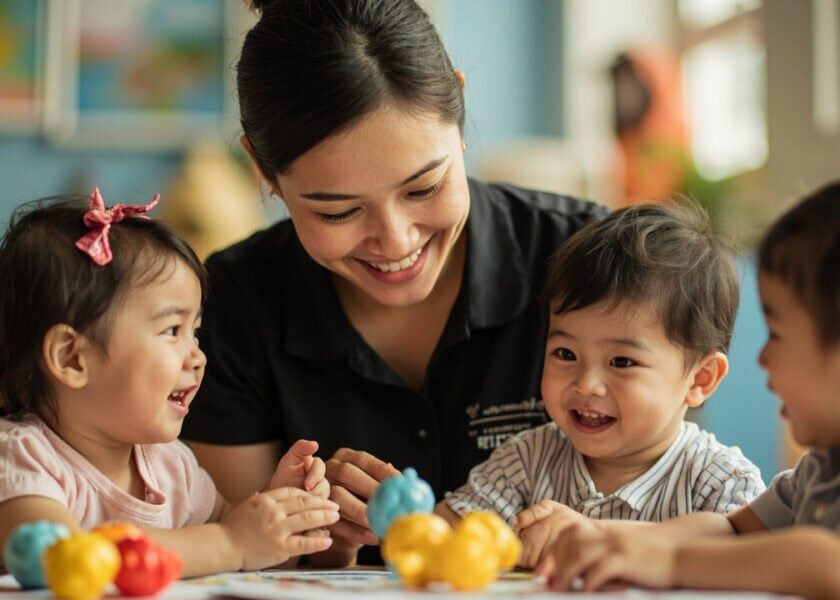
- The social environment should begin to include peers, because the toddler’s world is no longer just about their relationship with a caregiver. It is about their relationship with other children, with a group, with a little community of their own
This is why you might notice your two-year-old coming home with new words you did not teach them. It is why they might start asking to do things themselves—put on their shoes, pour their own water, choose their own shirt. It is why they might start talking about friends by name.
These are not random developments. They are the hallmarks of a child moving into a new phase of development, and they are asking—quietly, persistently, through their behavior—whether the adults around them are ready to meet them there.
Signs That Your Child’s Care Needs Are Evolving
Some of the care arrangements that work beautifully for infants become genuinely insufficient as children grow—not because anyone did anything wrong, but because the child changed and the care did not. This is not a failure. It is a recognition that the relationship between a family and their childcare provider is not a static contract. It is a living thing, and it needs to breathe.
Language Is Expanding Beyond Simple Labels
If your child is beginning to use words not just to label but to question, to negotiate, to express preference, and you sense that their daytime environment is not matching that growth—that is a sign. Toddlers who are being engaged intellectually will often come home buzzing with new vocabulary, new ideas, new versions of stories. If that is not happening, it may be worth asking what is happening during the day.
Autonomy Is Asserting Itself
If your child is insisting on doing things themselves, resisting being dressed or fed, expressing fierce preferences—they are doing exactly what they should be doing. But if the care environment does not support this, if they are still being managed in ways that assume a dependent infant, there is a mismatch. The child is growing; the structure around them is not.
Peer Interest Is Emerging
Somewhere around eighteen months to two years, most children begin to notice each other. By two and a half or three, many are actively seeking social interaction with children their own age. If your child’s daytime environment does not offer regular, facilitated peer interaction, you may be missing a window that will not wait.
Curiosity Is Expanding
Does your child come home asking questions you cannot easily answer? Does their curiosity feel like it is expanding beyond what your current arrangement can contain? This is a beautiful problem to have. But it is still a problem, in the sense that it is asking something of you.
None of these are alarms. They are invitations to look more closely.
What Quality Looks Like in the Toddler Years
For the toddler and the emerging preschooler, quality care is not about a caregiver who loves your child—though that is necessary. It is about a caregiver who knows what your child is capable of and is helping them reach it.
Here is what this means in practice:
- Real conversations: Back-and-forth exchanges, not just directives. A caregiver who gets down on the child’s level to see the world from where they are standing.
- Space for discovery: Allowing mess and noise and the slow process of a child figuring something out, rather than rushing to fix or entertain. Understanding that the toddler’s play is not downtime between activities. It is the work.
- Social facilitation: A skilled caregiver in the toddler years does not just supervise children in parallel. They create opportunities for interaction, model conflict resolution, support the emerging ability to share and take turns, and help children understand that other people have feelings and perspectives.
- Honoring emerging autonomy: When a toddler says no, it is not defiance for its own sake. It is an assertion of personhood. A developmentally engaged caregiver recognizes this and responds not with domination but with guidance—setting limits while still respecting the child’s emerging independence.
This is one of the most important skills in early childhood caregiving, and it is one of the things that distinguishes care that evolves with the child from care that remains stuck in infant-mode.
What EduNanny Offers for Singapore Families
EduNanny was designed with a specific insight: that the first years of a child’s life are not a single stage but a sequence of stages, each with its own demands and each requiring something different from the adults who care for them.
The aim is to build a service that can genuinely grow with your family—attentive to infants who need to receive, and equally attentive to toddlers who need to reach.
Small Ratios That Mean Different Things at Different Stages
The ECDA Childminding Pilot that EduNanny participates in is structured around small ratios—because small ratios allow caregivers to know each child as an individual, to track their development, and to respond to their changing needs.
- At the infant stage, those ratios mean that a caregiver can be fully attuned to your baby’s rhythms, cues, and patterns of comfort
- As your child grows, those ratios mean something different: space to explore, to be curious, to test their independence, while still having a caregiver who is close enough to notice, to encourage, and to step in when needed
Caregivers Trained for the Full Arc
Caregivers are trained not just in infant care but in the full arc of early childhood development. They understand the infant who needs to receive and the toddler who needs to reach. They know how to adapt. They are not following a script; they are in a relationship, and relationships change as both parties grow.
Transparency and Communication
Honest communication with families is central to how EduNanny works. Where CCTV measures are in place, parents have visibility into the day. Communication protocols are used not as formality but as genuine dialogue—sharing what happened, what was discovered, what your child was interested in today. The goal is to help you know your child, not just trust that they are being cared for.
Accessibility for Singapore Families
Singapore families navigate real pressures—work schedules, commuting, the costs of raising children in this city. Monday to Friday care blocks are built to meet the practical realities of family life. Fees are structured to remain accessible within the pilot framework, and families can utilize CDA and Baby Bonus where applicable. Quality care should not be a privilege available only to those who can afford premium pricing.
Questions to Ask—Before Choosing or Continuing Any Arrangement
- Does the caregiver understand that my child is not the same person they were six months ago?
- Is my child being spoken with, not just spoken to?
- Are there opportunities for peer interaction appropriate to my child’s developmental stage?
- Is my child being supported in their growing independence, or managed as if they were still an infant?
- Do I feel comfortable asking questions about what my child does during the day?
- Do I receive genuine updates, not just perfunctory reports?
The Morning Drop-Off—Revisited
Let me close by coming back to where I started: that moment at the drop-off, when your child turns away from you toward something else.
I think that moment is one of the most profound in parenthood, precisely because it is so quiet. There is no ceremony. There is no announcement. Your baby just wakes up one morning and decides that today, they are interested in the world more than they are interested in you.
And it is wonderful. It is exactly what should happen.
But it also asks something of you.
It asks you to release the version of your child that you knew—the one who needed you in that total, absolute way of the infant—and to meet the one who is emerging. The one who wants to do things alone. The one who has opinions about what to wear. The one who comes home with stories about friends, with questions you have to look up, with a personality that is unmistakably and gloriously their own.
That child deserves a care environment that sees them as they are, not as they were.
They deserve adults who are paying attention to who they are becoming, not just keeping them safe. They deserve relationships that grow alongside them.
This is not a small thing to ask for. But it is not an impossible thing either.
If you have been wondering whether your current arrangement still fits, we would love to have that conversation with you—not to convince you of anything, but to listen, to share what we see, and to help you think through what your child actually needs right now.
Because they are changing. They are growing. And they deserve care that grows with them.
Learn more about EduNanny’s approach to infant and toddler care within the ECDA Childminding Pilot, or connect with our team to explore whether we might be the right fit for your family.