The Quiet Partnership That Makes Singapore Parents More Attuned
The Quiet Moment Every Singapore Parent Will Recognise
There is a moment — quiet, unremarkable by most measures — that happens in homes across Singapore more often than anyone talks about.
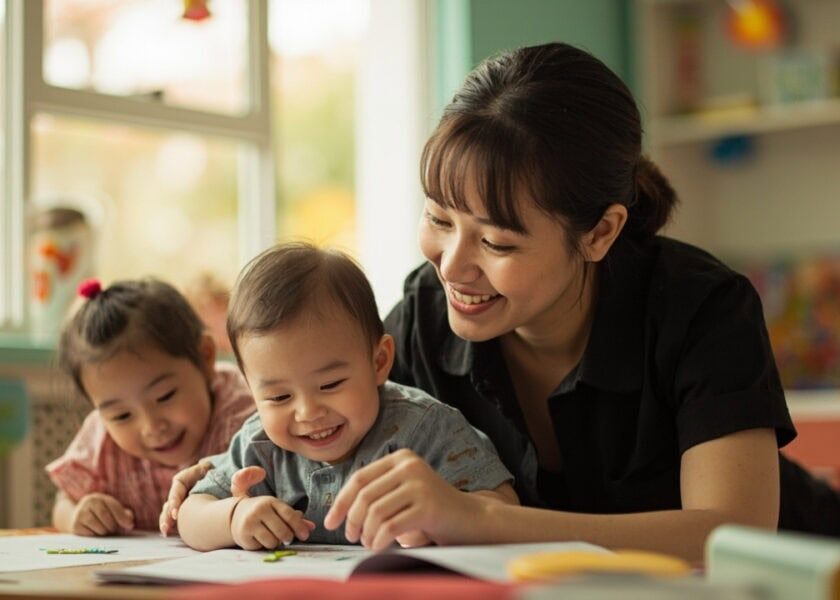
A parent returns from work, slightly frayed, already rehearsing the evening’s logistics in their head. The caregiver passes the child over and says, almost in passing: “She was so fascinated by the way water pools in the drainage grate this afternoon. She kept pointing at it.”
And the parent stops. Because they had not known that. And in the knowing, something shifts — not just about the child, but about the parent themselves.
That moment is not small. It is one of the most quietly transformative experiences available to a parent in Singapore — and yet almost no one talks about it in these terms.
We talk about childcare in terms of logistics. We talk about schedules, subsidies, ratios, and resumes. We talk about whether a centre or a home-based arrangement makes more sense, whether the commute is manageable. All of that is real. All of it is important.
But it misses something essential. It misses what actually happens to a parent — to their confidence, their intuition, their understanding of their own child — when they enter into a genuine partnership with a trained caregiver.
The Fear Nobody Talks About Honestly
Consider what it means to parent in Singapore. Not as a concept, but as a lived experience.
You are raising a child in a city that runs on precision and ambition. You are navigating an education system that begins shaping expectations before your child can form a full sentence. You are surrounded by advice — from family, from forums, from well-meaning strangers on the MRT — and somewhere in that noise, it becomes genuinely hard to hear your own instincts.
The quiet confidence that you knew how to read your child’s cry, that you understood what a particular fussiness meant — that confidence gets worn down. Not because parents are uncertain people. Because Singapore is a city that makes certainty feel like a luxury.
And then there is the guilt. The fear is not that childcare will be inconvenient. The fear is that it will make you irrelevant.
That your child will form their deepest sense of security, their primary understanding of the world, with someone else. That you will come home one evening and realise that the person who knows your child best is no longer you.
That fear is real, and it deserves honesty, not dismissal. It comes from love. It comes from the profound, almost sacred sense of responsibility that parents carry. And it is precisely because this fear is so deeply felt that the answer to it matters so much.
The answer is not reassurance. The answer is a different way of thinking about what quality care actually does.
The Mirror That Reveals, Not Replaces
Quality childcare does not replace what a parent does. It amplifies it.
Think of it this way: a trained, daily, expert caregiver holds up a mirror to your child’s behaviour, development, and unfolding personality. And through that mirror, you — as a parent — begin to see your child with a clarity you did not know you were missing.
When a caregiver is trained in infant development — not just in safety protocols and feeding schedules, but in the subtle science of how a child’s brain builds connections, how language emerges from cooing, how social awareness takes root in parallel play — that caregiver becomes something more than a caretaker. They become a developmental partner.
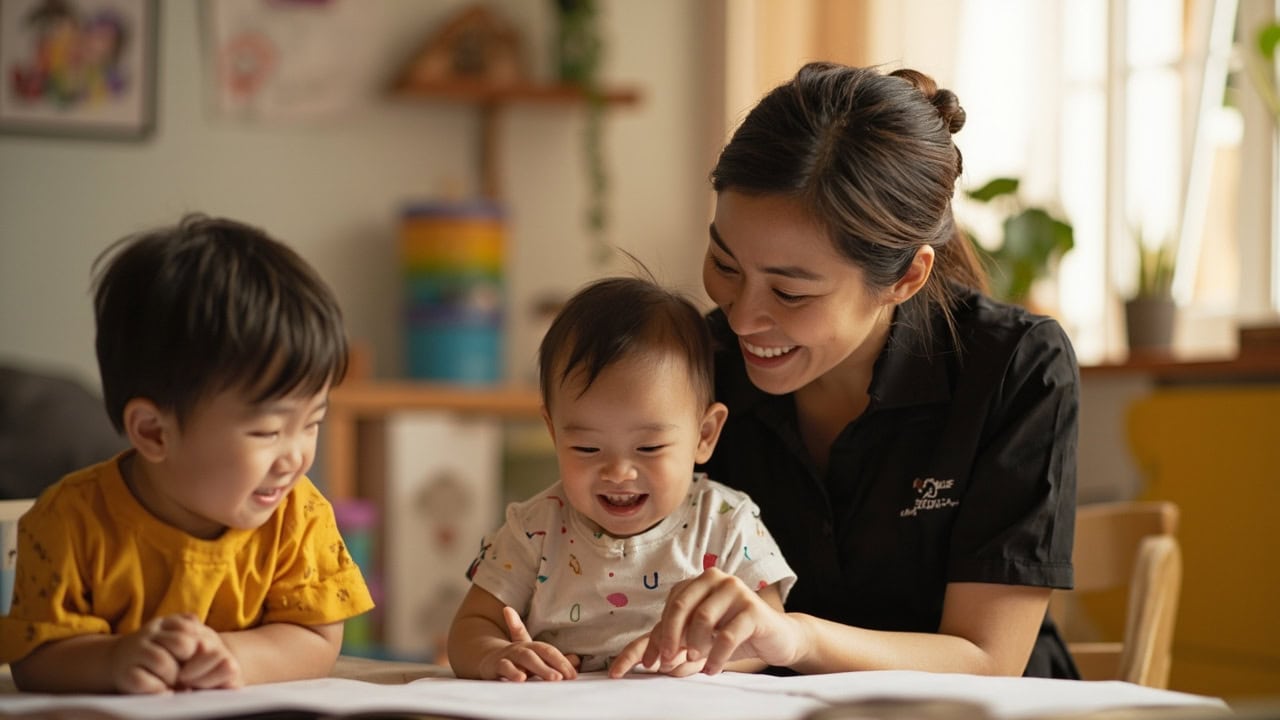
When that caregiver shares their observations with you — not in a formal report, but in the daily handover, in a note about how the baby reached for a specific toy today, in a question about whether your child has always been so cautious with new textures — something remarkable begins to happen.
You start to receive information about your child that you could not have gathered alone. Not because you are failing — because no single person, however devoted, can be fully present and fully objective at the same time.
A caregiver sees your child in contexts you cannot be in. They see how your child navigates separation, how they respond to another adult’s voice, how their play changes when they are in a group versus alone.
And when that observation is shared with care and with expertise, it does not diminish your role as a parent. It enriches it. It gives you new material to think with, new data points in the ongoing, beautiful, imperfect project of understanding another human being.
What Quality Childminding Actually Looks Like
Not all childcare is created equal, and this matters enormously. When we talk about quality care, we are not simply talking about safety standards or clean facilities. We are talking about the quality of attention your child receives — and by extension, the quality of insight you receive as a parent.
Quality childminding means:
- Intentional observation — Caregivers trained to notice developmental patterns, sensory responses, and social behaviours, not just manage daily routines
- Developmental knowledge — An understanding of how infant brains build connections, how language emerges, how attachment patterns form
- Consistent presence — Low ratios that allow for genuine attunement rather than logistical management
- Transparent communication — Regular sharing of observations, questions, and insights that help parents understand their child better
In the ECDA Childminding Pilot, ratios are designed to allow for genuine attention — up to three infants in close proximity to one caregiver. This means the caregiver is not simply managing logistics but actively observing, noting, reflecting. This is not an accident of policy. It is a design choice rooted in the understanding that the quality of the observation determines the quality of the insight.
Trust Is Built, Not Assumed
Without trust, none of this works. And in Singapore, where parents are regularly asked to extend enormous trust to people and institutions, this matters deeply.
Trust is not a feeling. Trust is a structure. It is built through very concrete, very intentional means.
In quality childminding programmes, transparent communication is not an add-on — it is the medium through which the parent-caregiver relationship operates. Parents receive regular updates, ongoing dialogue, and genuine partnership in understanding their child.
Where deployed, measures like CCTV provide an additional layer of assurance. These are not surveillance tools in the cold sense of that word. In this context, they are trust architectures — the physical infrastructure of a relationship that says to the parent: we know this is hard, and we have nothing to hide because we believe in what we are doing.
The Long Arc of Parent Growth
Think about what this looks like over months. Not days. Months.
A parent who receives consistent, professional observation of their infant begins to notice patterns in their own responses. They start to understand that when their child is overwhelmed, it shows up in a particular way — something the caregiver noticed first, but that now the parent sees too, because they have been given the vocabulary for it.
The caregiver’s trained eye — informed by developmental frameworks, by an understanding of milestone progressions, by experience with dozens of children — works in tandem with the parent’s intimate, day-one knowledge of their child. Together, these two sources of understanding form something neither could achieve alone.
This is the shift worth naming. It moves parents from feeling like they are outsourcing something irreplaceable to realising they are gaining something irreplaceable: a skilled ally who is as invested in understanding their child as they are.
The parent is still the parent. Still the primary. Still the one whose bond with this child is the bedrock of everything. But they are now a parent who is sharper, more attuned, more confident in their own judgment — because that judgment has been validated, refined, and occasionally gently redirected by someone who knows what they are talking about.
What About the Cost?
This deserves a moment of honest attention, because too often it is treated as either a footnote or a barrier.
The cost of quality care matters. It is not the whole story, but it is part of the story, and parents know it.
In the ECDA Childminding Pilot, fee structures have been designed with accessibility in mind. Parents can access subsidies and schemes that make professional care genuinely within reach for a broader range of families. The Child Development Account and Baby Bonus schemes are usable within the programme’s framework, which means the system is designed to work with the financial realities of Singapore family life, not around them.
Here is the reframe worth considering: when you pair affordability with developmental value — the observation, the partnership, the long-term sharpening of parental intuition — quality childminding is not an expense in the narrow sense. It is an investment in the most important relationship your child will ever have: the one you have with them.
What to Look For When Choosing Infant Care in Singapore
If you are researching your options, here are the questions worth asking — beyond the logistics of location, hours, and cost:
- How does the caregiver observe and document development? Look for programmes that prioritise daily observation and regular communication with parents, not just incident reports
- What is the training background of the caregivers? Quality programmes invest in ongoing development around infant development, attachment, and sensory processing
- How are ratios structured? Lower infant-to-caregiver ratios mean more attention, more observation, and more insight for you as a parent
- What does communication look like? The daily handover matters. Ask how they share observations, raise questions, and invite your input as a parent
- How is trust structured? Understand what transparency measures are in place and how they support the parent-caregiver partnership
- Do you feel heard in the conversation? The best test is whether the programme feels like a partnership or a service. You should feel like the primary parent, supported — not managed
EduNanny Singapore: Partnership, Not Replacement
In the conversation about childcare, the people doing the work are often reduced to their functions — the person who feeds the baby, the person who changes the nappy, the person who keeps the schedule.
What gets lost in this reduction is what quality childminding actually requires: a professional with genuine expertise. They are trained. They are observed and supervised within the programme structure. They bring knowledge of infant development, of sensory processing, of the way attachment patterns form and what helps or hinders them.
They are not background figures in your child’s story. They are co-authors of it.
EduNanny has built its approach around a single organising principle: every element of the programme exists to strengthen the parent-child relationship, not to circumvent it.
From the ratios it maintains to the communication standards it upholds, from the training its caregivers receive to the transparency measures it implements — everything is designed with one question in mind: what does this do for the parent-child relationship?
Whether through home-based care under the ECDA Childminding Pilot or through centre-based pathways, EduNanny maintains structures that allow for genuine attention. The caregiver is not simply managing logistics. They are actively observing, noting, reflecting. And they are sharing that observation with parents in ways that add to, not replace, parental understanding.
Here is what quality childminding in Singapore can be.
You are standing at the window of your home, watching your child play under the care of someone you trust. You notice something — a small thing, a gesture, a sound, a moment of fierce concentration on your baby’s face — and for the first time in weeks, you feel no urgency to document it or analyse it or worry about whether you are interpreting it correctly. You just see it. Clearly.
And you know, with a quiet certainty, that you understand your child. That you are still the person who understands your child best. Not because no one else is paying attention. Because so many people are paying attention — and in that generous, professional, structured attention, you have found something that makes your own attention sharper, your own bond deeper, and your own role as a parent more purposeful, not less.
Explore What Genuine Partnership Feels Like
If you are navigating the early years — those first thousand days that neuroscientists tell us are foundational in ways we are still learning to understand — the right support is not a luxury. It is one of the most practical, grounded, deeply sensible choices a parent can make.
Not because it takes over. Because it takes alongside.
It says: you do not have to carry all of this alone. You do not have to be the sole observer, the sole interpreter, the sole keeper of your child’s development. You can have help. And that help, when it is the right kind, does not diminish you.
It reveals you. It sharpens the parent you already are into the parent you are becoming.
Learn more about the ECDA Childminding Pilot or connect with the EduNanny team to discover what a genuine partnership in your child’s early development feels like.