The Quiet Evolution: How Singapore Families Are Building a Better Village
The Generational Contract
This is not unique to Singapore. But the intensity of the arrangement — the degree to which it is woven into the fabric of how this country functions — is particular to who we are. We take pride in it. We should. The fact that grandparents in Singapore willingly and lovingly shoulder this responsibility, often at significant cost to their own health, their own retirement plans, their own freedom, is a testament to the depth of family bonds that exist in this society.
And yet there comes a moment — different for every family, arriving at its own time — when something shifts. When a parent notices their child has begun to plateau in ways that no amount of love can quite address. When a grandmother’s back pain means she can no longer lift a growing toddler without wincing. When a grandfather who promised to be the world’s best caregiver begins to forget the small things — the diaper changes, the afternoon discipline, the structured routine that a child of two begins to need with increasing urgency.
This is not failure. This is the nature of care itself — that it asks everything of those who give it, and that those who give it eventually reach their limits, not from lack of love but from the full measure of what they have already poured out.
The Weight Grandparents Carry
When a grandmother agrees to provide full-time care for a grandchild — to wake before dawn, to manage the chaos of feeding and sleeping and tantrums, to be everything to this small person during the hours when the parents are absent — she is not simply babysitting. She is reorganizing the architecture of her own life. She is setting aside hobbies she had begun to explore in her newfound freedom. She is declining invitations because the timing does not work with nap schedules.
The unspoken burden is this: grandparents often feel they cannot say no. Not because they are coerced — though family dynamics in Singapore can be complex — but because they understand the impossible mathematics their children face. The cost of full-time childcare in Singapore is real. The availability of good childcare is uneven. The logistics of commuting with an infant are brutal. And so grandparents say yes, again and again, long after the yes has become a weight they carry in their hips and their shoulders and the quiet sigh they make when the front door closes and the house finally, finally, is still.
Some grandparents thrive in this role. They find joy in it, purpose, a second wind of connection with the grandchildren they adore. But even in these cases, there is an asymptote — a point at which the arrangement reaches its natural limit, where the child’s developmental needs begin to outpace what one person, however loving, however dedicated, can provide alone.
The Weight Parents Carry
And then there is the weight that parents carry, which is altogether different and yet somehow the same. When a Singapore parent begins to consider formal childcare — when they allow themselves to even think the words “maybe we should look into other options” — they are not making a logistical decision. They are navigating a minefield of emotion that has very little to do with logic and everything to do with love, loyalty, and the deep human need to be seen as a good child and a good parent simultaneously.
The guilt is real. It arrives in the night, in the quiet moments when the house is asleep and the question surfaces: Am I replacing my mother? Am I telling her she was not enough? Am I failing my child by not being here, and am I failing my mother by not being grateful for what she has given?
In Singapore, where filial obligation is not merely a social expectation but a foundational pillar of how we understand ourselves as children and as parents, the decision to step away from grandparent care carries a particular charge that parents in other cultures may not fully grasp. And so parents wait. They delay the conversation. They tell themselves the child is still too young, that next year will be better, that things will sort themselves out.
Sometimes they are right. But sometimes the delay is not wisdom — sometimes it is avoidance, and the longer the avoidance continues, the harder the transition becomes for everyone.
What Children Actually Need
Let us set aside, for a moment, the question of what parents feel and ask instead what children need — because at the center of this decision, often overlooked in the swirl of adult emotion, is a small human being whose development is happening at a pace that will never be repeated.
In the early years — what researchers call the first thousand days, from conception to approximately age three — the architecture of the brain is being constructed at a speed that will never occur again in a human lifetime. Neural connections are forming at a rate of one million per second. The quality of care a child receives during this period does not merely influence their immediate happiness; it shapes the very pathways through which they will experience the world for the rest of their lives.
This is not a scare tactic. It is a context — a framing that helps us understand why this decision matters so deeply, not because parents who choose grandparent care are doing anything wrong, but because the question of what children need is worth asking clearly, without sentiment or judgment.
What Quality Care Gives Children
It gives structure. Not rigid, joyless structure, but the gentle architecture of routine — predictable rhythms of eating and sleeping and playing that allow a child’s nervous system to settle into the world with a sense of safety and trust. Young children thrive on predictability not because they are incapable of change, but because predictability is the language through which their bodies and minds learn that the world is a reliable place.
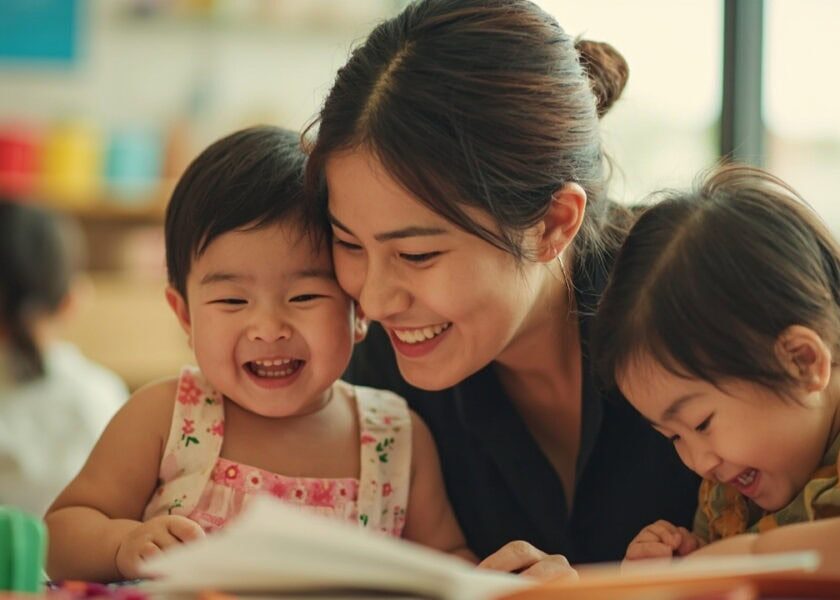
It gives peer interaction. In quality childcare settings, children play alongside others their age — learning the complicated, beautiful grammar of sharing and conflict and cooperation that cannot be taught by even the most devoted grandparent. These are skills that emerge in the friction of peer relationships, in the push and pull of children negotiating the same toy, the same space, the same attention.
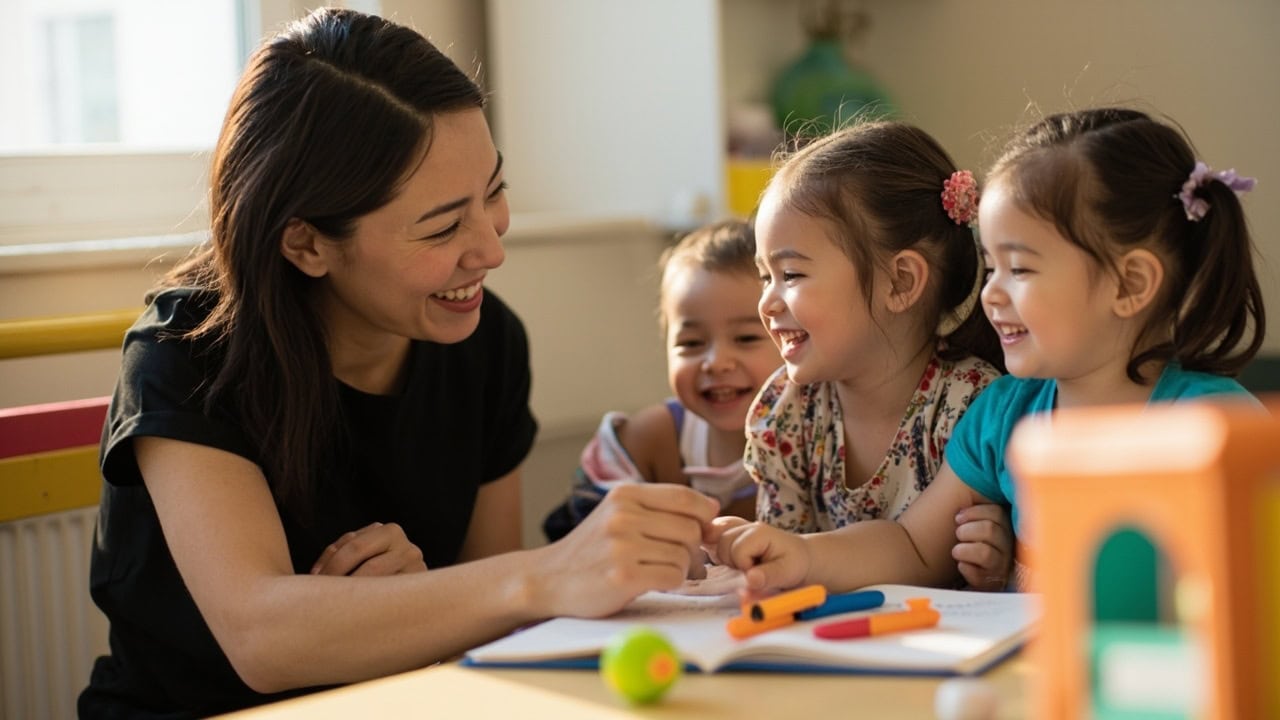
It gives exposure to a wider world. A trained caregiver has intentionally designed environments for learning — spaces where a child can climb and explore and discover, where language is modeled and curiosity is encouraged, where the world is presented not as a series of demands but as a landscape of wonder.
It gives children the experience of multiple attachments. This is perhaps the most important thing to understand, because it runs counter to a fear that many parents carry: that exposure to other caregivers will somehow dilute the bond between child and parent, or between child and grandparent.
The science here is clear and reassuring. Children are not pie — they do not divide their love into finite portions. A child who has a strong, secure attachment to a parent does not lose any of that attachment by also forming meaningful bonds with a grandparent, a childcare teacher, a trained caregiver. What we call attachment is not a reservoir that empties when others draw from it. It is more like a spring — it flows more freely the more it is given room to express itself.
Children who have access to multiple quality attachments tend to be more adaptable, more socially confident, more able to navigate the complex social worlds they will encounter as they grow. They learn that love is not scarce. They learn that care can come in different forms and still be real. They learn, in the deepest cellular sense, that they are worthy of attention and tenderness regardless of who is providing it.
This is not an argument against grandparent care. It is an argument for abundance — for understanding that the village a child needs may be larger than one household, that the wisdom of elders and the intentionality of trained professionals are not competing forces but complementary ones, each offering something the other cannot fully provide.
Making the Transition
For those who are ready to take this step — or to begin considering it — the question becomes practical: how do you make this transition in a way that honors the relationships that matter?
There is no universal answer, because every family is a distinct ecosystem with its own history, its own tensions, its own way of being. But there are principles that tend to hold true across contexts.
Begin with Honest Conversation
Not the kind that asks for permission, but the kind that shares your thinking. When parents approach this transition as if they need their parents’ approval, it creates a dynamic that is unfair to everyone. Your parents do not need to give you permission to make decisions about your child’s care. What they do need is to be told honestly what is happening and why, in a way that acknowledges what they have given.
“We are so grateful for everything you have done. This is not about anything you have done wrong. This is about what we think our child needs now, and we want to figure out how to do this together.”
Involve Grandparents in the Process
Where possible, allow your parents to meet the caregiver. Show them the space. Let them see that this is not an institution designed to replace them but a partnership designed to support everyone. If they are resistant, give them time. Sometimes the fear is rooted in not knowing — in imagining something worse than the reality.
Preserve the Relationship Deliberately
The transition from full-time grandparent care to shared care often means that grandparents need help figuring out what their role is now. Be proactive in creating space for them. Establish a new rhythm — perhaps one day a week that is grandparent day, or a regular weekend routine that keeps the bond strong even as the daily structure changes.
Some families find that grandparents become the backup care — called upon in emergencies, for occasional mornings when schedules shift — and this can work beautifully when both parties feel the arrangement is fair and chosen rather than assumed.
Be Patient with the Grief
Your parents may mourn the loss of daily closeness with your child, just as you may mourn the loss of the arrangement that felt safer in some ways. These feelings are not obstacles to be cleared; they are part of the transition, and they deserve acknowledgment.
Children are remarkably perceptive about emotional undercurrents. If the adults around them are tense or sad about the change, children will feel it. Creating space for the grief — naming it, honoring it — is often what allows it to move through and eventually resolve.
Trust Your Child
Children are more resilient than we fear, and more adaptable than we expect. A child who has been in grandparent care may take time to adjust to a new environment, but they are also learning something valuable: that the world contains multiple safe spaces, multiple people who love them, multiple homes where they can belong.
This is not a source of insecurity. It is a source of richness.
What Quality Childminding Looks Like
I want to speak now about what this kind of support actually looks like — because philosophy only carries us so far, and at some point, parents need to know what options exist and how they work.
EduNanny operates within the ECDA Childminding Pilot, which means it is part of a government-acknowledged framework designed to address exactly this gap in Singapore’s childcare landscape. The pilot recognizes what families have long known: that childcare is not one-size-fits-all, that home-based and community-based care pathways serve needs that centre-based options may not fully address, and that quality matters enormously in the early years.
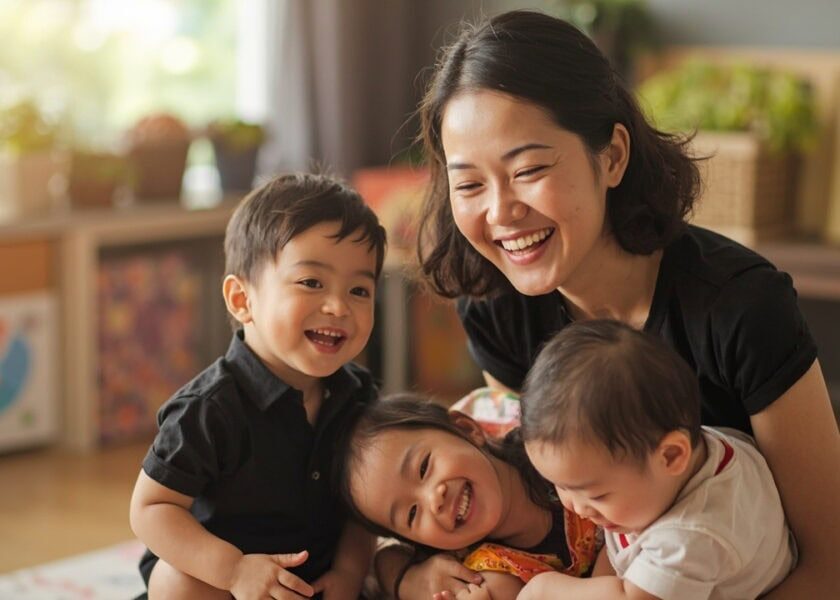
Within this framework, EduNanny offers home-based childminding with ratios of up to one to three infants — a ratio that allows for genuine attention, genuine responsiveness, and the kind of individual care that is simply not possible in larger group settings with higher caregiver-to-child ratios. This is a deliberate design choice rooted in what developmental research tells us about the needs of very young children.
| Dimension | What EduNanny Offers |
|---|---|
| Care hours | Monday through Friday, covering the core working week |
| Group size | Up to 1:3 caregiver-to-infant ratios in home-based settings |
| Costs | Structured to be affordable; CDA and Baby Bonus funds can be used |
| Transparency | CCTV visibility in designated areas; regular parent updates |
| Parent support | Thomas AI chatbot for navigating practical and emotional questions |
Communication and transparency are built into the model. Where CCTV measures are deployed, parents have visibility into their child’s day — not because caregivers need surveillance, but because trust is constructed through openness. Parents receive regular updates, structured communication that helps them stay connected to their child’s experiences even while they are at work.
The Thomas AI chatbot supports parents in navigating the practical and emotional dimensions of childminding. This is not a gimmick. It is a recognition that modern parenting is complex, that questions arise at odd hours, and that sometimes a parent needs a resource that can point them toward answers quickly and reliably.
What EduNanny offers is not a replacement for the village you already have. It is an extension of it — a way of adding trained, intentional, quality care to the ecosystem your child already inhabits. The goal is not to render grandparents unnecessary. The goal is to ensure that children have access to the best possible combination of family wisdom and professional care, layered in a way that serves their development and their wellbeing.
The Village You Are Building
Singapore has made remarkable progress in expanding childcare options over the past decade. The government has invested in infrastructure, subsidies, and training pathways for early childhood educators. The ECDA Childminding Pilot itself is a recognition that the solution to Singapore’s childcare challenges cannot be centre-based care alone — that families need a diversity of options, calibrated to their specific needs, delivered with quality at every level.
And yet the cultural shift has been slower. We still carry, in our bones, the belief that family should handle this — that turning to professional care is somehow an admission of failure, a symptom of a society that has lost its way. This belief does not serve us. It puts an unfair burden on grandparents, who gave decades of their lives to their own children and deserve the freedom to enjoy their later years on their own terms. It puts an unfair burden on parents, who carry guilt for choices that are not wrong but simply different.
The families navigating this transition with honesty and intention are not abandoning tradition. They are reimagining it. They are building a version of the village that our grandparents could not have conceived — one that includes trained caregivers alongside loving grandparents, professional curriculum alongside family wisdom, structured environments alongside the warmth of home.
There is a woman I know — let us call her Mdm. Tan — who cared for her granddaughter five days a week from infancy until the child turned two and a half. She loved that little girl with a ferocity that was beautiful to witness. She gave up her morning taichi class. She stopped traveling to visit her own sister in Malaysia. She rearranged her entire life around this small person’s needs, not because she was asked to, but because she could not imagine doing otherwise.
But there were moments — she told me this herself, carefully, as if testing whether she was allowed to say it — when she felt a flicker of something that was not quite resentment but was not quite gratitude either. She felt tired in a way that sleep could not fix. She felt a longing for the days when her own children were small, when she was the mother, the decision-maker, the one in control — and also the one who could set down the weight at the end of the day because the next day was hers.
When her daughter finally made the decision to move to a childcare arrangement, Mdm. Tan cried. She was sad, genuinely sad, because she loved that child and the daily rhythm they had built together. But she also felt something else — something she had not expected. Relief. Permission. A door opening onto a version of her own life that she had not realized she was missing.
Today, Mdm. Tan picks up her granddaughter every Friday afternoon. They go to the market together, just the two of them. They eat ice cream. They sit on the bench outside the block and watch the neighbors’ cats. She tells her granddaughter stories about when her own children were small. The relationship has not diminished. It has deepened — precisely because it is no longer entangled with the exhausting, relentless work of full-time care.
This is what choosing quality childcare can offer your parents. Not replacement. Restoration.
For Those in the Thick of It
And for those who are in the thick of it right now — who are lying awake at night weighing this decision, who feel the pull of filial obligation on one side and parental intuition on the other, who are searching for a way forward that does not require anyone to lose — I want to offer this.
You are not failing. You are not choosing your career over your child. You are not replacing your parents or diminishing their contribution or telling them they did not do enough.
You are doing what every generation of parents has done: you are adapting. You are responding to changed circumstances with the best tools and information available to you. You are building a life for your family that honors the past while serving the future.
Your child will grow up knowing that she is loved by many — by grandparents who gave the first years, by caregivers who gave skill and intention, by parents who gave everything they had to build a life where all of this could coexist. She will carry this expanded sense of village into her own life, her own relationships, her own understanding of what family means.
And your parents — the grandparents who gave so much — will have the chance to love her in a different way. Not as the daily source of care, but as the keepers of family history, the tellers of family stories, the ones who show up on weekends with mangoes and leave with tired, happy hearts.
This is not loss. This is transformation. And it is happening in homes across Singapore, quietly, without fanfare, in the hands of parents who are brave enough to choose something new because they believe — with every ounce of their being — that it is what their children deserve.
The village you are building is bigger than you thought. It is stronger than you feared. And your child — this small, extraordinary person at the centre of all of this — will thrive in it.
If you are exploring what quality home-based childminding could look like for your family — or if you simply want to have a conversation about where you are and what your options might be — EduNanny is here.
The village you are building matters. You do not have to build it alone.
Learn more about EduNanny and our approach to quality childminding, or read about our story and values.