The Quiet Classroom Where Siblings Learn to Be Human Together
The Hidden Curriculum: What Siblings Actually Learn From Each Other
Singapore has one of the highest rates of multi-child families in the developed world. More than half of our families are raising two children or more. And yet, when we talk about what children learn in quality childcare, we almost always talk about what they learn individually—their milestones, their skills, their readiness for school.
But children with siblings are never growing alone. And the childcare environment is the only place outside the home where this reality is lived, every single day, in every single interaction.
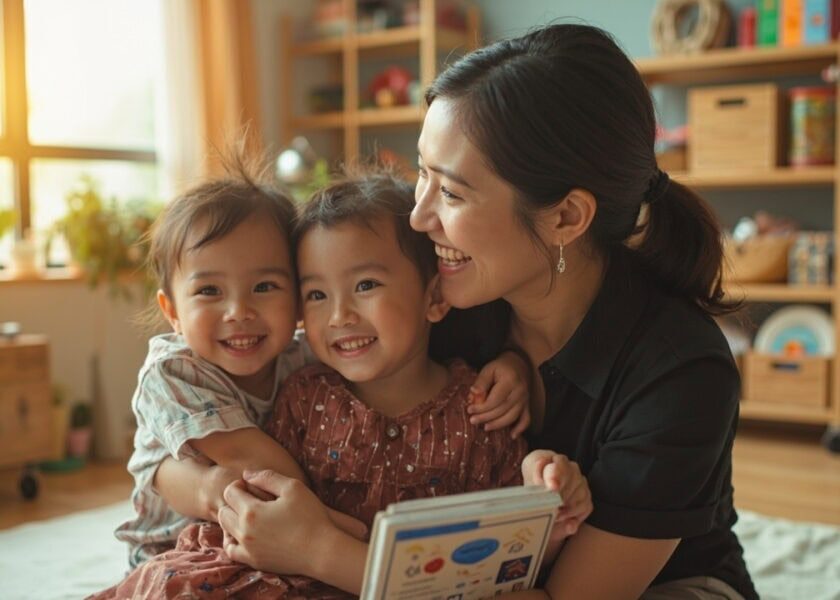
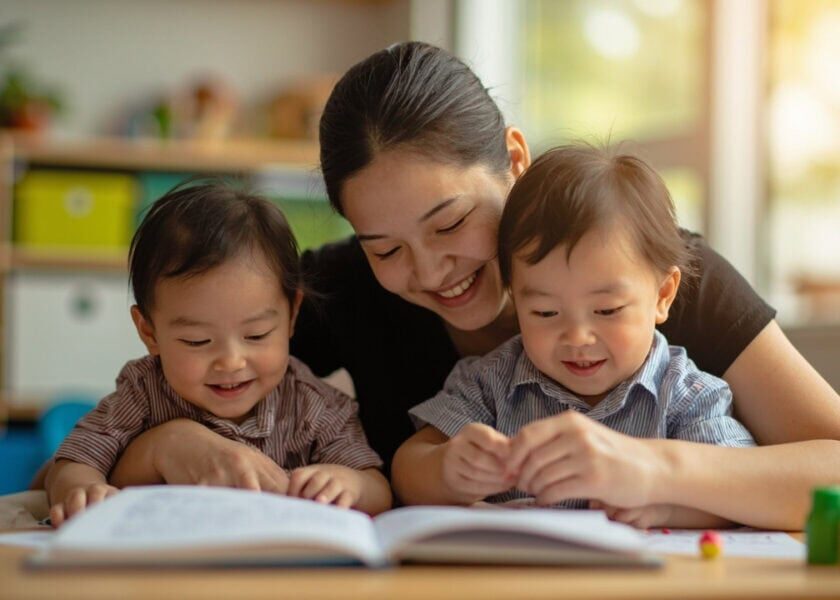
Children learn to relate to each other primarily through sibling interaction, not adult instruction. They learn conflict resolution in the thirty seconds between one child grabbing a toy and the other crying. They learn emotional regulation by watching how their sibling’s mood shifts the room. They learn cooperation, not from being told to share, but from the lived negotiation of who gets the blue cup and who has to wait.
They learn social comparison, empathy, loyalty, rivalry, and the entire architecture of human relating—inside the sibling relationship, long before they are old enough to sit in a circle and learn it from a teacher. This is the hidden curriculum. And it has been hiding in plain sight.
What Siblings Learn Together
- Conflict resolution — children learn to work through disagreements in the moments between grab and cry, not from being told what to do
- Emotional regulation — siblings notice each other’s distress and learn to respond, sometimes before they have words for it
- Social comparison and empathy — the sibling relationship is the first place children learn what others feel and need
- Language acceleration — older siblings speak in a register that is more playful, more iterative, more forgiving of imperfection, stretching younger ones toward words faster
- Motor skill motivation — watching a sibling climb, reach, and try makes the body want to follow
The Unspoken Worry: When Two Children Share the Same Childcare
There is another reality that parents carry, one that is harder to say out loud. Many families tell us that when they enrolled their second child in the same childcare as their first, they expected relief. Two children, one drop-off. One pickup. One set of bags and bottles and extra clothes.
And instead, they found a new kind of vigilance. Because now they were not just worrying about whether their children were happy and safe and growing. They were worrying about whether they were happy and safe and growing in relation to each other.
The older child, who was the center of the world before, now watches a caregiver kneel down to the younger one, and something in her chest tightens. This is not drama. This is development. This is the oldest conflict in the human family: the question of whether there is enough love, enough attention, enough space.
What trained caregivers notice, when they are paying attention to sibling dynamics, is everything. They notice when the older child starts to mother the younger one—not because she has been asked to, but because that is the role that feels safe when the adults’ attention is divided. They notice when the younger child starts to provoke the older one, deliberately, because even negative attention from a sibling is a form of connection. They notice when children who have been placed in the same room begin to orbit each other in ways that have nothing to do with what the caregivers are doing and everything to do with what they are learning about each other.
How Quality Childcare Supports the Sibling Relationship
This is why we believe in intentional moments of separation, even when siblings are in the same childcare. Children need time to be seen as individuals, to exist outside the sibling system, to have experiences that belong only to them.
A morning where the older child goes to the outdoor play area while the younger one stays indoors with a smaller group is not a punishment. It is a gift. It says: you are not only a sibling. You are also a person with your own age, your own needs, your own pace.
And that separation, when handled with care, makes the coming back together more generative. More spacious. More full of what they have to show each other rather than what they are fighting over.
At EduNanny Singapore, our caregivers are trained to see these patterns. Not to intervene constantly, not to police sibling interaction, but to hold the space in a way that allows siblings to work through their dynamics while preventing those dynamics from calcifying into patterns.
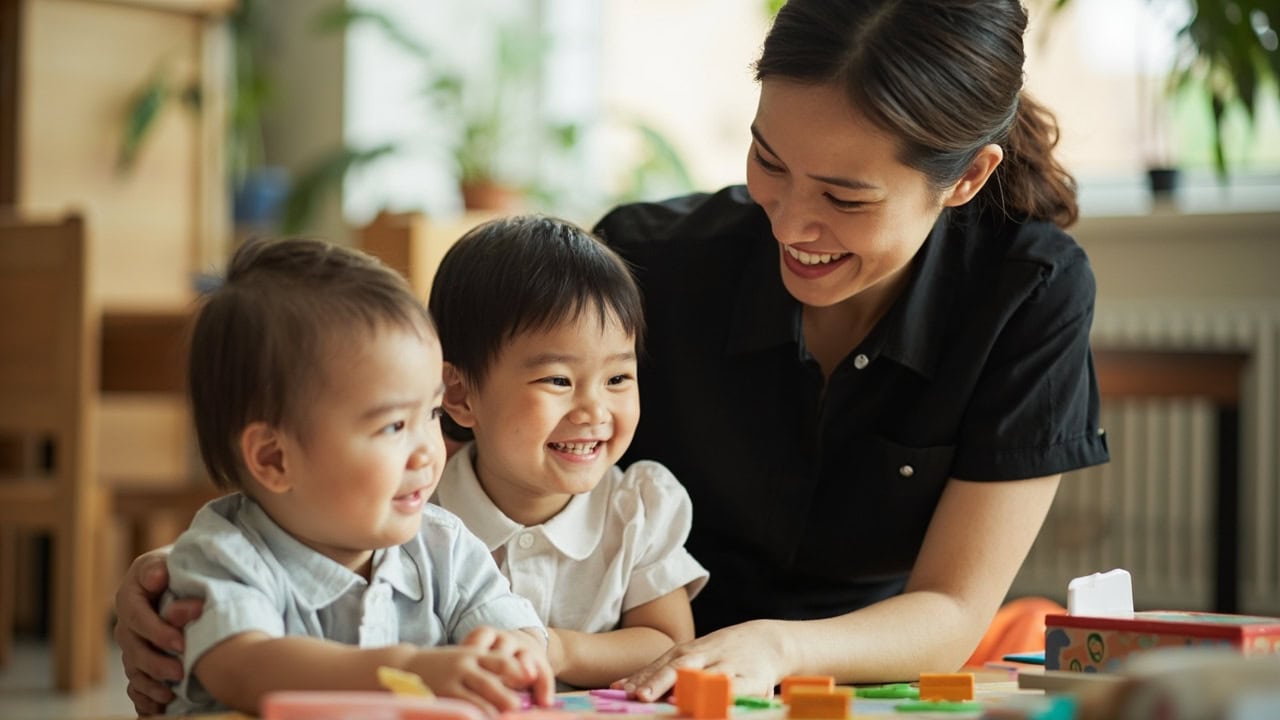
Quality childcare interrupts the default. Not by removing conflict, but by shaping what conflict becomes. When caregivers understand sibling dynamics, they can redirect a moment of competition toward collaboration. They can name what they see—”I notice you both want the red truck”—in a way that models language for the emotion underneath. They can create environments where there are enough resources, enough attention, enough space that siblings are not constantly in competition for the same things.
Our infant ratios are designed so that caregivers can actually see what is happening. Up to one to three infants means that when two siblings are in the same space, a caregiver is not managing chaos. She is observing. She is noticing the subtle shifts in tone when the older child enters the room. She is seeing who reaches for whom when the lights dim for rest time. She is present in a way that allows for presence, not just supervision.
The Long Game: Compounding Sibling Relationship Quality
Parents who trust their childcare to see sibling dynamics stop worrying about something they could never quite name before.
They stop worrying that their children are learning to resent each other. They stop worrying that the childcare environment is inadvertently rewarding one child at the expense of the other. They stop worrying that they are sending their children into a place where the sibling bond is weakening rather than deepening.
And what they find, over months and years, is that their children are coming home changed in the way they relate to each other. Not perfect. Not without conflict. But more fluent in each other’s language. More skilled at working things out. More genuinely interested in what the other one thinks and feels.
This is the compounding of sibling relationship quality in early childhood. It is slow. It does not show up in a report card. But it compounds. And by the time your children are adolescents, by the time they are adults choosing where to live and who to call and how to be family to each other, the foundation was laid in the years when you could not see it happening—in the small moments of childcare, in the presence of caregivers who understood that they were not just caring for individuals. They were caring for a relationship.
What EduNanny Singapore Offers
EduNanny Singapore was built on this understanding. We are part of the ECDA Childminding Pilot, and we offer families pathways that recognize how different families need different things.
Some families need home-based childminding, where a trusted caregiver comes to your space and your children are in their own environment, with their own routines, their own toys, their own sense of safety. Some families need the community of a centre-based setting, where children move between different groups and experiences. We offer both. We do not believe there is one right answer for every family. But we believe that whatever pathway a family chooses, the sibling relationship deserves to be held with intention.
We know that Singapore families are navigating real pressures. The cost of living, the demands of dual-income households, the search for childcare that does not feel like a compromise. We have designed our pilot fee structures to be affordable. We accept CDA and Baby Bonus, because we believe that financial considerations should not be the reason a family cannot access quality care. Our care blocks run Monday to Friday, because that is how Singapore families work.
And because we know that trust is built in the small acts of transparency, we have implemented communication and CCTV measures in our centre-based settings. We do not share footage casually. But we know that parents want to know what is happening, and we have built systems that allow for that knowing without intrusion. We send updates. We notice things and tell you about them. We treat communication as part of the care, not an add-on to it.
Questions Worth Asking
If you are researching childcare for multiple children, here are the questions most tours will not answer for you:
- How do your caregivers observe and respond to sibling dynamics throughout the day?
- Do siblings have intentional time apart as well as together?
- What are your infant-to-caregiver ratios, and can caregivers actually observe what is happening?
- How do you support the older child who may be adjusting to divided attention?
- What happens if sibling rivalry becomes a pattern—how do you intervene?
- How do you communicate what you notice about how my children are relating to each other?
The right answers will not sound like marketing language. They will sound like someone who has watched children carefully. They will reference specific moments. They will acknowledge that sibling dynamics are complex, ongoing, and worthy of as much attention as any individual milestone.
Finding a Partner Who Sees Your Children Whole
What we are offering, at the end of all of this, is not just childcare. We are offering parents something they may not have known to look for—a partner who understands that your children are a unit. A team. A small society that will outlast your daily management of it.
We are offering caregivers who have been trained to see siblings as they truly are: as each other’s first teachers, first rivals, first confidants, and first models of what it means to be human alongside someone else.
There is a quiet confidence that comes when you realize your childcare sees your children this way. It is not the confidence of having solved every problem. It is deeper than that. It is the confidence of knowing that the relationship your children will carry into adulthood is being tended to, in the small hours of ordinary days, by people who understand its weight.
Your children do not just grow. They grow through each other. And in quality childcare, that growth is seen. It is honored. It is shaped with the same care and intention you bring to it yourself.
That is what EduNanny Singapore offers. That is what we have always believed childcare could be.
Ready to learn more? Schedule a conversation with our team to explore how EduNanny Singapore’s infant care and childminding services support the sibling relationship from the very beginning.