The Primary One Preparation Mistake Most Singapore Parents Are Making
Are You Doing Enough to Prepare Your Child for Primary One?
There is a question that keeps Singapore parents awake at night. It is not a question they ask out loud at playdates or raise in parenting forums. It is the quiet, persistent worry that lives beneath the surface of every enrichment signup, every assessment book purchase, every conversation with grandparents about whether their child will cope.
The question is this: Am I doing enough to prepare my child for what is coming?
And beneath that question lies another one, rarely spoken, even more rarely answered: Where do I begin?
This article is for parents who feel the weight of Primary One preparation and suspect—perhaps without being able to articulate why—that the answer may not lie in more enrichment classes. If you are wondering whether your childcare choices actually matter for your child’s academic future, read on. What we share may change the way you think about what comes first.
The Enrichment Trap: Why More Programmes Are Not the Answer
Here is what we have observed, working alongside families across this island: most parents in Singapore approach school readiness like they are assembling a puzzle. They gather the pieces—phonics classes, mathematics workshops, Chinese tuition, motor skills programmes—and they hope that somehow, when Primary One begins, the picture will come together.
And yet, for all the money spent and weekends sacrificed, there is a growing sense that something fundamental is missing. The preparation feels fragmented. The child themselves seems less confident, less curious, less ready to engage with learning than all this effort should have produced.
Consider a common scenario: a four-year-old who can recognise fifty Chinese characters but falls apart when asked to share a toy. A child who can count to one hundred but cannot manage the transition from playtime to circle time without a meltdown. A learner who has been so thoroughly drilled on academic content that they have lost the very curiosity that would make all that knowledge meaningful.
The reason for this gap is not difficult to understand. It is just rarely said plainly.
Enrichment is built on the assumption that the child is ready to receive it. But readiness is not something that arrives at age six. Readiness is built in the years before. It is constructed in the daily rhythms of early childhood—in the way a toddler learns to wait, to try again, to ask for help, to feel safe being wrong, to believe that effort leads somewhere.
These are not soft skills. These are the precise capacities that determine whether a child in a Singapore classroom raises their hand or keeps it firmly in their lap. Whether they see a difficult problem as a challenge or a threat. Whether they arrive at Primary One believing that school is a place where they belong, or a place where they will be found out.
What School Readiness Actually Means
Ask most Singapore parents what school readiness looks like, and they will describe early literacy, numeracy skills, or the ability to sit still for extended periods. These are the metrics visible on assessment forms and discussed at parent meetings.
But school readiness, understood properly, is something far more fundamental: the ability to learn. And the ability to learn is not taught in enrichment classes. It is built in the quality of care a child receives in their first thousand days.
The First Thousand Days: Why These Years Matter Most
You may have heard the phrase “first thousand days.” It refers to the period from conception to approximately age three—a window of developmental sensitivity that neuroscientists describe as the most consequential of the entire human lifespan.
During these thousand days, the architecture of the brain is being laid down at a speed that will never be matched again. The neural pathways that determine how a child processes emotion, responds to stress, forms language, and relates to other people are not waiting to be installed later. They are being built now, in the interactions, routines, and relationships that make up your child’s daily life.
This is not a soft claim. This is the consensus of developmental science, endorsed by institutions from the World Health Organization to Singapore’s own National Early Childhood Development Agency. And yet, as a society, we have built an entire industry around preparing children for school that almost entirely ignores this foundational period. We pour resources into Primary One preparation while spending comparatively little attention on what happens in the three years before.
The Capacities That Actually Matter
When we speak about school readiness, we mean something specific. We mean:
Emotional Regulation
The child who enters a Primary One classroom already equipped with the capacity to sit, to listen, to manage the mild frustration of not knowing something immediately. The child who has learned, through consistent and responsive caregiving, that their feelings are valid but manageable. That a new situation can be navigated. That separation from a parent does not mean abandonment.
These are not personality traits that some children are born with and others are not. They are capacities that develop in relationship—with caregivers who model calm, who respond to distress with presence, who create predictable rhythms that allow a child’s nervous system to feel safe.
Social Confidence
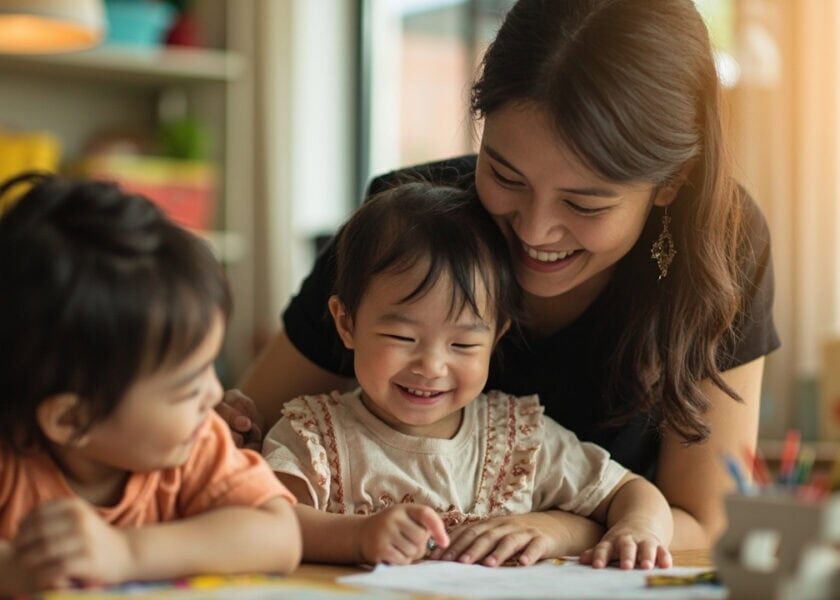
Not bravado, but genuine ease in the presence of other children and unfamiliar adults. The ability to share, to take turns, to navigate small conflicts without escalation, to understand the social grammar of a group setting.
These skills are not intuitive. They are learned. They are learned when a child has enough individual attention to feel seen, enough peer exposure to practice, and enough guidance to understand the unwritten rules of social life.
Language Foundations
The child who comes to literacy with curiosity rather than anxiety. Not the child who has been drilled on characters, but the child who has been spoken to, read to, sung to, and listened to. The child who has learned that sounds become words, that words become stories, that stories are worth the effort of decoding.
In Singapore, where language demands begin early and never ease, the child who arrives at Primary One already in love with language—not afraid of it—has an advantage that no enrichment class can replicate in the same way.
The Belief That Learning Is Worthwhile
Not because of stickers or rewards or parental pressure, but because learning feels good. Because asking questions was encouraged. Because trying something hard and failing was met with warmth rather than correction.
Somewhere in those first thousand days, this child developed the disposition that makes all academic effort meaningful: the conviction that they are capable of figuring things out.
What Quality Childminding Actually Looks Like
For Singapore parents, the childcare market can feel overwhelming. Infant care centres, student care facilities, full-time helpers, grandparents, playgroups—the options multiply, and each comes with trade-offs that feel impossible to evaluate.
What does quality actually look like when you are choosing care for your infant or toddler? Let us be specific.
The Caregiver Ratio Matters More Than Most Parents Realise
At this age, the ratio of caregivers to children is not just an administrative number. It is the difference between a child who is observed and a child who is truly known.
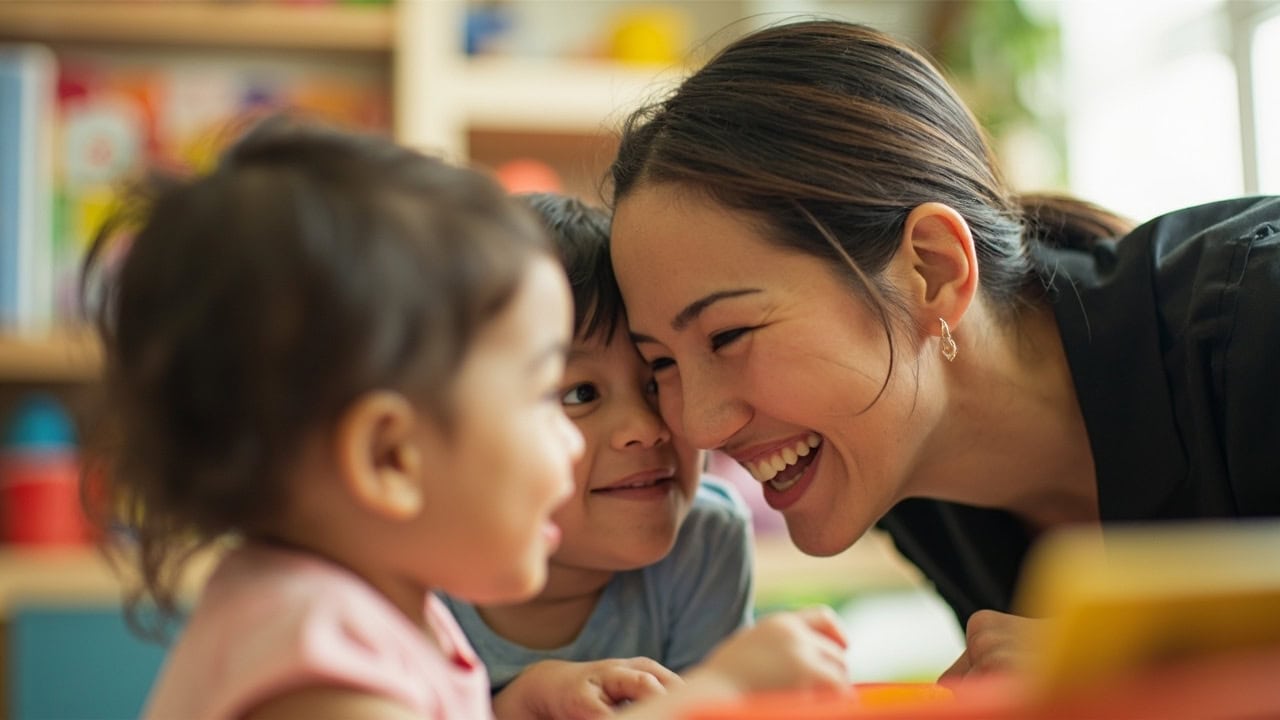
When an infant cries, does someone come within seconds? When a toddler is struggling with a puzzle, does someone notice the frustration before it becomes a meltdown? When a two-year-old is on the verge of hitting another child, is there an adult close enough to intervene with guidance rather than correction?
In settings with lower ratios—one caregiver to every three infants, for example—these moments of responsiveness become possible. In crowded settings where one adult is responsible for ten or fifteen young children, they simply cannot. The child’s brain is building either way. The question is whether the building happens in an environment of stress or security.
Predictable Rhythms Build Neurological Stability
Children in their first thousand days are not capable of managing chaos. Their nervous systems are still learning to regulate, and they do this by relying on predictability. The same sequence of morning activities, the same response to hunger and tiredness, the same faces greeting them each day.
This is not about rigid scheduling or deprivation of spontaneity. It is about creating an environment where a child’s brain can develop the capacity for flexibility—because that capacity is built on a foundation of security.
Language Exposure Happens in Conversation, Not Screens
Research consistently shows that children develop language best through responsive human interaction—not passive exposure to television, apps, or recordings. A caregiver who narrates the day, who responds to a baby’s coos, who reads books interactively rather than reciting words, who engages in genuine back-and-forth conversation with toddlers—this caregiver is building language foundations that will serve your child through every year of schooling.
In Singapore specifically, where bilingual development is both an asset and a challenge, this quality of language exposure matters even more. The child who has learned that communication is pleasurable will approach Mandarin or Malay with curiosity rather than dread.
Secure Attachment Is the Foundation of Everything
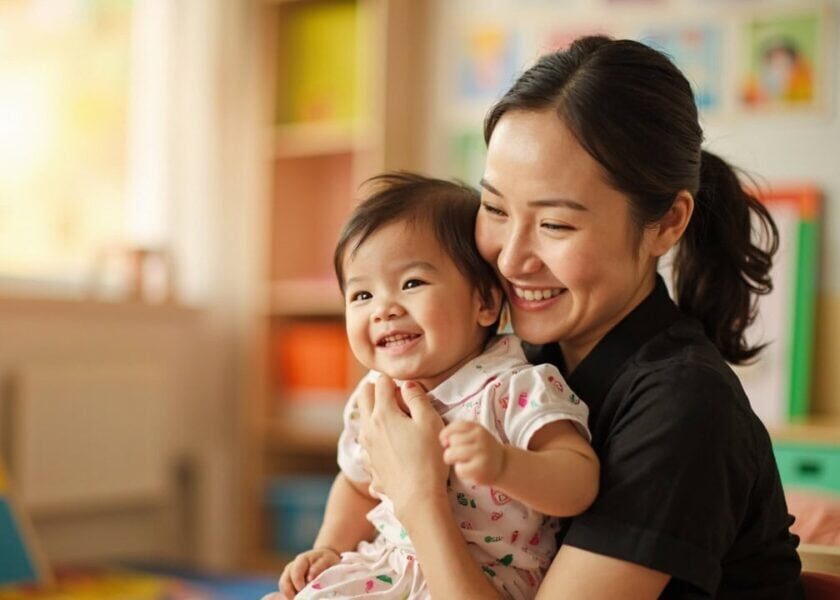
Perhaps most importantly, quality childminding means that your child develops a secure attachment to their caregiver. This does not mean your child will love the caregiver more than you—it means your child will use the caregiver as a secure base from which to explore the world.
A child with secure attachment can tolerate short separations because they trust the caregiver will return. They can approach new situations with curiosity rather than fear. They can regulate their emotions because they have learned, through consistent attunement, that difficult feelings are survivable.
These capacities do not appear suddenly when Primary One begins. They are built slowly, through hundreds of responsive interactions, over months and years of quality care.
The EduNanny Approach
EduNanny was founded on a specific premise: that childcare is not a waiting room before education begins. It is education. It is the soil from which everything else grows.
Under the ECDA Childminding Pilot, EduNanny offers pathways that work with the realities of Singapore family life—home-based care options for families who value the familiarity and individualized attention of a home environment, as well as community and centre-based options for those whose circumstances call for different arrangements.
The infant ratios we maintain ensure that your child is not one of fifteen in a room. They are one of three, or fewer. This is not an accident. It is by design. It is the practical expression of everything we have discussed: that responsiveness builds readiness, that attention builds security, that quality relationships build the brain architecture that makes all future learning possible.
What Singapore Parents Need to Know
Trust is not abstract for parents in Singapore. It is logistical. It requires communication, transparency, and visibility. Our programme incorporates regular updates to parents, clear channels for questions and concerns, and where deployed, measures such as CCTV that allow parents to see into their child’s day with their own eyes. You should not have to wonder. You should know.
Affordability matters. Singapore families plan carefully. The Child Development Account and Baby Bonus structures exist precisely so that early childhood investment does not require choosing between your child’s development and your family’s financial wellbeing. Our pilot fee structures are designed to be accessible within these frameworks.
Flexibility within structure. Our care operates Monday through Friday, in defined blocks, recognising that most families need reliable, predictable arrangements. This is infrastructure, not just service. It is the dependable rhythm that children—particularly in those crucial first thousand days—actually need to thrive.
The People Who Care for Your Child
There is one more thing we want to name, because it is central to why EduNanny exists.
The childminder, in Singapore, has not always been treated as a profession of dignity and consequence. There is a tendency, in our society as in many others, to see the work of caring for young children as lesser—less skilled, less important, less worthy of respect.
This is not a view we share.
The person who holds your infant, who responds to your toddler’s distress, who creates the daily environment in which your child’s brain is being built—that person is doing some of the most consequential work in your child’s life. At EduNanny, we treat our caregivers with the seriousness this deserves. We invest in their training, their development, and their professional identity.
Because when caregivers are valued, they are present. And presence is everything.
The Questions That Actually Matter
If you are currently evaluating childcare options for your infant or toddler, these are the questions worth asking:
- What is the caregiver-to-child ratio? For infants, aim for no more than one to three. This is the difference between observation and true attunement.
- Is there consistency of caregivers? Frequent rotation undermines attachment security. Ask how long caregivers typically stay and how transitions are managed.
- What does a typical day look like? Predictable rhythms are not about rigidity—they are about building neurological regulation. Ask about the daily schedule and how changes are handled.
- How is language development supported? Look for interactive conversation, reading, and singing—not screens or passive activities.
- How are conflicts and distress handled? The way caregivers respond to a crying infant or a toddler’s tantrum teaches your child about emotion regulation. Ask about their approach.
- What communication can you expect? Regular updates, photos, and accessible channels for questions are signs of a programme that values transparency.
- How does the programme support your family’s needs? CDA Baby Bonus eligibility, flexible arrangements, and parent partnership are practical considerations that affect your daily life.
The Decision You Are Already Making
Let us return to that question we began with. Am I doing enough?
Here is what we know. You are not lacking effort. You are not lacking love. You are lacking a framework for understanding where your effort matters most.
And once you see that emotional regulation, social confidence, language foundations, and the love of learning—all of it begins in the quality of care your child receives in these earliest years—the path forward becomes clear.
You do not need to choose between nurturing and preparing. They are not separate things.
The same responsive caregiver who makes your infant feel secure is building the brain architecture that will allow your child to sit in a Primary One classroom and believe they can learn. The same predictable routines that make your toddler feel safe are teaching the self-regulation that Singapore schools reward. The same warm interactions that make your child feel loved are constructing the confidence that will carry them through every challenge school brings.
Not a promise that your child will top their class. We will not make that promise, because no one can.
But we will make this one: we will treat your child’s first thousand days with the seriousness they deserve. We will know your child. We will build the capacities that matter. We will partner with you as you make the most important early decisions of your child’s life.
When Primary One arrives—when your child walks through those school gates, perhaps a little nervous, but fundamentally ready, fundamentally curious, fundamentally sure that they belong in a place of learning—you will know that the decision you made in these early years was not an afterthought to enrichment. It was the beginning of everything.
That is what EduNanny is for. That is why we are here.
EduNanny is a Singapore childminding and early childhood care programme built on developmental warmth, professional standards, and the conviction that the first thousand days matter more than any enrichment class that comes after. Learn more about our approach or reach out to speak with our team.