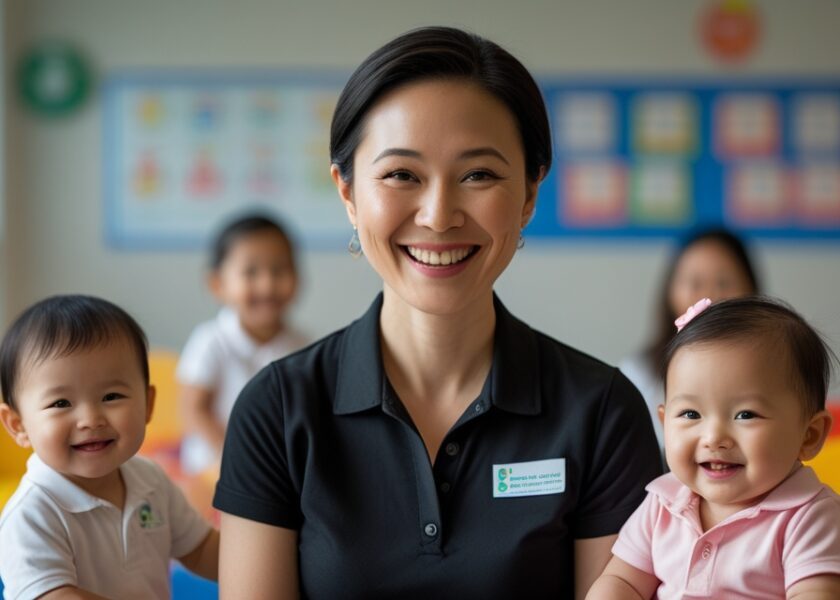
The Partnership Model Singapore Parents Are Looking For
Why Parents Feel Like Outsiders in Their Child’s Care
For years, the conversation around childcare in Singapore has focused on selection. How do I find the right centre? What questions should I ask on the tour? How do I know if the caregivers are qualified? What are the ratios? What is the curriculum?
These are not wrong questions. They are necessary ones. But they share a common assumption: that the parent’s job ends at enrollment. Once you have made the right choice, your role becomes one of observation and occasional evaluation. You become the audience in your own child’s daily life.
This is the invisible wound that many Singapore parents carry. They have made thoughtful, deliberate choices about their children’s care. They have done the research, visited the centres, weighed the options. And yet somewhere along the way, they have been cast in a role that does not fit them. The role of the anxious watcher. The concerned evaluator. The parent who must remain vigilant because the real work of raising their child happens somewhere they cannot fully see.
The relationship between parent and childcare provider has almost always been framed as a transaction. You select a service. You pay for a service. The service is rendered. In this framing, the parent is the customer, the provider is the vendor, and the child is the recipient.
It is clean. It is understandable. And it is profoundly incomplete.
Here is why: your child does not live in a world where care is delivered and received in neat transactions. Your child lives in relationship. Every interaction, every response, every moment of being seen and heard and held shapes the neural architecture of their growing mind. And the most important relationship in your child’s life is not the one with their caregiver, however wonderful that caregiver may be. It is the one with you.
When we design a childcare model that positions you as the external evaluator, the occasional visitor, the anxious recipient of daily updates, we are not just creating an awkward dynamic. We are separating your child from the most important developmental resource they have. We are saying, in effect, that care happens here, and love happens there, and we hope they somehow connect.
What Partnership Actually Means
The alternative is a relationship built on partnership. But this word is sometimes used loosely in the childcare world to mean friendly communication or open-door policies. I want to be precise about what I mean.
Partnership means that your intelligence about your child is treated as a professional resource, not a sentimental preference. You know your child’s rhythms, their fears, their emerging words, the particular way they show they need comfort. That knowledge is valuable. It belongs in the conversation about your child’s care.
Partnership means that the caregiver is not an interchangeable service provider but a collaborator who knows your child in ways that complement what you know about them. The relationship is not a handoff. It is a continuing dialogue.
Partnership means that the daily experience of your child’s development is not something that happens to you but something you participate in, even when you are not in the room. The handover and the pickup are not the beginning and end of communication. They are touchpoints in an ongoing conversation.
This is what EduNanny was built to honour. Not just at enrollment, when everything feels new and hopeful, but every day after, in the small moments and the larger rhythms of your child’s life.
What Partnership Looks Like in Practice
Philosophy without practice is just sentiment. Here is what this partnership model actually looks like for families at EduNanny Singapore.
Communication That Flows Both Ways
When your child is enrolled with EduNanny, you are not handed a generic daily report and left to interpret it on your own. Communication is purposeful and reciprocal. We share what we observe because we want you to understand your child’s day, yes, but we also ask what you observe, because your observations at home complete the picture.
When we notice that your child seems particularly engaged by music on a certain afternoon, we tell you not just as an update but as an invitation. We are inviting you to notice the same thing at home, to extend that interest, to make the connection between what happens here and what happens there. The learning is not confined to one setting. It flows between them.
Care That Knows Your Child by Name, Not by Number
In our home-based pathways, which are part of the ECDA Childminding Pilot, your child receives care in a setting that is warm, consistent, and deeply personal. With ratios of up to one caregiver to three infants, every child receives the attention their development requires.
This is not a luxury feature. It is a structural commitment to the kind of care that the science of early childhood tells us makes a difference. Your child is not one of twelve in a room. They are one of three, which means their caregiver knows their rhythms, their preferences, their emerging words, their particular way of showing they need comfort.
A Caregiver Who Is a Collaborator, Not a Vendor
Your child’s caregiver is not a stranger you hired and placed in your home. They are part of an EduNanny community, trained and supported, operating within clear standards and open to your conversation. When you have a concern, you raise it not as a complaint to a vendor but as a discussion with a collaborator. When something goes well, you share in that success as well.
This is the texture of the partnership we are building. It is not just the big moments. It is the daily accumulation of shared attention, mutual respect, and consistent care.
Trust Built Through Transparency
We know that trust is earned, and that parents in Singapore have every reason to be cautious. You have heard stories. You have read accounts. You want to know that your child is safe, and you want to know that the people caring for them are worthy of your trust.
This is why we have built transparency into the architecture of our service. Where CCTV measures are deployed, parents have clarity about how they work and what they provide. Where communication is open, it is genuinely open, not a curated version of events designed to reassure.
We believe that trust is a two-way street, and that the only way to build the kind of partnership we are describing is through honest, consistent, professional transparency.
Why Partnership Matters for Your Child’s Development
Partnership is not just good for parents. It is profoundly good for children.
Children whose parents are genuinely engaged with their childcare experience show better developmental outcomes, not because the parents are doing more, but because the consistency of relationship is stronger. When the same values, the same language, the same responsive attention that a child receives at home is echoed in their care setting, the child does not experience a jarring discontinuity. They experience a world that makes sense, where they are known and valued in the same way by the people who matter most.
At EduNanny, we see this regularly. We see the child who arrives nervous on Monday morning and is soothed not just by the caregiver’s warmth but by the fact that the caregiver and the parent have already communicated about what might help. We see the child whose emerging interests are noticed at care and brought home, so that learning flows between settings. We see the child who knows, in some deep way that does not require words, that the adults in their life are talking to each other, are working together, are united in their commitment to this small person.
Questions Singapore Parents Ask Us
Will I feel guilty for putting my child in care?
We know that Singapore families are complex. Parents have careers. Households have two working adults or single parents carrying significant loads. We are not here to add guilt to an already difficult arrangement. We are here to make the arrangement better. The question is not whether your child should be in care. The question is what kind of care experience your child deserves.
Are quality options accessible to me in the heartlands?
We participate in the ECDA Childminding Pilot, which means our fee structures are designed to be affordable for the families who need us most. Your Child Development Account can be used. Your Baby Bonus can be applied. These are not gimmicks. They are genuine commitments to making quality care accessible across Singapore, in the heartlands and beyond.
How do I know I can trust a caregiver in my home?
Trust is built, not assumed. That is why EduNanny caregivers are part of a supported community with clear standards, not isolated contractors left to navigate complex situations alone. When concerns arise, the structure exists to address them. When things go well, the relationship is celebrated. You are not alone in this arrangement.
What if I have questions outside of pickup hours?
We have developed a Thomas AI Chatbot that serves as a resource for parents navigating the landscape of childcare, development, and parenting itself. When you have a question at 10 p.m. after a long day, when you are wondering about a milestone or a behaviour or a concern, Thomas is there. Not as a caregiver, not as a substitute for professional advice when that is needed, but as a knowledgeable companion who helps you stay informed and confident between the conversations that matter.
What should I look for when choosing infant care?
Here are questions that go beyond the standard checklist and speak to the deeper quality of care your child deserves:
- After enrollment, how is my voice included in my child’s daily experience? Are parents treated as ongoing contributors, or just recipients of updates?
- How well does the caregiver know my child? Can they tell you about your child’s specific interests, fears, and patterns? Or do updates feel generic?
- Is communication two-way? Do you feel comfortable sharing observations from home, and are those observations received as valuable input?
- What happens when there is a concern? Is the process collaborative and transparent, or does it feel like filing a complaint with a service provider?
- Are the ratios sustainable? Can a caregiver genuinely know each child in their care, or is the structure designed for throughput rather than connection?
You Are Still the Most Important Person
I want to speak directly to the parent who has been watching from the outside. The one who sends their child to a centre and checks the app religiously for updates. The one who lingers at pickup, asking questions the caregiver may or may not have time to answer fully. The one who comes home and wonders, with a mix of guilt and longing, whether they are still the most important person in their child’s world.
You are. You are still the most important person. And the distance you feel is not proof that your bond is weakening. It is proof that the structure around you has not caught up with what you instinctively know.
You know that your child needs continuity. You know that what happens in your absence should connect to what happens in your presence. You know that the person caring for your child should know your child, not just as a charge but as a person.
This is what EduNanny was built to honour.
Your child’s best care does not happen despite you. It happens because of you, and because of the caregivers who honour your role in their life, and because of the structures that bring these two sources of love and attention into alignment.
There is a word that comes up often when parents describe the experience we are building together at EduNanny Singapore. That word is trust. Not the trust that is demanded or assumed, but the trust that is built, day by day, through consistent communication, genuine transparency, and the quiet daily proof that everyone involved is working toward the same thing.
EduNanny exists because we believe that every child in Singapore deserves care that respects their developmental needs, every parent deserves to remain meaningfully present in their child’s life even while working, and every caregiver deserves to be treated as the professional they are rather than a service function to be evaluated.
We are part of the ECDA Childminding Pilot, and we take that responsibility seriously. It means we are building something that does not exist yet—a model that treats the home-based and centre-based pathways not as inferior alternatives but as genuine options for families with different needs. It means we are learning, always learning, because the work of caring for young children demands humility and continuous growth.
But what we are most proud of is simpler than any programme or pilot. We are proud of the conversations we have with parents. We are proud of the moment when a parent who came in feeling like an outsider leaves feeling like a partner. We are proud of the caregiver who tells us that working with EduNanny feels different, because their expertise is respected and their relationship with families is supported rather than squeezed into efficiency metrics.
The relationship your child deserves is already there, waiting to be fully realised. We would be grateful to build it with you.
To learn more about EduNanny Singapore and how we support families through thoughtful, development-oriented childcare, visit our homepage or get in touch with our team.