The Morning Goodbye: Why Your Child’s Tears Are a Sign of Healthy Attachment
Why Goodbye Hurts: The Science Behind the Morning Transition
When a child cries at drop-off, our instinct is to interpret it as a verdict. She is unhappy here. He does not want to stay. Something must be wrong with this place, this caregiver, this choice we have made.
We scan the room for evidence. We question whether we were wrong to enrol them. We second-guess our decision before we have even reached the car park.
But here is what developmental science tells us, and I want you to hold onto this: separation anxiety is not a sign of inadequate care. It is a sign of healthy attachment. It is the natural, expected, and reassuring response of a child who has formed a strong bond with their primary caregivers — first you, and then, in the context of quality childcare, their caregiver too.
What Is Actually Happening in Your Child’s Brain
The research is consistent across infant, toddler, and preschool ages. Between six months and three years, separation anxiety peaks because your child’s cognitive development has reached a point where they understand that you exist even when you are not in the room — but they have not yet developed the sense of time that tells them you will come back.
For a two-year-old, ten minutes can feel like forever. And forever, to a developing brain, can feel like abandonment.
This is not drama. This is neurology. Their prefrontal cortex — the part of the brain responsible for managing uncertainty and delay — is not yet fully developed. What they experience in your absence is not mild discomfort. It is genuine distress.
The Misconception That Causes the Most Damage
The intensity of a child’s protest at the door has very little to do with how they feel once you are gone. Multiple studies in early childhood settings have shown that children who exhibit significant separation distress upon drop-off often settle within minutes, especially when the environment and the caregiver are attuned and prepared.
The crying at the door is not a window into the whole morning. It is a response to a specific, acute moment — the moment of transition, the moment of rupture, when the person they trust most in the world hands them to someone else and disappears.
What happens next, inside the door, is where the story continues.
The Drop-Off Window: Where Trust Is Made or Broken
For parents in Singapore, the morning transition is not a minor logistical hurdle. It is the moment where your trust — in your childcare arrangement, in your choice to work, in yourself as a parent — is either reinforced or quietly undermined.
In dual-income households, where both parents may leave for work before 7am and commute an hour or more each way, the morning goodbye carries additional weight. There is no lingering, no second trip back to check. There is only the door, the handoff, and the walk to the car knowing that the next few hours are not yours to control.
This is why the quality of the morning transition matters so profoundly — and why choosing a childcare provider who understands the emotional architecture of drop-off is one of the most important decisions you will make.
What Quality Morning Transitions Look Like
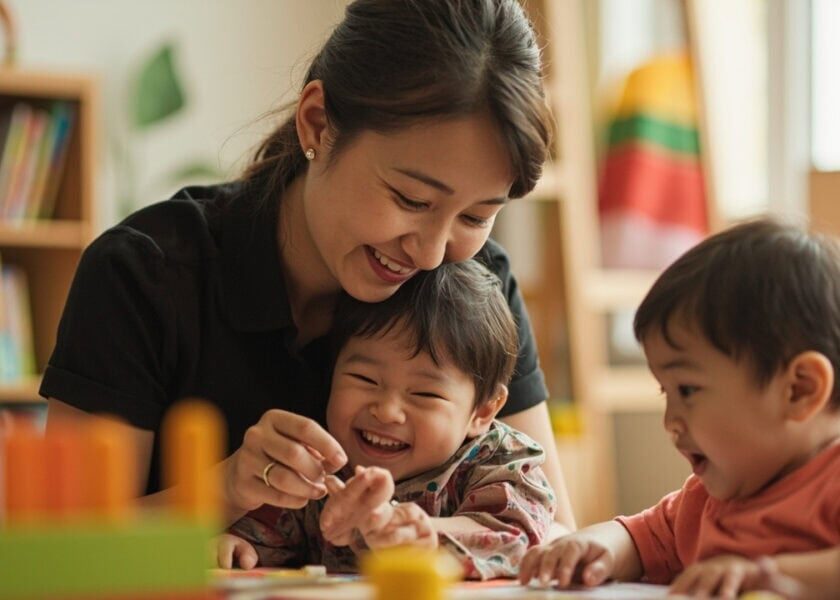
Developmental psychologists use a term called emotional scaffolding to describe what happens when a caregiver meets a child at the door with warmth, presence, and an immediate invitation into a familiar activity or routine. In plain terms, the caregiver is bridging. They are saying, without words: I see you. I know this is hard. I am here. We are going to be okay.
Consider what that looks like on a typical morning:
- Named greeting: The caregiver greets your child by name — not just your child’s name, but yours too. A brief, warm exchange acknowledges that yes, this moment is real, and yes, it matters.
- Physical warmth: The caregiver kneels, makes eye contact with your child, and offers a gentle transition — an activity already set up, a song that signals the start of the routine, a comfort item that carries the familiarity of home.
- Brief, calm goodbye: Parents are encouraged to keep the departure consistent and short — not because the child does not feel the loss, but because an elongated, tearful goodbye actually heightens distress rather than easing it.
- Presence in distress: The caregiver stays with the child in their distress — not dismissing it, not rushing past it, but being present with it. Naming it. I know you miss Mummy. That is okay. I am here. We are going to play now, and she will come back after snack time.
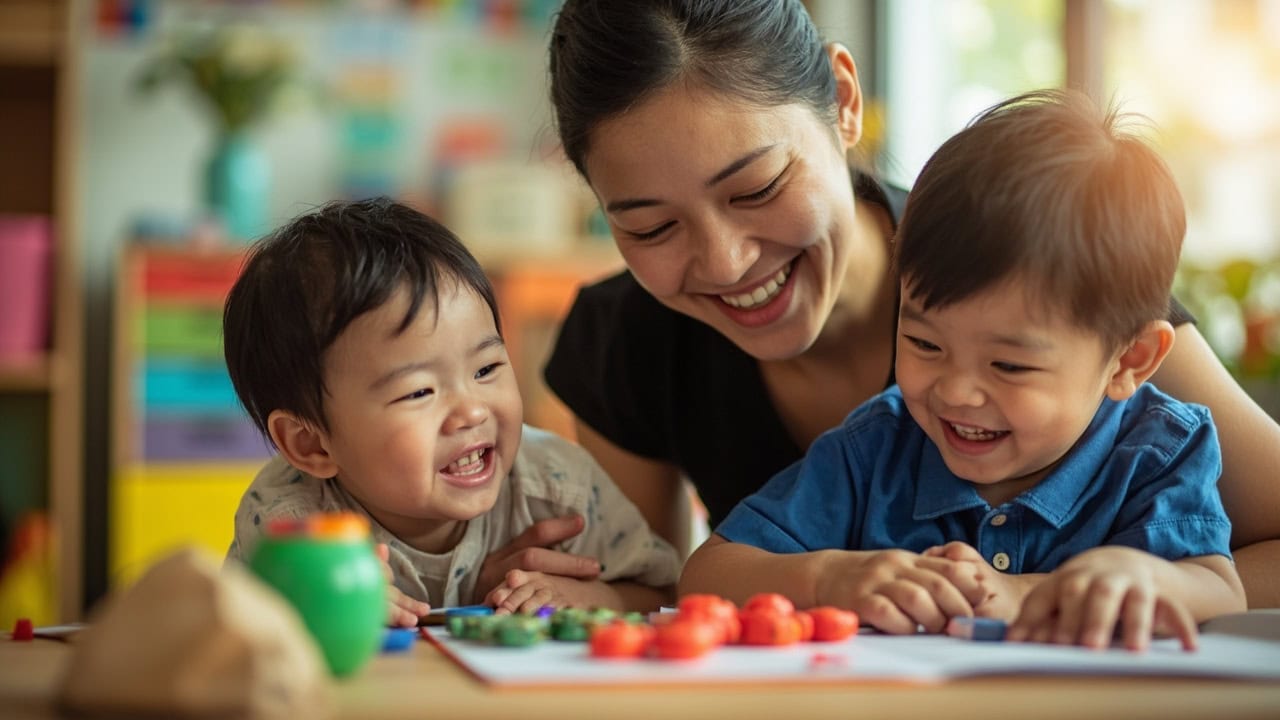
Within minutes — sometimes three, sometimes ten — the child’s nervous system registers safety. The caregiver is familiar. The space is consistent. The routine is predictable. And the morning begins.
This is what EduNanny calls holding the moment. It is not just a phrase. It is a commitment to treating the transition window as sacred — because for parents, it is.
Your Side of the Door: Emotional Regulation for Parents
We talk so much about helping children manage the goodbye, and we forget that parents need to manage it too. Your nervous system is intertwined with your child’s. When you are calm, you send calm signals. When you are anxious, you send anxiety signals.
This is not metaphor. It is psychophysiology. Your child reads your face, your voice, your posture, the way your hand lingers before letting go. If you are suppressing panic, they know. If you are dreading the handoff, they feel it.
This does not mean you must be stoic or false. It means that your own emotional preparation matters — that the quality of your goodbye is shaped by how you have prepared yourself before you even arrived.
The Link Between Your Peace and Your Child’s Peace
The parent’s peace at the door and the child’s peace inside the room are not separate experiences. They are one experience, reflected through two people.
When you trust the door, your child feels that trust. When you feel held by the caregiver, that holding passes to your child. The childcare provider who gives you clear information about the morning routine, who tells you what to expect, who sends you a photo within the first fifteen minutes and a note at lunch — that provider is not just caring for your child. They are caring for you. They are giving you the reassurance you need to walk away with your head up.
A Simple Practice for Harder Mornings
The next time you stand at that door and your child’s face crumples and you feel your own composure threatening to crack, try this: before you hand them over, take one slow breath. Look at the caregiver. Make eye contact. See if you can find, in that moment, something you can trust.
And if you can — if the caregiver is warm, if the room is calm, if the routine is already beginning to unfold — then give yourself permission to let go.
Not because it is easy. Because it is hard, and you are doing it anyway. And that is what trust looks like. Trust is not the absence of fear. Trust is the willingness to act in the face of fear because you have good reason to believe that what you are leaving your child with is worthy of them.
What Quality Care Looks Like at Drop-Off and Beyond
Not every childcare arrangement handles the morning transition well. Some meet your child with warmth. Others meet your child with a checklist. The difference matters — not just for your peace of mind, but for your child’s ability to settle.
At the Door
- Does the caregiver greet your child by name every single morning, before they greet you? This signals that the relationship is with your child, not with you. The caregiver is your child’s person.
- Does the caregiver receive your child with physical warmth? A gentle hand on the shoulder, a scooping up of a toddler who is reaching — or do they wait passively for the child to come to them? For infants and toddlers, the difference is enormous.
- Is there an immediate comfort routine? A specific station, activity, or song that begins the moment you step through the door — a deliberate bridge from your world into theirs.
After You Leave
- Does the caregiver communicate with you? A message, a photo, a voice note — not as a luxury, but as a standard. Communication is the infrastructure of trust.
- Do you receive updates throughout the day? Not just at drop-off, but at lunch and beyond. Consistent communication is how you know your child is not just being managed, but being noticed.
The Deeper Question
When you walk away from the door, do you feel like your child is in good hands? Not perfect hands. Not hands that will never let your child cry or get frustrated or have a hard day. Good hands. Hands that are attentive, warm, trained, and present.
If the answer is yes, even through the ache, then the goodbye is doing what it is supposed to do. It is not a failure of the system. It is the system working.
The Child Who Walks In Without a Backward Glance
Sometimes, parents feel relief when their child does not cry at drop-off. The child walks in, waves, and moves on. No drama. No tears.
This can feel like success. But it is not necessarily a sign of security. Sometimes it is a sign of learned helplessness. Sometimes it is a sign of emotional shutdown.
A healthy, securely attached child in a high-quality setting will typically show some protest. They are wired to. What matters is what happens after the protest — whether there is a caregiver there to catch them, to hold them, to help them find their footing in the new environment.
The child who screams and then settles is not a child who has been damaged by your choice to work. They are a child who has been deeply loved, and who knows, with exquisite sensitivity, when the most important person in their world is about to leave the room.
How EduNanny Singapore Approaches the Morning Goodbye
At EduNanny by BUTLER, the drop-off protocol is built around a single conviction: the morning transition is not an interruption to the care. It is part of the care. And how it is held determines everything that follows.
EduNanny operates within the ECDA Childminding Pilot, which means the programme is not improvised or approximate. It is structured, monitored, and grounded in a framework that prioritizes your child’s development and your family’s peace of mind.
Across home-based, community, and centre-based pathways, every EduNanny caregiver is trained in the same core principle: meet the child at the door with presence. Bridge the transition. Stay with the distress. Name what is happening. Offer predictability. And communicate — so that the parent walking to their car knows their child has landed somewhere safe.
What This Means for Your Infant
For infants, EduNanny maintains ratios of up to one caregiver to three children. What that means in practical terms:
- Your infant will not be one of twelve.
- When your baby signals hunger or fatigue or discomfort, there is a caregiver whose attention is undivided enough to notice and respond.
- The crying you dread so much in the morning will not go unanswered.
- The floor of care is high by design, not by luck.
Reliability, Consistency, and Accessibility
EduNanny care blocks run Monday through Friday, because we know the rhythm of working parenthood in Singapore. We know that the morning commute does not bend around your childcare schedule. We know that you need reliable, predictable coverage, week in and week out, not just on the days when it is convenient.
The ECDA Childminding Pilot has been structured with fee frameworks that aim to make quality childminding accessible to families across income levels. Where applicable, your Child Development Account and Baby Bonus funds can be used, so you are not forced to choose between the care you want and the care you can afford.
This is not a side note. It is a core commitment. Every parent deserves access to care that meets their child at the door with the same seriousness they would bring to any other critical stage of development.
A Resource Built for the 2am Anxieties
There is a tool called Thomas — an AI-powered chat resource designed to answer your questions about development, milestones, what is normal, what to watch for, and the small anxieties that arise at two in the morning when you cannot sleep because you are wondering if your child had a good day.
Thomas does not replace the caregiver. It supplements the conversation. It gives you a reliable first point of information when you are not sure whether to worry, and it points you toward the human support you need when your question is bigger than any chatbot can answer.
I mention Thomas because it reflects a broader philosophy at EduNanny: that parents should never feel isolated in their decision-making. The morning goodbye is hard enough without the additional weight of uncertainty. We want to reduce that weight, not add to it.
Questions Parents Ask — and Straightforward Answers
If you are still sitting with questions after reading this, you are not alone. Here are the ones EduNanny hears most often, answered directly.
My toddler screams every morning. Is this normal?
Yes. Separation anxiety peaks between six months and three years. What matters is not the absence of protest, but what happens after. If your child is screaming at the door but settling within ten to fifteen minutes with a warm, attentive caregiver, that is a healthy trajectory. If the distress continues all morning with no comfort offered, that is a different situation worth investigating.
I feel like I am abandoning my child. Does this mean I am a bad parent?
No. The ache you feel is evidence of your love, not evidence of your failure. Parenting is not about being present for every moment — it is about being present in the moments that matter most, and making choices that support your family’s wellbeing in the long term. Working parents are not abandoning their children. They are building the lives their children will grow up in.
What if my child never adjusts?
Most children adjust within two to four weeks of consistent, quality care. If your child continues to show extreme distress after a month — not just at drop-off, but throughout the day, in ways that seem to be affecting their overall wellbeing — it is worth speaking directly with the caregiver and, if needed, with a developmental professional. Adjustment takes time, but it should progress. It should not feel static or worsening.
How do I know if the caregiver is actually good, or just good at drop-off?
Ask to see how the caregiver interacts with children throughout the day, not just in the first few minutes. Request a mid-day update — a photo, a note, a description of what your child is doing. Quality caregivers are consistent across the day, not just performative at the door. And trust your instincts: if something feels off, it is worth investigating, not dismissing.
A Practical Framework for Choosing Infant Care in Singapore
If you are currently researching childcare options, here is a framework to guide your evaluation. These are the factors that research and experience tell us matter most:
- Caregiver warmth and attunement: Watch how the caregiver responds to children who are upset, not just children who are happy. The quality of care is visible in the hardest moments.
- Transition protocol: Ask specifically how the morning drop-off is handled. A provider with a clear, intentional approach is a provider who has thought about your child’s emotional experience.
- Communication practices: Ask what you can expect in terms of updates, photos, and notes. This is not a luxury — it is how you stay connected to your child’s day.
- Group size and ratios: For infants, smaller ratios mean more individualized attention. Ask how many children are in the caregiver’s care at any given time.
- Consistency: Will your child have the same caregiver most days, or will they rotate? Consistency of person matters deeply in the first three years.
- Alignment with your values: Does the provider’s approach to discipline, play, and development feel aligned with what you want for your child? This is not about finding a carbon copy of your parenting — it is about finding a partner whose philosophy is compatible with yours.
The Morning Goodbye Is Not the End
You are not failing your child by leaving them. You are not failing yourself by needing to work. You are not failing by feeling the ache of the morning goodbye — that ache is proof that you love your child with your whole heart, and that you trust enough to let them go.
There is a question I want you to carry with you after today. Not as a test, but as a compass:
When I walk away from the door, do I believe my child is in a place that sees them? That knows their name, their preferences, their fears, their joys? That will notice when they are falling apart and be there before they hit the ground?
If the answer is yes — not perfectly, not without hard days, but genuinely yes — then you have found what you are looking for. Not perfection. Not a childcare arrangement where goodbye is painless. But a place that holds the moment every parent dreads most, and holds it with the care it deserves.
That is what EduNanny Singapore stands for. Not as a slogan, not as a marketing promise, but as a daily practice, repeated five days a week, in every setting we operate, with every child and every family who walks through our doors.
We know that the morning goodbye is where trust is made or broken. We know that the child you leave in our care is not just a child in our programme. They are the most important person in your world, and they are in our world now, and we do not take that responsibility lightly.
We are not here to make leaving easy. Leaving is hard, and it should be hard, and we will never pretend otherwise.
We are here to make leaving possible — to give you a door you can walk away from with your heart intact, your child in capable hands, and the knowledge that you made the right choice.
Because you did. You are making it, every single morning. And it matters.
Every parent deserves to walk away from that door feeling like their child is in the right place. We would be honoured to be that place for your family.
If you are researching infant care and childminding options in Singapore, we invite you to connect with us to learn more about how EduNanny by BUTLER approaches the morning goodbye — and every moment after.