The Morning Goodbye Is the First Lesson in Trust
Why the Morning Goodbye Feels So Hard
You feel it before you name it. That tightening in your throat. The way your hand lingers a half-second longer than it needs to. The voice in your head that says, perhaps today I should stay. Perhaps one more day of being home. Perhaps I am not ready either.
You are not being overprotective. You are being a parent.
The bond between a parent and infant in the first thousand days is not sentimental. It is neurological. It is the architecture of the human nervous system being built, one interaction at a time. When you hold your child, when you respond to their cry, when you look into their eyes in the early morning and they look back at you, something profound is happening at the level of brain chemistry.
This is why leaving your child feels so hard. It is not weakness. It is the purest expression of a biological imperative. You are wired to stay close. And when you choose to step away, even into the capable hands of someone you trust, there is a dissonance that cannot be reasoned away. It must be felt.
But here is what the research tells us, and what experience confirms: that dissonance, that anxiety, that morning weight—it is not a sign that childcare is wrong for your family. It is a sign that you are paying attention. It is a sign that your attachment system is intact and working as it should.
The question is not whether you feel it. The question is what happens next.
The Morning Transition: Where Trust Is Built or Broken
What happens next is the part that separates adequate care from something far more meaningful.
In the first few weeks of any new childcare arrangement, the morning goodbye is rarely peaceful. The child may cry. The parent may linger. There may be a moment where you turn back at the car, or at the lift, or at the bus stop, and wonder if you should return.
This is normal. This is expected. This is not a failure of your childcare choice.
But here is what you are looking for, even if you do not yet have the language for it: you are looking for the response.
The Five-Minute Test
When you bring your child to a quality childcare environment in those early weeks, what you are really doing is running a test. Not consciously. Not deliberately. But with every cell in your body, you are watching how the caregiver receives your child.
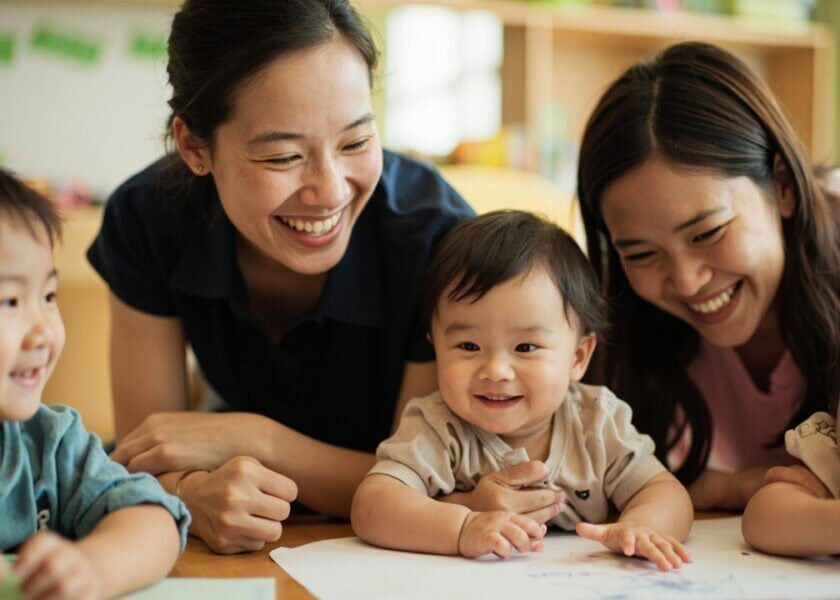
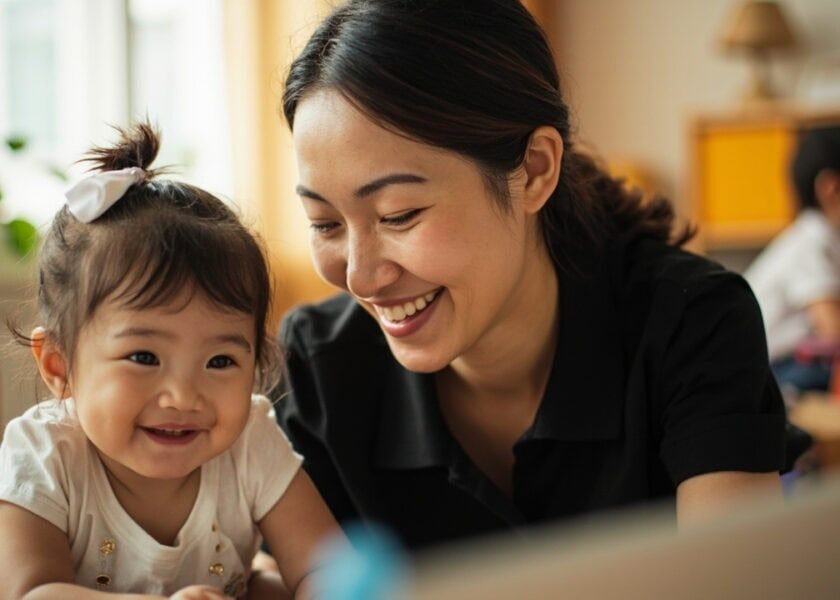
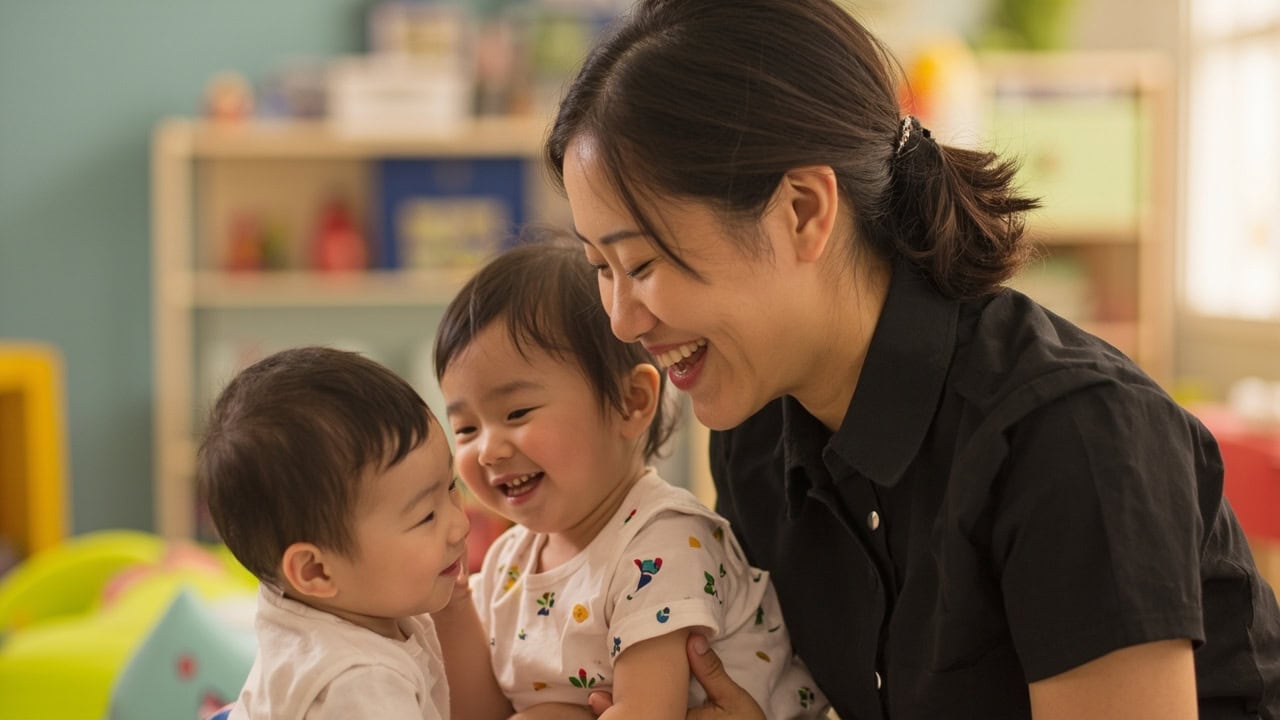
You are watching whether they kneel down to eye level. Whether they speak to your child by name. Whether they offer their hand, or a familiar song, or a transition object from home. Whether they acknowledge you, the parent, with warmth and patience and no trace of impatience at your lingering.
Whether they signal, in those first thirty seconds, that your child’s distress is understood, welcomed even, as part of a process that they know how to navigate.
This is the five-minute test. And it tells you more than any inspection report, any certification frame on the wall, any conversation with the centre director.
Because the morning transition is where trust is either built or broken. It is where a child learns, in real time, whether this new place is safe. Whether these new hands are kind. Whether Mummy or Daddy is coming back.
The caregiver who understands this—who treats the morning greeting not as a logistical necessity but as the first and most important act of the day—is a caregiver who understands child development at its deepest level.
What Attachment Science Tells Us About Morning Goodbyes
Let us speak plainly about what is happening in those little brains, because it matters.
Attachment science—the foundational work of researchers like John Bowlby and Mary Ainsworth, built upon and refined by decades of subsequent study—tells us that secure attachment in the early years is not about the amount of time a child spends with a caregiver. It is about the quality of responsiveness, the consistency of presence, and the reliability of the environment.
A child does not need their biological parent to develop secure attachment. They need a caregiver who is attuned, who is present, who responds to distress with comfort rather than dismissal.
This is the science behind the morning goodbye. When a child experiences a consistent, warm transition at the start of each day—when the caregiver is waiting at the door with genuine warmth, when the handover is unhurried, when the parent is able to leave without sneaking away—the child’s nervous system begins to encode a new belief: this place is safe. These people are trustworthy. I will be okay here.
This encoding takes time. It does not happen on day one. But it does happen. And when it does, something remarkable occurs.
The crying at the door softens. The clinging becomes a brief embrace. The child looks back once, perhaps twice, and then turns toward the caregiver with something like curiosity. With something like trust.
This is not the absence of attachment to you. It is the expansion of attachment. It is your child learning that love is not diminished by distance. That security is not fragile. That the world contains more than one safe place.
The Parent’s Journey: From Doubt to Quiet Confidence
When this happens in your child, something equally remarkable begins to happen in you.
In the first weeks, you may check your phone compulsively. You may reread the morning messages, study the photos, replay the goodbye in your mind. Was she really okay? Did I see worry in her eyes? Should I have stayed?
This is not pathology. This is the adjustment period. And the childcare arrangement that understands this—the one that sends you a morning photo not to prove they are caring for your child, but to close the loop for you, to say we see you too, we know this is hard, here is your evidence—these are the arrangements that earn your trust not through words but through practice.
Over time, something shifts. The goodbye becomes shorter. The hug becomes lighter. You begin to notice that your child is reaching for the caregiver’s hand. That she is looking at the toys with anticipation. That the morning ritual—which began as a source of dread—has become almost routine.
Not in the hollow sense of the word, but in its truest meaning: a practice repeated enough times that it becomes part of the architecture of the day.
And you, the parent, begin to walk to your car or your bus stop or your lift with a different posture. With breath that is fuller. With a thought that surfaces, almost surprising you:
I think this is right.
That thought is not a feeling. It is evidence. It is the accumulated testimony of dozens of morning goodbyes, each one confirming what the last one suggested. Your child is okay. This place is good. You made a decision that was hard, and it was the right one.
What Quality Childminding Looks Like in Singapore
If you are researching infant care in Singapore, here is what to look for—and what questions to ask—during your search.
Warm, Unhurried Morning Transitions
The difference between adequate and premium childcare is not measured in curriculum frameworks or facility square footage. It is measured in those first five minutes.
When you observe a morning handover, notice: does the caregiver kneel down to your child’s level? Do they speak your child’s name with warmth? Do they receive your child’s distress with patience rather than impatience? Do they acknowledge you before turning their full attention to your child?
Consistency of Caregiver
In centre-based settings, turnover can be high. In home-based or childminding arrangements, consistency is often easier to maintain. Ask: will the same caregiver be with my child every day? Will there be a small, known team rather than a rotating cast?
Communication That Closes the Loop
Quality caregivers understand that information is not administrative—it is relational. Ask how they communicate during the day. You should know what your child ate, how they slept, and how they seemed. Morning updates, not just evening reports.
Understanding of Attachment Dynamics
The best childcare providers do not dismiss your anxiety or your child’s tears. They understand that separation is a developmental milestone, not a problem to be solved. Ask how they handle morning transitions. Their answer will tell you everything.
ECDA Childminding Pilot: A New Pathway for Singapore Families
Singapore families now have access to a new model of quality infant care through the ECDA Childminding Pilot. This initiative represents a meaningful shift in how the early childhood landscape serves families with infants and toddlers.
Unlike larger centre-based settings, home-based childminding through the pilot offers something that has been difficult to find in Singapore: small numbers, warm relationships, and consistent caregivers who stay. The pilot makes quality infant care more accessible and more affordable, while maintaining the oversight and community connection of the broader early childhood framework.
EduNanny by BUTLER: Where the Morning Ritual Is the Practice
We founded EduNanny by BUTLER with this understanding at the centre of everything we do.
We know that Singapore parents are not asking for convenience alone. You are asking for something far harder to provide: partnership. Someone who walks alongside you in the first thousand days of your child’s life. Someone who understands that the morning goodbye is not a logistical hurdle to be managed efficiently. It is a sacred threshold, and every family who crosses it deserves to cross it with care.
Our approach begins with ratios that allow for genuine attention. When a caregiver is responsible for one, two, or three infants at most, they can do what no ratio of five or six allows: they can kneel down, they can look your child in the eye, they can receive your child’s distress without hurry, without distraction, and without the quiet frustration that creeps into any human relationship when there are simply too many bodies requiring attention at once.
Monday through Friday. Morning to evening. The rhythm that Singapore working families need, delivered with the attentiveness that your children deserve.
We also know that transparency matters to you. When you leave your child in our care, you want to know what is happening behind that door. Where CCTV measures are deployed, they serve not as surveillance of our caregivers, but as a gift to you. A window. A confirmation. Evidence that your child is in the place you chose, doing the things you hoped, with the people you trust.
Our caregivers communicate. Not in the perfunctory way of checkbox updates, but in the way of genuine partnership. You will know what your child ate. You will know how they slept. You will know if they discovered something new, if they played with another child, if they needed extra comfort.
And we make it easy, where we can, to use the resources Singapore has put in place to support families like yours. Your Child Development Account. Your Baby Bonus. These are not just bureaucratic tools. They are recognitions by the state that the early years matter, and that raising a child is a shared responsibility between families and society. Where we can help you navigate those systems, we will.
Common Questions from Singapore Parents
Is my child’s separation anxiety a sign that childcare isn’t working?
No. Separation anxiety in the early weeks is not a red flag—it is a developmental milestone. What matters is how the caregiver responds to it. Quality care does not promise to eliminate your child’s protests. It promises to meet those protests with warmth, patience, and consistency.
Is home-based care really as good as centre-based care?
Research on attachment and early development consistently shows that the quality of the caregiver relationship matters more than the setting. In a small, warm, consistent childminding environment, infants can develop the same secure attachment they would in a high-quality centre—with the added benefit of smaller ratios and more individualised attention.
What if my child still cries every morning?
Some mornings will still be hard. Your child may have days of protest, days of tears, days when the goodbye catches in your throat. This does not mean the arrangement has failed. It means your child is experiencing normal human emotions. What matters is the pattern over time—and whether, on balance, your child is settling, growing, and beginning to trust the morning ritual.
The Morning Goodbye, Done Well
We believe that the morning goodbye, done well, is one of the greatest gifts you can give your child. Not because it teaches them to be independent—we are suspicious of that word in the early years, when what children need is not independence but security.
But because it teaches them that the world contains trustworthy people. That love is not possessive. That leaving and returning are part of the same rhythm, not opposites but partners in the dance of attachment.
When your child can walk through that door in the morning without fear, something in their nervous system settles. A foundation is laid. Not just for today, but for every threshold they will cross in their lives: the first day of school, the first sleepover, the first heartbreak, the first leap into something unknown. They will carry this with them. The knowledge that goodbye is survivable. That someone will be there on the other side. That the world is, on the whole, a place where people can be trusted.
In the evenings, parents ask: What did my child do today? Did they learn? Were they happy?
These are good questions. We are glad you are asking them.
But the morning question is older than education. It is older than curriculum. It is the question that predates all of our modern structures of care. It is the question every parent has asked at every threshold, in every generation:
Will my child be okay when I am not here?
We do not have the audacity to promise you that every morning will be easy. Some mornings will be hard. Your child will have days of protest, days of tears, days when the goodbye catches in your throat and you wonder if the world is moving too fast.
But we can promise you this: we will be there at the door. We will receive your child the way you would receive them, if you could be in two places at once. We will not rush the goodbye. We will not dismiss your child’s distress, or yours. We will treat every morning transition as the developmental milestone it is—not as a problem to be solved, but as a ritual to be honored.
And over time, what we hope you will find is that the question changes.
It begins as: Is this right?
And it becomes something quieter. Something that lives not in your chest but in your body, in the settled feeling you carry through your workday, in the way you close your eyes at your desk and see your child’s face—not distressed, but curious, reaching for a toy, looking up at a caregiver with something like recognition.
The question becomes: Why did I ever doubt?
If you are reading this and you are standing at the beginning of your search—if you are a parent in Singapore with an infant or a toddler, weighing your options, feeling the weight of that morning door—we want you to know that you are not alone.
We have stood where you are standing. We have asked the questions you are asking. And we have built something that we believe answers them.
Not with promises, but with practice. Not with grand gestures, but with the small, daily, transformative act of meeting your child’s eyes and saying: I am here. I see you. You are safe. And tomorrow, we will do this again.
This is EduNanny by BUTLER. This is what we do in the morning.
And this is why, when you walk away from that door, you will find that you are able to walk away.
Not because it is easy. But because you trust the people you are leaving your child with. And they trust you too.
And together, in that small, daily act of mutual trust, something extraordinary is being built. Not just for your child. For your family. For the village it takes to raise a child in Singapore today.
That village exists. We are part of it.
And we would be honored to stand at the door with you.
Choosing childcare is one of the most personal decisions a family makes. At EduNanny by BUTLER, we understand the weight of that choice—and the importance of finding care that truly feels right. Learn more about our approach or connect with us to begin the conversation.