The Morning Goodbye Every Singapore Parent Needs to Understand
The Morning Signal: How Singapore Parents Read Their Child at Drop-Off
There is a moment every parent in Singapore knows. It happens before the first word is spoken at breakfast, before the bag is packed, before the car seat buckle clicks into place. It happens in the space between deciding to leave and actually walking through the door.
By the time most parents arrive at the childcare gate, they are already carrying something heavier than their child’s small backpack. They are carrying doubt.
What am I missing? Is she ready? Should I have waited another year? Will he remember I left? Is this the right choice?
These questions arrive silently, sometimes fiercely, every single morning. This is the moment that matters most in your child’s childcare journey. Not pickup, when you can breathe again and see what the day made of your child. The morning. The door. The goodbye that happens before anyone else has had their first cup of coffee.
Because here is what thousands of mornings in Singapore have taught us: the morning drop-off is not a small thing. It is not just logistics. It is the hinge on which an entire day can swing.
Why This Hits Singapore Parents Harder
Singapore parents carry particular pressures that make the drop-off moment even more intense. The cost of quality infant care feels significant. The fear of missing your child’s milestones weighs heavily. The cultural expectation that parents—especially mothers—should sacrifice everything creates quiet guilt when you place your child in someone else’s arms.
Add to that the genuine logistical reality: long commutes, tight school schedules, and very little extended family nearby to share the burden. Most parents here do not have the luxury of gradual transitions or flexible arrangements that other countries might offer.
This is why the morning matters so much. For Singapore families, there is rarely a second chance. The morning sets the tone, and the day follows.
What Skilled Caregivers Actually See at Drop-Off
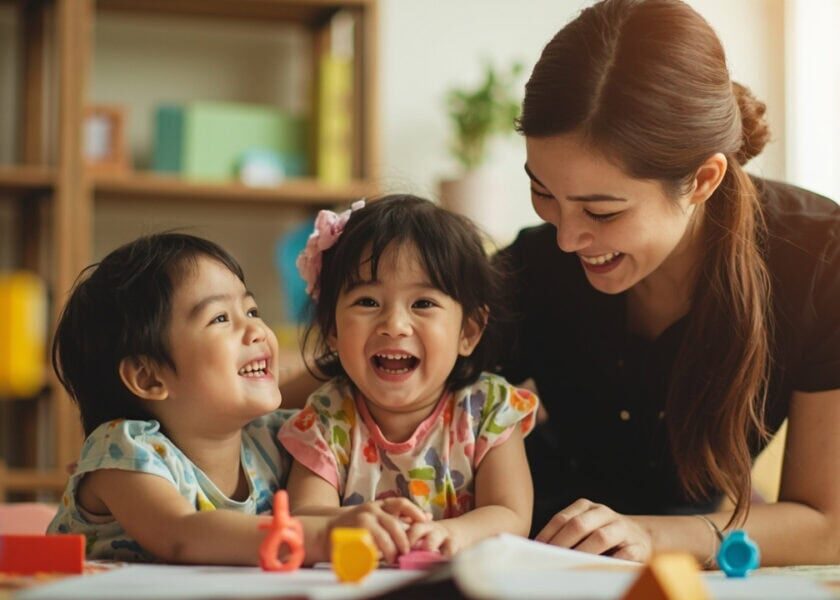
When a trained caregiver receives your child at morning drop-off, she is not just taking over supervision. She is reading a language that most people have never been taught to see.
She notices whether your child’s body is relaxed or clenched. She watches whether eye contact is offered freely or avoided. She observes whether there is curiosity in the glance toward the room or retreat into your shoulder. She sees how your child holds you, because that tells her what the goodbye needs to look like.
She sees the parent too. The hesitation. The false cheerfulness. The quiet desperation to get it right.
The First Minutes Are Diagnostic, Not Incidental
That caregiver is not judging. She is gathering information. Because the first minutes of the morning are not incidental—they are diagnostic. They reveal where your child is emotionally, developmentally, even physically.
Consider these observations:
- A child who clings may be overtired, not necessarily anxious
- A child who walks away quickly may be genuinely confident—or may be avoiding the goodbye entirely
- A child who asks detailed questions about the day ahead may be processing anxiety through information
- A child who is unusually quiet may be overwhelmed, or may simply still be waking up
The signals look similar but mean entirely different things. Reading the difference is not instinct. It is trained observation. And it is the foundation of everything that follows.
“Reading the difference is not instinct. It is trained observation. And it is the foundation of everything that follows.”
How EduNanny Approaches the Morning Transition
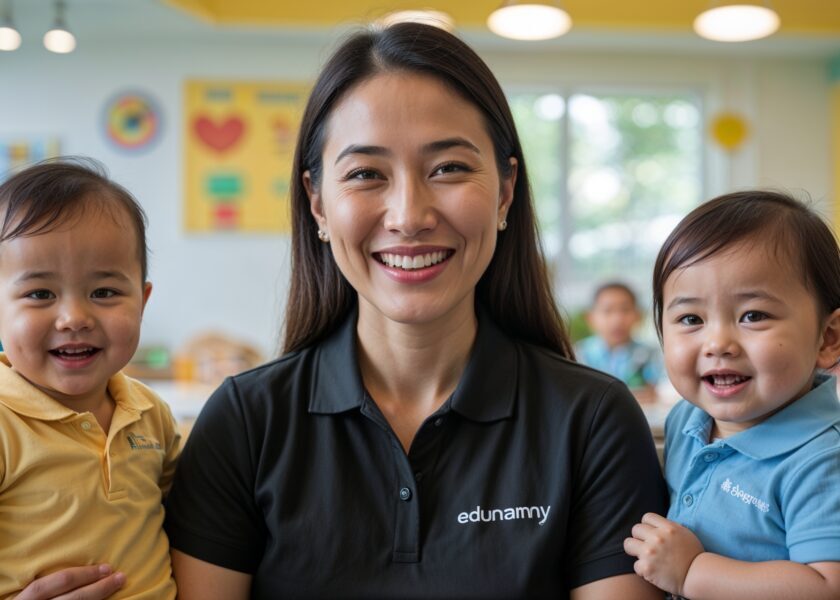
At EduNanny, this is how we begin every single day. Not because it is a nice idea, but because we have seen what happens when mornings are handled well—and what happens when they are not.
Our caregivers notice the quality of your child’s walk. The pitch of their voice. Whether they go toward a familiar toy or hang back near the door. These are not guesses. These are observations that shape how we engage with your child in the next hour, and how we communicate with you at the end of the day.
We know that the way you say goodbye, the way you handle your own anxiety in that moment, directly affects how quickly and how well your child settles. This is not blame. It is biology. Children read their parents like text. If you are tense, they wonder why. If you are hurried, they feel the rush. If you are calm—genuinely calm—they borrow that calm like a warm coat and step forward into their day.
By the time you pick them up in the afternoon, they will show you something different than they showed you at dawn. They will show you that they were okay. That they learned something. That they were held.
Three Things You Can Do Tomorrow Morning
Parents deserve more than knowing what happens behind our doors. You deserve to know what you can do before you even get in the car. Here are three things grounded in what we have seen work across thousands of drop-offs.
1. Name the Feeling Before You Leave the House
Children do not always have language for anxiety, but they can feel it in your body and hear it in your voice. Before you leave, sit down for thirty seconds and say out loud, calmly, to yourself or to your child:
“Today is a good day for her. She is ready. I am sure.”
You do not have to believe it fully. Say it anyway. The nervous system responds to repeated reassurance the same way it responds to repeated worry. You are training a pattern.
2. Keep the Goodbye Short
This one is hard. Every instinct says to linger, to explain, to promise you will be back. But children experience lingering as uncertainty.
A quick, warm, confident handoff tells your child: this is routine, this is safe, this is expected. You are not abandoning her. You are showing her that separation is survivable, even pleasant, because you are not afraid of it.
3. Resist the Second-Guessing Afterward
The moment you drive away, your brain will start its loop. Was that right? Did she cry? Is she okay?
These thoughts are normal. But they are not information. They are anxiety. Do not let them drive you back to the door—not because it will harm your child, but because it teaches your child that your departure is a crisis, not a rhythm.
Trust the caregiver you have chosen. Text if you need to. But drive away.
What Singapore Parents Actually Worry About
It is not weakness to feel uncertain at drop-off. It is not failure to have ambivalence about returning your child to care. It is the mark of a parent who cares deeply about getting this right.
The parents who feel nothing at drop-off are not better parents. They are simply parents who have found a way to protect themselves from the intensity of this moment.
What You Feel Is Love. What You Doubt Is Whether Love Is Enough.
The answer is no, and that is okay.
Love is not enough. Love needs help. It needs a partner who can receive your child with the same attention you give at home. It needs a system that does not leave you guessing by 6pm what happened between 8am and 4pm. It needs people who are trained to read what your child cannot say, and who will tell you the truth.
Is Your Child in the Right Place?
Every parent asks this. Here is what we have observed: children who are settled into quality care with consistent, attentive caregivers do not just survive the morning transition—they grow through it. They learn to trust new people, to navigate social situations, to develop independence in small, supported doses.
The children who struggle are not necessarily those who cry at drop-off. They are those whose cries go unnoticed, whose distress signals are missed, whose caregivers are too overwhelmed by ratios to offer individual comfort.
What to Look For
We cannot answer the “right choice” question for you. But we can tell you what matters most:
- Caregiver-to-child ratios: Lower ratios mean more individual attention and observation
- Communication practices: Regular updates reduce parental anxiety and build trust
- Morning transition approach: Intentional handoffs signal quality throughout the day
- Consistency of caregivers: Your child needs familiar faces, not a rotating cast
What Quality Childminding Looks Like
EduNanny operates under the ECDA Childminding Pilot, which means we are part of a national effort to give Singapore families access to quality, affordable, home-based and community-based childcare that actually works for how modern families live.
What This Means for Your Family
- Caregiver ratios designed around attention: Your child should not be one of ten or fifteen in a room. We maintain ratios of up to one to three for infants, because that ratio is not a luxury. It is the difference between observation and supervision. Between noticing and missing.
- Affordable access: Your Child Development Account and Baby Bonus can be used, which means the financial conversation does not have to be a barrier to the quality your child deserves.
- Predictable care blocks: We offer Monday to Friday care blocks because working parents need predictability, not a menu of options that creates new decisions every week.
- Transparency where it matters: Communication practices and CCTV measures where deployed mean you can see, when you need to, exactly what your child is experiencing in our care. Not because we have anything to hide. Because parents deserve to feel certain, not just hopeful.
What Parents Tell Us After the First Month
They do not say that their child never cried. Children cry. That is not failure. That is childhood.
What parents say is that they finally understood what was happening. They stopped guessing. They stopped imagining worst-case scenarios at 10am. They started receiving messages, photographs, small updates that painted a picture of a child who was not just safe but engaged, curious, and genuinely held.
“I used to spend my whole morning at work wondering if my daughter was okay. Now I get a photo and a note, and I can focus. That peace of mind is worth everything.”
That is the difference between childcare that simply occupies a child and childcare that invests in a child.
The Door, and What Comes After
Let me take you back to the door. Not just any door, but the specific door you walk through every morning. The one with the caregiver who holds out her arms. The one where your child looks up at you one last time. The one where you have to choose to let go.
Here is what I want you to know with complete clarity: that moment is not an ending. It is a beginning. Every morning, your child is beginning something. A day of discovery, of social learning, of small triumphs and manageable frustrations that will slowly build the person they are becoming.
And every morning, you are making the decision to let that beginning happen. Not because you do not love them. Because you do.
The Families Who Thrive
They are not the ones who feel no doubt. They are the ones who learn to hold the doubt and still move forward. Who learn that trust is not a feeling but a practice, built one morning at a time.
Who learn that the caregiver at the door is not a replacement for them. She is an extension of them. A trusted colleague in the most important work of your life.
The Morning Sets the Tone
There is something we believe at EduNanny that shapes everything we do: the morning sets the tone for the day, and the day sets the tone for the week, and the week sets the tone for the year, and the year sets the tone for the kind of person your child will become.
None of us can control every variable in a child’s life. But we can be extraordinary in the moments we are given. And in infant care, the moments are small but they are constant. They are the ones that add up.
So when your child walks through our door tomorrow morning, we will be ready. We will see them. We will see you. We will do our part so that by the time you pick them up in the afternoon, you will not have spent the day wondering.
You will have spent the day trusting.
And trusting, for a parent, is not weakness. It is the bravest thing you can do.
Begin Your Partnership with EduNanny
EduNanny offers more than childcare. We offer partnership. From the first goodbye to the last hello of the day. From door to door. And every door in between.
If you are exploring infant care or childminding options in Singapore and want to understand how we approach the morning transition—how we see your child, how we support you, and how we build trust from the very first moment—we welcome the conversation.
Speak with EduNanny about your child’s care
Your child’s next good morning starts here.