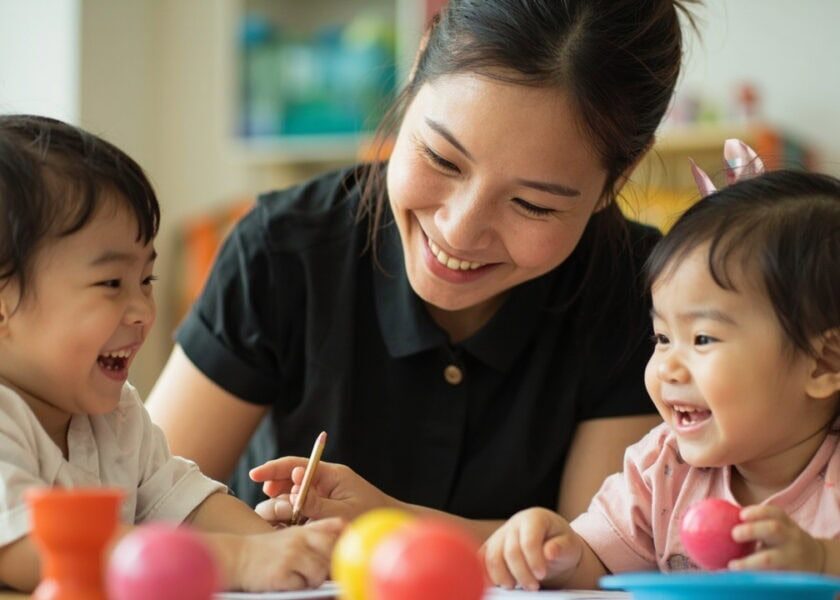
The Moment Your Child Stops Bracing and Starts Belonging
When My Child Is Away From Me, Do They Feel Held?
We do not ask this question enough because it is difficult to answer. We talk instead about ratios and routines, about drop-off rituals and caregiver qualifications, because those are things we can check, measure, compare. But the real question is deeper, and it belongs not to the parent standing at the gate but to the child standing somewhere beyond it, in a room full of sounds and faces and sensations they have never encountered before.
What your child needs in quality care is not complicated in theory but is profound in practice:
- Safety that is felt: Your child senses safety through consistent warmth, calm voices, and predictable rhythms—not through certificates on walls.
- Belonging that begins before language: Being genuinely seen and noticed by caregivers builds a sense of place your child cannot yet name.
- Trust that grows quietly: Over weeks and months, your child accumulates sensations of comfort. They feel safe before they understand why.
- Security that strengthens your bond: When your child feels held outside your presence, they return home more curious, more open, more ready for you.
So let us look at what is actually happening in your child’s interior world during those early weeks of quality care—because what happens there is not random. It is the beginning of something your child will carry for the rest of their life.
The First Language of Care: What Your Child Actually Experiences
When a child enters a new environment, they do not walk in with a checklist or a set of expectations. They walk in with their senses. They notice the temperature of the room, the quality of light, the way certain voices move through the space.
They notice whether the adults around them are calm or hurried, present or distracted. They notice whether the children nearby are noisy in a way that frightens them or in a way that intrigues them. All of this arrives before a single word is spoken, before any activity begins.
This is the first language of a child’s experience in care: sensory, emotional, pre-verbal. And it is the foundation on which everything else is built.
The Question Their Nervous System Asks
In those first days, your child is not learning colours or numbers or social skills in any formal sense. They are doing something far more fundamental. They are asking a question that their entire nervous system is wired to answer:
Is it safe here?
Safety, for a young child, is not an abstract concept. It is not a policy on a wall or a certificate in a hallway. For your child, safety is a felt experience:
- The warmth of an adult who does not hover but notices
- A voice that comes when they cry, not in panic but in steady reassurance
- A hand that wipes their face without rushing them
- A rhythm of the day that begins to feel predictable
So that somewhere in the second or third week, your child stops bracing for the unknown and begins to expect the familiar.
Belonging Before Language
There is a difference between being watched and being seen, and children feel it even when they cannot name it. Being seen means:
- When a caregiver picks up a child, they do so with attention rather than routine
- When a child points at something, the caregiver looks where they are pointing and reacts to what they see
- The small communications a child makes before they have words are received not as noise but as meaning that matters
In a setting where this happens consistently, something remarkable begins to occur. Somewhere between the third week and the third month, the child stops experiencing the care environment as a place they are visiting and begins to experience it as a place that is partly theirs. They recognize a specific chair. They know which toy lives on which shelf. They have a face they look for when they enter the room.
They have, without ever being taught to name it, a sense of place.
What Quality Childminding Actually Looks Like
For parents in Singapore navigating infant care options, understanding what separates adequate care from genuinely excellent care can feel overwhelming. The differences are not always visible in brochures or inspection reports. They live in the quality of human attention your child receives.
Indicators of Genuinely Attentive Care
- Consistency of caregiver: Your child has a primary caregiver who is present most days, not a rotating cast of unfamiliar faces.
- Responsive interaction: Caregivers notice what your child is attending to and react to it—not just managing behaviour but engaging with interest.
- Predictable rhythm: The day has a structure your child can begin to anticipate—regular mealtimes, nap times, outdoor moments.
- Sensory warmth: The environment feels comfortable—appropriate lighting, manageable noise levels, space for movement.
- Genuine communication: You receive meaningful updates that tell you about your child’s experience, not just what they ate or slept.
Why Small Ratios Matter
In infant care, group size directly affects the quality of attention each child receives. When caregiver-to-child ratios are kept small, every interaction becomes an opportunity for your child to be seen, noticed, and responded to as an individual—not managed as part of a group.
This is not a detail. It is the architecture of belonging.
What Singapore Parents Often Wonder
“How do I know what my child feels when I can’t see?”
You cannot see through the walls, but you can look for signs:
- The way your child separates at drop-off—does distress ease within minutes, or does it intensify?
- The quality of your child’s engagement when they return—are they depleted or energised?
- The language they use about their day—do they mention people, routines, favourite moments?
- The physical signs of stress or ease in their body—relaxed shoulders, open curiosity, or tension and guardedness?
These are the windows into your child’s felt experience. Trust them, and ask your care provider about them.
“What if my child doesn’t bond with the caregiver?”
Bonding takes time, and every child moves at their own pace. Some children warm quickly; others need longer. What matters is that you see a trajectory—not stagnation. If your child seems to be moving toward comfort rather than away from it, that is the direction you want. A caregiver who remains the same gives your child the repeated exposure they need to build familiarity and, eventually, trust.
“Is home-based childminding as good as centre-based?”
Both can be excellent. The question is not the setting but the quality of attention within it. Home-based childminding offers specific advantages: smaller groups, consistent caregivers, a domestic environment that can feel more immediately comfortable for young children, and individualised rhythms.
What matters is finding the arrangement where your particular child can be genuinely known—not managed, not just supervised, but known.
The Transformation That Happens for You Too
Here is what many parents discover: when your child develops a genuine sense of security in their care environment, it does not take anything away from your bond with them. It adds to it.
There is a certain kind of guilt that whispers that perhaps you are being replaced, or that your child needs you less. What quality care tells us is the opposite. When your child feels safe outside your presence, they are not withdrawing from you. They are expanding. They are taking the security you have given them and using it as a base from which to explore, to connect, to grow.
And for you as a parent, there is a quiet transformation that happens too. When you begin to see your child return from care more confident, more playful, more at ease in the world, the anxiety that lived at the gate begins to soften. You start to notice they point at the door with excitement rather than hesitation. They have songs they learned that week. They mention friends by name. You begin to trust not just the place but the process.
How EduNanny Approaches This Work
All of this—the sensory safety, the quiet trust-building, the belonging that grows before language—requires something specific. It requires caregivers who are not just trained but attuned. It requires environments that are not just safe but warm. It requires ratios that allow for individual attention, and systems that support the kind of consistency and communication that lets parents stay connected to what their child is experiencing even when they are not in the room.
EduNanny operates within the ECDA Childminding Pilot, which means the service was designed with intention. It offers home-based childminding as a primary pathway—giving your child consistent, familiar care in familiar surroundings, or within a carefully structured community setting that maintains the intimacy young children need.
What This Means for Your Family
| Feature | What It Provides |
|---|---|
| Home-based childminding | Your child in familiar surroundings with consistent, known caregivers |
| Small infant care ratios | Every child is known rather than just managed |
| ECDA Childminding Pilot | A structured, intentional approach to quality care |
| CDA and Baby Bonus subsidies | Quality care made financially accessible |
| Monday–Friday structured blocks | Regularity for parents and predictability for children |
Practical Guidance for Choosing Infant Care in Singapore
- Visit more than once. First impressions can be polished. Return for an unannounced short visit to see what routine looks like when no one is preparing for you.
- Ask about consistency. Who will be the primary caregiver? How often does that change? What is the turnover rate?
- Watch the interactions. When a child approaches a caregiver, does the caregiver engage? When a child cries, how quickly and how calmly does someone respond?
- Notice the environment. Is it sensory-friendly—appropriate lighting, manageable noise, space to move and explore?
- Ask how they communicate. What will you know about your child’s day, and how will you know it? Meaningful updates matter more than scheduled ones.
- Trust your child’s response. After visits, pay attention to how your child reacts. Do they seem curious or withdrawn? Eased or tense?
- Give it time. The felt sense of belonging takes weeks to develop. Initial resistance does not mean the arrangement is wrong. Look for gradual movement toward comfort.
The Moment Everything Becomes Visible
There is a moment that every parent hopes for and few know how to name. It usually arrives somewhere around the third or fourth month of consistent quality care.
Your child wakes up, or walks into a room, or greets a caregiver, and there is something in their face that was not there before. It is not excitement exactly, though it may include that. It is something quieter and more profound.
It is ease.
It is the sense that your child has found a second place in the world where they feel at home. And in that moment, you realise that the invisible work that has been happening all along—the building of trust, the settling of nerves, the growing sense of belonging—has become visible after all.
You can see it in the way your child walks a little taller. You can hear it in the way they talk about their day. You can feel it in the way they separate from you at the gate not with distress but with confidence, turning back to wave, turning forward to go.
What Your Child Has Learned
Because what it means is that your child has learned something that many adults spend their whole lives trying to learn:
- How to feel safe in the world beyond the people they love most
- How to belong before they have to prove anything
- How to trust the process of being known by someone new
That lesson, learned so early and so deeply, will stay with your child as they grow, shaping the way they approach every new school, every new friendship, every new chapter of their life.
You gave them this. You were the one who stood at the gate, uncertain, and walked away anyway. You trusted the process, and the process worked.
Begin the Conversation
Finding the right care for your child is one of the most important decisions your family will make. It deserves more than a checklist—it deserves a conversation. If you are ready to explore what thoughtful, development-oriented childminding could look like for your family, we would welcome the opportunity to speak with you.
Learn more about who we are, or reach out to begin a dialogue about what your child needs and how we might meet them there.
#ChildmindingSingapore #InfantCareSingapore #HomeBasedChildcare #QualityChildcare