The Mealtime Table Is Your Child’s First Real Classroom
What Your Child Is Really Doing at the Mealtime Table
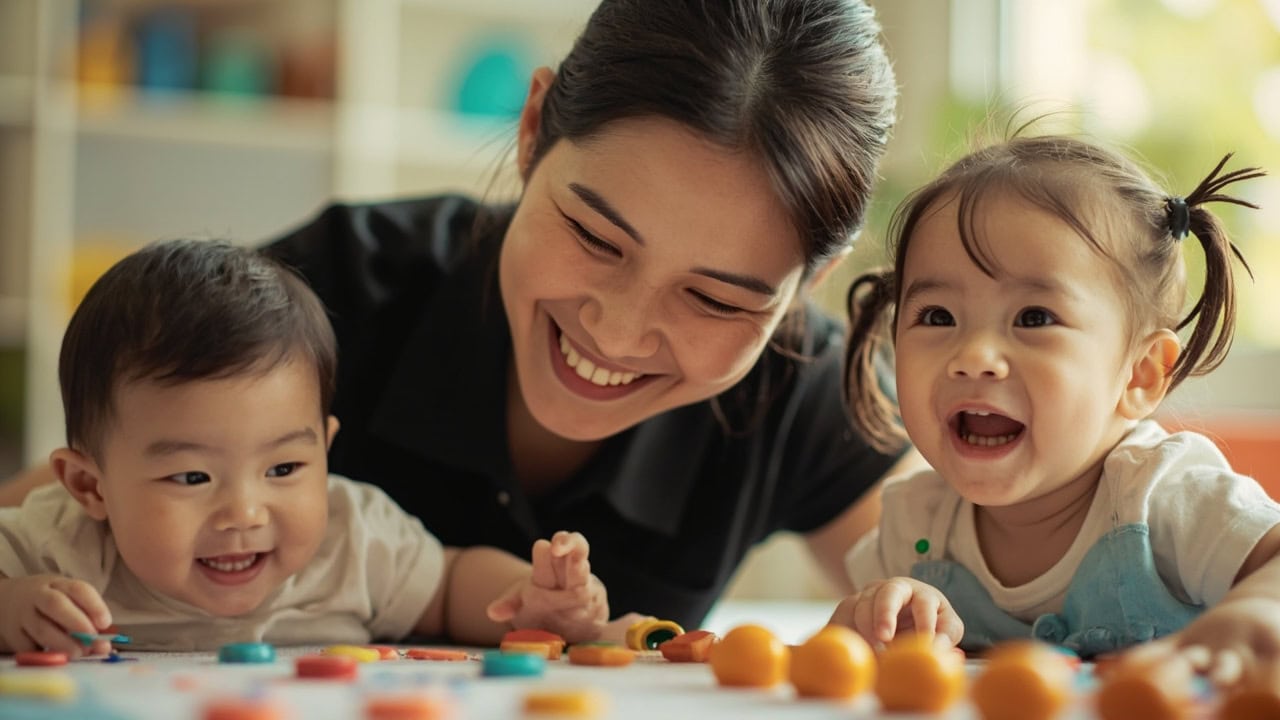
Your child sits at a child-sized table—perhaps in a high chair still, perhaps already in a booster seat. There is a tray, a bowl, a spoon that is not quite the right size for their small hand. Around them are other children, each with their own rhythms, each with their own relationship with what is in front of them. The caregiver moves between them. Not hurrying. Not rushing. Simply present.
What happens in that room—in that ordinary, messy, beautiful gathering around food—is far more than feeding. When we think about what children learn in childcare, our minds often jump to milestones: words spoken, shapes sorted, hands guided toward puzzles. But the most profound learning often happens in the spaces we don’t think to look. The mealtime is one of those spaces.
Consider what a child is actually doing when they sit down to eat in a quality childcare environment:
- Self-regulation—that quiet, difficult work of managing hunger and patience, of waiting their turn, of recognizing when they are full.
- Social skills—through the simple act of eating alongside others, of watching a peer try a new food and deciding, perhaps, to try it too.
- Food curiosity—children are not born with opinions about vegetables. They are born curious, open, ready to explore. A quality mealtime environment nurtures that curiosity rather than extinguishing it.
- Independence—the small, triumphant act of holding their own spoon, of choosing what to eat first, of feeling competent in their own body.
- Sensory integration—that fundamental task of early childhood, through textures and temperatures, through the messy, wonderful work of hands learning about food.
This is what happens at a great mealtime. Not merely eating. Learning. Growing. Becoming.
Institutional Feeding vs. Developmental Mealtime Care
Here is an important distinction worth understanding. There is a difference—significant and consequential—between institutional feeding and developmental mealtime care.
Institutional feeding is exactly what it sounds like. Children receive food at scheduled intervals. They eat. They are refilled. They are moved along. It is efficient. It is logistical. It is, in a narrow sense, adequate.
Developmental mealtime care is something else entirely. It recognizes that each child comes to the table with their own history, their own temperament, their own current relationship with food. One child might be navigating a neophobic phase—that developmentally normal stage where new foods feel threatening—and needs gentle, patient exposure without pressure. Another child might be learning to manage portion sizes, to recognize their own fullness. Another might be transitioning from purées to solids, encountering textures that require new oral-motor skills.
In a quality childcare setting, the caregiver knows these individual stories. They have observed. They have documented. They have communicated with families. They understand that pushing a resistant child will backfire, that rushing a tentative child will backfire. What is needed is adaptation, patience, and a willingness to meet each child exactly where they are.
This is the difference between a cafeteria and a classroom. Both feed children. Only one teaches them how to feed themselves.
What Quality Mealtime Care Looks Like in Practice
When a trained caregiver enters a mealtime, they enter it with intention. They are not simply serving food. They are managing an environment.
For a neophobic child, they might offer a new food alongside familiar favorites, without comment, without pressure—simply present on the plate. They understand that repeated exposure in a safe context gradually builds acceptance. For a child learning textures, they provide appropriate finger foods, opportunities for messy exploration, the chance to touch and taste and learn through sensory experience. For a child who is developing portion awareness, they offer small servings and allow the child to ask for more, building the skill of internal regulation rather than external control.
The caregiver also manages the social environment of the table. They facilitate modeling between children—the gentle peer influence that is one of the most powerful drivers of food acceptance in early childhood. They manage dynamics, support struggling children, and create a climate where eating is a positive experience rather than a battlefield.
None of this happens by accident. It requires training, observation, and a philosophy that sees mealtimes as developmental moments rather than logistical necessities.
Signs of Positive Mealtime Development at Home
Here is the practical question every parent asks: How do I know if this is actually happening? What can you observe at home that tells you your child’s mealtime experience at childcare is positive?
Food Curiosity
Children who experience positive mealtime environments become curious about food generally—not just at childcare but at home. They might reach for vegetables before carbohydrates. They might show interest in foods you hadn’t offered before. They might verbalize preferences with increasing sophistication.
Flexibility
Children who have been exposed to diverse foods in non-pressured settings become more flexible eaters. They are willing to try new things—not always and not instantly, but with less resistance than children in more restrictive feeding environments. The fear response diminishes. The curiosity remains.
Independence
Can your child manage their spoon or fork with increasing competence? Do they attempt to serve themselves when given the opportunity? Do they express preferences and make choices about what to eat? These are signs of a child who has been allowed to develop autonomy in feeding.
Self-Regulation
Can your child recognize and communicate when they are full? Do they stop eating when satisfied rather than when the plate is empty? This is a sophisticated skill that develops through exposure to responsive feeding environments, and it protects children from a lifetime of eating without internal guidance.
Emotional Association
Does your child speak about food and mealtimes positively? Are they calm and interested at the table, or anxious and resistant? The emotional relationship children develop with food is a direct reflection of how mealtimes have been handled.
Progression Over Time
Quality mealtime care produces visible change in children—not dramatic transformation, but a gradual, consistent evolution in food relationship over weeks and months. If your child is becoming more curious, more flexible, more independent, more positive about eating, that is meaningful data about what is happening in their childcare environment.
Mealtimes as a Window Into Your Child’s Broader Development
Mealtimes are not isolated developmental moments. They are connected to your child’s growth in ways that extend far beyond nutrition.
Motor skills. A child learning to use utensils, manage liquids, and navigate the physical challenges of eating is simultaneously developing fine motor control, hand-eye coordination, and body awareness. These are the same skills required for writing, drawing, dressing, and countless other tasks. The mealtime table is a gymnasium for the hands and mouth.
Self-regulation. That skill sits at the foundation of school readiness. Children who learn to manage impulses at the mealtime table—who learn to wait, to share, to tolerate the frustration of wanting something someone else has—carry those skills into the classroom. They can attend. They can persist. They can regulate their emotions because they have practiced doing so in a supportive environment.
Social development. The mealtime table is where children first practice the social rituals of civilized life. They learn turn-taking, conversation, the unwritten rules of eating together. They develop the capacity to be part of a group while maintaining their individual identity and needs.
Physical development. Appetite regulation, the relationship between food and energy, the rhythms of hunger and satisfaction—these are learned behaviors that shape physical health for years to come. Children who learn to eat in response to internal cues rather than external pressure develop healthier relationships with food that protect them throughout their lives.
This is what I mean when I say that mealtimes reveal the developmental philosophy of a childcare setting. A setting that treats mealtimes as logistical necessities, that prioritizes efficiency over observation, will show that same pattern across other developmental moments. Mealtimes are a lens. Look through them carefully.
The EduNanny Approach: Mealtimes as Learning Opportunities
EduNanny operates within the ECDA Childminding Pilot, a framework that reflects something important: a recognition that quality childminding requires structure, training, and accountability. The pilot structure means caregivers are trained, supported, and held to standards designed for excellence rather than mere compliance. It means that when you choose EduNanny, you are choosing an arrangement that has been examined, validated, and structured around the developmental needs of children.
This matters because childminding is not simply babysitting. It is a professional practice rooted in child development science, and the ECDA Childminding Pilot acknowledges that by creating pathways that require and support quality.
Within this framework, EduNanny maintains ratios that prioritize individual attention. With up to one-to-three infant ratios in home-based care, your child’s caregiver is not divided among too many children. They can observe, individualize, and respond. They can notice the subtle signs—the food curiosity, the emotional regulation, the motor development. They have the capacity to be truly present.
EduNanny also offers both home-based and centre-based pathways, recognizing that families have different needs. Home-based care provides the warmth and individualized attention of a familiar environment. Centre-based care provides community and peer learning. Both are developmentally valuable. Both are available within the EduNanny structure.
For the practical realities of Singapore parenting, EduNanny has been designed with these realities in mind. Monday to Friday care blocks that fit working schedules. CDA and Baby Bonus usability that makes quality care financially accessible within pilot fee structures. Communication and transparency measures, including CCTV where deployed, that support the trust parents need to feel confident in their childcare arrangement.
But what matters most is this: EduNanny’s caregivers are trained to see mealtimes as what they truly are. Not feeding. Learning. Growing. The mealtime is not a pause in the developmental day. It is a core part of it. And that philosophy—that every moment with a child is an opportunity for development—is what shapes everything EduNanny does.
Questions Worth Asking About Any Childcare Setting
If you are evaluating a childcare arrangement and want to understand their approach to mealtimes, here are questions worth asking:
- How do you introduce new foods? What you are listening for is neutrality—the absence of pressure, the presence of patience. If a caregiver talks about forcing children to eat everything on their plate, that is a significant warning sign.
- How do you handle food refusal? The right answer involves observation, not discipline. It involves checking in, adjusting, trying again tomorrow. Refusal is a message, not a problem to be solved through coercion.
- How do you support children at different feeding stages in the same room? This question reveals whether the caregiver individualizes or applies a blanket approach.
- What does a typical mealtime look like in terms of structure and atmosphere? You want to hear about calm, supportive environments where children are learning—not performing, not being managed.
- How do you communicate with families about mealtime development? Regular updates, documented observations, genuine partnership in supporting your child’s food journey. These are signs of intentional, transparent care.
- What training do caregivers receive in child nutrition and feeding development? This question separates those who have thought about this deeply from those who have not.
Ask these questions. Observe the answers. Trust your instincts. The quality of a childcare setting reveals itself in how it handles the ordinary, everyday moments—and there is nothing more ordinary, or more important, than the mealtime.
Nourishing the Whole Child
If you are feeling the weight of this decision, you are not alone. Singapore parents carry genuine, tender questions about what happens during the hours their child is in someone else’s care. And the food questions are some of the most vulnerable ones: Is my child eating enough? Are they developing a healthy relationship with food? Are they learning the skills they need? Is someone really seeing them?
These are not small questions. They are foundational questions. And they deserve more than institutional answers.
The distance between you and your child during those hours can feel vast. But when a child is in a quality childcare environment, when a caregiver is trained and attentive, when mealtimes are treated as the developmental opportunities they truly are, something meaningful happens. Children learn to approach food with curiosity. They develop healthy eating habits. They build self-regulation, social skills, motor development, and independence at a table surrounded by peers and supported by a caregiver who sees them.
The mealtime table is a classroom. Your child’s relationship with food is worth protecting and nurturing. You are right to care about this. You are right to ask your questions, to observe, to seek quality.
When you find a childcare arrangement that gets this right—when you see your child coming home curious about new foods, eating with growing independence, developing a positive emotional relationship with mealtimes—you will know. Because you will see your child growing in confidence, developing skills, and becoming more and more themselves.
That is what quality mealtime care does. It nourishes the whole child. Not just their body, but their curiosity, their capability, their emerging personhood.
If you are exploring childcare options in Singapore and want to understand how EduNanny’s trained caregivers approach mealtime as a developmental moment, we invite you to connect with our team or learn more about our approach.