The Invisible World Your Child Lives When You’re Not There
What Is Your Child Actually Experiencing When You’re Not There?
There is a moment, most mornings, when you hand your child to someone else. It might last three seconds. It might feel like three hours. You watch them disappear through a door, or turn away in someone else’s arms, and for just a breath, the world narrows to a single question: Are they okay?
Not: Is the facility licensed. Not: Is the food nutritious. Not: Are the ratios correct. Those things matter, and you have checked them, and you will keep checking them. But beneath all of that, in the quietest part of your mind, is a question that cannot be answered by a checklist or a tour or a report card. It is simply this: Is my child, in this place where I am not, truly alright?
You are not wrong to ask. You are not anxious or overprotective or insufficiently trusting. You are a parent, and the hours your child spends away from you are, by definition, hours you cannot see. What you are doing, when you carry that question with you through your workday, through your commute, through the moments when your phone stays silent — what you are doing is something profoundly human. You are holding space for a world you cannot enter. And you are doing it because you love your child in a way that makes their absence feel like a presence you must constantly negotiate.
Today, we want to talk about that question. Not as theory. Not as reassurance. But as something more specific and more honest — an exploration of what is actually happening inside your child’s experience during the hours they spend in quality care, and why understanding that invisible world is not just interesting information but the foundation of every decision you will make about who cares for your child.
Here is what developmental science has taught us, and what every experienced caregiver knows in their bones: children are not passive in care. They are not simply supervised, waiting for you to return. They are living. They are feeling. They are building, in those hours, a world of relationships, discoveries, challenges, and small triumphs that will shape who they are becoming in ways that no drop-off observation or homecoming report can fully capture.
The child’s inner life in quality care is not a mystery to be speculated about. It is a real and consequential world, and it matters enormously that we understand it — not to assuage our own anxiety, but because our children deserve to be understood, even in the places we cannot go.
What Happens When Your Child Is in Someone Else’s Care
Let us begin with what it means for a young child to be in the care of someone who is not their parent. This is one of the most emotionally complex experiences of early childhood, and it is one we rarely discuss with the depth it deserves.
Secondary Attachment: What Science Actually Tells Us
When a child enters care, they are not simply adjusting to a new environment. They are doing something far more significant: they are beginning to form what developmental psychologists call secondary attachment relationships. These are bonds with caregivers that are different from the bond with a parent, but that serve a real and important function in the child’s emotional development.
Think about what attachment means for a young child. Attachment is not just love, though it contains love. It is a biological system that keeps the child close to a protective figure and that develops, in the first year of life, most intensely around the primary caregiver — usually a parent. When a child feels secure in attachment, they can explore. They can be curious. They can move away from the safe base and return. This is the foundation of healthy development, and it is laid down in the earliest months and years.
But here is what is not always understood: children are not limited to one attachment figure. They have a capacity for multiple significant relationships, and when those relationships are secure, warm, and consistent, they add to the child’s sense of the world as a trustworthy place.
A child who has a strong attachment to a parent does not somehow lose that attachment when they form a bond with a caregiver. What happens, in quality care, is that the child extends their sense of security. They come to understand, over time, that there is more than one person who knows them, who responds when they are distressed, who celebrates their discoveries, who is genuinely glad to see them. This does not replace the parent. It deepens the child’s experience of being cared for, of mattering, of belonging.
Being Known Versus Being Watched
This is why the quality of the caregiver relationship matters so much more than most parents are led to believe. It is not just about whether your child is supervised. It is about whether your child is known.
There is a profound difference between being watched and being known, and children feel it even when they cannot yet name it. A caregiver who truly knows your child is not simply monitoring their safety. They are tracking their rhythms, their preferences, their vulnerabilities, their joys. They are noticing, perhaps before you do, that your child is frustrated before they cry, that they are about to share a discovery, that they need comfort in a particular way, that they are braver today than yesterday.
This knowledge is not incidental. It is the substance of your child’s emotional safety in your absence.
“The caregiver relationship is not a service transaction. It is a human connection that shapes your child’s sense of whether the world is a trustworthy place.”
The Social World Children Build With Each Other
But the caregiver relationship is only one thread in the invisible world your child inhabits during care hours. There is also the world of peers — and this is something we almost never discuss with the seriousness it deserves.
Children in quality care are not isolated individuals waiting for their parents. They are members of a small community, and that community teaches them things no adult can teach.
From the earliest months, children notice each other. They study each other’s faces. They reach out, tentatively, and learn what happens when they do. They experience the shock of a toy being taken and the discovery of how it feels to give. They witness another child’s distress and, in some small way, learn that emotions are shared, that the people around us are affected by what we feel. They negotiate, in their primitive and powerful way, questions of fairness, of turn-taking, of whose turn it is, of what happens when you want what someone else has.
These are not trivial experiences. They are the raw material of social development. The child who has spent time in quality care with peers has a vocabulary for social life that goes far beyond what any single adult can provide. They have learned, through direct experience, that:
- Other people have needs that matter.
- Sharing is hard but possible.
- You can be angry at someone and still want to be near them.
- Conflict is not the end of connection.
In the best childminding and infant care settings, caregiver support comes from people who do not rush to resolve every conflict or smooth over every difficult moment, but who intervene with precision and warmth — protecting without overprotecting, guiding without controlling, helping children feel safe enough to practice the hard work of being with others.
The Quiet Competencies That Develop in Quality Care
And then there is what happens inside the individual child — the quiet competencies that are forming, invisibly, in every hour of quality care.
Self-Regulation Begins From Birth
Children begin developing self-regulation almost from birth. They learn, over time and with support, to manage their own arousal, to calm themselves, to wait, to shift their attention, to tolerate frustration without falling apart.
This does not happen automatically. It happens in relationship — when a caregiver consistently helps the child move from distress to calm, again and again, until the child begins to internalize that capacity. The child learns, through hundreds of small experiences, that:
- Difficult feelings pass.
- They can be held through hard moments.
- The world is survivable even when it does not feel okay.
This is the foundation of emotional regulation, and it is built, in large part, in the hours you are not there.
Curiosity Flourishes in Safe Environments
Similarly, curiosity flourishes in environments that are safe enough for exploration. When a child feels secure — when they know, in their body, that their caregiver is attentive and responsive — they are free to move away, to investigate, to touch, to taste, to climb, to wonder.
They are free to make mistakes without catastrophizing. They are free to say, with their whole being, “What happens if I do this?” and to discover the answer without fear.
The child who is secure in care is not passive or merely content. They are alive with curiosity, driven by the deep human need to understand the world, and supported by caregivers who make that exploration possible.
What These Invisible Competencies Look Like Over Time
These are the invisible competencies. They do not show up on daily report cards. They may not be visible in a single homecoming moment. But over time, they become visible in:
- The child’s confidence in new situations.
- Their willingness to approach unfamiliar experiences.
- The way they handle disappointment.
- The richness of their emotional vocabulary.
- Their ability to be with others in genuine rather than anxious ways.
When your child walks into Primary One, these are the quiet capacities that will carry them: the ability to regulate their own emotions, to engage with curiosity, to be with others, to feel that the world is a place where they belong.
This is why the question of what is actually happening in your child’s care hours is not an academic one. It is a question about who your child is becoming.
How to Recognise Quality Care in Singapore
For parents researching infant care and childminding options, it helps to understand what quality actually means in practice — not as an abstract ideal, but as the daily reality of how your child’s hours are spent.
The Difference Between Supervision and Care
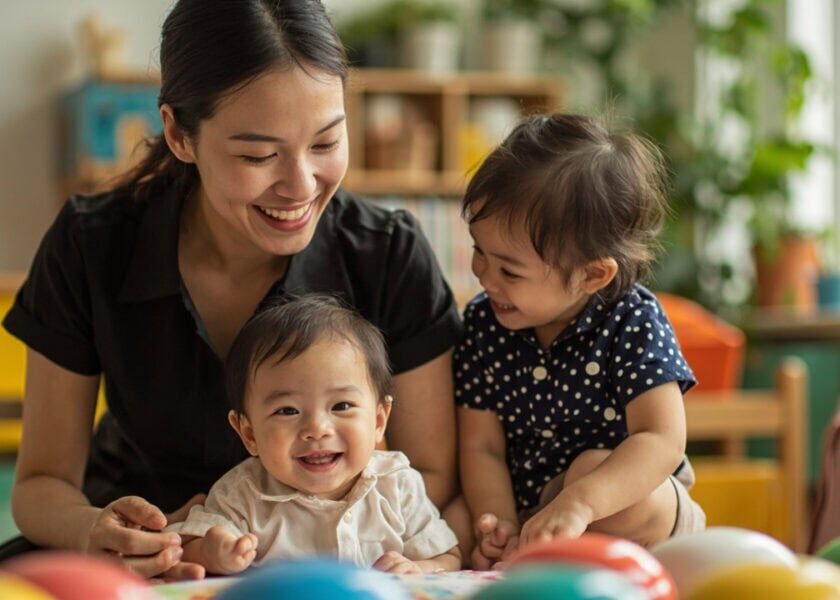
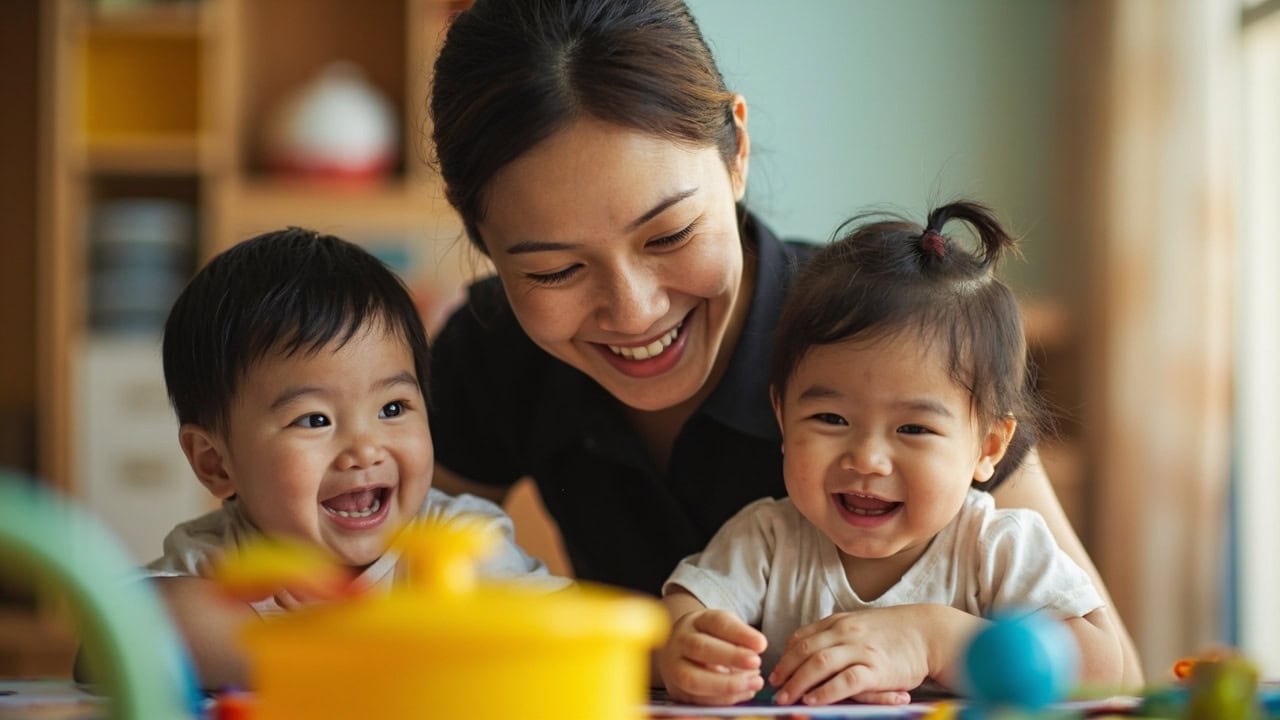
Quality childminding is not simply a matter of ratios and regulations. It is about relationship depth. It is about whether your child is one face in a group or an individual known by name, by need, by personality, by the particular way they like to be held when they are tired.
In a quality home-based childminding setting operating under the ECDA Childminding Pilot, the ratio of caregivers to infants — up to one to three in infant placements — means that your child is not lost in a crowd. They are seen. They are noticed. They are known.
Questions to Ask When Visiting a Caregiver or Centre
- How does the caregiver respond when a child is distressed? Look for warmth, consistency, and respect for the child’s emotional state.
- What does a typical day look like? Look for structure that balances rest, play, and exploration.
- How does the caregiver communicate with parents? Look for regular updates, honest reporting, and openness to questions.
- What is the caregiver-to-child ratio? For infants, smaller is generally better for emotional development.
- How does the caregiver support peer interactions? Look for guided rather than unsupervised peer time.
Signs of Quality Beyond the Checklist
Licensing, ratios, and food quality are important baselines. But what you really want to observe is:
- Do the caregivers seem genuinely engaged with the children, not just supervising?
- Do the children seem at ease — not uniformly happy, but comfortable, curious, interested?
- Is the environment set up for exploration, or just for safety?
- Do the caregivers speak about the children as individuals, with knowledge of their personalities and preferences?
- Are your questions welcomed, or deflected?
Your Child’s Development as the Real Indicator
Beyond the visit itself, here is what we want you to watch for over time — the signs that your child is thriving in care in the deepest sense, not just that they are safe and fed, but that they are growing in the ways that matter for who they will become.
Watch their relationship with you. Does your child seem secure in your attachment? Do they greet you with joy, but also with the confidence to show you their independence? A child who is thriving in care will come to you with delight, and be comfortable going back. They will not be clinging in a way that suggests their needs are not being met elsewhere, but they will also not be dismissive or disconnected. They will move between worlds — home and care — with growing ease, because both worlds are working.
Watch their relationship with other children. Are they beginning, in whatever way is appropriate for their age, to negotiate, to share, to play alongside others? These are skills that develop in care, and if they are developing, it is a sign that the social world of your child’s care setting is healthy.
Watch their curiosity and confidence. Does your child seem interested in the world? Are they willing to try new things, to approach unfamiliar situations with some degree of ease? Do they show evidence of having had experiences in care that have expanded their sense of what is possible?
Understanding the Options: Infant Care Pathways in Singapore
Singapore parents have several pathways for infant care, each with different characteristics. The right choice depends on your child’s temperament, your family’s needs, and the quality of the specific arrangement. What matters most is not the type of care, but the quality of the relationships within it.
| Option | Key Features | Best For |
|---|---|---|
| Centre-based infant care | Larger groups, structured programmes, trained teachers | Parents seeking formal curriculum and peer exposure |
| Home-based childminding | Smaller ratios, family-like setting, individualised attention | Parents seeking deeper caregiver relationships and flexibility |
| Nanny or au pair | One-to-one or one-to-two care in home environment | Parents seeking consistent individual care at home |
What Good Care Arrangements Do
The best care arrangements do not hide from the information gap between parents and caregivers. They close it by welcoming your questions, communicating regularly and honestly, letting you see what they are doing and why, and treating you as a partner in your child’s care rather than a client who has purchased a service.
You will never see everything. Your child will have moments of joy that no camera captures. They will solve small problems and have small victories that no report will mention. They will form a memory of a caregiver’s voice or a friend’s laugh that you will never fully access. This is the nature of care. It is a world your child inhabits, and you are not in that world the way you are in your home.
What you can do is choose a care arrangement that shares enough of that world to build your confidence, and that builds its relationship with you on honesty rather than performance.
Building Informed Trust as a Parent
Let me speak directly to you, because you are carrying something that is not easy to carry. You are making decisions about your child’s care based on incomplete information. You drop them off in the morning and you do not see what happens until you pick them up. You rely on reports, on photographs, on the occasional update — and you trust, because trust is part of parenting, but you also wonder.
You wonder if they cried and no one told you. You wonder if they had a wonderful day and you will never know the details. You wonder if the caregiver really loves your child, or simply does the job.
These are not irrational fears. They are the reasonable concerns of a loving parent in an imperfect information environment.
The Goal Is Not Anxiety — It Is Grounded Confidence
Understanding your child’s invisible care world — the relationships they form, the competencies they develop, the inner experience they are having while you are not there — this understanding is not a luxury of highly engaged parenting. It is not something extra, something you do if you have the bandwidth.
It is the highest form of informed parenting.
It is what allows you to make decisions not based on fear or guilt or marketing, but on a genuine understanding of what your child needs and what different care arrangements offer. It is what allows you to ask better questions, to notice what matters, to be a true partner in your child’s care even when you are not present.
You are not a background figure in your child’s care story. You are the author of it. But you can only author it well if you understand the full landscape — including the parts you cannot see.
Informed Trust Comes From
- Knowing what quality care looks like.
- Choosing a care arrangement designed around your child’s developmental needs.
- Building a relationship with your child’s caregivers based on honesty and mutual respect.
- Watching, over time, as your child grows into someone who is curious, confident, connected, and capable.
Informed trust is what allows you to leave your child in the morning and go to work with your whole heart, knowing that they are in a place that is good for them, and that the hours they spend there are building something that will last.
How EduNanny Approaches Your Child’s Invisible World
At EduNanny, this understanding shapes everything we do. Our caregivers are not assigned to children. They are formed into relationships.
In our home-based childminding model, which operates under the ECDA Childminding Pilot, the ratio of caregivers to infants — up to one to three in our infant placements — means that your child is not one face in a group of ten. They are seen. They are noticed. They are known by name, by need, by personality, by the particular way they like to be held when they are tired.
This is not a luxury. For a child navigating the emotional terrain of separation and reconnection, it is the difference between mere supervision and genuine care.
What Parents Can Expect From Us
We are part of the ECDA Childminding Pilot, which means our caregivers are trained, supported, and connected to a system that values quality and accountability. Learn more about our approach and standards.
We offer home-based childminding pathways as well as community-based options, because families are different and the right fit matters. Our care blocks are structured around the working week, Monday through Friday, because we know that parents need reliable, consistent care — not just in principle but in the practical rhythms of their lives.
We have taken steps to offer transparency measures — communication systems, regular updates — so that you can see, as much as is possible, what your child’s day looks like.
But more than anything, we are here for your child. For the child who wakes up each morning and goes somewhere they may not be able to name but who knows, in their body, whether they are safe, whether they are known, whether they are growing.
We cannot promise you that every day will be perfect. No one can. But we can promise you that we will treat your child’s inner life with the seriousness it deserves. We will pay attention to what is happening inside them, not just outside them. We will build relationships that matter. And we will work every day to be worthy of the trust you are placing in us.
What You Made Possible
You dropped your child off this morning. You may be dropping them off again tomorrow, and the day after, and for months or years to come. The hours will pass. Your child will grow.
And somewhere in that growth, in the competencies they develop, in the relationships they form, in the curiosity that is kindled and the confidence that builds, there will be something that you cannot see — but that you made possible.
By choosing care that takes your child seriously. By trusting what you cannot observe. By being the kind of parent who asks not just whether their child is safe, but whether they are thriving.
That question — the deeper one — is one you carry every day. It is the question that makes you a parent who cares about more than supervision, more than safety, more than logistics. It is the question that says: I want to understand what is happening inside my child’s world, even the parts I cannot enter.
We are here to help you find that understanding. And we are here, every day, to be part of the world your child is living while you are not there — so that when you pick them up in the evening, and they run to you with whatever joy or exhaustion the day has brought, you can hold them and know, with a quiet and grounded confidence, that the hours apart were hours well spent.
That they were known.
That they were safe.
That they were growing.
That is what quality care offers your child. That is what we offer you.
And that is why what happens in the hours you are not there matters so much — not because you are absent, but because you chose to love your child in a way that extends beyond your own presence. That is the deepest kind of parenting. And it deserves the deepest kind of care to meet it.
We are honored to be part of that story.
If you are a parent in Singapore researching infant care or childminding options, we invite you to begin a conversation with us about how EduNanny approaches the invisible world of your child’s daily care — and how we work to be worthy of the trust you place in us.