The Guilt Singapore Parents Carry Is Love Not Failure
The Weight You Carry Is Not Evidence of Failure
There is a particular silence that happens before the handover. Not the chaos of the morning rush — not the logistics of the bag, the bottle, the tiny shoes that never stay on. I am talking about the moment after: when you have walked away from the nursery door and you are standing somewhere, perhaps a lift lobby, a car park, your own office corridor, and the weight arrives. The second-guessing. The quiet negotiation with yourself that goes something like this: Is this the right choice? Will she be okay? Am I doing enough?
That moment is more universal than most Singapore parents realize. And it is far more revealing about the kind of parent you are than about the quality of the choice you have just made.
I want to begin here, because that particular ache is where this conversation needs to start. Not because EduNanny has all the answers, but because we have learned, through hundreds of conversations with parents across Singapore, that the single most important thing we can offer you is not a curriculum, not a schedule, not even a ratio. It is this: the permission to stop apologizing for a decision that was never something to apologize for in the first place.
Here is what I want you to hear, and what I want you to sit with for a moment: every ounce of that guilt you carry is love looking for somewhere to land. It is not evidence of failure. It is evidence of a parent who takes this responsibility seriously.
The mother who lies awake wondering if she should have delayed her return to work by another month — that is not a failing parent. That is a parent who is so attuned to her child’s needs that she can barely distinguish them from her own. The father who checks the nursery camera four times in an hour not because he does not trust the caregivers, but because leaving his daughter in someone else’s arms still feels like handing over something sacred — that is not weakness. That is devotion.
Singapore makes this harder than it needs to be. I say that with deep respect for this city and everything it has given us, but also with honesty. Singapore is a society that runs on achievement, on excellence, on the quiet, relentless message that you should have done more, prepared better, been more. And nowhere is that pressure more acute than in the space between parenthood and professional identity.
You are told, from every direction, that your child’s first thousand days are irreplaceable. And you are also told — by employers, by housing policies, by the sheer cost of living in one of the world’s most prosperous cities — that you need to work. These two truths are not contradictory. But the space between them is where Singapore parents live, and it is often a very lonely place.
What the Guilt You Carry Actually Means
Here is the deeper truth that Singapore parents deserve to hear, and that very few people are willing to say plainly: your emotional state as a parent is not a luxury. It is a developmental variable.
The research here is robust and quietly radical. When you are anxious, guilt-ridden, and second-guessing your choices every single day, your child feels that. Not as a conscious message — young children do not have the cognitive architecture to parse parental anxiety into words — but as an ambient emotional field. A child learns security not just from the warmth of individual interactions, but from the emotional coherence of the adults around them.
A parent who is at peace, who has made a decision and trusts it, who walks into the nursery each morning with genuine confidence that this is good — that child is learning something invaluable. They are learning what it looks like to be a person who makes thoughtful choices and then stands behind them.
What the Brain Actually Responds To
Warm, responsive, intentional caregiving — whether it comes from a parent or from a well-trained, deeply qualified caregiver in a quality environment — builds neural architecture. The brain does not know, and does not care, whether the responsive face it sees each morning belongs to a biological parent or to someone who has been thoughtfully chosen and carefully prepared for this role.
What the brain responds to is consistency, warmth, attunement, and safety. When children receive these in a high-quality setting, they do not suffer. They thrive. And the evidence is not abstract. It shows up in language development, in social confidence, in the ability to regulate emotion, in the willingness to explore the world with curiosity rather than fear.
Your child is not learning that you left. Your child is learning what it feels like to be held by a responsive, attentive adult in a safe environment. That lesson, when delivered consistently, builds the foundations for every relationship your child will ever have.
The Science Behind What You Already Feel
The research consistently shows that quality childcare — including infant care and childminding — is associated with positive developmental outcomes in language, social skills, and emotional regulation. The caveat is always “high-quality” — which is exactly why choosing carefully matters so much.
But beyond the outcomes data, there is a simpler truth worth sitting with: children who experience warm, responsive caregiving in any consistent relationship do not develop differently from those who receive the same quality of care from a parent. What matters is not who delivers the care, but the quality of the attunement, the consistency of the presence, and the safety of the environment.
What Quality Childcare Actually Looks Like
Now, let me be precise about what I mean by quality, because this is where the conversation becomes practical and not just philosophical. Not all childcare is equal. That is not a criticism of parents who have made different choices — it is simply a fact, and it is the most important variable in everything we are discussing.
The difference between a child who blossoms in a care setting and a child who merely tolerates it is not the fact of the care itself. It is the quality of the care.
Key Indicators of Quality
- Caregiver training and qualifications — ongoing professional development, not just certifications
- Child-to-adult ratios — in infant care, lower numbers mean deeper attention and stronger attachment
- Environment design — stimulating, safe, and intentional in its layout for developmental stages
- Programme philosophy — whether each child is treated as a whole human being with an inner life worth understanding, rather than a set of milestones to check off
- Communication practices — transparency about daily routines, developmental progress, and moments of concern
- Emotional attunement — caregivers who respond to cues, not just schedules
These are the variables that matter. And they are the reasons why choosing carefully — spending time understanding the difference between one setting and another — is not overthinking. It is thinking exactly as clearly as this decision deserves.
The People Behind the Care
I want to add something here, because it is a dimension of this conversation that Singapore’s childcare discourse has largely missed. The caregivers themselves — the childminders, the infant care professionals — deserve recognition as skilled practitioners whose work has genuine dignity and importance.
When we talk about quality care, we are not just talking about an abstract system. We are talking about specific people who have chosen to dedicate their professional lives to the care of other people’s children. That is not a small thing. It is, I would argue, one of the most consequential forms of work that exists.
The caregiver is not a peripheral figure in your child’s life during those early years. She is a primary relationship. And she deserves to be treated as such — not just by us, but by the entire ecosystem of parenting support that surrounds your family.
The EduNanny Approach: Partnership in Parenting
And this is precisely where EduNanny Singapore steps in — not as a brand that wants your business, but as a partner that genuinely understands what you are carrying.
We are part of the ECDA Childminding Pilot, which means our standards are aligned with national frameworks designed to protect and support Singapore families. We offer home-based and centre-based pathways, because Singapore families are not all the same, and the right solution for one household may not be the right solution for another.
We maintain ratios of up to one to three infants, because we believe that in those earliest, most formative years, the closeness of the care matters more than the efficiency of the programme. Our fee structures are designed to be accessible within the pilot framework, and CDA and Baby Bonus funds can be used — which means the financial conversation does not have to be another source of stress on top of everything else.
Across our settings, we hold ourselves to standards of communication and transparency that I believe Singapore parents have every right to demand. Because when you are trusting someone with your child’s first thousand days, you deserve to know exactly what is happening in those days, and you deserve to feel that your trust is well-placed.
Beyond the Logistics
Beyond the policy frameworks and the operational details, what EduNanny actually offers is something harder to quantify and more important to name. We offer a model of care that takes your guilt seriously.
Not by dismissing it. Not by telling you there is nothing to feel. But by building a system that is designed, at its very foundation, to carry some of that weight alongside you.
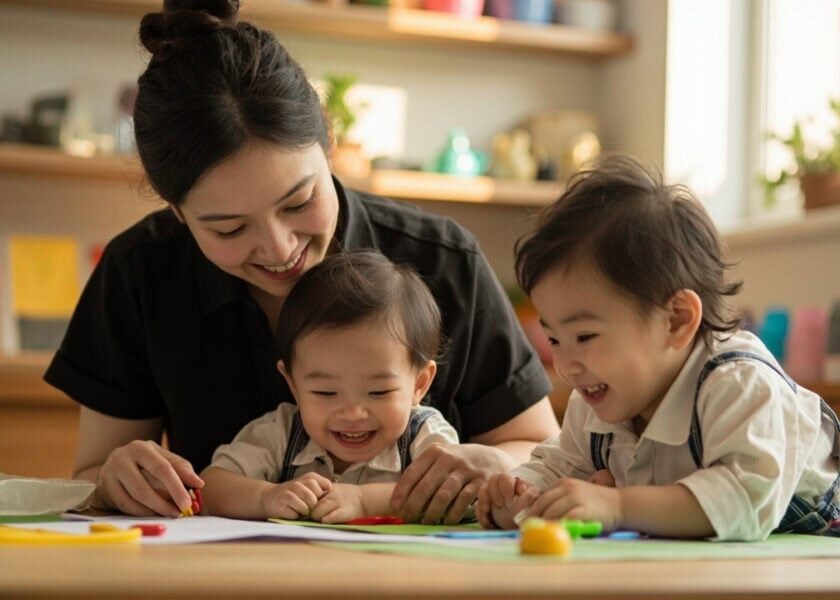
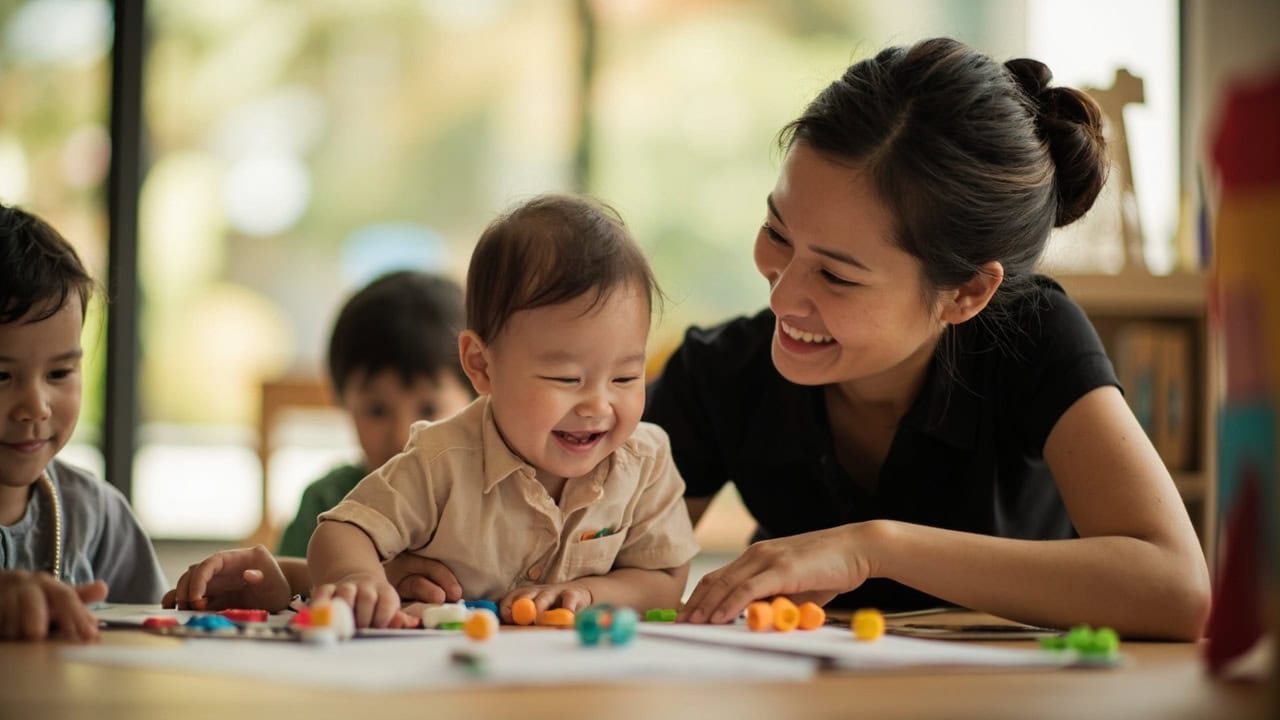
When you drop your child with an EduNanny caregiver, you are not handing your child to a stranger. You are bringing your child into a relationship that we have already thought through with the same care and intentionality that you bring to it. The caregiver is not a replacement for you. She is a complement to you — a skilled, trained, emotionally attuned professional who is part of an ecosystem that has your child’s development at its centre, and that has your peace of mind as one of its core objectives.
For the moments when the questions come at 2am, our Thomas AI Chatbot offers thoughtful, informed responses — not a replacement for human conversation, but a quiet ally when the anxiety is loudest and answers feel furthest away. Sometimes the thing that breaks the cycle of second-guessing is simply having a clear, honest answer at the moment you need it most.
Addressing Your Real Concerns
You may still have questions. That is reasonable, and I would expect nothing less from a parent who is thinking carefully about this decision. Let me address a few of the concerns we hear most often.
“Will my child feel abandoned?”
Not if the care is quality care, delivered by attuned, trained caregivers in a consistent, warm environment. Abandonment is a pattern of neglect, not a single relationship. Your child is building multiple attachments — with you, with your partner, with grandparents, with caregivers — and each one teaches them something different about safety, trust, and love. What matters is that each relationship has warmth and responsiveness. A quality care setting provides that consistently.
“Am I hurting my child’s development?”
The research does not support this. High-quality childcare is associated with positive developmental outcomes across language, social skills, and emotional regulation. The caveat is always “high-quality” — which is exactly why choosing carefully matters so much.
“What will people think?”
This concern is real, but it belongs to them, not to you. Social judgment in Singapore can be sharp, and the look from a stranger or a relative can feel like a verdict. But that look says far more about the person giving it than about your worth as a parent. Your child will not remember what others thought. Your child will remember feeling secure, loved, and held by adults who showed up consistently. That is what you are building.
“How do I know if the care is actually quality?”
Ask questions. Observe without announcement. Review training records and ratios. Ask about the programme philosophy. Watch how caregivers interact with children — not just when they know a parent is watching, but in the ordinary moments. Trust your instincts, but also trust evidence. At EduNanny, we welcome these questions because we know that parents who ask them are exactly the parents we want to work with.
What Your Child Learns When You Choose With Confidence
Here is what children learn when they watch their parents make a difficult choice, trust it, and step forward with confidence: they learn that love is not about proximity. It is not about being in the same room every waking moment. It is about the quality of attention, the thoughtfulness of preparation, and the courage to trust that the people you have chosen to help you raise your child are worthy of that trust.
A child who sees their parent make a considered, intentional decision about care — and then move through the world with that decision rather than against it — learns something extraordinary. They learn what it means to be a person who chooses well, and who does not apologize for it.
That child is building a model of what healthy decision-making looks like. They are learning that their parent is not perfect, but is wise. That their parent is not present every moment, but is deeply invested. That their parent makes mistakes, but also makes commitments and follows through.
These are not small lessons. These are the foundations of emotional intelligence.
Ready to Explore Your Options?
That moment after the handover. The silence in the car park. The weight you carry before you have even had your first coffee of the day. We see that moment. We have sat with parents in that moment. We have understood it not as evidence of a system that has failed them, but as evidence of parents who are doing the hardest, most important work of their lives — which is loving their children so deeply that they cannot imagine ever doing enough.
The question is not whether you should feel guilty about returning to work or placing your child in care. The question is whether the care you are choosing is worthy of the love you are bringing to it.
And if it is — if you have thought carefully, chosen intentionally, found a setting and a programme and people who reflect your values and your commitment — then the guilt you are carrying is not yours to hold. It is a residue of a narrative that tells parents, and mothers in particular, that they can never do enough unless they do everything themselves.
That narrative is not true. It is not supported by the science. It is not aligned with the reality of raising a child in a modern city like Singapore. And it is certainly not a fair measure of your worth as a parent.
The child in a quality care setting, held by a trained and attentive caregiver, surrounded by language and stimulation and warmth, is not a child who has been abandoned. She is a child who has been chosen — by you, with extraordinary care, for extraordinary reasons.
If this conversation has resonated with you, we would welcome the opportunity to continue it — not as a sales call, but as a genuine exploration of what your family needs and how EduNanny Singapore might be able to support you through the earliest, most important years of your child’s life.
Whether you are just beginning to research infant care options, or whether you are ready to take the next step, we are here. Reach out to speak with our team, explore our home-based and centre-based pathways, and discover what quality, guilt-aware childminding can look like for your family.
Because you have already proven, by the very fact that you are reading this, that you care enormously about getting this right. That is exactly the kind of parent we want to work with. And we believe, with evidence and with heart, that the choice you are considering is one you deserve to make with confidence.
EduNanny Singapore is part of the ECDA Childminding Pilot, offering home-based and centre-based childcare pathways designed around developmental value, thoughtful care, and genuine partnership with families. Learn more about our approach or connect with our team.