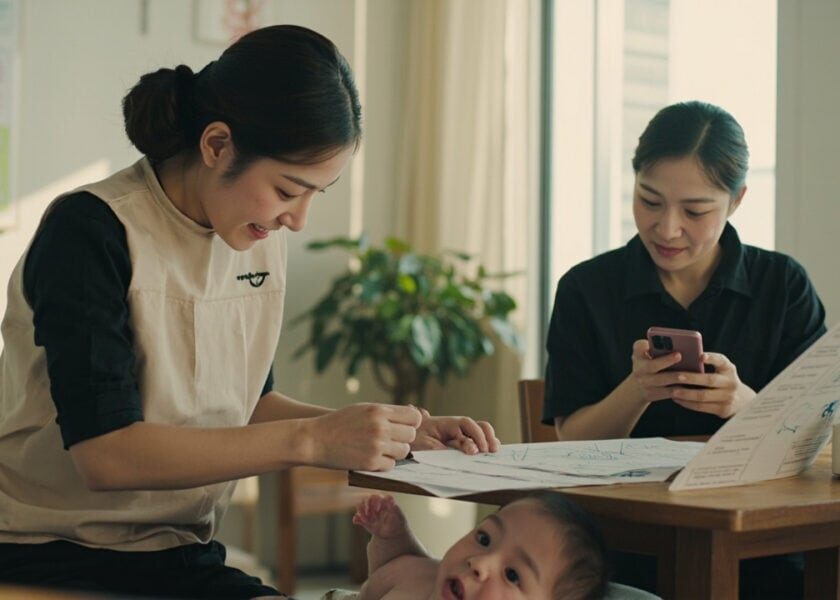
The Foundation That Determines How Your Family Can Thrive
Why This Decision Shapes Everything
Singapore parents who plan carefully for their future eventually arrive at an understanding our society rarely names for them. We talk about childcare as if it belongs in the same category as finding a cleaner or arranging a delivery—as a logistical challenge to be solved rather than a strategic decision to be designed.
But families who have lived a few years into their choice know better. They know that the childcare decision is not one decision among many. It is the decision that makes every other decision possible—or limits every other decision’s feasibility. Like any foundation, it determines what you can build, how high you can go, and whether the structure will hold when wind comes.
This reframing matters because it changes the questions you ask. When childcare is logistics, you ask: Who is available? What are the hours? What is the cost? When childcare is architecture, you ask: What does this arrangement make possible over the next five years? What kind of daily life does this create for my family? Who will partner with us as our children grow and our needs evolve?
You are not simply choosing who will watch your child. You are choosing the architecture that will determine how ambitious, how flexible, and how flourishing your entire family can be over the coming years.
What Quality Childcare Makes Possible
Consider what you actually want for your family over the next decade. The answer is rarely simple, but the aspirations underneath usually are:
- Professional growth that provides for your children’s opportunities and your own sense of purpose
- A marriage that thrives, not merely survives—with space for connection beyond logistics and exhaustion
- Presence as a parent, not just physically, but mentally and emotionally available
- Flexibility to consider a second child when the time feels right, not when you have solved an impossible equation
- Relationships with extended family that give your children roots and your life texture
- Financial stability that accumulates over years, not a constant drain of anxiety
Every one of these aspirations is downstream from the architecture you choose now. Not because the childcare arrangement is magic, but because it is structural. It either creates capacity for all of these things, or it absorbs that capacity entirely, leaving you to wonder where the time, energy, and possibility went.
How Capacity Compounds Over Time
When a parent has childcare that truly works—care that is reliable, developmentally appropriate, and aligned with their family’s values—something shifts. The workday becomes a workday, not a negotiation with anxiety about whether the child is okay, whether pickup will work, whether the arrangement will hold next month.
That shift in psychological space translates into professional presence: the willingness to take on a project, to stay for the meeting, to pursue the opportunity that requires full attention. Over years, that accumulated difference in professional capacity becomes the difference between a career that grew and a career that plateaued.
The same logic applies to marriage. When both parents are exhausted from fragmented childcare arrangements and the constant mental load of coordinating coverage, there is little left for each other. But when the architecture holds, evening hours become available for connection. Parents become partners again, not just co-survivors of the day’s logistics.
For families considering expanding, the childcare decision is not a secondary concern that follows the emotional decision to grow. For many families, it is the primary factor that determines whether a second child feels like an addition to a thriving family or an addition to an already straining system. The families who look back and say, “We were ready for the second child because we had figured out the foundation”—those families designed that readiness deliberately.
What Genuine Childcare Architecture Looks Like
If childcare is architecture, then the quality of that architecture matters in concrete, observable ways. Here is what families who have designed their childcare intentionally tell us they were looking for:
- Reliability that holds over time: Not just this month or this semester, but across the span of your child’s early development. The arrangement does not become precarious when circumstances shift.
- Attention ratios that allow for relationship: In home-based settings, ratios of up to 1:3 allow for genuine responsiveness rather than minimal supervision.
- Communication that keeps parents informed: Regular updates, transparency about the child’s day, genuine partnership. You should never wonder what happened while you were apart.
- Values alignment: The caregiver understands and respects how you want your child to be spoken to, comforted, and engaged with.
- Flexibility within structure: You know the boundaries clearly, which gives you freedom within them rather than constant negotiation.
Questions Worth Sitting With
Before you evaluate any specific arrangement, it is worth asking yourself:
- Does this arrangement create anxiety or reduce it over the course of an average week?
- Would I describe this as a partnership, or as a vendor relationship?
- Can I imagine this arrangement still working when my child is two years older?
- Do I feel comfortable being fully present at work because I trust this care?
- When I imagine adding another child to our family, does this arrangement feel like it could absorb that addition?
If your answers reveal gaps, those gaps are worth addressing before you commit. The cost of discovering that your childcare architecture does not hold is measured in career opportunities missed, relationships strained, and options foreclosed.
How EduNanny Singapore Partners With Families
This is the understanding that EduNanny Singapore was built to honor. Within the ECDA Childminding Pilot, we offer an approach that treats childcare as infrastructure rather than transaction—as the kind of deliberate family design that creates lasting capacity rather than temporary solutions.
What Families Experience
When a family comes to EduNanny, they encounter something different from a typical search process. We begin by understanding your family’s specific architecture—your working patterns, your support network, your values, your hopes for the years ahead. From there, we explore pathways that fit.
Home-based childminding is one pathway we offer: an arrangement where a trained, vetted caregiver provides care within a setting that feels like home, with ratios that allow for genuine attention and relationship. For families where center-based or community care better suits their circumstances, we also provide access to those pathways. We are not advocating for one form of care over another; we are advocating for the right architecture for your family.
Elements That Make the Architecture Durable
| Element | What It Provides |
|---|---|
| Communication systems | Regular updates, transparency, genuine partnership between caregiver and family |
| Safety assurance | CCTV measures where deployed, respecting both safety and trust |
| Ongoing support | Thomas AI Chatbot for questions and concerns between formal check-ins |
| Attention ratios | Up to 1:3 in home-based arrangements—early months deserve more than minimal supervision |
| Cost management | Pilot structure keeps care affordable; CDA and Baby Bonus arrangements supported |
Care runs Monday through Friday, in structured blocks that give families the predictability they need to plan their weeks, their careers, and their lives. This predictability is not a small thing. It is the difference between a family that can make plans and a family that lives week to week, uncertain whether the next schedule disruption will cascade into chaos.
Addressing Common Concerns
“Is home-based care actually safe?”
Safety is not a feeling; it is a standard. At EduNanny, caregivers are vetted, trained, and supported within the ECDA Childminding Pilot framework. Where CCTV measures are deployed, they provide an additional layer of assurance. But the foundation of safety is selection, training, ratios, and ongoing communication that lets you know how your child’s day is unfolding.
“We have family support—do we really need formal childcare?”
Family support is a gift, and families who have it often use it well. The question is whether your current arrangement is creating capacity or consuming it. Some families find that leaning entirely on grandparents creates strain on relationships they value. Others find that informal arrangements lack the reliability they need for professional commitments. The architecture that works is the one that sustains—not the one that just barely holds.
“What if our needs change as our child grows?”
This is exactly why we think in terms of partnership rather than transaction. A family design partner asks about your trajectory—not just your needs today, but the shape of the next three to five years. The arrangement should be one you can evolve with, not one you have to abandon when circumstances change.
“Can we really afford quality care?”
Affordability is a legitimate concern, and it deserves a thoughtful answer. Our pilot structure keeps costs manageable, and families can utilize CDA and Baby Bonus arrangements to manage expenses thoughtfully. But the honest conversation is this: the cost of childcare is real, and so is the cost of childcare that does not work. Anxiety-driven workdays, career opportunities not taken, relationship strain that compounds—these have costs too. The question is not whether you can afford quality care, but whether you can afford the alternative.
Making This Decision With Confidence
Here is what I have observed in families who have built genuine stability and flourishing in Singapore over the years: it is not luck. It is not exceptional circumstances. It is, more often than I can count, the result of a family that treated their childcare decision as an act of architecture, not logistics.
They asked different questions. They thought about the arrangement not just for next month but for the next three years, five years, the span of their child’s early development. They looked for partners who could design with them, not vendors who could provide a service.
A Framework for Your Decision
When you evaluate childcare options, try this shift:
- Instead of asking “Who is available?”, ask “What kind of daily life does this arrangement create for us?”
- Instead of asking “What is the cost?”, ask “What capacity does this arrangement create or consume?”
- Instead of asking “Do we trust this person?”, ask “Is this a partnership we can grow with?”
- Instead of asking “Does this solve our immediate need?”, ask “Does this foundation support the family we are building?”
No childcare arrangement is a cure-all. What I am saying is that when the architecture is designed thoughtfully—when the childcare choice is made with the strategic weight it deserves—it creates the conditions for everything else to function better. It creates capacity. And capacity, accumulated over years, becomes the difference between a family that is managing and a family that is flourishing.
The Invitation
If you are a parent in Singapore, considering your childcare options, I want to invite you to see this decision differently than you may have been encouraged to see it.
You are not simply choosing who will watch your child. You are choosing the architecture that will determine how ambitious, how flexible, and how flourishing your entire family can be over the coming years. You are designing the foundation beneath your family’s best years.
That is not a small thing. It is, in fact, one of the most consequential decisions you will make as a family. And it deserves to be made with the seriousness, the strategic thinking, and the long-term perspective that you would bring to any other defining choice.
EduNanny exists for families who understand this. For parents who plan carefully, who think in decades rather than months, who know that the choices made now ripple outward into the lives they are building.
The families who thrive are not the ones who had everything figured out from the beginning. They are the ones who eventually recognized that some decisions are structural, and who made those decisions with the intention they deserved.
If you are ready to think about childcare as architecture—as the foundation beneath everything else you are building—we would like to have that conversation with you. Not to sell you a service, but to understand your family’s architecture and explore whether we might be the right partner to help design it.
Your family’s best years do not happen by accident. They are designed—deliberately, thoughtfully, one foundational decision at a time. And for Singapore families who understand what they are truly choosing when they choose their childcare, that design begins here.
If this article resonated with you, we invite you to explore how EduNanny Singapore approaches family design partnership. Schedule a conversation with our team to discuss your family’s architecture and the childcare pathway that might serve it best.
Connect with EduNanny Singapore
#ChildcareSingapore #FamilyArchitecture #InfantCareSG #HomeBasedChildminding #EduNannySingapore