The Five Daily Signs That Show Your Child Is Thriving
The Five Key Signals Every Parent Can Learn to See
After years of watching children, listening to parents, and training caregivers in the art of noticing, we have come to understand something important: children speak constantly. They speak through the way they hold their bodies, the quality of their attention, the sounds they make, the games they choose, and the way they move between people and spaces.
Every day, your child is showing you something real. The challenge is not that your child is hiding something. The challenge is that no one has given you the framework to read what is already visible.
To understand why children communicate so clearly, you need to understand how much they are absorbing in those early years. A child’s brain is building connections faster than it ever will again. Every sensation, every interaction, every moment of being held or spoken to or simply present in a warm, responsive environment — these are not passive experiences. They are active ones, shaping the child’s nervous system every single day, teaching it what the world feels like, whether it is safe, whether people are reliable, whether crying brings comfort.
These are biological facts that show up in behavior. And behavior is where the answers are.
When a child is in an environment that genuinely supports their development — not just supervising them, but actively nurturing their sensory, emotional, and social growth — there are signs. Observable, real signs that trained caregivers learn to notice, and that parents can learn to see too.
Sensory Signals
When a child has spent a day in quality care, something subtle happens to their state of alertness. You can see it in their eyes — not the glazed, overstimulated look of too much screen time or too little interaction, but a clear, present quality of attention.
The child notices you when you arrive. Their eyes track movement, follow sound, engage with what is around them. This is not a performance. It is the natural baseline of a nervous system that has been well-regulated throughout the day.
When a child’s sensory world is chaotic or understimulating, this clarity dims. When it is nurtured — when caregivers are attuned to a child’s need for quiet or activity, for stimulation or calm — the child’s alertness becomes a quiet testimony to what happened in those hours.
Emotional Signals
These are perhaps the most legible of all signs. A child who is thriving in care does not arrive home as a blank slate. You can see the residue of their emotional day.
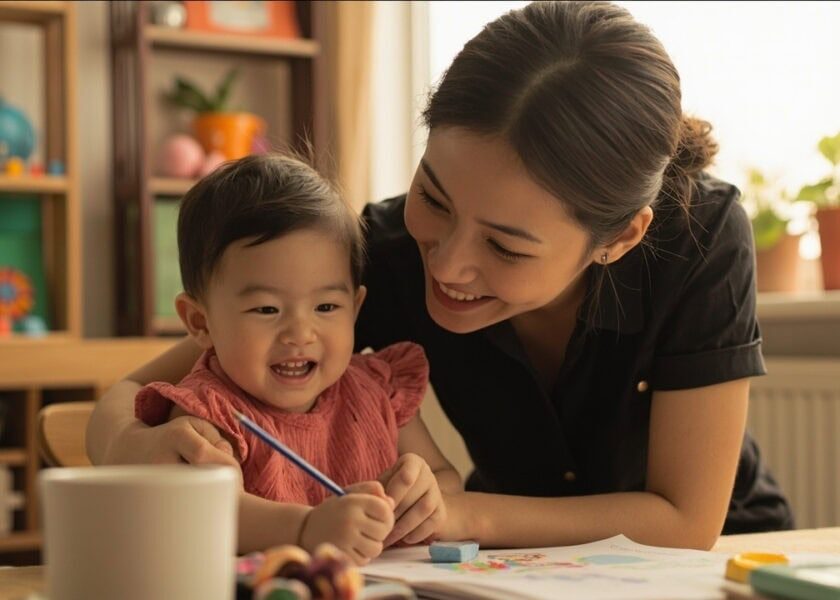
A secure child will seek connection with their caregiver at pickup — not clinging anxiously, but approaching with the confidence of someone who expects a warm response. Their face is expressive. They have been able to feel things during the day, and that capacity shows.
A child who is merely tolerating their childcare often shows something different: a flatness, or a jumpy, hypervigilant quality that comes from spending the day in a state of low-grade stress. They may be well-behaved. They may appear fine. But the energy of the return will tell you something different.
A child who thrives comes home open. A child who merely endures often comes home shut down.
Language Signals
Not just whether your child is speaking — though that matters too — but how they are speaking. Children who are in environments that support their communication development will bring language home. Not perfectly pronounced, not always clear, but purposeful.
They will name things that happened. They will try to tell you something about their day. The drive or walk home becomes a space where their day finds words. This reflects a caregiver who has been talking to the child all day — narrating the world, responding to their attempts to communicate, expanding their sentences, building their sense that words matter and that people listen.
A child who comes home silent, who shows no interest in telling you anything, is not necessarily struggling. But a child who consistently tries to share, who uses language to connect rather than just request, is showing you something important about the quality of their day.
Physical Signals
The child’s body will tell you things if you know how to listen. How tired are they? There is a difference between the deep, satisfied tiredness of a child who has been active and engaged all day — active in the way that promotes development, through play and movement and exploration — and the exhausted, depleted tiredness of a child who has been managing stress or simply unstimulated.
Appetite at the end of the day matters too. A child who has been in a warm, responsive environment often comes home ready to eat — not from deprivation, but from the healthy hunger of engaged activity.
And there is something else: the quality of a child’s movement. A thriving child moves with a certain ease, a looseness in their body that suggests they have been free to explore and grow. Watch for that.
Social Signals
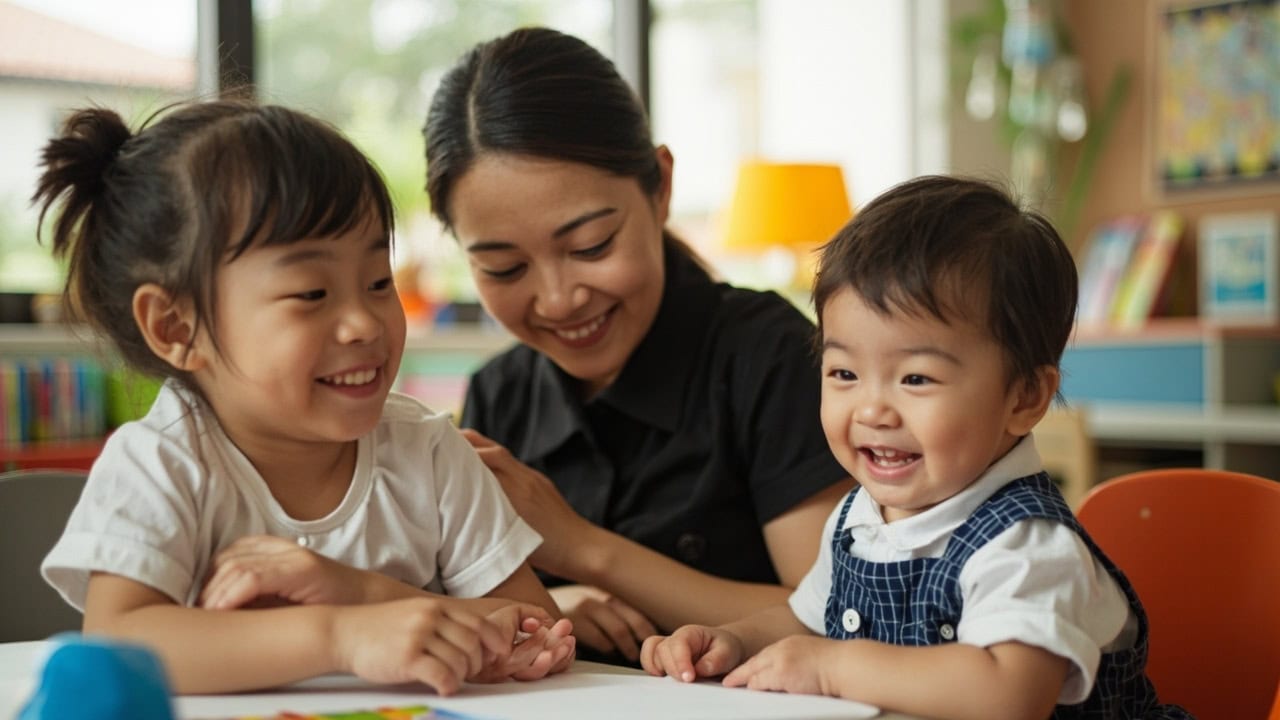
At this age, social signals are still unfolding. But even in infant care, you can see the beginning of social attunement. A child in quality care is learning about other people. Not just parallel play, but the beginning of noticing.
Crucially, they are learning something about the relationship between themselves and their caregiver — that this is a person who responds, who is consistent, who can be trusted. You can sometimes see this in the way a child looks at their caregiver at pickup: not with panic, but with recognition. With the easy recognition of someone familiar.
What Thriving Looks Like: Bringing the Signals Together
When you bring these observations together — sensory, emotional, language-based, physical, social — you have something that no report card can give you. You have a daily reading of your child’s actual experience. Not a snapshot from one observation. Not a grade or a score. A living, daily record of evidence that tells you whether your child is tolerating or thriving.
This is not about becoming an anxious parent who over-interprets every moment. It is about the opposite. When you have a framework — when you know what to look for — you can relax into your own observation. You stop second-guessing. You stop needing the teacher to tell you everything is fine, because you can see it yourself.
You develop a kind of grounded confidence that comes not from trust in an institution, but from trust in your own ability to read what your child is showing you.
That is what quality care does. It makes the evidence visible. It makes your child’s signals legible. It creates an environment where the signs of wellbeing are not hidden behind closed doors but are there, every day, for any parent paying attention.
What Quality Childcare Actually Looks Like
Before choosing any childcare arrangement, it helps to understand what separates supervision from genuine care. Quality childminding is not just about keeping children safe and occupied. It is about creating the specific conditions that allow a child’s signals of wellbeing to emerge naturally.
These conditions include:
- Caregiver-to-child ratios that allow for individual attention — not just in policy, but in practice
- Environments that are warm and responsive, where children feel secure expressing their needs
- Caregivers who are trained to notice — to read cues, to attune to sensory needs, to engage language throughout the day
- Daily rhythms that balance activity with calm, stimulation with rest
- Communication that keeps parents informed without requiring them to guess
When these conditions are present, the signals we discussed become visible. When they are absent, the signals are still there — but they tell a different story.
How EduNanny Approaches This
EduNanny was built on a single conviction: that Singapore parents deserve more than a childcare slot. They deserve a partner who understands what children are communicating and who works every day to nurture exactly the conditions that produce those observable signs of wellbeing.
Our caregivers are trained in exactly what we have been describing — the art of noticing. Of reading a child’s cues. Of creating an environment where a child’s sensory needs are met, where their emotional security is held steady, where their language is invited and expanded, where their body moves freely, and where their social world is warm and safe.
In our home-based pathway, where care takes place in carefully selected environments, that attunement is even more possible because of the intimacy of the setting. In our centre-based pathways, that same attentiveness to individual signals is embedded in how our teams work.
Across both, we maintain ratios designed to make noticing possible — including up to one-to-three care for infants — so that every child’s signals can be seen, not just in passing, but with care.
We are also part of the ECDA Childminding Pilot, which means our approach is aligned with national standards and our work is grounded in the kind of legitimacy that Singapore families can rely on.
We know that parents need more than good care. They need connection to that care. That is why communication is built into how we work — regular updates, transparent exchange, and in settings where it is deployed, tools like CCTV access so that parents can see for themselves what we see.
We do not want your trust blindly given. We want your informed observation. When you watch your child come home thriving — when you see the evidence yourself — that is when we know we are doing what we set out to do.
Choosing Infant Care in Singapore: A Practical Framework
If you are beginning to explore your options, here is a starting framework — along with honest answers to questions Singapore parents often carry.
Observe at pickup
Visit at the end of the day, not just for a tour in the morning. Watch how children move, how they interact with caregivers, what energy fills the room. The end of the day tells a different story than the beginning.
Ask about caregiver ratios
In infant care, lower ratios mean more individual attention. Ask specifically about how many children each caregiver is responsible for. Then notice whether the ratio you were promised is the ratio you see in practice.
Notice the language environment
Are caregivers talking with children throughout the day? Is there narration, response, expansion? Or is it mostly quiet? A rich language environment is one of the clearest indicators of quality care.
Ask about daily communication
What does regular updates look like? How does the centre or caregiver keep parents informed about daily experiences? You should not need to guess what your child’s day was like.
Address your specific concerns
“How can I really know what happens when I’m not there?” You cannot be there. That is the reality of working parenthood. But the solution is not to hope for reassurance — it is to look for the evidence your child brings home every day. The signals we discussed are not guessing. They are observable, daily proof of what your child’s experience was like.
“My child can’t tell me much yet. How do I know?” Before children have words, they have behavior. The quality of their attention, the expression on their face, the tension or ease in their body, the way they seek or avoid connection — these are all communication. You do not need your child to narrate their day. You need to learn what their behavior is telling you.
“What if I am just being an anxious parent?” Noticing your child is not anxiety. Anxiety is the second-guessing that comes from having no framework. When you know what to look for, observation becomes grounding, not worrying.
Trust the week-by-week evidence
After your child settles in, pay attention to the patterns. Does your child come home open or shut down? Engaged or depleted? These patterns over weeks are more meaningful than any single observation. When everything sounds good on paper, the daily evidence will tell you whether the promises match reality.
Your Child Is Not a Mystery
Here is what we have learned from watching so many parents walk through that door at pickup.
The parents who feel most confident are not the ones who were told everything would be fine. They are the ones who learned to read their child. Who stopped needing to guess. Who stood in the corridor, watched their child come toward them, and understood — clearly, specifically, with evidence — that this was working.
That the child who ran into their arms was not just tolerating the day. That the child who came home talking was not just coincidentally verbal. That the child who slept well, ate well, and moved through the evening with ease was showing something true and meaningful about where they had spent those hours.
Your child is not a mystery. They are a daily message, written in behavior, waiting to be read.
And you are not a worried outsider hoping for good news. You are the person who knows your child best — and you are capable of reading the evidence when someone helps you see it clearly.
That is what EduNanny offers. Not a promise. A partnership. One where your attention is welcomed, where your observation is respected, where your child’s daily signals are noticed, nurtured, and made visible for anyone who cares to look.
When you see your child thriving — not just safe, not just occupied, but genuinely thriving — you will know. And you will know because of what you see, not because of what you were told.
That is the kind of childcare we believe Singapore parents deserve.
That is what we are here to build.
If you are ready to explore what this looks like in practice — for your child, in your family — we are here. Whether you have questions, want to understand your options, or simply want to talk through what you have been observing at pickup, we would welcome the conversation.
Because when you see your child thriving, you will know it. And we want to help you get there.