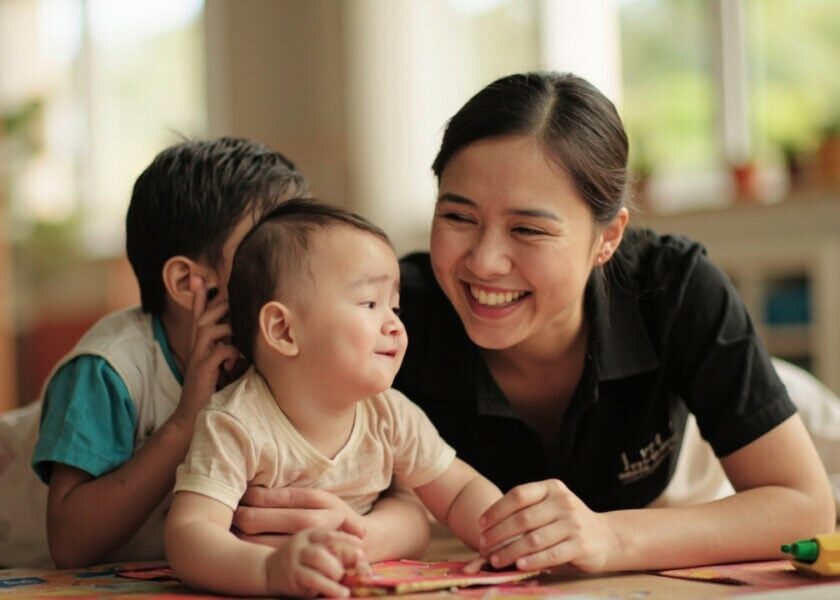
The First Year That Shapes Everything: What Quality Infant Care Looks Like
The First Year Is Not a Waiting Room
Consider, for a moment, what is happening inside your baby’s body and brain right now. In the first year of life, a child’s brain forms more than one million neural connections every single second. This is not a statistic designed to alarm you. It is a fact that should change the way you think about what your infant needs from the people who care for them during those hours when you are apart.
In these early months, attachment is not a soft, abstract concept. It is a biological imperative.
When an infant feels consistently responded to — when a caregiver notices a subtle shift in mood, meets a hungry cry not in three minutes or five but in a way that communicates I heard you, I am here — that infant is building the neurological architecture for trust, for emotional regulation, and for the capacity to explore the world with confidence later on.
Toddlers are remarkable in their own right. But a toddler has language, has mobility, has a sense of self that can weather the imperfection of a transitional object or a slightly delayed response. An infant has none of these. An infant has only the absolute certainty that the world will or will not respond to them, and every hour of every day in that first year is teaching them which it will be.
This is what makes infant care not just different, but categorically distinct. This is why the checklist that works for choosing a toddler programme is insufficient for your six-month-old. This is why the decision you are facing right now deserves more than a brochure and a tour.
What Quality Infant Care Actually Looks Like
So let us talk about what quality infant care actually looks like. Not as an abstract ideal, but as a set of observable, verifiable practices that any parent can learn to recognise.
1. Responsive Caregiving
The first pillar is something that developmental psychologists call responsive caregiving. It sounds clinical, but it is one of the most human things there is.
It means that when your baby coos, someone coos back. When your baby turns away from a stimulus, someone respects that signal and adjusts. When your baby is settling into sleep and stirs with a small whimper, someone is there — not to force sleep, but to offer the gentle, familiar presence that says you are not alone.
Responsive caregiving is not a curriculum. It is a posture. It is a way of being with a baby that communicates, moment by moment, that their needs matter and that someone is paying attention.
2. Primary Caregiver Consistency
The second pillar is primary caregiver consistency. This one matters more than most parents realise when they first begin their search.
In the first year, trust is built through repetition. Your baby does not simply need a loving environment — they need specific people who become familiar, predictable, and irreplaceable in their daily lives.
When an infant is passed from caregiver to caregiver, week after week, they are being asked to rebuild their sense of security from scratch, again and again. This is not about finding the most affectionate individual. It is about the neurological need for reliable, consistent attachment figures.
The goal is not to provide many capable hands. It is to provide the same capable presence, day after day, so your baby can relax into trust rather than spend their days in quiet, exhausting vigilance.
3. A Sensory-Rich, Safe Environment
For a newborn or young infant, the world is sensory. It is tasted, it is touched, it is watched from the safe anchor of a caregiver’s arms.
A quality infant environment is not a miniature classroom. It is a space that is safe, warm, and rich with appropriate sensory stimulation:
- Contrasting images at eye level
- Textured surfaces for tiny hands to explore
- Gentle music and spoken language
- Natural light where possible
- Space to move freely on a safe mat
Motor development in the first year is astonishing — from the first head lift to reaching, to rolling, to the tentative beginnings of crawling. Quality infant care does not rush this. It supports it by giving babies the space, the time, and the attentive presence to develop at their own pace, with encouragement that feels like love.
4. Language Exposure From Day One
You might wonder what language exposure looks like for a baby who cannot yet speak. It looks like narration.
It looks like a caregiver who describes what they are doing — now we are changing your nappy, let me wipe gently, there we go, all clean — long before your baby understands a single word.
This is not decoration. Research in early childhood development consistently shows that infants who are spoken to frequently in the first year develop stronger pre-linguistic communication skills, broader vocabularies, and more sophisticated comprehension down the line.
Language does not begin at the point of speech. It begins at the point of being included in conversation.
Red Flags and the Questions That Matter
All of this sounds meaningful in theory. But you, as a parent, need more than theory. You need to know how to verify whether a service is genuinely delivering on these promises — because the truth is that not every programme that calls itself infant care is built with these principles at its core.
Warning Signs to Watch For
- High or undisclosed caregiver turnover. Consistency is not a marketing term — it is a developmental need.
- High infant-to-caregiver ratios. Ask how many infants each caregiver is responsible for. In those critical early months, ratios matter enormously. A caregiver responsible for two or three infants can notice and respond to each one. A caregiver responsible for six or seven is making impossible choices about whose need to meet first.
- Vague communication protocols. In the first year, you are not simply leaving your baby for the day — you are asking a stranger to become, in some meaningful sense, an extension of your family. You deserve to know how your baby slept, how they fed, what made them smile, what unsettled them.
- Generic caregiver training. The difference between general childcare training and specialised early infant development training is significant. The youngest babies cannot advocate for themselves. They cannot tell you if they were held enough, if they were stimulated appropriately, if they were spoken to with warmth.
Questions to Ask Before You Commit
- How many infants does each caregiver look after? What is the ratio?
- Will my baby have a primary caregiver, or will they be passed between staff?
- What does your daily communication with parents look like?
- What specific training do your caregivers have in infant development?
- How do you support the transition period when my baby first starts?
- How do you think about and support the parent’s emotional experience?
The EduNanny Approach: Built for This Moment
Here is what no one tells you when you are in the thick of this decision: your emotional experience matters too.
Leaving your infant is not a failure. It is not a betrayal of attachment. It is a choice made out of love, out of necessity, out of the reality of how most families in Singapore function today.
A quality infant care service does not pretend that separation is easy. It acknowledges it, holds space for it, and works actively to build the kind of trust that allows you to leave your baby in the morning and genuinely believe — not hope, not pray, but believe — that your child is in excellent hands.
EduNanny by BUTLER is built on a philosophy that starts from the beginning — not from the toddler years, not from the convenient point when children are verbal and mobile and easier to manage, but from the very first day your family needs support.
The ECDA Childminding Pilot guides our approach, ensuring that our home-based and centre-based pathways meet the rigorous standards that Singapore’s regulatory framework demands, because we believe that structure and warmth are not opposites. They are partners.
Our care blocks are designed around the rhythm of family life — Monday to Friday, with the flexibility and affordability that pilot fee structures make possible, and with CDA and Baby Bonus usability so that financial complexity does not add to the emotional weight you are already carrying.
The first visit matters more than you might expect. It is where fear meets information. It is where doubt meets a caregiver who looks you in the eye and says, tell me about your baby.
Not about the programme. Not about the centre. About your baby — their rhythms, their preferences, the way they like to be held, the sound that makes them settle.
That is where trust begins. Not with a tour of brightly coloured walls, but with someone who understands that your six-month-old is not a slot in a room. They are the only baby like them in the world, and they deserve to be known accordingly.
From Uncertainty to Confident Trust
There is something we want you to carry with you from this conversation.
It is not that infant care is simple. It is not that the fear will disappear the moment you find the right programme.
It is that the fear, when met with the right information and the right partner, can become something else — not certainty, because no parent ever arrives at complete certainty about any decision regarding their child, but something quieter and more durable.
Call it confident trust. The kind that allows you to drop your baby at the door in the morning and drive away without your hands shaking on the steering wheel. The kind that allows you to focus at work not because you have stopped caring, but because you have found people who care as deeply as you do.
We believe infant care is the most important decision you will make in your child’s early years — not because older children matter less, but because those first months are a foundation, and foundations deserve everything we have to give them.
The neural pathways, the attachment patterns, the sense of security that will carry your child into toddlerhood and beyond — they are being built right now, in every interaction your baby has with the world outside your arms.
To every parent in Singapore who is sitting with this decision right now — who is reading reviews at midnight, who toured a centre this morning and left with more questions than answers, who felt their throat tighten walking out the door for the first time — we see you. We understand the weight. And we built EduNanny to carry some of it with you.
Because your baby deserves more than adequate care. They deserve to be in a place where they are known, and responded to, and loved — not as a substitute for you, but as a partner in the extraordinary work of raising them.
From the very beginning.
Ready to Explore Your Options?
If you are beginning to research infant care in Singapore, we invite you to speak with us. Not to pressure you — but to answer your questions honestly, walk you through our approach, and help you determine whether EduNanny is the right partner for your family at this particular moment.
Your baby’s first year only happens once. Let us help you make it count.
#InfantCareSingapore #BabyCareSG #NewbornCare #ChildmindingSingapore #EduNannySG