The Feeling Behind the Gate Understanding Quality in Singapore Childcare
The Question Every Singapore Parent Carries at the Childcare Gate
There is a moment, isn’t there, that every parent in Singapore knows. It happens at the gate of the childcare centre, or at the doorstep when the caregiver arrives. You crouch down to your child’s level. You kiss their forehead. You say the things you always say—I’ll be back soon, I love you, have a wonderful day.
And then you stand up, and you walk away. Your child is no longer in the room with you.
And in that moment, something surfaces inside you. Not a question about safety—you have checked the ratios, you have visited the centre, you have read the certifications. It is something deeper:
What is happening inside my child right now?
Not what are they doing. What are they feeling? Are they okay? Not physically. Emotionally. Are they being seen? Are they being known?
This is the question that lives beneath every childcare decision. Not the one we say out loud, but the one that keeps us reading reviews at midnight, the one that tightens our chest when the teacher mentions something small—a moment of withdrawal, a hesitation at drop-off, a new behaviour we cannot quite name.
We are not just leaving our children with someone who will keep them safe. We are leaving them with someone who will shape, in ways we may never fully witness, the story they are writing about themselves.
Two Children, Two Experiences
Imagine two children, both starting childcare for the first time in Singapore. Both around fourteen months old. Both experiencing the same transition, the same new room, the same small crowd of other children. On the surface, their days might look identical. Same toys on the shelf. Same morning circle. Same nap time.
But the felt experience of these two children could not be more different.
The Child Who Is Known
The first child enters a room where the caregiver knows them. Not just their name, not just their schedule, not just the fact that they do not yet eat fish. The caregiver knows that this child brightens when she sings, even before she sings it—that there is a particular hum she does before the familiar verse, and this child perks up at that hum like a plant toward sunlight.
The caregiver knows that when this child is tired, she does not cry. She goes still. She finds a corner. She needs to be approached gently, without urgency. She needs a voice that is soft and unhurried.
This child is known. And because she is known, she can rest.
The Child Who Is Still Learning
The second child is in a room where the caregivers are kind and competent and well-trained. But they are caring for seven other children, and this child is still learning to be one of the group. The caregiver greets her with warmth, but it is the same warmth she greets every child. When she cries, she is soothed—but sometimes the soothing comes a little late, or a little rushed, or with a toy offered before the feeling has been fully met.
She is not unseen. But she is not, yet, known.
What Is the Difference?
Not the curriculum. Not the toys. Not the beautiful walls painted in pastel Singapore sunlight.
The difference is attunement.
The difference is whether someone in that room is doing the slow, patient, demanding work of truly understanding this particular child—not children in general, not this age group, not the average toddler, but this one, with her specific rhythms, her specific signals, her specific way of being in the world.
This is what we mean when we talk about quality in infant care. Not the things you can photograph and post. The thing that happens between two people when one of them decides to pay attention.
What Is Attunement, Really?
Attunement is a word that comes from developmental psychology, but what it describes is not clinical. It is the oldest thing in the world.
It is what a mother does when she notices her newborn turning his head before he makes a sound. It is what a grandparent does when she reads the shift in a child’s mood and sits down beside them without a word. It is the quiet understanding that passes between two people when one of them knows how to listen—not with their ears, but with their whole self.
In the context of childcare, attunement looks like this:
- A caregiver who notices that your child reaches for other children before she reaches for toys
- A caregiver who understands that your toddler needs a few minutes to watch a new situation before he enters it—and gives him those minutes, instead of hurrying him along
- A caregiver who greets your child the way your child needs to be greeted on any given morning, reading the cues that tell her whether this child needs a boisterous hello or a soft, quiet acknowledgment today
Attunement is not a technique. It is a posture. It is the decision to stay close enough to a child that you can feel what they feel. It is the discipline of slowing down when the child needs slowness, and the wisdom to know when they need to be met with energy instead.
Why Numbers Matter
Attunement is not possible when the ratios are too high. It is not possible when a caregiver is managing six infants at once, or when the schedule moves so quickly that there is no time to pause with a child who is pausing.
Attunement requires presence. It requires space. It requires, quite simply, enough time and enough attention for one human being to truly understand another.
This is why the structure of care matters. When an infant is in a setting where the caregiver-to-child ratio is one to three, something becomes possible that cannot become possible in a larger group. Not perfection. Not an unbroken bond. But the real possibility of being known.
What Attunement Looks Like in Real Moments
You, as a parent, may not always see it directly. The moments of deep attunement are often quiet. They happen in the gap between your child’s need and the response to that need.
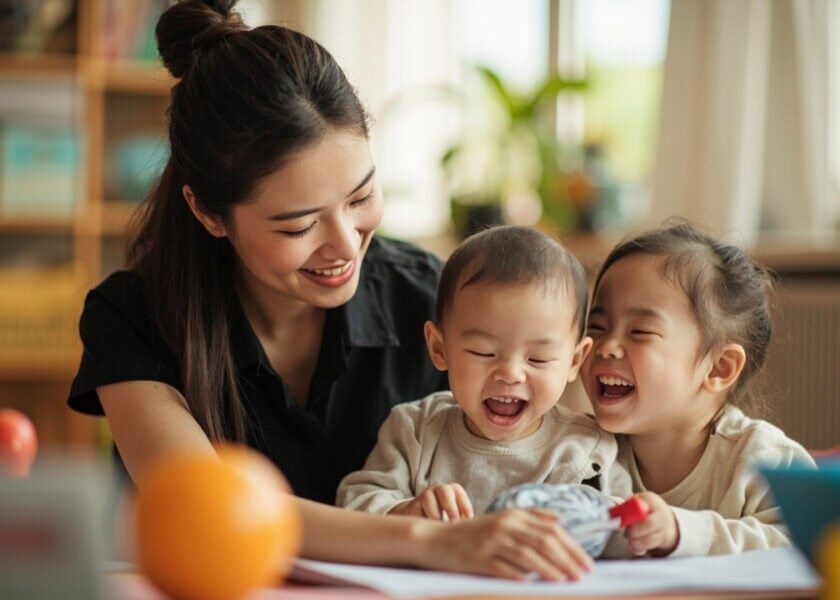
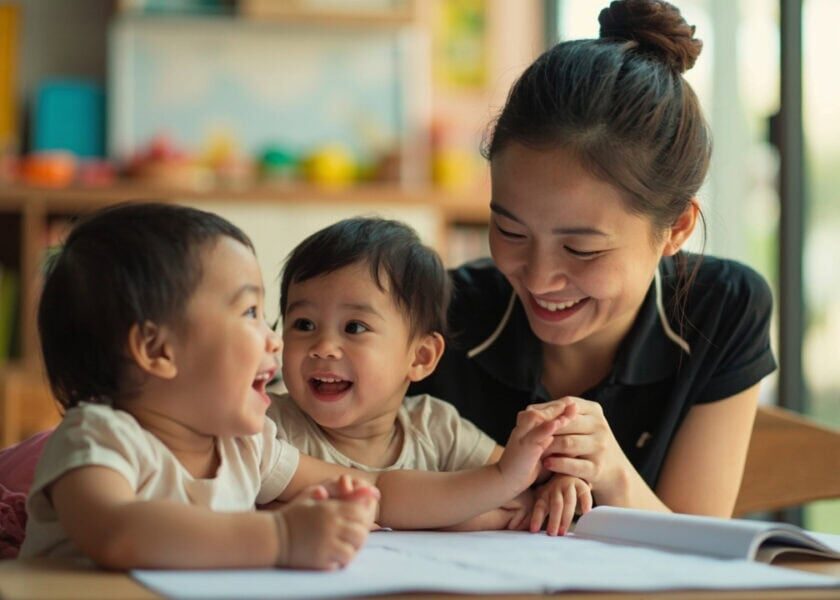
They happen when the caregiver bends down to tie a shoe and notices that your child’s eyes are not on the shoe but on a butterfly outside the window—and names it, pauses, lets your child see that she sees what he sees.
They happen when a child falls and scrapes a knee, and the caregiver does not rush to fix the wound first but crouches down and meets the child’s eyes and says, with complete presence: “You got a surprise. That hurt. I’m here.”
These moments may not make it into the daily photo update. But they are the moments your child is learning from. Your child is learning:
My feelings are real. They are worth pausing for. Someone can see what I am going through, and they can stay with me in it.
What You Can Actually Observe
When you watch your child after a day in quality care, you may notice things. Not dramatic things. Small things.
How they play: A child who is being attuned to may come home and play differently—not better, not more advanced, but with a certain freedom. A looseness. A willingness to experiment, to fail, to try again. Children who feel secure in their care take more creative risks. They are not performing for approval. They are simply, quietly, themselves.
How they speak about feelings: You might notice that your child has begun to name her own feelings. “I sad,” she says, or “I scared,” or “I happy so big.” This language does not come from curriculum. It comes from being in the presence of adults who have been naming her feelings for her, accurately and consistently, until she has the words to claim them herself.
How they handle separation: You might notice that your child has a different relationship with separation. Not that it is easy—separation is never easy for young children—but that it has texture. That it is survivable. That when you leave, someone will stay close, and will notice, and will be there when you return.
How they respond to you: You might notice that your child runs to you when you arrive, not away from you. That they are glad to see you—and that they are also glad to have been where they were. That there is trust in their body when you pick them up.
What Quality Childminding Looks Like in Singapore
When you are researching infant care and childminding options in Singapore, it can be overwhelming to know what to look for beyond the basics. Here is a practical framework for understanding quality:
| Surface Indicators | Invisible Indicators |
|---|---|
| Clean, stimulating environment | How caregivers respond to a child who is upset |
| Certified staff | Whether caregivers slow down when a child needs slowness |
| Age-appropriate curriculum | If your child is greeted by name, by their specific caregiver |
| Safety certifications | Whether the ratios allow for real attention |
| Photo updates of activities | How your child responds when you arrive—not just to you, but to the caregiver |
Questions to Ask Yourself After a Visit
- Did the caregiver seem to be managing the group, or truly noticing each child?
- Did I see moments where an adult bent down to a child’s level—not to instruct, but to connect?
- When a child showed a feeling, how did the caregiver respond? Did they name it?
- Did the environment feel warm, or just clean?
- When I watched the children, did I see them being managed, or being known?
Questions Parents in Singapore Actually Ask
“I cannot be inside the room. How do I know what is really happening?”
You cannot be inside the room every moment. What you can do is look for the observable indicators of attunement: how your child responds to their caregiver, how they talk about or act out their day, whether they seem to be growing in confidence and security.
You can also ask about the structure: the ratios, the communication systems, whether there are transparent ways to understand what your child’s day looks like beyond a photograph of a craft activity.
“Is home-based care as good as centre-based care?”
This depends less on the setting and more on the structure. Home-based and community-based care, when structured with the right support, the right training, and the right ratios, can offer something that larger centre-based settings often cannot: a smaller, more intimate environment where your child is not a number but a person to be known.
What matters is not whether the care happens in a centre or a home. What matters is whether the ratios allow for attunement, and whether the caregiver has the training and support to do this work well.
A Note to Singapore Parents
You are not failing your child by placing them in someone else’s care. You are not outsourcing love. You are not abandoning them.
You are making a choice—a difficult, thoughtful, sometimes agonized choice—because you want your child to have the best possible environment for their growth. And in making that choice, you are entrusting your most precious human being to someone else’s heart.
That is not a small thing. It is one of the bravest things a parent does.
But bravery is not enough. The question you are really asking when you make this choice is not just “Will my child be safe?” You already know the answer to that question, in the way that you have already arranged for safety.
The question you are asking is deeper: “Will my child be seen? Will they be known? Will someone in that room understand them—not just manage them, not just watch them, but truly understand them?”
This is the question that EduNanny has built its answer around.
What EduNanny’s Approach Means in Practice
EduNanny has built its approach around the principle of attunement—not as an abstract ideal, but as a working philosophy that shapes everything from how caregivers are trained to how ratios are structured.
When you choose EduNanny, you are choosing a setting where the numbers make attunement possible. Where a caregiver can know your child—truly know them—because she is not overwhelmed by numbers that make genuine attention impossible.
- Structured ratios that allow caregivers to give real attention to each child in their care
- Flexible pathways across both home-based and centre-based settings, so you can find what fits your family
- Monday to Friday care blocks designed around the rhythms of working families in Singapore
- Transparent communication so you understand what is happening in your child’s day—not just the photograph of the activity, but the quality of the experience behind it
- Where deployed, CCTV measures offer additional peace of mind, because trust is built through transparency
- Where pilot fee structures apply, care is designed to be accessible—to make quality attunement not a privilege reserved for families with unlimited resources, but a genuine possibility for Singapore parents who want their children to be seen
This is what the ECDA Childminding Pilot is designed to recognize: that home-based and community-based care, when structured with the right support and the right ratios, offers something that larger centre-based settings often cannot. Not a replacement for family, but a genuine extension of it. A relationship where your child is not a number, not a slot to be filled, but a person to be known.
The Greatest Gift
When a child is truly seen, something remarkable happens.
They begin to understand themselves. They begin to trust the world. They begin to believe, in the quiet core of their being, that they are worth paying attention to. That their feelings matter. That they are not alone.
And that belief—that invisible, unshakeable belief—is the greatest gift you can give your child. It will shape how they relate to themselves for the rest of their life. It will shape how they love, how they work, how they weather disappointment, how they reach for joy.
This is what childcare is, when it is done right. Not a service that watches your child while you work. A relationship in which your child learns what it feels like to be known.
That is what you are choosing. That is what you have always been choosing.
And that is what EduNanny is here to offer: not just a place where your child goes, but a space where your child becomes themselves.
If this way of thinking about childcare resonates with you—if you are looking for a setting where your child will not just be supervised but truly known—we would love to hear from you.
Explore EduNanny’s infant care and childminding options