The Evidence of Quality Childcare Is Already in Front of You
What Quality Childcare Gives Your Family
- The moments you cherish most are not coincidences. They are the result of consistent, attentive care that compounds over time.
- A child who trusts their caregiver generalizes that trust to the world—and carries it into every new situation they encounter.
- When your child’s days are well-structured, your evenings become calmer. Quality care reduces family friction.
- The best evidence of quality care is your child’s ease. Their willingness to explore, persist, and connect says more than any report card.
- These returns are real, even when they are quiet. They are accumulating, often in ways you have not yet named.
How Quality Care Shapes Your Child’s Development
The first thousand days of a child’s life represent a period of neural plasticity that will never be repeated. Connections are forming in the brain at a rate faster than at any other time in the human lifespan. The child is not merely growing—they are constructing the architecture of everything that will follow: their capacity for regulation, their willingness to approach new situations, their baseline expectation of whether the world is safe and whether other people are reliable.
This is decades of research in developmental psychology, neuroscience, and early childhood education. It is why the stakes feel so high for parents in Singapore. You know, beneath the logistics and the paperwork, that these early years are consequential.
And this knowledge sits alongside another truth that is equally real and far less discussed: you cannot be present for all of it.
The Security That Amplifies Rather Than Competes
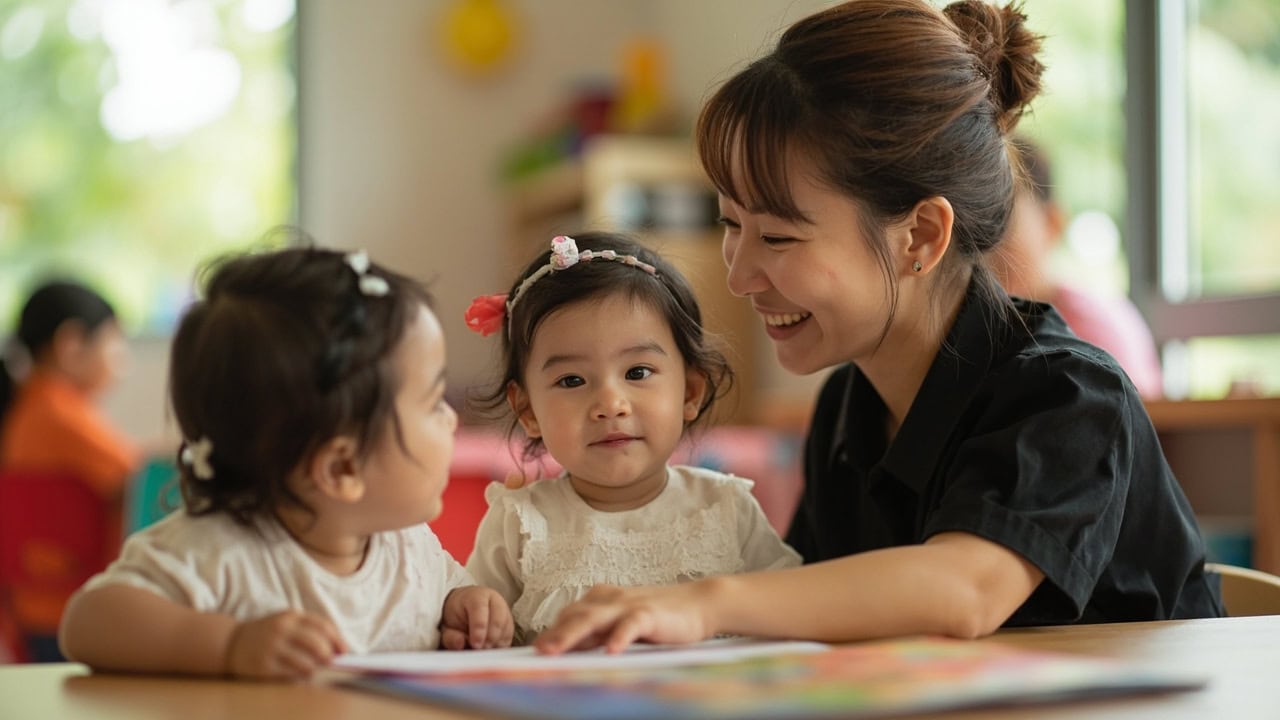
A good caregiver does not substitute for a parent. A good caregiver creates a second reliable presence, a second warm voice, a second set of eyes that notices when your child is about to master something new.
What is remarkable—and what we rarely pause long enough to appreciate—is this: the emotional security your child builds with their caregiver does not compete with the security they build with you. It amplifies it.
A child who has one secure attachment has learned the concept of security. A child who has two or three has generalized that concept. They know, in their body and their behavior, that adults can be trusted, that separation has an end, that the world contains people who will respond when they call.
You may notice this in places you did not expect. At a birthday party, where other children are clinging to parents’ legs, your child wanders toward the play area. At the pediatrician’s office, your child looks at you once and then settles into exploration. At a family gathering, your child approaches an elderly relative they have not seen in months and initiates a conversation.
These are not personality traits your child was simply born with. These are skills. They were learned. And they were learned, in significant part, in the hours of care you trusted to someone else.
What Trust Looks Like in Practice
We so often reduce trust to logistics. We speak of it as a feeling parents have or do not have about a childcare arrangement. But trust, in the developmental sense, is something a child learns. It is a skill they practice. It is a conclusion they draw from repeated evidence.
When a caregiver consistently responds to a child’s needs—when a cry is met with comfort, when a question is met with engagement, when a small frustration is met with patience—the child is not just being soothed. They are learning the fundamental lesson that their communications matter, that other people are reliable, that the world operates according to predictable and benevolent rules.
This lesson, absorbed in the first year or two of life, becomes the template the child applies to every subsequent relationship. Children who have experienced consistent, responsive care in infancy tend to form friendships more easily, resolve conflicts more constructively, and recover from disappointment more quickly. They have learned, at a foundational level, that people can be trusted.
How This Changes Your Whole Family
Here is what happens when your child is genuinely well-cared for: the friction in your home decreases. The evenings are calmer. The weekends are not spent managing a child who has been overstimulated or under-rested or quietly anxious.
When your child’s days are well-structured—when they are eating well, sleeping well, and having their social and emotional needs met—they come home ready to be a child. They have the bandwidth to play. They have the security to test limits in the safe way that children need to. They have enough emotional regulation to weather the small disappointments that would otherwise derail an entire evening.
In a city like Singapore, where the rhythms of work and family life are tightly compressed, where parents are juggling expectations from multiple generations and multiple institutions, the relief of a child who is genuinely thriving in care is transformative. It is not indulgence. It is infrastructure.
The Evidence Is Already in Front of You
Singapore parents are familiar with documentation. We are accustomed to receiving updates, photographs, developmental checklists, and progress summaries. These have their place. They can provide reassurance and help track whether your child is meeting certain milestones.
But the deepest evidence of quality care is something simpler and harder to capture. It is the way your child moves through the world. It is their ease. It is the way they handle small frustrations without spiraling. It is the way they initiate play with other children at the playground. It is the way they look at their caregiver when that caregiver arrives, or the way they mention their caregiver’s name unprompted on a Saturday morning.
These moments are not quantifiable. They will not appear in a learning summary. But they are real, and they are significant, and they are the product of hundreds of hours of consistent, attentive, developmentally-informed care.
When you observe your child at play and notice that they persist at a task even when it is difficult, that is not a temperament trait alone. That is a child who has learned, through experience, that effort leads to results, that adults in their life will support them when they struggle, that failure is not catastrophic.
These micro-moments are how development actually happens. Not in dramatic leaps, but in accumulated small experiences. And here is what is most remarkable, most quietly hopeful: you are already seeing the evidence.
You may not have named it as such. You may have attributed it to your child’s natural disposition, or to your own parenting, or to luck. But when your child does something that surprises you with its maturity, its confidence, its warmth—there is a good chance that somewhere in the chain of causation, there is a caregiver who showed up consistently, who noticed your child genuinely, who created the conditions for your child to become who they are becoming.
Choosing Quality Care: What to Look For
Not all childcare is the same, and it can be difficult to assess quality when you are evaluating options from the outside. Here are some markers that signal genuine attentiveness to your child’s development:
- Responsive interaction. Caregivers who narrate what they are doing, follow your child’s lead, and respond to their communications with genuine engagement.
- Consistent presence. The same faces, day after day. Your child knows who will be there, and that predictability builds security.
- Appropriate ratios. Fewer children per caregiver means more attention per child. A caregiver who is not stretched thin can actually notice the small moments that matter.
- Safe, stimulating environment. Not flashy, not overscheduled, but warm and organized—somewhere your child can move freely and explore at their own pace.
- Communication with families. Not just daily logs, but genuine transparency about routines, challenges, and small victories.
- Your child’s comfort. Watch how your child responds to their caregiver over time. Ease, recognition, willingness to go to them—these are meaningful signals.
Questions to Ask When Evaluating Options
- What is the caregiver-to-infant ratio in this setting?
- How long have the primary caregivers been in their roles? How consistent is the team?
- What does a typical day look like for infants? How is care tailored to individual rhythms?
- How do you communicate with families? What can I expect in terms of updates?
- What training do caregivers receive, and how is it ongoing?
- What does your approach look like when an infant is struggling—with sleep, feeding, or separation?
What to Observe on a Visit
- The tone of the space. Is it warm? Is it calm? Does it feel like a place where a child can thrive?
- How caregivers speak to the children—not just in front of you, but when they think no one is listening.
- How children move through the space. Do they seem at ease? Are they engaged?
- Your own instinct. If something feels off, it is worth exploring why.
Among all the factors—credentials, environment, curriculum—the one that cannot be substituted is the quality of the relationship between caregiver and child. Everything else supports that relationship or fails to. When your child is with someone who genuinely notices them, who responds with warmth and consistency, the conditions for healthy development are in place.
What EduNanny Offers Singapore Families
EduNanny is part of the ECDA Childminding Pilot, designed as a response to a question Singapore families have been asking for some time: how do we give families access to high-quality, home-based and community-based infant and child care that is both developmentally sound and genuinely accessible?
Quality childcare should not only be available to families who can pay a premium. The pilot fee structures are designed to make quality care accessible, and families can explore what can be paid using the Child Development Account and the Baby Bonus scheme.
What distinguishes quality childminding is the combination of warmth with professionalism. EduNanny caregivers are not isolated individuals left to navigate the complexity of infant development alone. They are supported, trained, and connected to a system that values both their competence and their humanity.
In infant care settings, ratios are maintained at up to one caregiver to three children. This is not a bureaucratic requirement. It is a recognition that infants need responsive, consistent care, and that responsiveness is only possible when a caregiver’s attention is not fractured across too many children.
Trust Requires Visibility
When you are leaving your child in someone else’s care, you need to be able to see, in some form, what that care looks like. You need to know that the promises being made are promises being kept.
The communication structures in place—regular updates, transparency around daily routines, and CCTV measures where deployed—are there because trust requires evidence. This is not about surveillance. It is about partnership. It is about recognizing that the relationship between a family and their caregiver is built on repeated small proofs, and those proofs should be accessible.
Support for the Everyday Questions
Modern parenting comes with a particular kind of cognitive load—the ordinary uncertainties that do not require a doctor or an emergency, but that still need an answer. The sleep regression you are not sure how to handle. The feeding question that came up at dinner. The developmental milestone you are wondering about.
The Thomas AI Chatbot is available to help parents navigate these everyday questions. It is not a replacement for human judgment or human warmth. But it is an acknowledgment that reducing the cognitive load of parenting, even slightly, is a gift worth giving.
Trust What You Are Already Seeing
Let me return to where we began. The evening moment. The child at the door. The small thing they show you that you did not expect.
That moment is not a coincidence. It is the result of months, perhaps years, of consistent, attentive, developmentally-informed care. It is the result of a caregiver who showed up, who noticed, who responded, who created safety and warmth and opportunity in the hours when you could not be there yourself. It is the result of an investment you made—not just financially, but emotionally, when you decided to trust someone else with the most important thing in your life.
I want to pause here and speak directly to something that I know many of you are carrying. The question of whether you made the right choice. The wondering, on the days when the drop-off is hard or the report is thin or the other parents seem more certain than you feel, whether the investment is truly worth it.
Those feelings are not evidence that something is wrong. They are evidence that you care deeply. They are the natural byproduct of loving your child with an intensity that no amount of rational reassurance can fully settle.
But here is what I have observed, watching many families navigate this same terrain: the families who worry most about whether they have chosen well are often the families who are most engaged, most reflective, most committed to getting it right. Your attention to this decision, your willingness to question and wonder and seek—this is not weakness. It is a form of love that shows up as vigilance.
And the value is there. It is accumulating. It may not look the way you expected. It may not announce itself with fanfare or arrive on a schedule you can predict. But it is there. In the way your child greets you at the end of a long day. In the way they have begun to play with other children. In the way they surprise you with a word or a gesture or a capacity you had not noticed before.
These moments are not coincidences. They are the dividends.
Most of the returns on that investment will not come in the form of report cards or measurable milestones. They will come in the form of a child who is at ease in the world. A child who is curious, who is socially confident, who has internalized the lesson that people are reliable and effort is worthwhile.
These are the dividends that compound. They are not dramatic. They do not announce themselves. But they are real, and they are significant, and they are the thing you were hoping for when you made the choice you made.
So look at your child. Not at the reports, not at the comparisons, not at the other families who seem more certain. Look at your child. Notice what they know. Notice what they can do. Notice how they move through unfamiliar situations, how they relate to other people, how they persist at things that are hard. Notice the ease with which they approached a new person at the hawker centre, the way they negotiated a turn with a toy, the question they asked about something they noticed on the walk home.
That child is the evidence. That child is the return.
And if you are a parent who is still searching, who is trying to figure out what to do with a newborn who will soon need more than you alone can provide—know that the choice you are facing is not a test of your worth as a parent. It is a practical decision about how to extend the conditions your child needs into the hours when you are working.
And know that when you find the right arrangement, the returns will not be what you expected. They will be quieter, subtler, and more valuable than you can imagine.
EduNanny exists to walk this path with families in Singapore. We know the weight of the decision. We know the complexity of the landscape. We know that what you want, in the end, is simple: a caregiver who will love your child the way you would. And we know that this is not a small thing to ask.
But it is what we ask of ourselves every day. It is what we have built our systems to support. And it is what we see, quietly and consistently, in the children who come through our care.
The dividends are accumulating. Your child knows more than you think. And the investment you made is already paying off in ways you did not plan for.
Trust what you are seeing.
If you are exploring infant care or childminding options for your family in Singapore, learn more about how EduNanny supports families through quality, consistent, and warm home-based care.