The Education Inside Your Child’s Day When You’re Not There
The Quiet Moment That Changes Everything
There is a moment that happens quietly, without ceremony, usually at the most ordinary time. You arrive to pick up your child from care. Perhaps it is late afternoon. The light is the soft gold it gets before evening. And your child looks up from whatever she was doing — playing, listening, building something with her hands — and she says something.
Perhaps she uses a word you do not remember teaching her. Perhaps she asks you a question that surprises you, one with genuine curiosity behind it. Perhaps she notices a friend who is upset, a bird on the fence, a change in the room — and she responds with a kind of social awareness that was not there last week.
And you think, almost without thinking: where did that come from?
You search your memory. It was not from you. Not from last night’s bedtime story or this morning’s breakfast conversation. It came from somewhere else. From the hours you were not there.
This is the moment. Because that moment — where your child shows you something new, something you did not put there, something assembled in your absence — is not luck. It is not coincidence. It is evidence of something that most parents sense but rarely get to see: the invisible curriculum of quality childcare. The education that is happening right now, in the hours you cannot observe, in a place designed not merely to mind your child but to grow them.
The Hidden Curriculum: What Singapore Parents Cannot See
Every parent in Singapore asks a version of the same question, usually quietly, often at the end of a long month when the childcare receipt sits in the folder and you wonder: am I getting what I am paying for?
It is a fair question. An honest question. And the reason it feels so urgent is that the answer is invisible. You cannot open a textbook. You cannot see a report card. You cannot point to the exact moment when your child’s brain reorganized itself around a new concept, a new skill, a new way of being in the world.
The work of early childhood is, by its nature, hidden. It happens in play. In interaction. In the careful, intentional design of an environment where a child feels safe enough to take risks, curious enough to explore, and supported enough to fail and try again.
Educational psychologists call this the hidden curriculum — the set of skills, dispositions, and capacities that are not taught explicitly but absorbed implicitly through the culture of a learning environment. In the early years, it is the curriculum of self.
This curriculum determines whether your child walks into Primary One believing that learning is exciting or terrifying. That teachers are allies or adversaries. That school is a place where they belong or a place they must endure.
That curriculum begins long before your child ever sees a school gate. It begins in infancy. In toddlerhood. In the daily rhythms of eating, sleeping, playing, and relating to other humans who are not you. And in a quality care environment — one that is intentional, responsive, and developmentally informed — that curriculum is being actively assembled. Every single day. Even when you are not there to see it.
What Educational Quality Looks Like in Practice
Parents know that quality childcare should be safe. They know it should be clean and warm and staffed by people who genuinely care for children. But what does educational quality look like in practice?
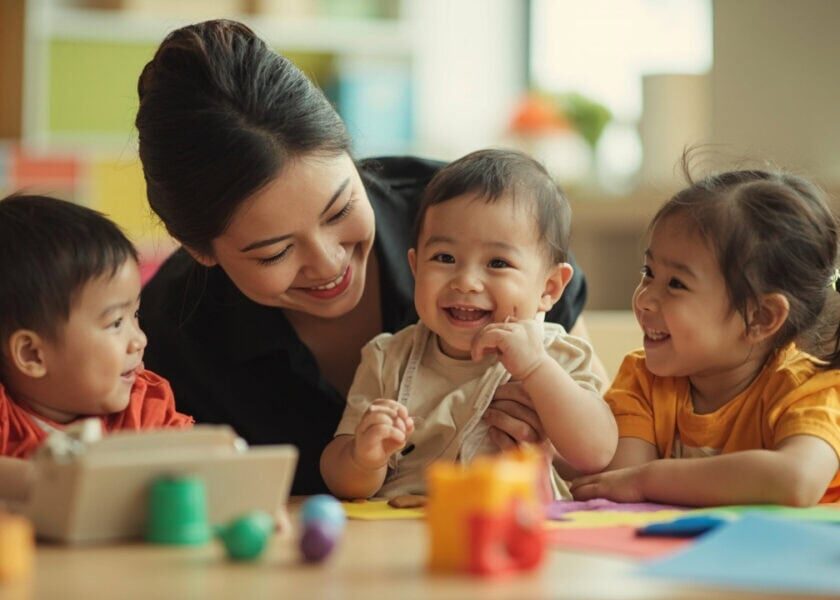
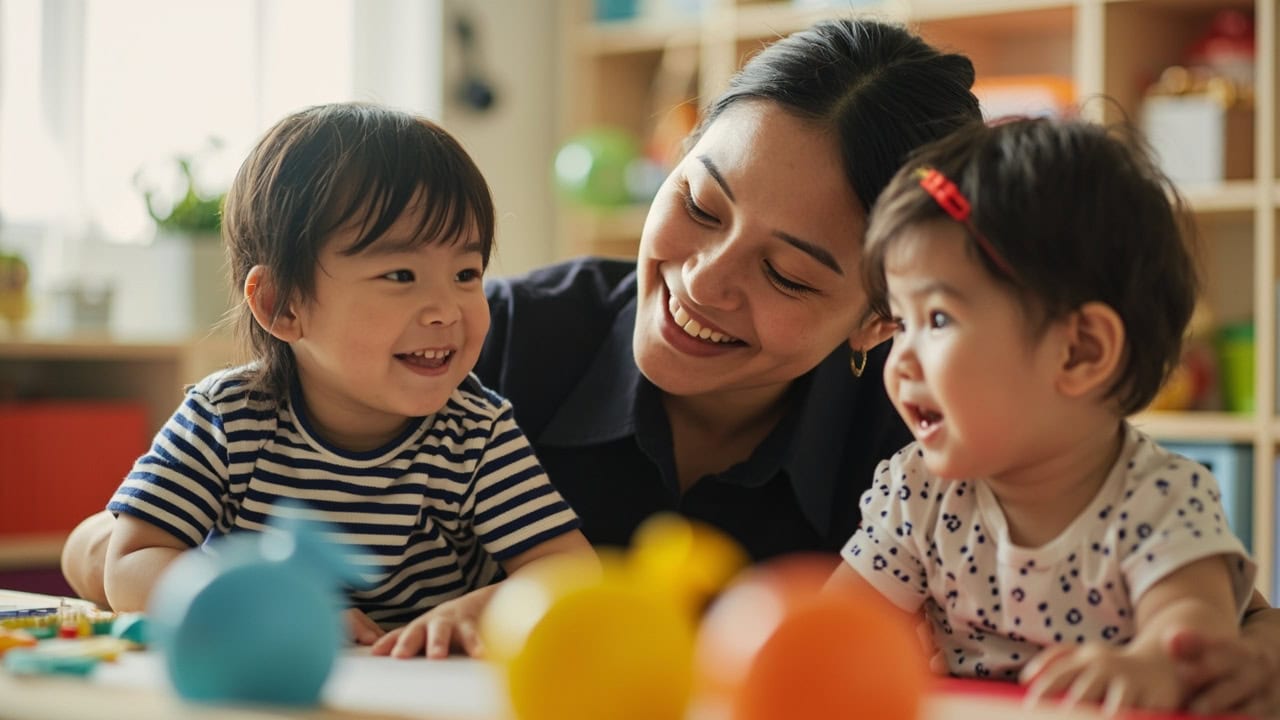
Following the Child’s Lead: It looks like a caregiver getting down on the floor at your child’s level and following their lead in play — not directing, not interrupting, but witnessing. When an adult genuinely attends to a child’s focus, something extraordinary happens. They learn that their interests matter. That they are worthy of attention. That the world responds to them. This is the foundation of confidence.
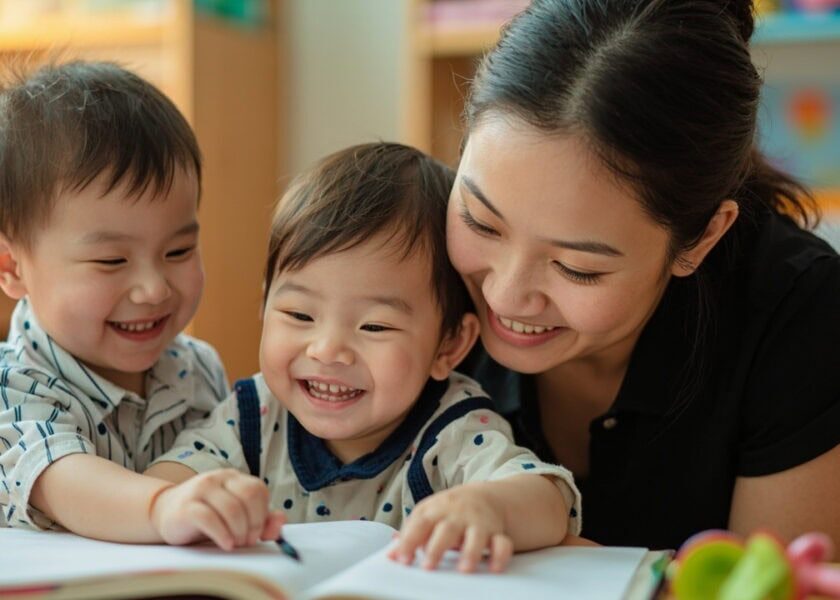
Rich, Responsive Language: It looks like a caregiver narrating what a child is doing as they do it — naturally, the way you might think out loud. “I see you are putting the red block on the blue one. You are building a tower.” This is language exposure at its finest: rich, contextual, and responsive. Research consistently shows that children in language-rich environments develop stronger vocabularies by age three, and that this advantage compounds over time.
Learning to Navigate Conflict: It looks like a caregiver gently intervening when a conflict arises between two toddlers — not solving the problem for them, but helping them find words for what they feel and guiding them toward a resolution. The capacity to manage emotions, delay gratification, and navigate social complexity — these are the skills that predict academic success more reliably than early reading or math scores.
An Environment Designed for Development: It looks like a carefully designed space where a child can climb, crawl, balance, and explore physically — building the proprioceptive and vestibular systems that underpin coordination, body awareness, and even attention. It looks like art materials that are open-ended, allowing for creativity without right or wrong answers. It looks like books that are always accessible, not locked away, because you want a child to understand that stories belong to them.
None of this looks like school. It looks like children playing. But beneath that play is a curriculum as deliberate as anything your child will encounter in formal education. Perhaps more so, because the brain is most plastic, most receptive, most hungry for this kind of learning in the years before age five than at any other point in life.
Why This Matters More in Singapore
Singapore parents are navigating a particular set of pressures that parents elsewhere do not face in the same way.
You are navigating a system that is highly academic, fast-paced, and competitive. You are aware that Primary One entrance is not the finish line but the starting gun. You have heard, perhaps from well-meaning relatives or from the parenting groups you scroll through at midnight, that you must prepare your child. That you must give them an edge. That the right preschool, the right enrichment, the right exposure will determine their trajectory.
There is a version of this anxiety that leads parents toward childcare that is really a junior school — worksheets for three-year-olds, flashcard drills, academic acceleration. This approach misunderstands what school readiness actually requires.
Primary One teachers will tell you, if you ask them honestly, what they are looking for in a new student. They do not primarily want a child who can already read or add numbers. They want a child who is curious. Who asks questions. Who can sit with discomfort and not fall apart. Who can share, take turns, navigate social dynamics. Who has the attention span to listen to a story from beginning to end. Who has the fine motor skills to hold a pencil correctly and the gross motor confidence to navigate a playground. Who believes, in their core, that learning is something they can do and that it is worth doing.
This is what quality early care builds. Not through acceleration, but through security. Through the quiet, consistent message that the world is a safe place to explore, that adults are trustworthy, that mistakes are not failures but information.
A child who has received this message enters Primary One not just prepared but eager. And that eagerness, that belief in themselves as learners, will carry them further than any head start in reading or math.
EduNanny Singapore: Where Care and Education Are One
EduNanny Singapore approaches infant care and childminding not as a placeholder until school begins, but as the first and most formative years of your child’s educational life. Every feeding time is a lesson in trust and routine. Every nap is a lesson in self-regulation. Every interaction with a caregiver is a lesson in whether the world is a kind place.
These are not tangential to education. They are education, in its deepest and most consequential form.
EduNanny operates as part of the ECDA Childminding Pilot, a government-supported initiative expanding childcare options for Singapore families. They offer both home-based and centre-based pathways, because families are not all the same and the best fit is the one that works for your life.
What This Means for Your Child
Their infant ratios reflect a commitment to responsive, individualized care. They maintain ratios of up to one caregiver to three infants in infant care settings. This is not a regulatory minimum — it is a deliberate choice. It means that your infant is not one of many. They are known. They are seen. Their cues are recognized and responded to by adults who have the capacity to actually notice.
Their caregivers are not just supervisors. They are trained, supported, and treated as the professionals they are. As part of an ECDA-registered pilot, they have met rigorous standards for early childhood care. They understand developmental milestones, know how to observe and document growth, and bring warmth and professionalism to every interaction.
Trust as Practice, Not Promise
They maintain open communication with families because you deserve to know what is happening in your child’s day. Where CCTV measures are deployed, they are deployed not for surveillance but for transparency and accountability — for the assurance that comes from knowing your child is in a space where quality is monitored and maintained.
Monday to Friday care blocks give families the consistent, predictable rhythm that children — and parents — thrive on. Your Child Development Account and Baby Bonus funds can be used, which means the government is already standing beside you in this investment.
Reframing Cost as Your Most Important Educational Investment
Let me address something that is on your mind: the cost.
Singapore is not an inexpensive city to raise a family. Childcare fees are a significant line item in any household budget, and every dollar spent is a dollar that could have gone elsewhere. The pressure to justify that expense — to see a return, to feel that it is worth it — is real and valid.
So let us reframe the question. What if we stopped thinking of quality childcare as a cost and started thinking of it as an investment? Not in the abstract, motivational-speaker sense, but in the concrete, financial sense that you already understand because you live in a city where investment language is part of daily life.
The Biology of Early Investment
The first five years of your child’s life are not a waiting period. They are the period of highest brain development your child will ever experience. The neural connections being formed in these years — in response to environment, interaction, language, challenge, and security — are the architecture upon which everything else is built. You cannot go back and redo this period. You can only work with what has already been laid down.
When you invest in quality care, you are investing in the most educationally significant years of your child’s life. You are investing in the foundation that will determine how quickly they learn to read, how resilient they are when math gets hard, how they navigate friendships and conflicts and the inevitable disappointments of school.
The Real Comparison
So yes, the fees matter. But what matters more is what those fees are purchasing. Are they purchasing a space where your child is kept safe and entertained? Or are they purchasing a deliberately educational environment where every interaction is designed to build the capacities your child will need for life?
These are not the same thing. And the difference is not small.
How to Choose: Questions That Matter Most
If you are researching infant care or childminding options in Singapore, here are the questions that matter most:
- Ratio matters. How many infants or toddlers is each caregiver responsible for? Lower ratios mean more individualized attention and responsiveness.
- Watch the adults, not the activities. A beautifully equipped room means little if the adults are distracted or disconnected. Observe how caregivers interact with children when no parents are watching.
- Ask about language and interaction. Are adults narrating, responding, and engaging with children throughout the day? Or is the environment mostly supervisory?
- Notice the physical space. Is it designed for exploration? Can children access materials independently? Are books and open-ended play items available?
- Trust your instincts. You know your child best. If something feels off, it probably is. But also: give a quality environment time to show its value. The results you cannot see today are the results you will see in two years.
The Question That Matters Most
Ask yourself: what kind of child do you want to send to Primary One?
Not what skills do you want them to have. What kind of child do you want them to be.
- Do you want a child who is anxious and clinging? Or a child who walks into that classroom with quiet confidence, ready to meet what is there?
- Do you want a child who sees learning as a chore? Or a child who is hungry for it, who asks questions because they cannot help themselves?
- Do you want a child who falls apart when things go wrong? Or a child who can recover, adapt, and try again?
If you want the second version of each of these — and every parent wants this — then you need to invest in the years before Primary One. Not in flashcard programs or academic acceleration. In the quality of care. In the responsiveness of the adults. In the safety and richness of the environment. In the daily, invisible, painstaking work of building a child from the inside out.
The Answer Is Already Growing
You cannot see this work. You will not always be able to articulate it. Some days you will pick up your child and she will be tired and cranky and you will wonder if today was even worth it.
But some days — the quiet days, the ordinary days, the days when you are not expecting anything — your child will look up at you and say something, or do something, or be something, that was not there before. And you will wonder where it came from.
It came from here. From the hours you trusted us with. From the curriculum that cannot be seen but is always, always working.
EduNanny Singapore is not just childcare. It is the first education your child will receive, and it is their privilege to be part of it — built around the conviction that these years matter most. That the work done now is the foundation upon which everything else stands. That when they do this right, they are giving your child something that no amount of money or effort can purchase later.
Explore their infant care and childminding options across Singapore. Every conversation begins with listening — to your child, your family, and your needs.
At EduNanny Singapore, they believe that the education inside care is the most important education of all. Reach out to learn more about their infant care and childminding programmes.