The Early Years Are Education Choosing Childcare That Grows
The Quick Answer (For Parents Short on Time)
Quality childcare is not a pause before your child’s real education begins. It is your child’s real education, happening right now, in the years when their brain is building more than one million new neural connections every second.
The difference between childcare that merely supervises and childcare that genuinely grows comes down to one thing: intentionality. In a developmental environment, every interaction becomes an opportunity to build language through responsive conversation, to strengthen motor skills through purposeful play, to develop social confidence through guided peer engagement, and to nurture the curiosity that will carry your child through Primary One and beyond.
Here is what this looks like in practice, and what you should look for when you are making one of the most important decisions for your child’s future.
Redefining What the Early Years Actually Mean
For decades, the conversation around childcare in Singapore has circled around one central anxiety: Can I trust this person or place with my child? That anxiety is understandable. Singapore parents are some of the most thoughtful, researched, and deeply invested parents in the world. You compare curricula. You check licensing. You read parent forums with the intensity of medical students preparing for finals. You want the best, and you want to be sure.
But somewhere in all that searching, a more important question often goes unanswered. It is not whether your child is safe—of course they must be safe. It is not whether they are loved, because love is something a good caregiver gives freely. The question underneath all the others is this:
Is my child being grown? Not just minded. Grown. Developed. Expanded. Prepared.
The reason this question matters so much is that the early years are not a waiting room before real education begins. The early years are the education. Between birth and the age of six, a child’s brain forms neural connections at an extraordinary rate. This means that the environments your child inhabits in these years are not incidental to their future. They are constitutive of it.
The language they hear. The ways they are spoken to. The textures they touch. The social challenges they navigate with other children. The problem-solving moments that seem so small and are, in fact, enormous. All of it is building something. The only question is whether it is being built with intention or by accident.
Language, Movement, and Social-Emotional Growth
These three developmental areas—language, movement, and social-emotional skills—are often discussed separately, but they grow together, interweaving into the foundations your child will draw on for years to come.
Language: Responsive Interaction Over Passive Exposure
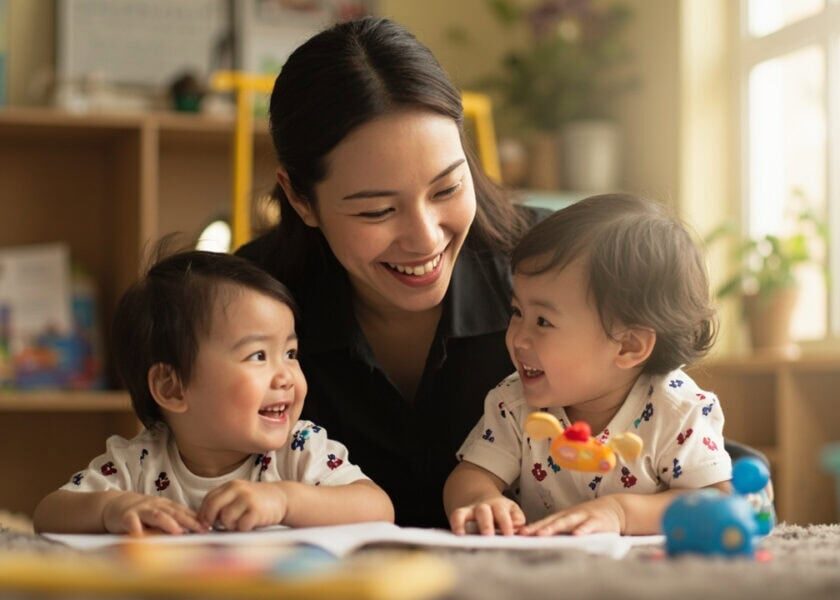
Think about language for a moment. A child in a high-quality developmental environment is not simply hearing words. They are being spoken with.
There is a distinction that sounds subtle and is, in fact, revolutionary. Passive language exposure—the kind that happens in front of a screen or even in a room where adults are talking among themselves—develops some vocabulary. But it does not develop language.
Language, the actual capacity to understand, to express, to engage in the back-and-forth of meaning-making, grows through responsive interaction. A caregiver who narrates what a child is doing, who pauses and waits for a response, who mirrors the child’s sounds and builds on them, who introduces new words in the context of a meaningful moment rather than a flashcard, is doing something neurologically significant. They are wiring the architecture of communication.
Research on early language development consistently shows that the quality and responsiveness of caregiver speech in the first three years has a stronger predictive effect on later language outcomes than the sheer quantity of words a child hears. In Singapore, where children will navigate bilingual classrooms, oral examinations, and a schooling system that rewards articulate thinking, these foundations are not a soft nice-to-have. They are the substrate.
Movement: Building the Learning Body
Consider movement. Motor development is not merely about a child learning to walk, run, or hold a crayon. It is about the integration of the body with the brain—what neuroscientists call sensorimotor integration—and it is deeply connected to cognitive development in ways we are still mapping.
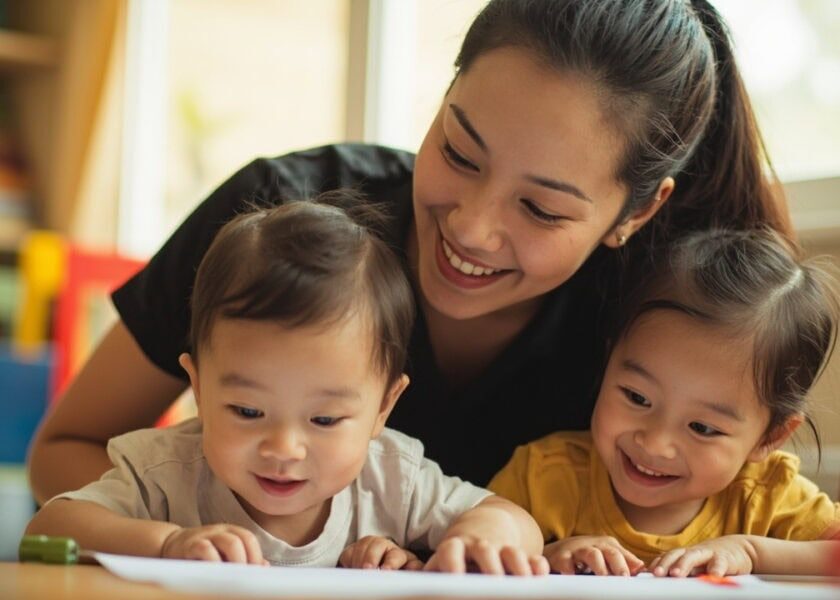
A child who spends their morning in a developmental environment with access to purposeful physical play, who climbs and balances and carries objects and pours water and manipulates playdough, is not just burning off energy. They are building the neural pathways that will later support their ability to sit still in a Primary One classroom, to attend to a teacher’s instruction, to coordinate their hand with their eye.
The body is not separate from the mind. It is a partner in it.
What does this look like in practice? It looks like a caregiver who notices when a child is ready for a new physical challenge and provides the exact level of support that helps them grow without doing the task for them. It looks like outdoor time that is not just recess but a curated sequence of gross motor experiences. It looks like fine motor activities woven throughout the day, building the dexterity your child will need for writing, drawing, and eventually, the demands of primary school.
Social-Emotional Skills: The Foundations of Classroom Readiness
And then there is social-emotional development, undervalued at our children’s peril.
A child in quality childcare is learning, in ways that cannot be taught from a textbook, how to be a person among other people. They are learning to read facial expressions. To share. To feel frustration and discover, with a skilled caregiver’s gentle guidance, that frustration does not end the world. To move from parallel play—where children play alongside each other—to cooperative play, where they play with each other.
These are not trivial milestones. They are the foundations of emotional regulation, of empathy, of the ability to navigate a classroom, a group project, a friendship, a team.
Children who enter Primary One with strong social-emotional foundations are not just more comfortable on the first day. They are more available to learn, because learning is, at its core, a social and emotional act. You cannot absorb what a teacher is saying if you are consumed by social anxiety or overwhelmed by the chaos of an unfamiliar room.
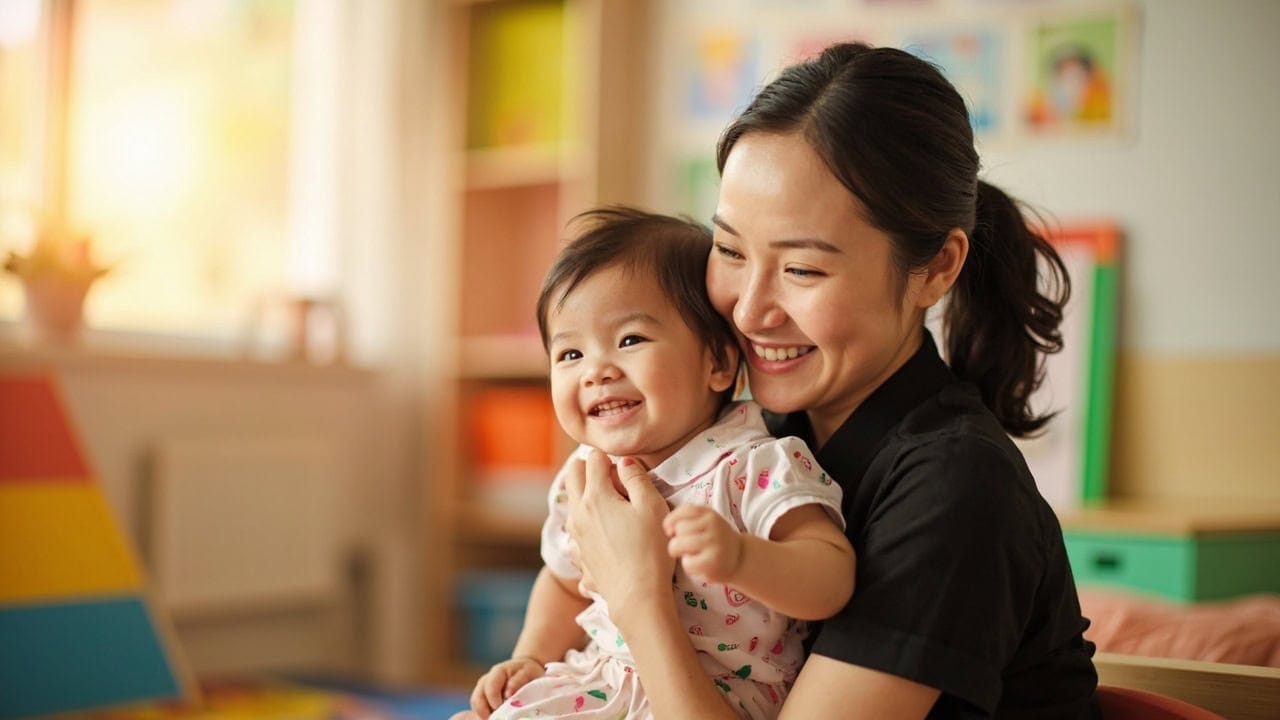
The child who has been in a developmental environment, who has already learned to feel safe in a group, who has experienced the rhythm of being part of something, starts from a different place. A more confident one.
Curiosity: The Disposition to Learn That Lasts a Lifetime
And then there is curiosity itself. The disposition to learn. That, too, is being built right now, in the hours you are not there.
A child in an environment where learning is treated as a natural, joyful, exploratory act, where their questions are taken seriously, where they are given time and space to wonder and discover rather than simply be entertained, is building something precious and durable.
They are building the belief that learning is possible, that the world is interesting, that their own mind is capable.
That belief will carry them through every examination, every subject change, every new challenge the Singapore education system places before them. It cannot be tested on a worksheet. But you will see it in their eyes on the first day of school, and you will recognise it for the rest of their lives.
What Actually Separates Developmental Care from Supervision
So what separates the environment that builds these things from the one that simply contains them?
The difference is not necessarily in the building, the resources, or even the curriculum on paper. It is in the intentionality of the adult in the room.
It is in whether the caregiver sees their role as keeping children occupied and safe, or as actively reading the developmental cues of each child and responding with purpose.
A caregiver in a truly developmental environment:
- Notices when a child is on the verge of a language leap and introduces the exact word that unlocks it
- Notices when a child is frustrated with a physical challenge and provides exactly the right level of support—enough to help but not so much that the child never discovers their own capability
- Notices when a child’s play is becoming a social experiment and scaffolds the moment with a question or a suggestion that deepens rather than disrupts
This kind of caregiving requires training, observation, and genuine attunement. And it requires something that no amount of background music or colourful wall posters can substitute: a ratio that makes attunement possible.
When one caregiver is responsible for three infants, there is time to notice. When one caregiver is responsible for eight or ten, the noticing becomes harder, the responses slower, the interactions less rich. The ratio is not a bureaucratic detail. It is the architecture of attention.
What to Look For When You Visit a Childcare Arrangement
When you are evaluating a childcare option, here are some questions that go beyond the surface checklist:
- How do the caregivers speak to the children? Are they speaking with them, narrating actions, pausing for responses? Or is the interaction mostly directives and corrections?
- What does the physical environment invite? Is there space for purposeful movement? Are there materials that invite sensory exploration and fine motor development?
- How do the children seem? Are they engaged, curious, moving purposefully? Or are they mostly waiting, watching screens, or engaged in activities that require minimal thought?
- How does the caregiver describe their role? Do they speak about the children as individuals with developmental trajectories? Or do they speak primarily about schedules and safety?
- How will you know what your child is learning? Is there a system for regular communication about developmental progress, not just feeding and nap times?
The answers to these questions will tell you whether you are looking at a place that keeps children or one that grows them.
EduNanny: A Developmental Partner for Singapore Families
There is a moment, almost every parent in Singapore knows it. You hand your child to someone else, and a quiet question rises from somewhere beneath all the logistics and the to-do lists. It is not the question you say out loud at the playground or at the dinner table. It is smaller than that, and it is larger.
It sounds something like this: What is my child learning right now, in this hour, while I am not there?
You love your child. That is not the question. The question is whether the hours you are apart are hours of mere safekeeping or something more. Whether somewhere across the island, in a room you have toured or not yet toured, your child is growing in the ways that matter, or simply being kept.
That question carries weight. And it deserves a real answer.
What Quality Developmental Childminding Looks Like in Singapore
In Singapore, families have more childcare options than ever, and this is a good thing. But not all options are the same. Quality developmental childminding is characterised by several key elements:
- Trained caregivers who understand child development, not just safety protocols
- Small ratios that allow for individualised attention and responsive interaction
- Intentional environment design that supports exploration, movement, and language-rich experiences
- Transparent communication with parents about their child’s development and daily experiences
- Consistency of caregiver relationship, so children feel secure and attachment can form
EduNanny operates within the ECDA Childminding Pilot, and this is worth understanding, because it is not simply a label. The pilot reflects a philosophy: that childminding, done with rigour and intention, can be a legitimate, high-quality developmental pathway for Singapore families.
For Parents Carrying Guilt
For many parents, returning to work carries a weight of guilt. I want to speak directly to that, because it is real and it is heavy, and it deserves to be set down.
The research is clear: the absence of parental presence is not what harms children. What harms children is the absence of responsive, attuned, loving interaction—whether that interaction comes from a parent or from a caregiver who has been trained to give it.
What your child needs is not your physical presence for every waking hour. What they need is the quality of engagement they receive in the hours they are with you and in the hours they are not.
A parent who returns to work with confidence, who has found a developmental environment that genuinely grows their child, who brings their full presence to the evenings and weekends, is not failing their child. They are doing exactly what the research supports: providing both the income that sustains their family’s future and the developmental environment that shapes it.
The guilt you feel is a sign of how much you care. But care and guilt are not the same thing, and the children of confident, informed parents who have made thoughtful choices do not suffer from parental doubt. They flourish from parental clarity.
The Support Behind the Care
EduNanny offers both home-based care, where a trained caregiver comes to your environment, and community or centre-based pathways, giving families choices that suit their circumstances. The infant ratios within the pilot structure are designed to allow for the kind of individualised attention that makes developmental care possible, not just aspirational.
The caregivers within the EduNanny network are trained, supported, and part of a structure that values consistency, communication, and ongoing development. For families, transparency measures offer reassurance—not as a gesture but as a genuine commitment to trust. EduNanny understands that trust is not given. It is built, one honest conversation at a time.
The fee structures within the pilot are crafted to make this quality accessible, not confined to families with unlimited resources. Many families find that their Child Development Account and Baby Bonus funds can be applied, which reflects a broader commitment to ensuring that developmental care is not a privilege of the few.
Your Child’s Foundations Are Being Built Right Now
What your child is learning right now, in the hours you are not there, is being built into them with every interaction, every word, every act of guided play, every moment of social discovery.
The question is not whether these hours matter. They matter enormously.
The question is whether the environment those hours are spent in has been chosen with the same intentionality that you bring to every other aspect of your child’s future. Because the truth is, you are already making this choice. Every parent is, the moment they enrol their child in any care arrangement.
EduNanny exists because we believe that Singapore’s children deserve more than supervision. They deserve environments that see them, that grow them, that treat every routine moment—every nappy change and every play session—as an opportunity to lay down the foundations of language, of movement, of social confidence, of curiosity, of the belief that they are capable learners who belong in the world.
If you are standing at the beginning of that search, feeling the weight of all the choices and all the what-ifs, you are not alone in it. The question you have been carrying, the quiet one, the one about what your child is actually learning, is the right question to be asking.
Finding the answer to that question, finding an environment that can give it to you honestly, is not just possible. It is what EduNanny is here for.
Your child’s foundations are being built right now. They deserve to be built well.
Ready to explore what developmental childminding looks like for your family? Connect with EduNanny Singapore to learn more about our trained caregivers, small ratios, and the philosophy behind care that grows.