The Daily Moments Building Your Baby’s Brain Architecture
That Moment When Your Baby Looked Up at You
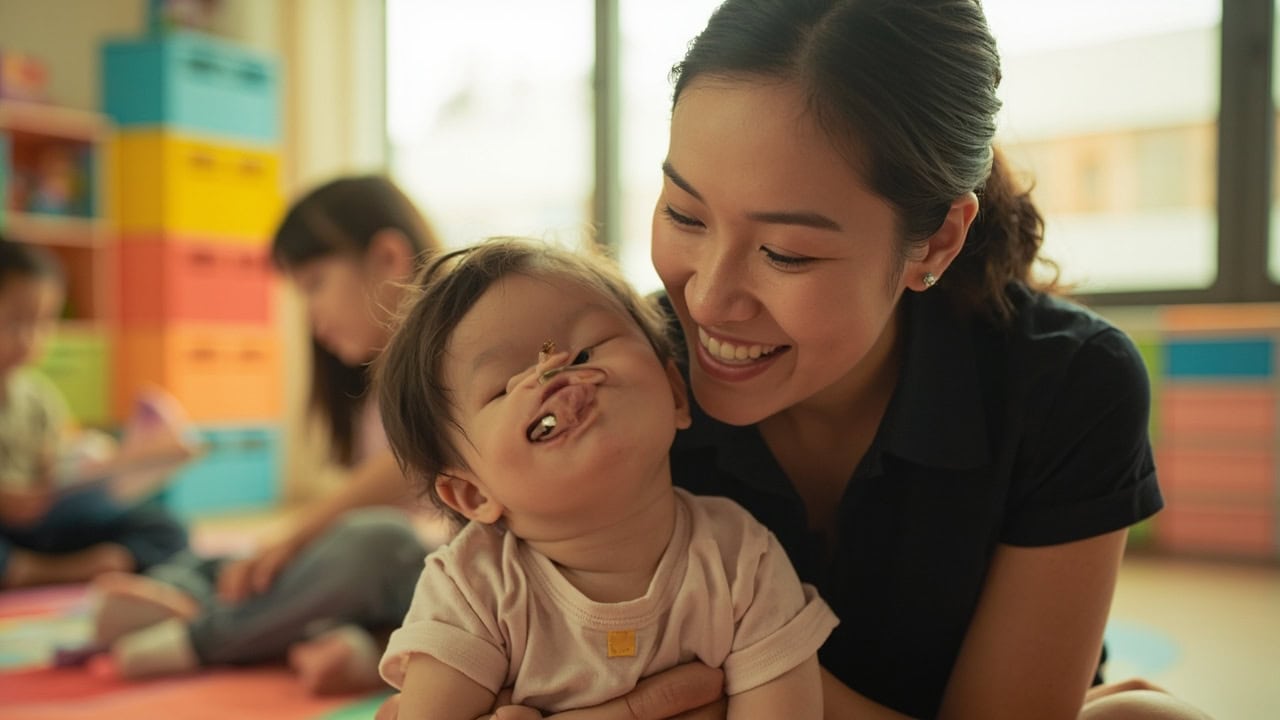
There is a moment familiar to most parents. You watch your infant reach for something just beyond her grasp—her fingers extending, her eyes focusing. And then she looks up at you. Not because she expects you to hand her whatever she’s after, but because she needs to know you’re there. She needs to confirm the world is still reliable.
When you respond—when your face shifts into her line of sight, when you nod, or smile, or say “you can do it”—something happens in her. Something measurable. Something real.
That moment is the beginning of everything. It is the beginning of trust. But it is also the beginning of neural architecture. The beginning of a capacity for exploration that will shape how she learns, how she forms relationships, how she eventually handles challenge and disappointment.
The way you responded to her in that moment—and the way your infant’s caregiver responds to her in the hundreds of moments like it that happen each day—that is not sentiment. That is not pampering. That is applied neuroscience, happening in real time, with consequences that compound across months and years in ways that researchers can now map with remarkable precision.
This is the truth that modern parenting research has been quietly revealing for the past several decades. And it is the truth that EduNanny has built its approach around: the daily, ordinary moments of infant care are not just about keeping children safe and comfortable. They are the moments in which the brain is literally being built.
Understanding the First Thousand Days
Every parent in Singapore has felt the weight of the childcare decision. It begins long before your child is old enough to need care—often in the final weeks of maternity leave, as you stare at your laptop screen comparing centres, reading reviews, asking friends for recommendations.
You want someone who will love your child. You want someone who will keep your child safe. You want warmth, patience, and the sense that your baby is in good hands.
But if you are like many parents today, you have also felt something else beneath that: a desire to know that your choice is not just emotionally right, but intellectually justified. You want to be able to explain, perhaps to a skeptical family member or to yourself on a difficult morning, why you chose what you chose.
That need—to validate a parental instinct with something more solid than a feeling—is not weakness. It is intelligence. And it is exactly where the science of early childhood development can help.
What Happens in a Child’s Brain During This Window
The window from birth to approximately age three is unlike any other period of human development. During this time, a child’s brain undergoes a phase of synaptic density that will never be repeated.
- One million new neural connections every second. In the first year alone, the brain creates connections at this extraordinary rate.
- Peak connection density by age three. By age three, a child has formed more connections than she will have at any other point in her life.
- Experience sculpts architecture. The brain is not merely growing—it is being shaped by every interaction, every responsive moment, every instance of care.
What does this mean for childcare? It means that the quality of care a child receives during these years is not incidental to her development. It is constitutive of it. The neural pathways that support emotional regulation, social connection, language acquisition, and cognitive flexibility are not waiting to be activated later. They are being laid down now, in the texture of daily care.
Researchers who study early childhood development use a phrase that can sound alarming until you understand what it means: the first thousand days are irreversible. Not in the sense that a single moment of less-than-ideal care will permanently damage a child—children are resilient, and relationships are repairable. But in the sense that the patterns established during this period tend to persist.
This is not a reason for parental guilt. It is a reason for clarity about what quality looks like.
The Secure Base: Why It Matters in Childcare
There is a concept at the heart of developmental science that EduNanny has made foundational to its approach: the secure base.
Psychologist Mary Ainsworth, whose research in the 1970s and 1980s fundamentally changed how we understand infant-caregiver relationships, described the secure base as a platform from which a child can explore the world, knowing that she can return to it for comfort and safety when needed. Think of it as an anchor—but not one that holds a child in place. Rather, it is the thing that allows her to venture out in the first place.
When a caregiver consistently responds to a child’s signals—her cries, her coos, her reaching, her facial expressions—with accurate attunement and appropriate response, the child develops what researchers call internal working models. These are not conscious beliefs. They are unconscious templates that shape how the child expects relationships to function.
A child who has experienced consistent, responsive care begins with an assumption that the world is reliable, that others can be trusted, and that she is worthy of attention and care. These assumptions do not guarantee success, but they create a foundation from which a child can approach challenge, connection, and growth with something essential in place: a basic sense of safety in the world.
Secure Base Formation in Daily Practice
In a childcare setting, the secure base concept translates into very specific, observable practices. Caregivers actively read infant cues, respond to distress before it escalates, mirror facial expressions that help infants learn emotional vocabulary, and provide physical comfort that research has shown calms physiological stress responses in measurable ways.
When a child at EduNanny reaches for her caregiver’s hand at the edge of a new activity, that caregiver notices. She doesn’t pull the child back into safety. She crouches beside her, puts a hand on her back, and says, “You’re deciding if you want to try. I’m right here.”
That small response—this is secure base formation in action.
What Quality Care Looks Like in Practice
This is where philosophy either becomes real or remains abstraction. Let us show you how developmental principles show up in daily care at EduNanny.
Arrival: A Psychologically Significant Transition
How a child enters a care environment affects her stress physiology and her ability to engage with learning activities for hours afterward. At EduNanny, caregivers greet each arriving child by name, with eye contact and a warm tone that matches the child’s energy. There is no clipboard procedure that overrides this moment.
There is a brief handoff conversation with the parent—not just “she slept well” but “she seems tired today, so we’ll watch for signs of overstimulation.” This kind of communication is not a courtesy. It is information transfer that allows caregivers to read signals more accurately throughout the day.
During Activities: Naming Emotions and Building Vocabulary
During morning activities, caregivers get down to the child’s level. They narrate what they are doing. They name emotions.
“I see you’re feeling frustrated that the block won’t stack. That’s a hard feeling. Let’s try again together.”
This practice has a specific developmental function. When caregivers consistently name emotions and validate children’s experiences, they are helping children develop what researchers call interoceptive awareness: the ability to recognize and communicate what’s happening inside their bodies. This is the foundation of emotional intelligence, self-regulation, and ultimately, mental health across the lifespan.
Feeding and Nap Times: Opportunities for Connection
During feeding times—whether bottle feeding for infants or mealtimes for toddlers—caregivers hold children in ways that allow for eye contact and interaction. They do not prop bottles or rush through meals to move to the next activity.
Feeding is not merely nutrition. It is an opportunity for bonding, for language exposure, for the kind of face-to-face interaction that activates the neural circuits associated with social development.
Similarly, sleep is not a logistical necessity to be scheduled and managed efficiently. It is a developmental process. Caregivers read tired cues, create consistent sleep routines, and provide the kind of physical comfort that helps infants transition into sleep without distress. When a child wakes, she is not left to cry alone. She is attended to, so that sleep remains associated with safety rather than abandonment.
Sustained Shared Thinking
Throughout the day, there are moments that educators call sustained shared thinking—when a caregiver and child are genuinely engaged with the same problem or experience, building on each other’s contributions.
It might be a caregiver noticing that a child is interested in how a ball rolls, and then placing the ball in different positions to test the child’s hypothesis. It might be a caregiver following a toddler’s lead during free play, asking open questions that extend the child’s thinking rather than directing it.
These moments are not scripted. But the conditions that make them possible—low ratios, trained caregivers, intentional design—are structural choices that EduNanny has made deliberately, based on research about what kinds of environments support cognitive development.
How to Evaluate a Centre Scientifically
You have heard phrases like “developmentally appropriate practice” and “quality care” before. They are everywhere in childcare marketing. Here is a practical framework for evaluating claims against observable reality.
1. Look at Ratios
Singapore’s regulatory minimum for infant care is one caregiver to eight infants. This is the floor—the legal minimum. At EduNanny, the infant ratio is configured at up to one caregiver to three infants.
This is not marketing language. It is a measurable, observable structural feature that you can verify by asking. Lower ratios are associated with better caregiver responsiveness, more individual interaction, and more positive outcomes for children. Ratios are not about how many children a caregiver can manage. They are about how many signals a caregiver can receive and respond to in a day.
2. Look at Continuity
Research on early attachment is very clear: the developmental benefits of responsive caregiving are greatest when that care comes from consistent, familiar caregivers over time. Infants do not form secure attachments to institutions. They form them to people.
Ask how many caregiver changes a typical infant experiences in a year, and what the transition process looks like when changes do occur. The answer will tell you something important about whether the centre’s stated philosophy matches its operational reality.
3. Look at Communication Systems
If a centre tells you they provide daily updates but can only share them once a week due to operational constraints, that gap is significant. At EduNanny, communication is built into the model. Parents receive regular updates—not just “she ate well” but information that allows you to understand how your child is developing within the programme.
Where deployed, transparency measures such as CCTV access allow parents to observe their child’s environment directly. These are not surveillance features. They are trust features, and the research on parental anxiety and childcare satisfaction suggests that they matter to outcomes for families.
4. Look at Training and Philosophy
Ask what the caregivers know about attachment theory. Ask how they handle separation anxiety. Ask what they do when a child is distressed. You are not looking for scripted answers. You are looking for evidence that the caregivers have been given a framework for understanding what they are doing and why.
A centre that can explain its practices in terms of developmental research is a centre that has made science part of its operation, not just its brochure.
Addressing What Singapore Parents Actually Worry About
Affordability and Accessibility
Singapore has made significant investments in early childhood support through mechanisms like the Child Development Account and Baby Bonus scheme. These structures exist because policymakers recognize what the research confirms: early investment in quality care generates returns that compound across a child’s entire educational trajectory and, ultimately, across a lifetime.
EduNanny operates within Singapore’s ECDA Childminding Pilot framework, which was designed precisely to expand the range of quality options available to Singapore families. The pilot fee structures are configured to make premium-quality infant care accessible in ways that standard centre costs often do not allow.
When you factor in CDA and Baby Bonus usability, the economics become not just manageable but strategically sound. You are not spending on childcare. You are investing in developmental infrastructure, with measurable returns that you may not be able to quantify today but that will reveal themselves across the years in your child’s capacity for learning, connection, and resilience.
Care is available Monday through Friday, in both home-based and centre-based pathways, making it possible for families across Singapore to access EduNanny’s approach regardless of their location or family structure.
Parental Guilt and the “Outsourcing” Concern
There is a quiet fear that many parents carry: that choosing childcare means somehow failing or shortchanging their child. This fear is understandable but misplaced.
The science is clear: the quality of the responses a child receives shapes her brain architecture, whether those responses come from a parent or from a trained caregiver. What matters is not the identity of the responder but the quality of the responsiveness.
When you choose EduNanny, you are not outsourcing parenting. You are partnering with a team that understands exactly what is at stake in the first thousand days, and that has organized every ratio, every routine, every training session, and every communication protocol around the science of what helps children thrive.
The Caregivers Themselves
In the research literature on quality childcare, there is a finding that sometimes gets lost in discussions of ratios and curriculum and neuroscience: the quality of the relationship between caregiver and child is the single most important variable in predicting positive outcomes. Not the toys. Not the facility. Not the curriculum documents. The relationship.
This means that when you choose a childcare centre, you are ultimately choosing people. You are choosing individuals who will spend more waking hours with your child than almost anyone else in her early life. You are choosing people whose patience, attunement, warmth, and professionalism will shape your child’s expectations of the world.
At EduNanny, the caregivers are not treated as interchangeable staff. They are supported, trained, and given the conditions that allow them to do this work well. Low ratios are not just better for children. They are better for caregivers, who can do their jobs without the chronic stress of impossible caseloads. They can be present. They can notice. They can respond.
The best caregivers stay when they are valued, trained, and given the conditions to succeed. And the best caregivers are what your child needs.
Making the Choice with Confidence
That moment when your infant looked up at you, reaching for something just beyond her grasp—you responded to her. That response mattered. But you are not always going to be there. And when your child is in someone else’s care, that response matters just as much.
It matters not because you have failed or because childcare is a poor substitute for parental presence. It matters because your child’s brain is building itself in real time, and the quality of the responses she receives shapes the architecture that will support her for the rest of her life.
This is not an abstraction. This is a fact of biology.
And it is a fact that gives every parent in Singapore more agency than they might realize. Because once you understand what quality looks like—once you can see it in ratios and continuity and caregiver responsiveness and communication—you are not at the mercy of marketing language or well-meaning intuition. You can evaluate. You can choose. You can justify your choice, to yourself and to others, with something more durable than a feeling.
Your instincts were right. You sensed that something mattered here, in these early years, in these ordinary daily moments. The science confirms what your heart already knew.
EduNanny exists to make that choice easier—not by pretending that care is simple, but by bringing together the warmth and the rigour, the heart and the intelligence, the trust and the transparency that Singapore families deserve. Not as a premium add-on. As a baseline.
Your child’s brain is building itself right now. Make sure it has what it needs.
If you are ready to explore what science-informed infant care looks like in practice, we invite you to reach out to EduNanny. Every question you ask is a sign of intelligent parenting. We are here to answer them.
EduNanny Singapore provides development-oriented infant care and childminding rooted in attachment science and the ECDA Childminding Pilot framework. Learn more about our approach or explore the ECDA Childminding Pilot.