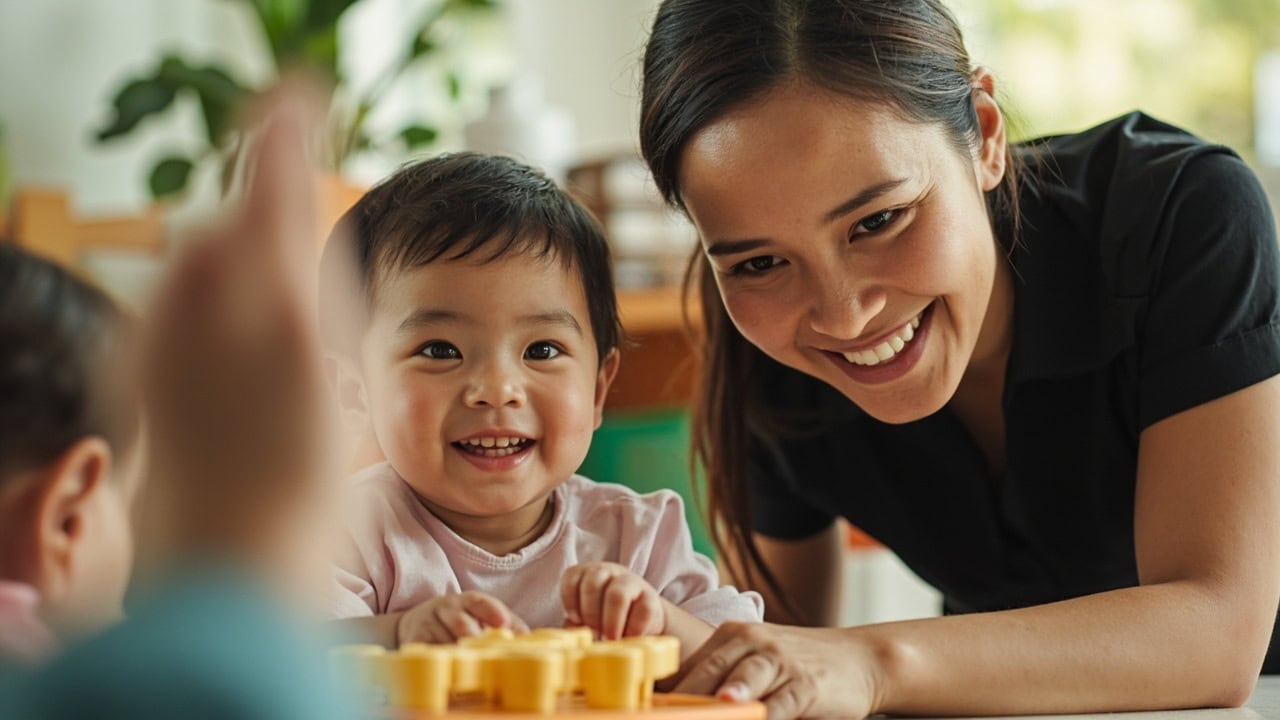
The Daily Habits That Transform Childcare Into True Partnership
After the Decision: What Every Parent Needs to Know
There is a particular quiet that follows a big decision. You have made the choice. You have toured the options, asked the questions, weighed the possibilities, and chosen the path that felt right for your family.
And in that moment after you sign the forms, after the settling visits, after the first week of tears and adjustments, there comes a thought that many parents in Singapore have learned to recognize: what now?
The choosing was hard. You know that. But somewhere in the weeks that follow, as you watch your child settle into a new rhythm, a quieter question emerges. It is less dramatic than the one that drove your search, but in some ways, more honest.
It asks not whether you chose well, but whether you are showing up well. Whether you are doing enough. Whether the partnership you have entrusted with your child’s earliest years is a collaboration you are actively building, or a service you are passively receiving.
If that question has found its way into your mind, I want you to know something: you are not alone in it. And more importantly, you are uncertain because you have recognized something true—that good childcare is not a thing you choose once. It is a relationship you build every day.
This article covers the shift from choosing well to partnering well, why daily presence matters, how to read the signals your child brings home, what meaningful reinforcement at home looks like, and how partnership evolves through your child’s earliest years.
Two Kinds of Parents
This is about the parent you become after the decision is made. The parent who walks through the door each morning not as a client dropping off a child, but as a partner in the most important work there is.
Let me tell you what I have observed. Some parents arrive at their childcare arrangement with confidence, having done their research, and they settle into a comfortable rhythm. They trust their caregiver. They believe their child is well cared for. And they stop there.
They become observers. They drop off. They pick up. They exchange pleasantries. They go home. And their child moves between two worlds that rarely speak to each other with real intention.
Other parents do something different. They stay curious. They notice. They ask questions not because they are suspicious, but because they are interested. They share what their child is doing at home—the new word, the stubborn phase, the fear of the vacuum cleaner, the book that cannot be read enough times.
They listen not just for updates, but for patterns. They see the caregiver not as a hired hand, but as someone who knows their child in a different context, someone whose observations carry weight and insight.
These parents are not doing anything magical. They are simply doing something that requires practice. They are learning to be active partners in their child’s care. And the difference it makes, over months and years, is extraordinary.
The Three Skills That Build Partnership
Presence
Partnership with your child’s caregiver is not something you are born knowing how to do. It is something you develop, and like any skill, it gets better with attention, with feedback, with a willingness to learn.
The first skill is presence. I do not mean physical presence, though that matters too. I mean the kind of presence that notices.
The parent who reads the daily chart and asks a follow-up question. The parent who notices that their child has been clingy for two mornings and mentions it—not with alarm, but with curiosity.
She seems a bit more attached to me at drop-off this week. Is that something you are seeing too?
That question, asked with genuine interest rather than implied criticism, opens a door. It tells your caregiver that you are paying attention. That you see her as a resource. That you are in this together.
Reading Signals
Reading what your child brings home from care is one of the most powerful things a parent can do. Not in a surveillance sense, not in a checking-up sense, but in a listening sense.
Children between infancy and preschool age communicate so much through their play, their behavior, their invented scenarios.
- When your three-year-old spends an afternoon lining up toys and being very firm about the order, that is not random. It might tell you something about her experience at care—the structure, the routines, the way her day is organized.
- When your infant comes home from a long day and is particularly needy, reaching for you with a kind of desperate relief, that is information too. Not a sign that care is bad, but a sign that your child knows what she needs and is telling you about it.
The parent who learns to read these signals becomes a better partner to the caregiver. Because then you can say, She has been talking about the song you sing before nap time. She wants me to sing it too. And the caregiver knows that her work is landing, that the relationship she is building with your child extends beyond the walls of the care setting.
Or you might say, She has been having big feelings in the evenings. Is there something that tends to trigger that during the day? Now you are not comparing notes like suspicious strangers. You are collaborating. You are building a picture together.
Daily Communication
Communication, in this context, is not about the formal check-in or the scheduled review meeting. It is about the small daily exchanges that build a shared understanding of your child.
- It is the text message that says, She didn’t sleep well last night, so she might be tired earlier today.
- It is the note in the communication book that mentions the new skill she mastered at home—the unprompted “please” or the successful potty attempt.
- It is the question you ask at pick-up that is not about logistics but about connection: What was the best part of her day?
Communication requires two willing participants. If you have shared your observations and found only monosyllables in return, if you feel like you are talking into a wall, that is real information too. A caregiver who is truly partnered with you will welcome your engagement. She will share her own observations. She will see your interest as an asset, not a threat.
Reinforcement at Home
What happens at home when your child comes back from care? Do you ask her what she did? Do you look at the art she made and hang it somewhere she can see? Do you follow up on a story she tells about a friend, a routine, a moment of triumph?
Or does the care day simply end when she walks through your door, replaced entirely by the home world?
Reinforcement is not about replicating the classroom at home. It is about acknowledging, validating, and building on what your child experiences in care.
When your toddler tells you about her friend and you say, Yes, the friend who builds towers with you. Tell me more about that, you are doing something powerful. You are telling your child that her care world matters to you. That it is not separate from your world. That you are paying attention.
Reinforcement is available to you even on the hard days, the exhausted days, the days when you feel like you have nothing left to give. It lives in small moments:
- The question you ask when your child comes home
- The conversation you follow instead of redirecting
- The art you hang where she can see it
- The song you learn because she talks about it
These are not burdens. They are connections.
And they compound. A child who experiences this kind of continuity develops a sense of security that goes deeper than any single caregiver relationship can provide. She knows that her parents and her caregiver are aligned. That they talk. That they care about the same things. That her life is not fragmented into disconnected pieces but is a coherent story that everyone around her is helping to write.
Growing Together Through Every Stage
As your child moves through developmental stages—from infant to toddler to preschool—this partnership evolves. What you need from communication changes. What you reinforce changes. The questions you ask become more complex. The observations your caregiver shares become richer.
You might find that the bedtime routine you built together in infancy becomes the shared story language of the preschool years. The trust you built in the early days becomes the foundation for honest conversations about challenges, about behaviors, about the hard moments that every child and every family encounters.
There are disagreements. There are misunderstandings. There are moments when you realize you had different expectations about something small—a feeding schedule, a sleep method, a response to a tantrum.
But when the foundation is one of genuine partnership, these moments become opportunities. You talk about them. You learn from them. You adjust. And you come out the other side with a deeper understanding of each other and, more importantly, of your child.
Staying Engaged Without Overstepping
There are moments when I can feel the resistance. Some parents have decided, consciously or not, that the way to protect themselves from the vulnerability of trusting someone else is to stay at a distance. To not ask too many questions. To not look too closely. To treat the caregiver as a service provider whose job is to deliver a product.
If that is where you are, I understand it. Trusting someone with your child is terrifying. And distance feels safer than engagement.
But I want to tell you what you lose when you choose distance.
- You lose the ability to know what your child is experiencing in those hours when you are not there.
- You lose the insight that only comes from a caregiver who feels trusted enough to share honestly.
- You lose the compounding effect of a child who knows her worlds are connected.
- You lose something for yourself—the deep satisfaction of knowing that you are an active, capable participant in your child’s care, not a passenger on someone else’s journey.
The parent who shows up as a partner is not the parent who interrogates. They are not the parent who hovers or second-guesses or undermines the caregiver’s authority.
They are the parent who brings curiosity to every interaction. Who shares generously what they know about their child. Who asks not is my child safe? but what is my child learning? Who is my child becoming? What can I reinforce at home?
They are the parent who walks into the care setting with the quiet confidence of someone who knows they belong there—not as an owner, but as a collaborator.
Quality Childminding in Singapore: What Actually Matters
In Singapore’s childcare landscape, families have access to different pathways—centre-based care, home-based childminding, and family-run options. Each has its place, and what matters most is not the setting itself but the quality of the partnership within it.
For infants especially, the ratios matter. A home-based setting with one caregiver for up to three infants allows for genuine attention—not just supervision, but knowledge. Your child is known, not just watched.
Beyond ratios, here is what quality childminding actually requires:
- A caregiver who sees parents as essential contributors, not obstacles
- Communication systems that support daily exchange, not just formal updates
- Routines that create security, not just schedule
- A caregiver who invites parental engagement rather than tolerating it
- Flexibility to adapt as your child’s needs change
The practical realities matter too. Affordable fees, access to subsidies and schemes like the Child Development Account and Baby Bonus, care blocks that align with the rhythms of working parents—these are not incidental details. They are the conditions that make partnership possible.
When parents are stressed about cost, when they feel like they are stretching to afford care, that stress leaks into the relationship with the caregiver. It creates guardedness where openness should be.
The Partnership Your Child Deserves
There is a phrase I keep coming back to when I think about what children need in their earliest years: consistency of care.
Not just consistent schedule, though that matters. Not just consistent environment, though that matters too. But the deeper consistency of a family and a care team moving in the same direction. Speaking the same language. Reinforcing the same values. Responding to the child in ways that complement rather than contradict each other.
That kind of consistency is not an accident. It is not the result of finding the perfect caregiver and hoping for the best. It is built, day by day, by parents who choose to stay engaged. By caregivers who invite that engagement. By an organization that understands that its job is not just to place a caregiver in your home or welcome your child into a centre, but to nurture a relationship that grows more valuable with every passing month.
If you are a parent in Singapore who has chosen childcare—any childcare, from any provider—I want you to know that the decision was only the beginning. The real work is what comes next.
And that work is not overwhelming. It is not complicated. It is simply this:
- Show up with intention, not just presence.
- Notice what your child brings home and what she tells you through behavior and play.
- Ask genuine questions and listen to the answers.
- Share what you observe at home—your child’s habits and rhythms and the small triumphs of each day.
- Reinforce the connections between your two worlds—the songs, the routines, the language, the love.
- Grow alongside your caregiver as your child grows, evolving together through every stage.
This is the partnership that transforms adequate care into something extraordinary. This is what your child deserves—not just a caregiver, but a team. Not just a service, but a relationship. And not just a choice made once, but a collaboration renewed every single day.
The children in their earliest years are not products to be delivered. They are people in the most critical phase of development, and the conditions that shape them extend far beyond any single caregiver, any single setting, any single moment.
The parent who actively partners with their childcare provider is giving their child something no single caregiver alone can provide—the consistency of a family and a care team moving in the same direction.
The quiet work of partnership. It happens in the small moments. And it matters more than almost anything else you will ever do.
At EduNanny Singapore, we believe that exceptional childcare is built on genuine partnership between families and caregivers. Our ECDA-registered childminding services are designed to keep parents informed, involved, and confident—because the best care happens when everyone is moving in the same direction.
Connect with us to learn how EduNanny supports the partnership your child deserves.