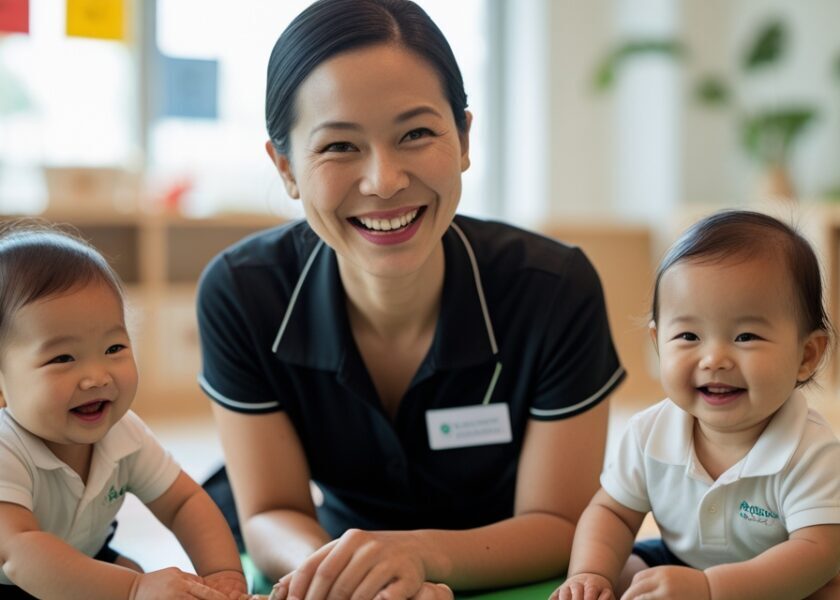
The Confident Goodbye: A Singapore Parent’s Guide to Trusting Childcare
Why Singapore Parents Feel This So Deeply
For most parents in Singapore, the belief that leaving your child in someone else’s care is an act of love is not quiet and confident. It is loud with doubt. It is shaped by something particular to how we parent here — the weight of cultural expectation, the narrative that a good mother should be present, the fear that every hour spent away is an hour that costs something irreplaceable.
We live in a city where early childhood development is taken seriously. Parents research pedagogical approaches and teacher qualifications and curriculum frameworks. We compare philosophies, read reviews, join parenting forums, and second-guess ourselves into exhaustion. And despite all of that research, the moment of leaving your child still feels like stepping off a cliff.
This is not weakness. This is not irrationality. This is the most honest thing a parent can feel, because it means you take seriously what you are doing.
Here is what EduNanny has seen lived out across hundreds of Singapore families: the transition period is not a footnote to the childcare decision. It is the decision. A difficult transition does not just make the first week hard. It makes the second month hard. It makes parents pull their children out not because the care was wrong, but because they were never given the tools, the time, or the reassurance to believe it was right.
This is the gap EduNanny exists to fill. Not because they have a magical solution to the emotions of leaving your child — those emotions are real, and no one should pretend otherwise — but because they have built an entire approach around the truth that how you say goodbye determines whether goodbye becomes easy.
What Quality Childminding Actually Looks Like
Before we go further, it is worth being clear about what separates quality childminding from adequate childcare, because the difference matters enormously during the transition period.
The ECDA Childminding Pilot Context
EduNanny operates within Singapore’s ECDA Childminding Pilot framework, and this is significant. The pilot was designed with something essential in mind: small ratios, consistent caregivers, home-based and community-based care that mirrors the intimacy of a family home rather than the scale of a large institution.
In the EduNanny model, infant ratios are kept at up to one-to-three. That is not a number on a brochure. That is the difference between a caregiver who is managing three children and a caregiver who can read one child’s face, one child’s cry, one child’s silence, and know what it means. It is the difference between care that is efficient and care that is attuned.
Why Caregiver Continuity Matters More Than You Think
EduNanny understands something that seems obvious but is surprisingly rare in the childcare landscape: your child does not need to meet a new person every day and learn to trust them. Your child needs one person, consistent, warm, attuned — and they need that person to become, gradually and respectfully, a part of their world.
That is not a luxury. That is the foundation of everything else.
When your child can form a genuine secondary attachment figure — someone who is predictable, warm, and responsive — they develop what psychologists call a “secure base.” From that secure base, exploration becomes possible. The goal was never a child who does not need their parent. The goal is a child who trusts their parent so deeply that they can be brave.
The Settling-In Process: How EduNanny Guides the Transition
Let us take you into the first morning. Not a generic first morning, but the one that is happening right now in a Singapore home — in a flat in Jurong, a condo in Bishan, a landed property on the East Coast.
The parent has packed the diaper bag the night before. They have laid out the spare clothes. They have triple-checked the emergency contacts. They have done everything they were supposed to do. And at six-thirty in the morning, they pick up their child — sixteen months old, maybe twenty months — and they feel that weight in their chest. Not the weight of the child, though that too. The weight of the decision. The weight of not knowing.
The caregiver, if it is an EduNanny childminder, has been prepared. Not just scheduled — prepared. The continuity plan is in place. The same caregiver. The same space. The same gentle face at the door.
The settling-in protocol is structured, but it is not a checklist. It is a choreography — a dance between your child’s pace and the caregiver’s skill, and the parent is not excluded from it.
Phase One: Shared Presence
In the first few sessions, the parent stays. Not hovering, not anxious — though the anxiety is acknowledged and allowed — but present. The caregiver engages the child while the parent is in the room, and the parent watches.
They watch how the caregiver speaks to their child. How they kneel to eye level. How they narrate what is happening rather than just directing it. They watch their child’s responses — the wary eyes, the tentative reach for a toy, the way the child glances back to check that the parent is still there.
That checking-back is not weakness. It is wisdom. Your child is gathering information. They are doing exactly what developing brains are designed to do: assess safety, read faces, and make decisions.
Phase Two: Gradual Separation
As the days progress, the parent begins to step back — slowly, and never faster than the child can tolerate. The caregiver takes over more of the interaction. The parent moves to the next room, then to a brief absence, then to the full drop-off and pick-up rhythm.
This gradual approach is not coddling. It is neuroscience. A child’s stress response system is designed to protect them; if that system is repeatedly overwhelmed before the child has developed coping resources, the stress becomes toxic rather than tolerable. Gradual settling-in respects the child’s biology while building their capacity.
Reading Your Child’s Signals
Here is something EduNanny’s caregivers are trained to recognise, and something every parent in that room needs to understand: there is a critical difference between separation anxiety and healthy adjustment, and they are not the same thing.
Signs of healthy adjustment include:
- A child who cries at drop-off but settles within minutes
- A child who resists being held by the caregiver on Day One and accepts a snack from them on Day Three
- The quality of cry changing over days — less frantic, more modulated
- Play that starts tentative and becomes absorbed
- Sleep that comes in a new place because the body has decided, at some level, that it is safe enough
Signs that need attention include:
- A child who is chronically distressed and cannot be comforted despite the caregiver’s best efforts
- Withdrawal that deepens rather than gradually lifting
- Regression in eating, sleeping, or developmental milestones that persists beyond a few days of adjustment
- Physical symptoms — unexplained rashes, digestive issues — that coincide with the transition
EduNanny’s caregivers are trained to observe these cues and communicate them honestly to parents, because the difference between a child who is adapting and a child who is suffering is not always obvious — and getting it right matters enormously.
The Parent’s Emotional Journey: You Are Not Excluded From This Process
And this is where most childcare arrangements fail — not because they are bad, but because they leave the parent alone in that feeling with no framework, no process, no guide.
EduNanny does not leave you alone.
The communication during the transition window is active, responsive, and honest. Parents receive not just a daily report but a narrative — what did your child eat, how did they sleep, what did they discover, where did they pause. This is not administrative. This is evidence. This is the daily proof that your child is not in distress but in process.
For a Singapore parent who is sitting at their desk, at a meeting, in a taxi, trying to concentrate on work while their mind is with their child, that message — that quiet, specific, honest update — is everything. It is the difference between wondering and knowing.
Because here is the truth that no one tells you clearly enough: your anxiety is not separate from your child’s adjustment. They are connected. When a parent can breathe, they transmit calm. When a parent receives evidence that their child is safe, the whole system settles. EduNanny’s approach treats the parent-child dyad as a single emotional unit during the transition — because it is.
There is a moment that EduNanny sees again and again, a moment that never stops being meaningful even after hundreds of families have walked through it. It happens around Day Five, or Day Eight, or sometimes Day Twelve.
The parent arrives for pick-up and their child is in the caregiver’s arms, or at the table with the caregiver, and the child looks up — and the child’s face changes. It lights up. The child reaches out to the parent, yes. But almost simultaneously, the child reaches back to the caregiver. A wave. A smile. The child is in two worlds and both of them feel like home.
That is the moment the transition stops being a period and starts being a foundation.
Addressing Your Real Concerns
“Will my child feel abandoned?”
This is the fear that wakes you up at night, and it deserves a real answer. When a child is placed in quality care with a consistent, attuned caregiver and a gradual settling-in process, the research consistently shows they do not feel abandoned. They feel what Attachment Theory calls “conditionally secure” — the caregiver becomes a secondary attachment figure, not a replacement for you, but a genuine source of comfort and safety in your absence.
The key words are “quality,” “consistent,” and “gradual.” Without those three elements, the answer is less certain. With them, the evidence is strong: children in these conditions show healthy attachment behaviours, not abandonment responses.
“Am I a bad parent for choosing childcare?”
No. This needs to be said clearly because the cultural narrative in Singapore still implies it. Choosing quality childcare is not a failure of love. It is an act of love that acknowledges reality: that families sometimes need two incomes, that children benefit from rich social environments, that parents who are fulfilled in their work bring more presence home to their children.
The question is never “childcare or no childcare?” The question is “what kind of childcare, and is it the right fit for my child?” That is a completely different — and much more productive — question.
“What if the caregiver is not good enough?”
This concern is legitimate, and it is exactly why caregiver quality and continuity matter so much. When you choose a service with rigorous caregiver training, small ratios, and a structured settling-in protocol, you are not hoping for the best — you are building in safeguards. The caregiver is not just hired; they are prepared. They are not just present; they are attuned.
EduNanny’s caregivers are trained not just in child development but in the far more delicate art of holding space for parents who are learning, alongside their children, how to trust. That training is not a checkbox. It is a practice.
“What if my child just cries every day?”
Some crying at drop-off is normal and expected. It is not a sign of failure. The question is what happens after the drop-off — does the child settle? Does the crying reduce over days? Does the caregiver have the capacity and skill to soothe and engage?
If your child is chronically, inconsolably distressed, that is a signal to pay attention to — not to immediately pull them out, but to investigate. Is the ratio right? Is the caregiver the right fit? Is the transition happening too fast? EduNanny’s caregivers are trained to communicate early if a child is struggling in ways that need adjustment.
What to Look for When Choosing Infant Care
If you are evaluating childcare options in Singapore, here are the questions that matter most:
- What is the caregiver-to-child ratio? For infants, one-to-three or better is ideal. Anything higher than that makes attuned care genuinely difficult.
- Will my child have one primary caregiver, or rotate between multiple people? Consistency is not a nice-to-have. It is the foundation of attachment.
- What does the settling-in protocol look like? Is there a gradual transition? Can parents stay initially? Is the pace guided by the child?
- How will I know what is happening during the day? Look for services that offer narrative communication, not just checkbox updates.
- Are caregivers trained in reading attachment cues and stress signals? This is the skill that distinguishes adequate care from attuned care.
- How does the service handle the parent’s anxiety during the transition? You should not be left alone with your fear. You should be guided through it.
- What happens if something goes wrong? Understand the communication protocols, the escalation pathways, and the philosophy around partnership with parents.
Centre-Based vs. Home-Based Care
Both can be excellent. Both can be inadequate. The distinction that matters is not the setting but the ratios, the caregiver quality, the consistency, and the presence of a structured transition protocol.
EduNanny’s home-based model within the ECDA Childminding Pilot offers particular advantages for infants — the intimacy, the small ratios, the family-home environment. Combined with their AI companion Thomas — available to parents for quick questions and reassurance between moments — EduNanny stays present across the full arc of the childcare journey, not just the transition but the months and years that follow.
The Goodbye That Builds Trust
Let us come back to where we started, because that is where the truest things live.
There is a parent in Singapore right now who has made a decision. They have decided that quality childcare matters. They have done the research, weighed the options, considered the cost, had the conversation with their partner, maybe had the harder conversation with their parents-in-law or their own mothers who do not quite understand why they are not staying home.
They have decided. And they are still afraid.
EduNanny meets that fear with structure, with consistency, with communication, with caregivers who are trained not just in child development but in the far more delicate art of holding space for parents who are learning, alongside their children, how to trust.
Not because they promise you will never feel worried — that would be dishonest. But because they meet your fear with a process designed with integrity — where every detail of the settling-in period is considered, where the caregiver continuity is maintained not as policy but as practice, where the parent receives honest updates not because it is part of a system but because the people at EduNanny believe that a parent who knows is a parent who can breathe.
Singapore parents do not need another reminder that the early years matter. They know. They are living it. What they need — what you need — is a path through the hardest part of that belief, a path that does not ask you to suppress your anxiety or pretend the drop-off is easy, but a path that walks beside you through it and shows you, day by day, with evidence and care and human warmth, that your child is not just safe but flourishing.
That the caregiver is not just competent but genuinely attuned. That you made the right call, not just on the first day but on the hundredth.
That is what EduNanny offers. Not certainty — nothing and no one can offer that, and any service that claims to is not being honest with you. But purpose. Process. Partnership.
The understanding that the transition is not an obstacle to overcome on the way to good childcare. It is the first act of it. The first act of something that, when done well, gives your child a secure base from which to grow, gives you the confidence to work and rest and be the parent you want to be, and gives Singapore’s children the early years they deserve — years full of not just learning, but belonging.
The goodbye that builds trust. That is where it begins. And that is why it matters so much.
Ready to explore what a supported transition could look like for your family?
EduNanny invites Singapore parents to learn more about their childminding approach, their settling-in protocols, and how they walk alongside families through this pivotal moment. Because the right start makes all the difference.
Connect with EduNanny to begin a conversation about your family’s needs, or read more about their philosophy and team.