
The Civic Cradle: EduNanny by BUTLER Redefining Infant Care as Public Infrastructure in Singapore
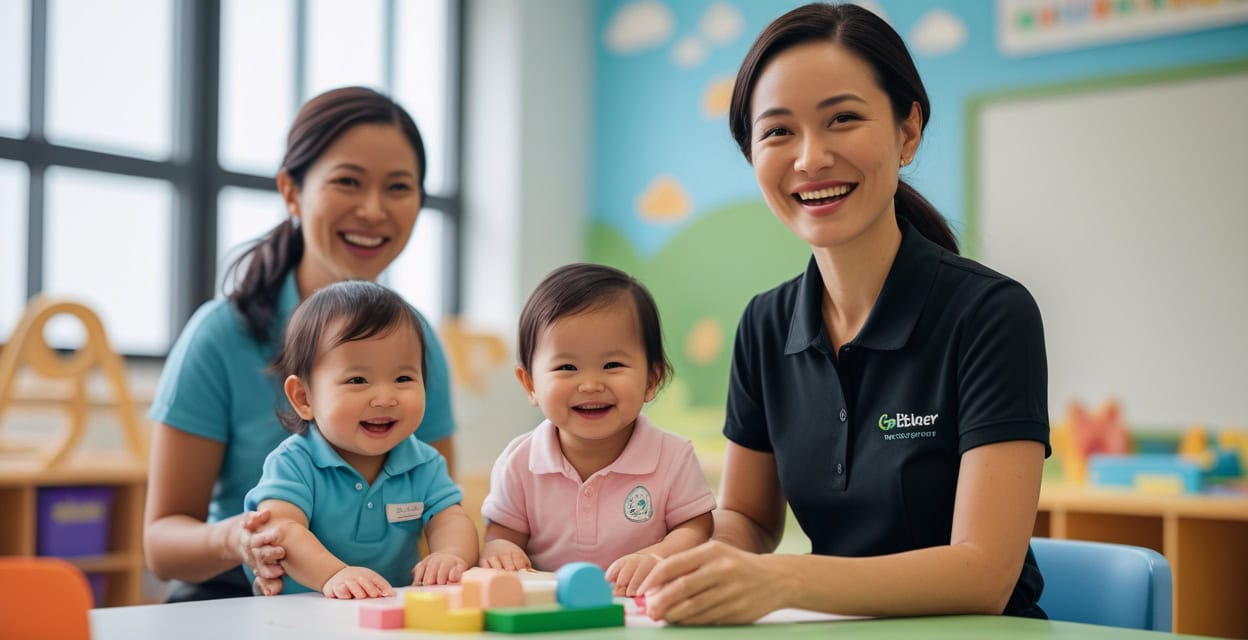
EduNanny by BUTLER: A Civic Standard for Infant Care in Singapore
Good beginnings deserve more than a schedule; they require a relationship. EduNanny by BUTLER positions infant care as a public good and a family treasure. This article expands the vision from the speech into practical, actionable guidance for parents, caregivers, and community stakeholders who seek a reliable, compassionate, and measurable standard for early care in Singapore.

What EduNanny Is and Why It Matters
EduNanny is a civic-minded childminding standard that unites centre-based and home-based care under one consistent framework. It emphasizes close-to-home care, a rigorous 1:3 infant ratio, trained childminders, and modern, welcoming environments. The aim is safety that is visible, learning that is playful, and joy that can be measured — all within hours that respect working families: Monday to Friday, 7am to 7pm. This section outlines how the standard translates into practical benefits for families and communities.
Key Benefits for Families
- Close proximity, consistent quality: A unified standard reduces the guesswork when choosing carers and makes it easier to compare options with confidence.
- Transparency without intrusion: The Balance of openness and privacy — including secure digital updates and optional CCTV windows — keeps parents informed while honoring caregiver dignity.
- Affordability that doesn’t compromise care: The 1:3 ratio and trained professionals ensure attention and development aren’t sacrificed for price.
- Nation-wide access across Singapore: Islandwide availability shortens commutes, increases opportunity for family time, and bolsters community employment.
What the Standard Demands of Caregivers
- Training and coaching: Ongoing professional development to maintain high-quality interaction with infants.
- Predictable workweeks: Consistent hours, stable shifts, and a supportive employment environment.
- Documentation and storytelling: Regular sharing of progress notes, routines, and daily highlights with families.
- Respect for dignity and safety: Safe environments, respectful care practices, and privacy-first policies in all moments of caregiving.

Three Practical Tensions We Solve — And How to Apply Them
Parents and providers often navigate triads of competing needs. EduNanny addresses these tensions head-on, with actionable guidance and transparent standards.
1) Proximity vs. Consistent Quality
- What it means: People want care near home or work, but quality must be reliably high across settings.
- Actionable steps for families:
- Ask to see the infant area layout: open sightlines, age-appropriate materials, and child-safe finishes.
- Request a sample day plan to observe how transitions are handled from arrival to mid-day activities.
- Inquire about staff turnover and rounding systems to ensure continuity of relationships.
2) Warm Relationships vs. Visible Safety
- What it means: Relationships matter deeply, but safety must never be invisible or optional.
- Actionable steps for families:
- Review safety routines: diaper changes, sleep safety, feeding protocols, and allergic accommodations.
- Seek information about supervision models (e.g., two-step verification for medications, handovers, and transport).
- Ask for how CCTV, if used, protects privacy and what zones are visible to families.
3) Affordability vs. Training and Ratios
- What it means: Reasonable fees should not undermine the training pipeline or the 1:3 ratio.
- Actionable steps for families:
- Review fee structures and any government subsidies (e.g., CDA/Baby Bonus) that apply.
- Ask for a transparent breakdown: staffing costs, room usage, meals, and materials that support development.
- Request progress milestones and how they map to ongoing costs and services.
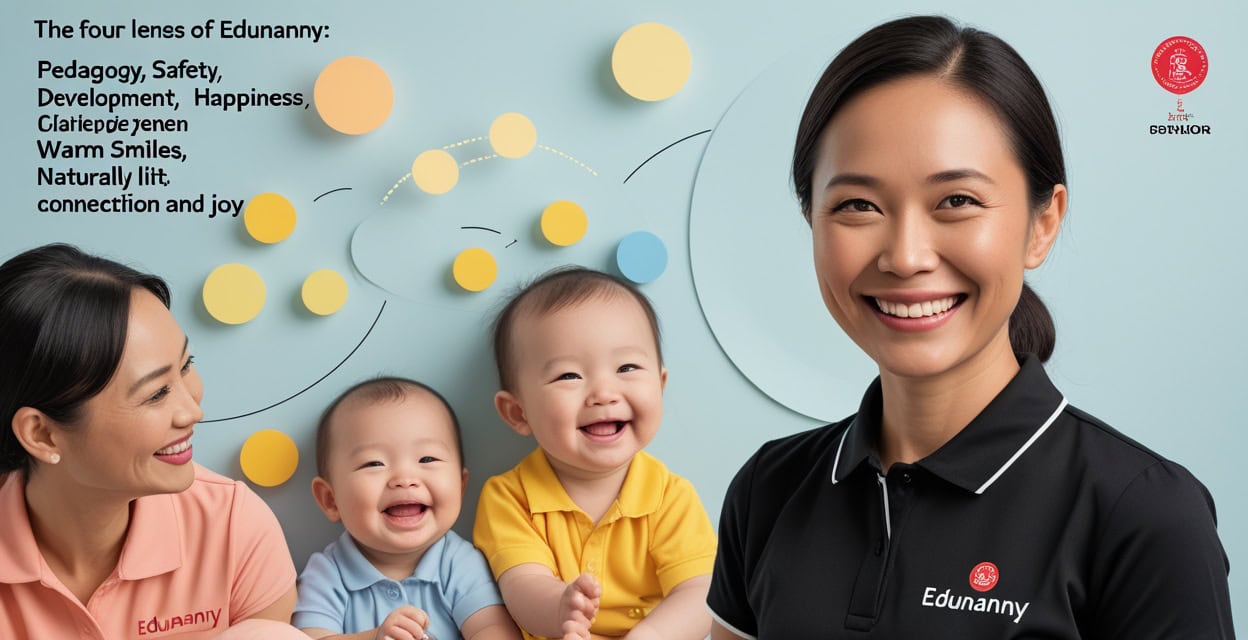
The Four Lenses of EduNanny: Pedagogy, Safety, Development, and Happiness
EduNanny organizes infant care around four integrated lenses. Each lens translates research into everyday practice, ensuring that learning is meaningful, safety is visible, development is trackable, and happiness is prioritized.
1) The Lighthouse Loop: A Pedagogical Promise
The Lighthouse Loop turns everyday moments into opportunities for growth. It is designed for real-time use, even within a small group of three infants.
- See: Observe breath, gaze, and reach before responding.
- Name: Narrate experience to build language and cognitive connections.
- Scaffold: Offer the right challenge just beyond the child’s current reach.
- Illuminate: Celebrate attempts to foster resilience and persistence.
Practical examples:
- During a transition from play to snack time, a caregiver narrates: “You’re looking at the spoon; you’re curious about the cheese puff. Let’s explore together.”
- When a child explores stacking rings, the caregiver slightly adjusts height and order to maintain engagement without frustration.
2) The Safety Weave: Visible Safety in Daily Habits
- Predictable pace: Calm arrivals, unhurried feeding, gentle handovers.
- Open sightlines: Room layouts designed for visibility without intrusion; staff present and engaged.
- Prepared rooms: Safe sleep practices, allergen controls, temperature checks, and clearly labelled bottles.
- Two-step verification: Double-confirmation for medications and handovers, with careful logging.
3) The Growth Constellation: Five Developmental Domains
- Security and attachment: Responsive soothing, predictable routines, and familiar voices.
- Sensory-motor mastery: Floor time, safe climbing, grasp-and-release play, water and tactile exploration.
- Language and joint attention: Face-to-face talk, songs, object naming, and turn-taking babble.
- Self-regulation and sleep: Gentle wind-down rituals and predictable nap patterns.
- Belonging and culture: Home-language songs and family-visible cultural rhythms in daily routines.
4) The Joy Index: Measuring Happiness Artfully
- Relaxed body: Shoulders down, calm breathing, open hands after soothing.
- Bright eyes: Sustained gaze on people and objects, not avoidance.
- Exploratory hands: Safe touching that signals curiosity and engagement.
- Reciprocal sounds: Babble and coos that respond to adult interactions.
Note: The Joy Index is not a score; it is a living portrait used to adapt the environment, pace, and adult approach to sustain engagement and safety.
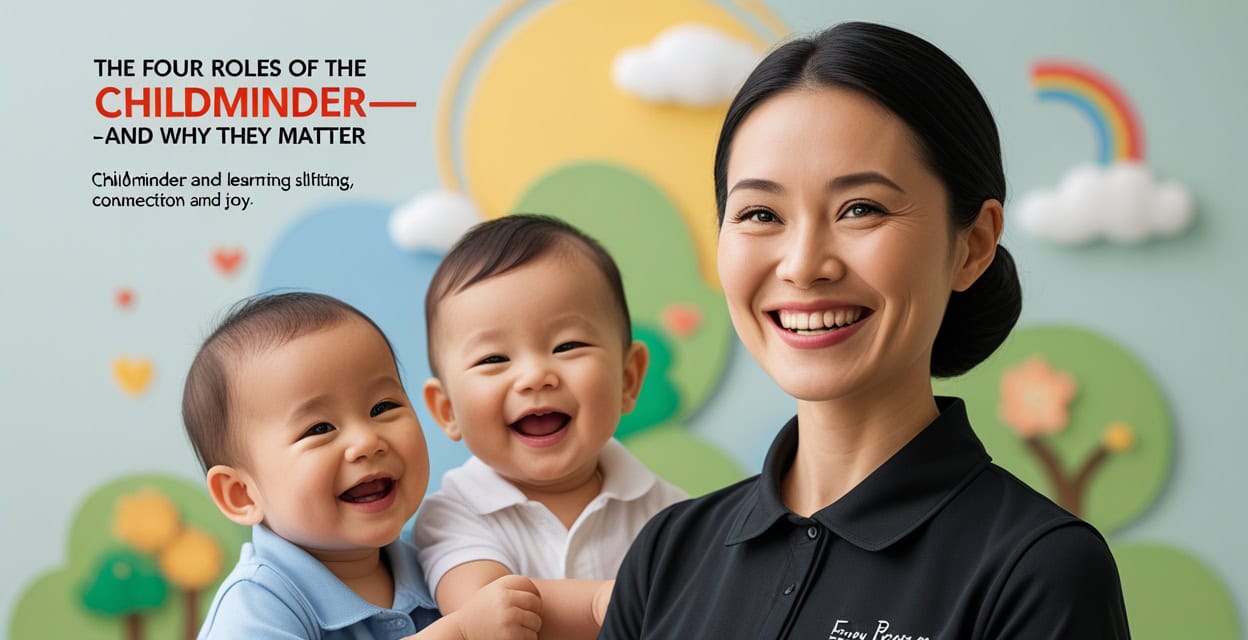
The Four Roles of the Childminder—and Why They Matter
EduNanny defines the childminder as a skilled, relational, and public-minded professional. The roles asked of them are intentional and dignifying.
- Guardian: Protects health, sleep, and emotional safety without compromise.
- Guide: Curates play that builds competence and delight, moment by moment.
- Gatherer: Collects observations and shares them with families, turning days into stories and strategies.
- Bridge: Connects home and world—honouring family culture while introducing new experiences.
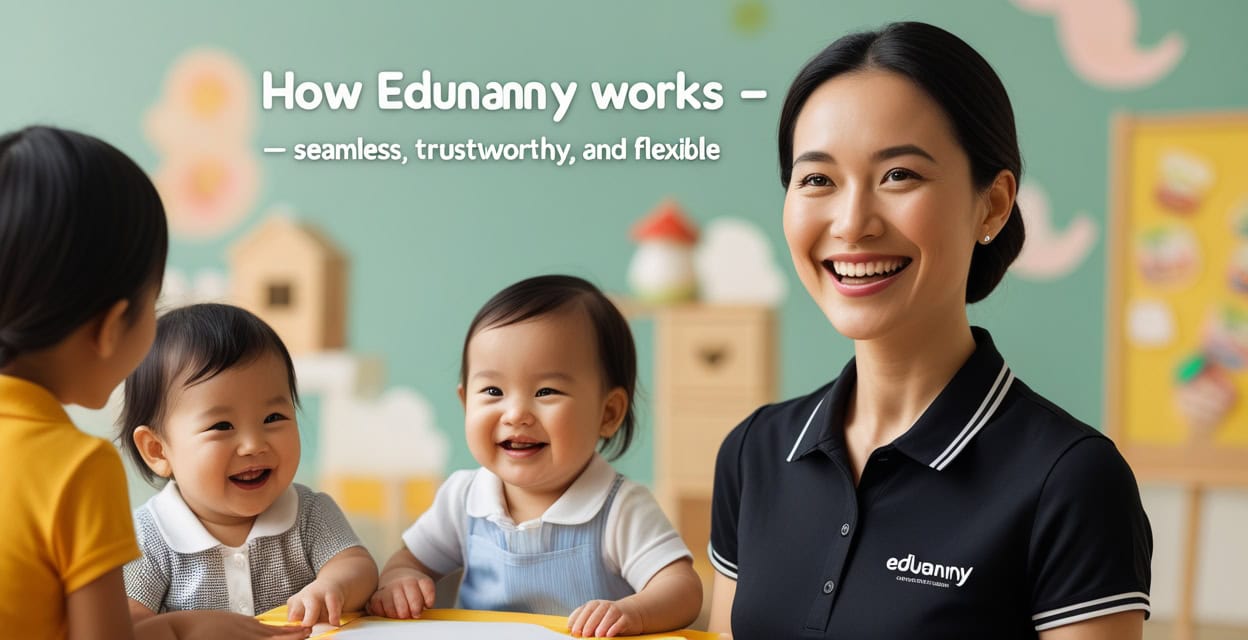
How EduNanny Works — Seamless, Trustworthy, and Flexible
EduNanny operates through two pathways that share a single standard:
- Centre-Based Childminding: Modern, open layouts, controlled environments, and professional supervision in dedicated spaces.
- Home-Based Childminding: Vetted residences that meet the same safety standards, with care delivered in a familiar home setting.
Key features that support families:
- Distance made humane: A secure digital portal delivers daily notes, captured moments, and optional CCTV windows — designed to be informative without being disruptive.
- Predictable availability: Monday–Friday, 7am–7pm, to align with work and family rhythms.
- Fair and accessible pricing: From $33/day, with subsidies (CDA/Baby Bonus) where applicable.
- Islandwide access: A network of community sites and home-based nodes to shorten commutes and maximize family time.
- One 1:3 promise: A careful, consistent ratio ensures attention is not rationed.
What a Day Looks Like in EduNanny
- Arrival: Names sung, comfort objects welcomed, and a personalized focus for the day written into the plan.
- Morning arc: Floor play with simple, safe materials; language guided by caregiver narration; pace and stimuli tailored to each infant.
- Feeding: Attention to eye contact, calm talk, log of temperatures and allergens, and meticulous bottle labeling.
- Nap: Dimmed lights, optional white noise, sleep monitoring, and a short, shared note on the child’s settling status.
- Afternoon: Outdoor time when possible, sensory invitations, songs, and joint attention activities; unhurried transitions for smooth handovers.

What Makes EduNanny Different — From the Inside Out
- Infant-centric design: Environments and routines crafted to support nervous-system regulation and early curiosity.
- Parent workday protection: Transparent updates, reliable hours, proximity, and contingency planning that reduce daily anxiety.
- Social mission: A role in ECDA’s Childminding Pilot and a National Social Initiative that expands access and builds talent in caregiving.
- Technology with humanity: Digital tools reveal care without replacing the caregiver; CCTV remains optioned and privacy-respecting.

A Brief Word on Safeguarding, Dignity, and Privacy
Transparent care must honour dignity. CCTV, when used, serves safety and reassurance, not surveillance theatre. Views are configured to protect children and caregivers, footage is securely managed, and families opt into what suits their needs. Personal moments, such as toileting and intimate care, remain highly private and handled with sensitivity and care.

Parents as Partners: The Home–Hub Seam
EduNanny invites families to actively shape the day. This partnership approach ensures care aligns with home routines and family values.
- Share sleep notes, feeding preferences, and new routines each morning to tailor daily care.
- Bring songs, phrases, and stories from home; caregivers echo these in daily care to strengthen belonging.
- Join monthly “Five-Minute Futures” chats: one strength, one stretch, one next step — quick, kind, and actionable.

The Promise and the Proof: Standards, Audits, and Continuous Improvement
Promises are earned through consistent practice. EduNanny publishes clear standards, trains to them, and audits against them. Key metrics include attendance, incident reports, development notes, and parent feedback. Transparent review cycles identify successes and surface misses quickly, enabling rapid repair and ongoing trust-building.
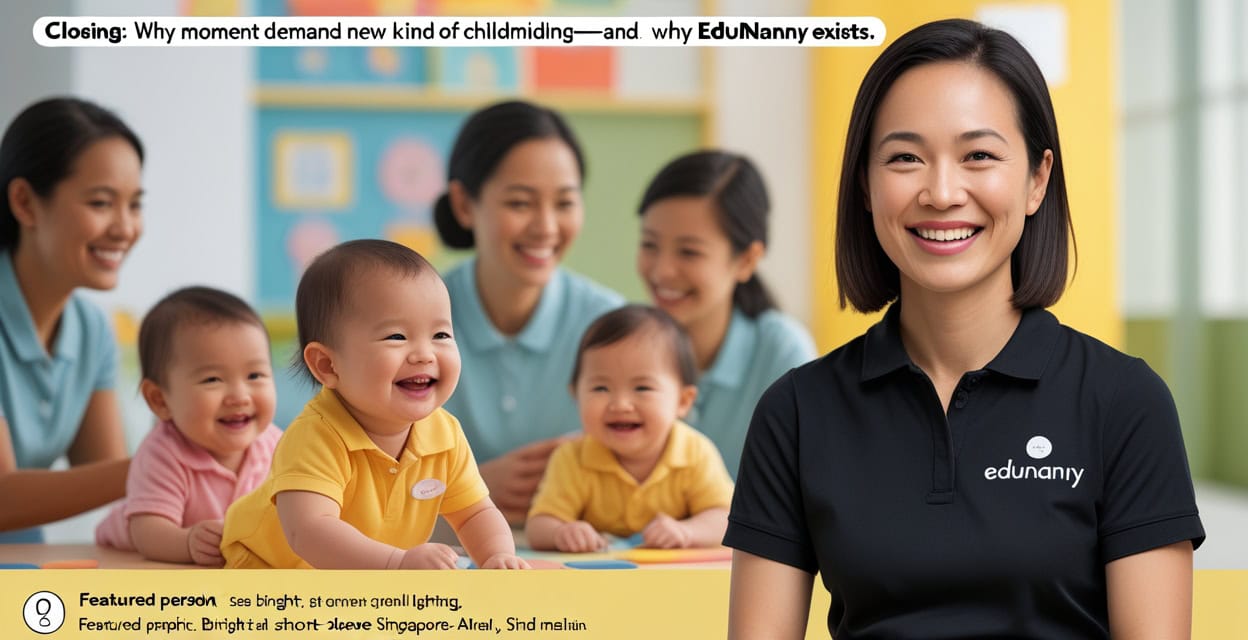
Closing: Why This Moment Demands a New Kind of Childminding—and Why EduNanny Exists
In Singapore, the first 1,000 days are a critical window for brain development, emotional security, and lifelong learning. EduNanny’s approach treats caregiving as a national project: calm, close care; visible safety; learning that feels like play; and dignity for professionals who commit to these standards daily.
If EduNanny’s vision resonates with your family, explore the options, tour a centre or a home-based node, and ask about the CDA/Baby Bonus subsidies. See how a 1:3 infant ratio, modern environments, and transparent updates can transform the day you hand your child to someone you trust to steward their beginnings.
Conclusion
EduNanny by BUTLER offers a comprehensive, research-informed framework for infant care that aligns with Singapore’s values of community, dignity, and opportunity. By integrating four developmental lenses, retaining a low caregiver-to-child ratio, and ensuring transparency through modern technology, EduNanny aims to redefine early childhood care as reliable, nurturing, and publicly supported. This is not merely a service; it is a national invitation to reimagine the beginnings of every child as calm, connected, and capable.
Are you ready to see EduNanny in action? Visit EduNanny.com or Childminding.EduNanny.com to learn more, schedule a tour, and discuss Centre-Based or Home-Based options near you. Ask about subsidies, about our 1:3 guarantee, and about how our care teams will know your child by name and nuance.
[#infantcareSingapore, #childminding, #earlychildhooddevelopment, #EduNanny, #SingaporeParents]Ready to Experience Excellence?
Transform Your Family’s Journey
Discover Singapore’s leading infant care and childminding services. Expert guidance for your little one’s first thousand days.