The Art of Observation: How Singapore Parents Learn to See Quality
Why That Quiet Question Is Actually a Sign You’re Doing It Right
We talk a great deal, as an industry and as a community, about how to choose childcare. The questions to ask. The red flags to watch for. The checklist of qualities that define a good programme. This content serves an important purpose. It helps parents make decisions with clarity and intention.
But it stops exactly where the real journey begins.
Because the moment after the choice is made — when the searching continues, when the parent who has already chosen well still watches, still wonders, still quietly asks themselves if this is really working — that moment is almost entirely unaddressed.
Here is what I have come to understand after years of walking alongside families in Singapore through this passage: that quiet question you carry, the one that sometimes makes you feel guilty or uncertain, is not evidence that something is wrong. It is evidence that you are paying attention.
And paying attention, when guided toward the right things, is the beginning of developing your own eyes for quality. You do not need to be told what to see. You need to learn to see.
Discernment: Developing Your Eyes for Quality
Let me tell you what often happens in those first weeks and months after enrollment. A parent brings their child to a programme they have researched carefully. They like what they hear. They trust their instinct in making the choice. And then the real observation begins.
Your child comes home. You watch them. You notice things:
- The way they move through a room
- The way they respond to certain sounds or textures or social cues
- The way they climb into your lap, or don’t
- The words they say, or don’t say
- The expressions on their face when you ask about their day
And you do not know what any of it means.
This is where most parents stop — in that uncertainty, sometimes retreating into false confidence because doubt feels uncomfortable, sometimes spiraling into worry because they lack a framework for interpreting what they observe.
But there is a third path. It is the path of discernment.
Discernment is not skepticism. It is the active, intelligent process of learning to read the evidence that quality leaves behind. It is what happens when a parent stops waiting to be reassured and starts developing the capacity to see for themselves.
Quality childcare produces evidence. It leaves traces. It reveals itself over time to anyone who knows where to look.
Your task is not to trust blindly. Your task is to learn what to look for.
What to Observe in Your Child: The First 90 Days
In the first ninety days of quality care, you are not just watching your child. You are beginning to learn a new language — the language of their behavior, their expressions, their small daily shifts in comfort and curiosity.
This is not about dramatic transformation. It is about noticing, with increasing clarity, the signs of a child who is safe, who is engaged, who is growing in the way that genuine development happens — gradually, unevenly, and then all at once in unexpected moments.
Signs Your Child Is Settling Into Quality Care
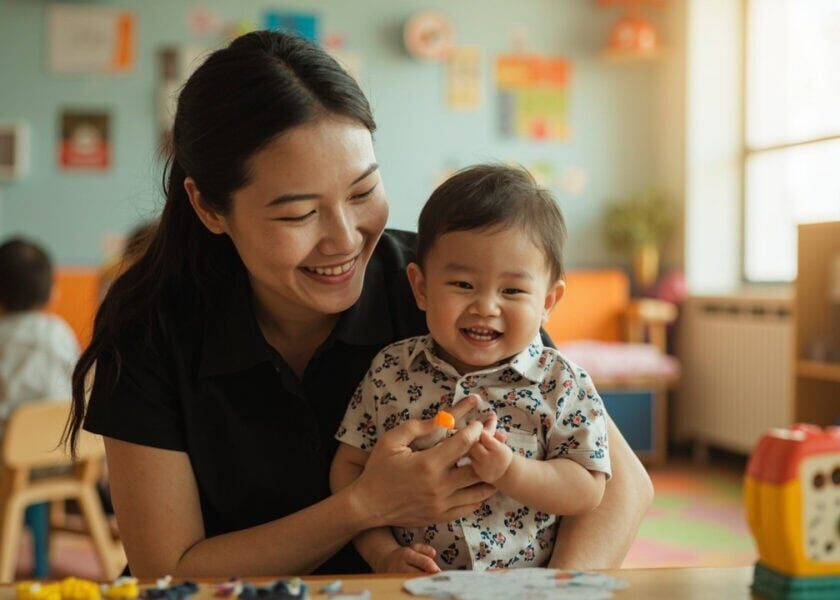
A more settled expression when you arrive. Your child, uncertain and clingy in the first weeks, begins to show recognition at the door. Not joy necessarily, because young children do not always perform joy on cue. But a kind of relaxation. The body posture of someone who has learned, through repetition, that this is a place worth being comfortable in.
Language and skills that come from beyond your home. Your child begins to use words or gestures that clearly originate somewhere else — a new song, a rhyme, a way of interacting with a toy that suggests they have been shown something. This is evidence of engagement. Of an environment that is actively stimulating and teaching, not merely minding.
The beginnings of attachment to caregivers. When a caregiver is absent — on leave or moved to a different class — you might see your child notice. You might see them look for that person. You might hear them use that person’s name. This is not dependency. This is evidence of attachment, and healthy attachment is one of the clearest markers of quality care that exists.
Understanding Regression and Adjustment
In those early weeks, you might also see behaviors that concern you:
- Regression — a child who was toilet trained beginning to have accidents
- Increased clinginess at pickup
- Changes in appetite or sleep
- Difficulty settling
These behaviors are not automatically red flags. They are, very often, completely normal markers of adjustment. Children do not settle into new environments the way adults do. They feel it. They process it. And sometimes they express that processing through their behavior, weeks after the change has occurred.
The question is never simply what the behavior is. The question is what it means in context:
- Is it softening over time, or intensifying?
- Does it appear alongside other signs of security, or in isolation?
- Does your child seem fundamentally okay in the world, even if there are specific areas of stress?
This is the work of discernment — and it is work that can be supported and guided with the right partnership.
What a Caregiver Who Truly Knows Your Child Looks Like
There is a difference — a profound and easily overlooked difference — between a caregiver who performs care and a caregiver who genuinely knows the child in front of them. The difference reveals itself in small moments that are easy to miss if you are not paying attention.
At Pickup Time
When you arrive to pick up your child, observe what happens.
Does the caregiver offer a genuine, specific update — not a generic “she had a good day” but something particular and individual? Do they mention that your child tried a new food, or was fascinated by the ants on the playground, or asked for the same book to be read three times?
These details are not small talk. They are evidence. They are evidence that your child has been seen, individually, as themselves. That the caregiver has been paying attention not just to safety and schedule, but to the specific texture of your child’s inner life.
The Caregiver’s Interaction With Your Child
Watch how the caregiver speaks to your child when you are present. Not to you about your child, but to your child directly.
- The tone — is it warm and consistent?
- The patience — do they wait for a response and truly listen to it?
- The knowledge — do they speak with informed familiarity, understanding your child’s rhythms, sensitivities, and particular way of being in the world?
When You Ask a Question
Ask a question when you are unsure about something. Ask about a specific behavior you have noticed. Watch how the caregiver responds:
- Do they deflect or become defensive?
- Or do they engage — thoughtfully, with genuine interest in your observation and a willingness to think alongside you about what it might mean?
A caregiver who truly knows your child is not threatened by your attention. They are sustained by it. Because their work is not about appearing perfect to parents. Their work is about knowing and nurturing the child in front of them.
This is the kind of knowledge that cannot be faked over time. It reveals itself in specifics. In the small, irreplaceable details that only someone who is truly present would notice.
The Daily Environment: Where Quality Actually Lives
Quality, in childcare as in most things, is most visible in the ordinary. There is a third source of evidence that is easy to overlook because it is not dramatic. It is simply the texture of the daily environment.
What You Sense When You Walk In
When you walk into a space — whether it is a home-based setting or a centre — notice what you feel. Not what you are told to feel, but what you actually sense.
- Is there a hum of purposeful activity, or a vague, restless atmosphere?
- When children are engaged, there is a quality of focus that is almost visible, like a frequency you can hear.
- When they are merely being managed, there is a different quality — an undercurrent of waiting, of subdued restlessness.
Observing the Caregivers
Notice the caregivers. Not just the one assigned to your child, but all of them.
- Do they move through the space with ease and intention?
- Do they speak to children as though they expect to be understood — not in baby talk, but in real, respectful language?
- Do they get down to the child’s level?
- Do they narrate what they are doing as a natural extension of how they think about their work?
How Conflicts Are Handled
Notice how conflicts are handled. In any group of young children, conflicts arise. The question is never whether conflict happens but how it is met.
A quality environment has developed ways of handling these moments that preserve dignity for all involved. There is no raised voice. There is patience, redirection, and the quiet teaching of social skills that will serve these children for years to come.
The Rhythm of the Day
Notice the way time passes. In a quality environment, there is rhythm. There is predictability without rigidity.
- Children know what comes next, and that knowledge creates safety.
- Transitions are managed with care.
- The pace is appropriate — neither rushed nor languid, but responsive to the actual needs of actual children in the actual moment.
These are not abstract ideals. They are observable. You can see them if you know to look.
When to Trust Your Instinct and When to Seek a Conversation
When do you trust your instinct, and when do you seek a conversation?
The answer is not simple, because the relationship between instinct and evidence is not simple. Instinct, in experienced parents, is often the distillation of evidence — a pattern recognition so deeply internalized that it operates below conscious thought. In newer parents, instinct can sometimes be anxiety wearing the costume of wisdom. The trick is learning to tell the difference.
A Practical Framework
When something feels off, ask yourself two questions:
- Is this a one-time observation or a pattern?
A single moment of uncertainty is not evidence. A pattern — the same concern arising repeatedly, over days or weeks — is worth taking seriously. - Do I have enough information to understand what I am seeing?
Sometimes a behavior that seems concerning in isolation is ordinary in context — a child who is tired, or hungry, or coming down with something. Sometimes a behavior that seems ordinary is actually a symptom of something deeper.
If you have a pattern and you do not have enough context to understand it, then ask. Not from a place of accusation, but from a place of genuine curiosity and shared investment in your child’s wellbeing.
A quality caregiver will welcome this conversation. They will not be defensive. They will think alongside you, share their own observations, and work with you to understand what is happening.
This is the purest expression of what a real childcare partnership looks like. Not blind trust on either side, but active, respectful, evidence-based collaboration around the child who is at the center of everything.
EduNanny Singapore: Built for This Journey
EduNanny Singapore, a service of BUTLER, was built with this journey in mind. We operate as part of the ECDA Childminding Pilot, which means our programme is grounded in standards and oversight that matter.
Small Numbers, Personal Attention
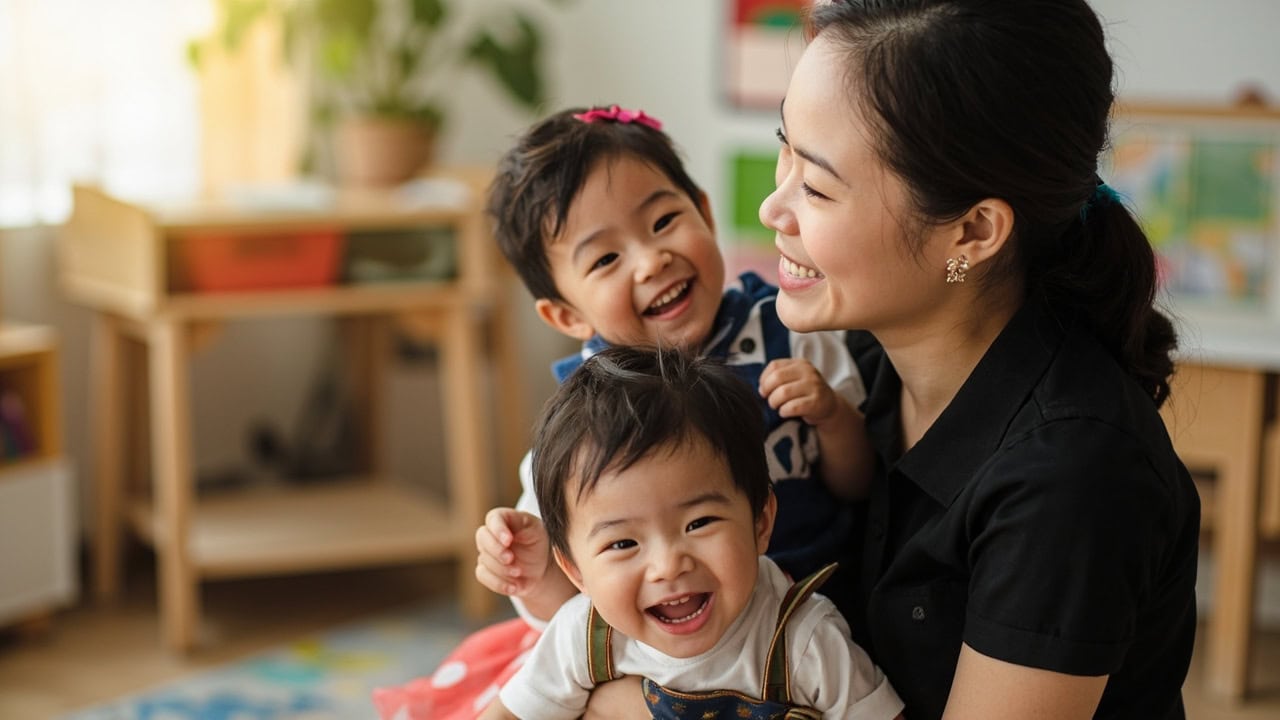
Our ratios reflect what both research and experience confirm: small numbers matter when the work is personal. With up to one to three infants in our care, our caregivers have the capacity to truly know each child — not just their schedules and safety, but their individual rhythms, preferences, and developmental trajectories.
Affordability and Access
We know that affordability is a genuine concern for families across Singapore. Our pilot fee structures are designed to make quality care accessible, and families can utilize CDA funds and Baby Bonus payments to remove some of the friction that often stands between parents and the peace of mind they deserve.
Transparency as a Foundation for Trust
We understand that transparency is not a luxury — it is a necessity for parents who are learning to see. Where deployed, our communication tools and monitoring measures are not surveillance for its own sake. They are windows. They are the infrastructure of trust, built on the understanding that parents who can see clearly develop confidence more surely than parents who must simply hope.
What we offer, at the deepest level, is not simply childcare. It is a partnership that does not ask you to stop asking questions, but invites you to ask better ones. One that does not promise to remove your doubt, but helps you develop the eyes to see past it.
Because Singapore parents are not looking for permission to trust. They are looking for the evidence that makes trust possible.
And that evidence exists. It has always existed — in your child’s face when they arrive, in the caregiver who knows their name and their favorite song, in the rhythm of the day, in the small irreplaceable moments of connection that quality care makes possible.
Your Next Step
You chose well. Now let yourself learn to see how well.
We are honored to be part of that translation.
Now go and watch your child. You will see.
If you are a parent seeking infant care or childminding in Singapore that supports this journey of observation and growing confidence, we invite you to connect with EduNanny Singapore to learn more about our approach to quality, development-oriented care.
Explore EduNanny Singapore — where thoughtful childcare begins with knowing your child.