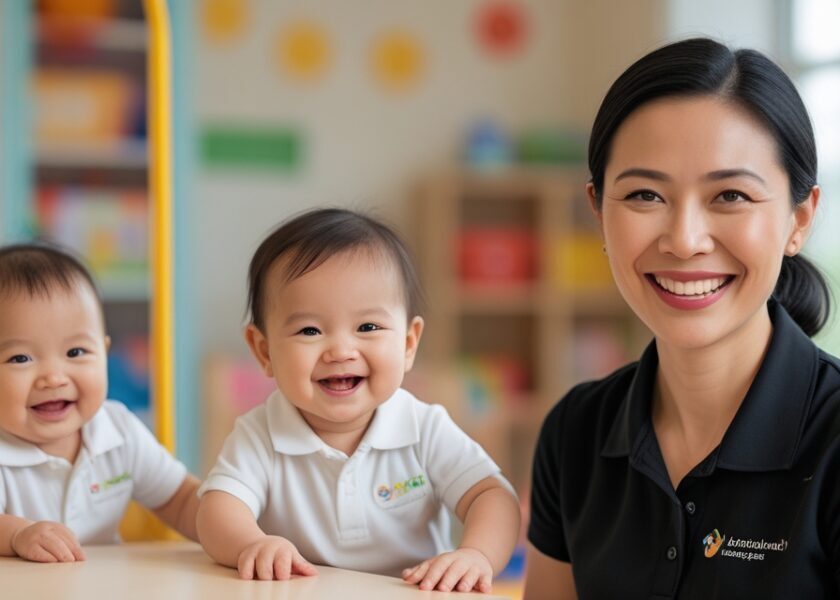
The Architecture of Trust in Your Baby’s First Year
Quick Summary: What Your Baby Needs in the First Year
- Responsive attunement: Caregivers who read your baby’s body language before a cry escalates
- Sensory-rich environments: Soft lighting, comfortable temperature, varied textures and sounds
- Consistent relationships: The same familiar face responding when your baby is hungry or upset
- Language exposure before speech: Gentle narration, melodic conversation, responsive interaction
- Physical milestone support: Tummy time, safe exploration, gradual introduction of solid foods
- Low caregiver ratios: Genuine attunement requires manageable numbers—ideally one caregiver to three infants
What Is Actually Happening in the First Twelve Months
There is a particular kind of silence that every parent of an infant knows. It is the silence of not knowing—not because you have failed, but because your child cannot yet tell you. Your baby cannot describe the quality of light in the room where she spent the morning, whether anyone’s arms felt like home when she fussed, or whether someone noticed the subtle shift in her cry that meant hunger was different from tiredness.
In those first twelve months, you are asked to make one of the most consequential decisions of your child’s life based on trust alone. This is the reality that no checklist captures. It is the space between what you hope is happening and what you can actually verify.
Let us begin with what is actually happening, because what unfolds in quality infant care during this period is nothing less than the scaffolding of your child’s future.
In the earliest weeks, a newborn lives in a world defined by sensation and physiology—feeding, sleeping, temperature regulation, the rhythm of being held. This is not a passive existence. From the moment your baby opens her eyes, she is absorbing everything: the quality of light, the cadence of voices, the texture of fabric against her skin. Her brain is building connections at a speed that will never be matched again.
Research in infant neuroscience confirms that the first months of life represent a period of extraordinary neural plasticity, where every interaction literally shapes the architecture of the brain. What this means practically is profound. The face hovering above your baby is not just providing food or comfort—it is teaching her that the world is reliable, that her needs register, that someone is paying attention.
When a caregiver notices the slight tension in your baby’s shoulders before a cry builds, or recognizes the flutter of eyelids that signals readiness for sleep, this is not mere childcare. This is the first and most fundamental education your child will receive—conducted not through words but through attunement.
What Quality Infant Care Actually Looks Like
Quality infant care looks like a caregiver who has learned to read your baby’s body before a cry escalates. It looks like a room where the lighting is soft enough not to overstimulate, where the temperature is comfortable, where there are moments of active engagement and moments of peaceful observation. It looks like your baby being placed on her tummy to build the neck strength that will later allow her to sit, roll, and eventually crawl—not as an afterthought, but as part of a deliberate rhythm of care.
Language Before Speech
In quality infant care, language begins long before speech. A caregiver narrates the routine—gentle commentary during feeding, soft words during diaper changes, playful sounds during playtime. Your baby is listening, absorbing the rhythm and melody of human speech, building the neural pathways that will one day allow her to form her own words.
Research in early language development shows that infants in responsive caregiving environments are exposed to significantly more language, even before they can vocalize in return. The connection between a caregiver’s responsiveness and a child’s later language development is well established in developmental science.
Physical Milestones in the First Year
Physical milestones in the first year unfold with astonishing speed, and quality infant care supports each stage appropriately. When your baby begins to reach for objects, the environment is prepared to encourage this. When she begins to roll, there is safe space and supervision for exploration. When she transitions to solid foods, the approach is gradual, attentive, and responsive to her cues.
None of this accelerates development unnaturally. Instead, it creates the conditions where your baby’s own developmental drive can unfold with confidence and security.
Why Consistency, Attachment, and Caregiver Ratios Matter
Quality infant care is fundamentally different from care for older children. A toddler can point to a boo-boo, ask for water, show you what she wants. An infant communicates through physiology, through posture, through the most subtle shifts in breathing or muscle tension. Reading this language requires patience, training, and genuine presence.
But beyond the skill of individual caregivers, there is the question of consistency. In infant care, attachment is not an abstract concept—it is a biological necessity. Your baby does not simply need competent care; she needs consistent care. She needs to learn that the same face will appear when she is hungry, the same voice will respond when she cries, the same gentle hands will lift her when she needs comfort.
This is the foundation of secure attachment, and it happens only when caregiver turnover is minimized, when routines are stable, and when your baby can predict, at the deepest physiological level, what will happen next.
This is also why ratios matter so profoundly. Genuine attunement requires manageable numbers. A ratio of up to one caregiver to three infants makes it possible to notice when your baby arches her back during feeding, to see when two infants need comforting at the same time, to respond to the subtle cues that distinguish one need from another.
| Caregiver-to-Infant Ratio | What Is Possible |
|---|---|
| 1:3 or lower | Genuine attunement, responsive feeding, individual attention, noticing subtle cues |
| 1:6 or higher | Basic supervision, scheduled routines, limited individual responsiveness |
In ratios where a single caregiver is responsible for six or seven infants, the kind of attentiveness your baby needs becomes physically impossible. The difference is not abstract. It is your baby’s lived experience, every single day.
Honoring Your Vulnerability and Finding the Right Fit
There is something else that parents often do not give themselves permission to feel: the weight of this decision is not a burden. It is evidence of love.
Leaving your infant in care for the first time is one of the most emotionally complex experiences a parent can go through. The question of infant care is not just about logistics—it is about whether you can trust someone else with the most precious thing in your life.
That vulnerability deserves to be honored. And the answer is not to tell you to feel less; it is to ensure that the care you choose can be trusted with the full weight of what you are entrusting to them.
When you visit a potential infant care arrangement, the questions that matter are not the ones you might expect. Do not ask only about certifications or curriculum frameworks. Ask these instead:
- How do your caregivers recognize when an infant is becoming overstimulated?
- What does a typical morning look like for a six-month-old?
- How do you handle feeding on demand versus scheduling?
- What training have your infant caregivers received in recognizing cues of distress or discomfort?
- How do you communicate with parents during the day?
A quality program does not just tolerate these questions—it welcomes them, because parents asking detailed questions is a sign of engagement, not doubt.
You cannot ask your baby what happened today. But you can observe. Quality infant care reveals itself in the small details: relaxed muscles and curious eyes when you pick her up, the way she reaches for the caregiver who has known her consistently, the ease in her breathing that signals genuine security rather than mere absence of distress.
EduNanny by BUTLER: Built Around What Infants Actually Need
EduNanny by BUTLER was built with this understanding. As part of the ECDA Childminding Pilot, EduNanny offers Singapore parents a pathway into quality infant care that meets both developmental and relational needs.
Whether through home-based childminding—where your baby is cared for in a familiar domestic setting with lower ratios and personalized attention—or through community-based arrangements that offer structured support within a neighborhood context, the pilot provides options designed around what infants actually need rather than what is most convenient for providers.
- Accessible fee structures with eligibility for Child Development Account and Baby Bonus schemes
- Monday to Friday care blocks providing the consistency your baby’s developing sense of security requires
- Lower caregiver ratios that make genuine attunement possible
- Communication systems and transparency measures where deployed—to bridge the gap between what you hope is happening and what you can verify
These are not marketing claims. They are structural commitments to the kind of care that infants in their first year genuinely require.
Getting Started: How EduNanny Can Help
In that first year, your baby is not waiting passively for care. She is building the architecture of trust, the neural pathways of attachment, the sensory foundations of how the world feels. What she receives—or does not receive—during these twelve months leaves a lasting imprint. Not because the stakes are artificially high, but because this is simply how human development works.
Quality infant care is not about finding someone who will love your baby the way you do. That is yours alone, and no one can replace it. Quality infant care is about finding people who understand what your baby needs to feel safe, who read her cues with skill and respond with consistency, who create an environment where her developing brain can build the foundations it needs for everything that follows.
It is about complementing your role as a parent, not substituting for it.
If you find yourself overwhelmed by the choices, by the uncertainty, by the sheer weight of wanting to get this right—EduNanny’s Thomas AI Chatbot is available to help you navigate the process. It can answer your questions about the pilot, help you understand your options, and provide knowledgeable guidance as you consider what kind of care fits your family’s circumstances.
Parenting in Singapore is complex. Having a resource that understands the landscape and can point you toward clarity is not a small thing.
EduNanny by BUTLER exists because we believe that parents in Singapore deserve to make this choice from a place of understanding, not confusion. That is why we do not just offer a service—we offer a knowing. A knowing of what infants in their first year actually require. A knowing of what parents in this moment need to hear. A knowing that begins with acknowledging the depth of what you are entrusting and ends with providing the care that entrusting deserves.
Ready to explore your options? Connect with EduNanny today to learn how the ECDA Childminding Pilot can support your family through the most important year of your baby’s life.
#infantcaresingapore #childmindingSG #ECDAchildcare #newborncaresingapore #firstyearbaby