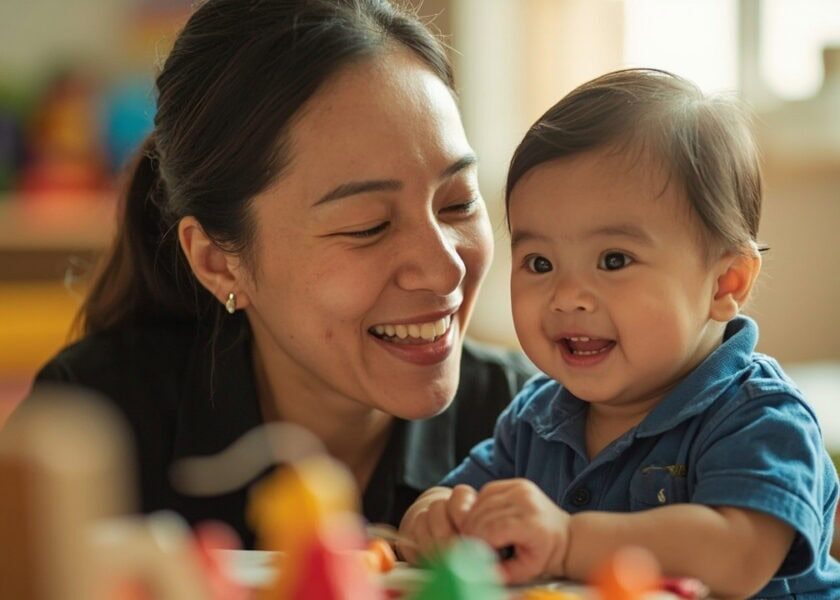
The Architecture of Care Singapore Families Are Choosing
The Photo You Cannot Unsee: What Fragmented Care Actually Looks Like in Singapore
Close your eyes and picture this.
It is seven in the morning. Your mother-in-law arrives to oversee breakfast and the early hours while you get ready. By nine, your domestic helper takes over, preparing your child for the afternoon session at the infant care centre down the road. At noon, a different face greets your child at the centre. By five, your helper collects them. By six, your parent returns. By seven, you arrive home to find three people who have each spent fragments of your child’s day with them—and none of them have spoken to one another about what happened in the hours between.
Your child is overtired. Your child is also, somehow, under-stimulated. You feel the weight of coordinating all of this, and you tell yourself this is what thoroughness looks like. This is what a family that has options does.
If this scene feels familiar, you are not alone. This is the quietly exhausting reality for thousands of Singapore families who have been told that more options mean more security. But here is the question that rarely gets asked plainly: Is more care actually more?
Or is it something that looks like care, feels like safety, but operates at a level of depth that neither you nor your child can fully access?
The Culture of Abundance: Why More Is Not Always Better
We live in a culture that has genuinely confused abundance with adequacy. Singapore parents have been taught to believe that a child who has a helper, a grandparent, and an infant care centre has more than a child who has one consistent caregiver. We have been taught that variety is richness, that flexibility is freedom, and that the parent who can orchestrate multiple caregivers has somehow succeeded where others have merely settled.
This narrative is everywhere. It shows up in parent group conversations, in the way childcare agencies market their services, and in the quiet assumptions we carry about what good parenting looks like in Singapore. More hands on deck feels like diligence. More people involved feels like safety. More options available feels like winning.
But children do not experience care the way we inventory it.
A child does not think, “I have three caregivers today.” A child thinks in people. In faces. In the accumulated weight of knowing someone deeply over time, and being known in return.
What Your Child Actually Experiences in a Distributed Care Model
When a child has multiple caregivers rotating through their days, what they experience is not richness. They experience a kind of gentle, persistent incompleteness. A relationship that keeps starting over. An emotional environment that resets. A developmental thread that gets passed from hand to hand without anyone holding the whole thing.
Consider the morning handover. Your helper has just spent four hours with your child. She noticed the new word your child said, the way they pushed food around their plate, the brief moment of distress when you left. But when your parent arrives, none of that context comes with them. Your child is adjusting again. Recalibrating. Learning a new voice, a new way of being held, different expectations about how things work.
This is not a failure of any individual caregiver. Helpers and grandparents love children in ways that matter profoundly. This is a structural problem. And structural problems require structural solutions.
Care Architecture: Why the Structure of Care Matters as Much as the Caregiver
The concept I want to offer you is what we at EduNanny call care architecture. It is the understanding that how care is structured matters as much as who delivers it. That a child’s developmental environment is not simply the sum of the people involved, but the quality of the relational system they inhabit.
Coherence is not a luxury. It is the foundation on which everything else is built.
Relational Continuity: What It Actually Means and Why It Matters
Relational continuity is the experience of having one primary caregiver who is present consistently across months and seasons. When this is present, something profound happens:
- The caregiver learns your child’s rhythms—their triggers, their particular way of expressing curiosity or distress
- The caregiver learns to anticipate needs before they become meltdowns
- Your child learns that this person can be relied upon
- Your child learns that their communication will be received and understood
- Your child learns that the world has a certain predictable warmth to it
This is not sentimental thinking. This is the architecture of secure attachment—and it is the single most predictive factor in early childhood emotional development that researchers have identified.
Now consider what happens in a distributed care model. The child encounters different faces, different voices, different ways of being held or spoken to. Not bad faces. Not cold voices. But faces that change before the child has had the chance to learn them. The child adapts, because children are extraordinarily adaptive.
But adaptation is not the same as flourishing.
What looks like flexibility in a young child is sometimes the quiet resignation of a nervous system that has learned not to expect perfect consistency, and so has learned to accept something less. This is not a criticism of your child. It is an observation about what distributed care structurally produces.
The Invisible Tax: What You Are Carrying When Care Is Distributed
There is something we rarely talk about, and that is the cognitive and emotional load carried by families who manage multiple care arrangements.
You know this load. It is the mental accounting of who is where, who was briefed on what, who noticed the new word your child said and who needs to be told. It is the guilt you feel when a caregiver has been with your child all day and you realize you do not actually know what happened in those hours. It is the scheduling calculus that turns weekends into logistics exercises. It is the WhatsApp updates, the communication threads, the moments of wondering whether everyone is on the same page about discipline, about sleep, about the foods you do and do not want your child to have.
This load is invisible to everyone except the person carrying it. And it is substantial.
It is the tax that distributed care charges on your attention, your energy, your capacity to simply be present with your child when you are actually with your child. You come home from work, and instead of inhabiting the moment—seeing your child’s face, hearing about their day in whatever way they can communicate it—you are mentally reviewing the logistics. Who needs to be updated? What got missed? What needs to happen tomorrow?
Many parents describe a persistent, low-grade sense that something is not quite right. They have resources. They have support. They have family nearby and helpers in the home. And yet there is this feeling that they are managing a system rather than inhabiting a solution.
This feeling is not irrational. It is the beginning of a very important insight.
The Question Worth Asking: Who Does Your Child Reach For?
Here is a question I sometimes ask families, offered not as a test but as a lens:
When your child is distressed, who do they reach for?
Not who is present. Who do they reach for?
If the answer is uncertain—if your child seems equally comfortable with several people and therefore, by some logic, with none of them in particular—that is not a sign of adaptability. That is a sign that the relational architecture has not been allowed to deepen. That your child has learned to spread their attachment thin rather than plant it deep.
Children are adaptive. They find ways to be okay. But okay is not the same as thriving, and adaptation is not the same as secure attachment.
True Flexibility Versus the Illusion of Freedom
Let me address the fear that sits underneath so many family conversations about this decision. The fear that choosing one focused model means losing something. Losing flexibility. Losing the safety net of having backup. Losing the variety that might enrich your child’s world.
I understand that fear. I also think it is based on a misreading of what flexibility actually means.
Flexibility that requires constant coordination is not flexibility. It is the illusion of freedom wrapped in the reality of management. True flexibility is knowing that your child is exactly where they should be, and that the person caring for them is not just filling a slot but inhabiting a role.
True flexibility is the freedom to focus on your work, your own wellbeing, your relationship with your child when you are together—because the architecture of care you have chosen is holding firm underneath you.
What Focused, Dedicated Care Makes Possible
Focused, dedicated care eliminates this tax. Not because it is perfect, but because it is coherent.
When your child is with one trusted model, one relational environment, one set of people who know your child as a whole person rather than a rotation slot, you get something back that is hard to name but easy to recognize.
You get peace.
Not the peace of having arranged everything perfectly, but the peace of knowing that the arrangement itself is doing what it is supposed to do. The architecture is holding. You can stop managing and start parenting.
A Different Kind of Answer
What I want you to understand is that when you choose focused, dedicated care, you are not choosing a service. You are choosing an infrastructure. You are deciding that your child’s developmental environment will be built on continuity rather than rotation, on depth rather than breadth, on one coherent relational model rather than several fragments that add up to something less than the whole.
This is the belief that has shaped everything we have built at EduNanny.
We are part of the ECDA Childminding Pilot, which means we operate within a framework designed to give families real, affordable access to quality home-based and community-based childcare options. This matters because it means our model is not designed for a narrow segment of families who can afford premium private arrangements. It is designed to be accessible, sustainable, and available to families across Singapore who are making real decisions about how to structure their children’s earliest years.
What Our Model Looks Like in Practice
- Infant ratios carefully maintained at up to 1:3—every child receives the attention and responsiveness their development requires. We believe the ratio is not just a number. It is the difference between a child being seen and a child being supervised.
- Care during Monday to Friday blocks—because childcare should serve the rhythm of family life, not create new demands on top of it
- Financial clarity—we work with families to ensure CDA and Baby Bonus funds can be used where applicable, because you should not have to choose between understanding the cost and understanding the value
- Transparent communication—where safety measures such as CCTV are deployed, they are deployed with clarity and consent. Updates are shared not as performance but as genuine partnership
When a family entrusts their child to us, they are not outsourcing a concern. They are inviting us into a relationship. We take that invitation seriously.
Addressing Common Concerns
“What if my child needs backup care?”
Focused care does not mean inflexible care. It means building a foundation that holds. When that foundation is solid—when your child has one coherent relational environment where they feel secure and known—you are actually better positioned to handle the genuine variations that family life requires. The difference is between a safety net that is woven tightly and one made of loose, unconnected threads.
“But my helper or grandparent loves my child—doesn’t that count?”
It absolutely counts. Helpers and grandparents love your children in ways that matter profoundly, and nothing in what I have said should diminish that. This is not about whether individual caregivers are good or loving. It is about whether the structure you have created allows relationships to deepen to the level your child needs for secure attachment to form.
Sometimes the most loving thing a helper or grandparent can do is be part of a coherent system rather than the whole system. But that decision requires clarity about what children actually need, not just what we hope they need.
“Is this just for wealthy families?”
This is one of the reasons we are part of the ECDA Childminding Pilot. We believe relational continuity should not be a privilege available only to families with significant resources. Our model is designed to be accessible—to serve families across Singapore who are making genuine, often difficult decisions about how to balance work, family, and the needs of their children.
Questions to Evaluate Your Current Arrangement
If you are currently managing multiple caregivers, here are some questions worth sitting with honestly:
- Can you name what happened in your child’s day? Not just where they were, but how they seemed, what they explored, what they struggled with. If you cannot, that is not a personal failure—it is information about the structure of your care arrangement.
- Who would your child reach for if they were hurt or frightened? If the answer is unclear, that is worth paying attention to.
- What is your evening mental load like? Are you processing logistics from the day, or are you able to be present with your child?
- Do the adults in your child’s life talk to each other? Not just briefings and updates, but actual sharing of what they observe, what they wonder about, what they notice developing?
- How does your child seem in the transitions? Are there signs of resetting—behavior that suggests they are recalibrating to a new person rather than building on where they left off?
These questions are not to generate guilt. They are to generate clarity. Understanding what your current arrangement structurally produces is the first step to deciding whether it is serving your family.
You Do Not Have to Justify Coherence
Perhaps you are in the midst of this decision. Perhaps you are weighing help against centre against family. Perhaps you feel the pull toward something simpler but have not yet found the language to justify it to yourself or to the people around you.
What I want you to know is this: you do not have to justify coherence. You do not have to apologize for wanting your child’s care to be unified rather than distributed. You do not have to defend the choice to build one strong foundation rather than maintain several partial ones.
The choice you are making, when you choose focused, dedicated, relationship-centred care, is not a lesser choice. It is the harder choice—because it asks you to resist the cultural narrative that more is better and to trust instead that depth is better.
But it is the choice that serves your child. And it is the choice that, ultimately, serves you.
At EduNanny, we build for depth. We build for the caregiver who knows your child’s mood at three in the afternoon and the song that always settles them. We build for the relationship that accumulates across months and becomes, for your child, a reliable home base from which to explore the world.
We are here not to add another option to the marketplace, but to offer something different: a model built on the belief that care architecture matters, that relational continuity shapes children in ways that cannot be replicated by rotation, and that families deserve a childcare solution that holds rather than requires constant management.
This is the work we have chosen. It is not simple work. But then, the raising of children has never been simple. It has only sometimes been more or less coherent.
We believe coherence is everything.
We believe that when you choose it for your family, you will feel the difference not just in your child’s development, but in the quiet, steady peace of knowing that they are exactly where they belong.
That is why we are here. That is what we hold. And that is what we offer to every family who walks through our doors and trusts us with the most important work there is.
If you are exploring childcare options for your infant or toddler in Singapore and would like to understand how EduNanny’s focused, relationship-centred model might serve your family, we invite you to start a conversation with us.
EduNanny is a Singapore childcare and childminding service built on relational continuity, developmental care, and the belief that every family deserves an architecture of care they can trust. Learn more about us or explore our approach to childcare.