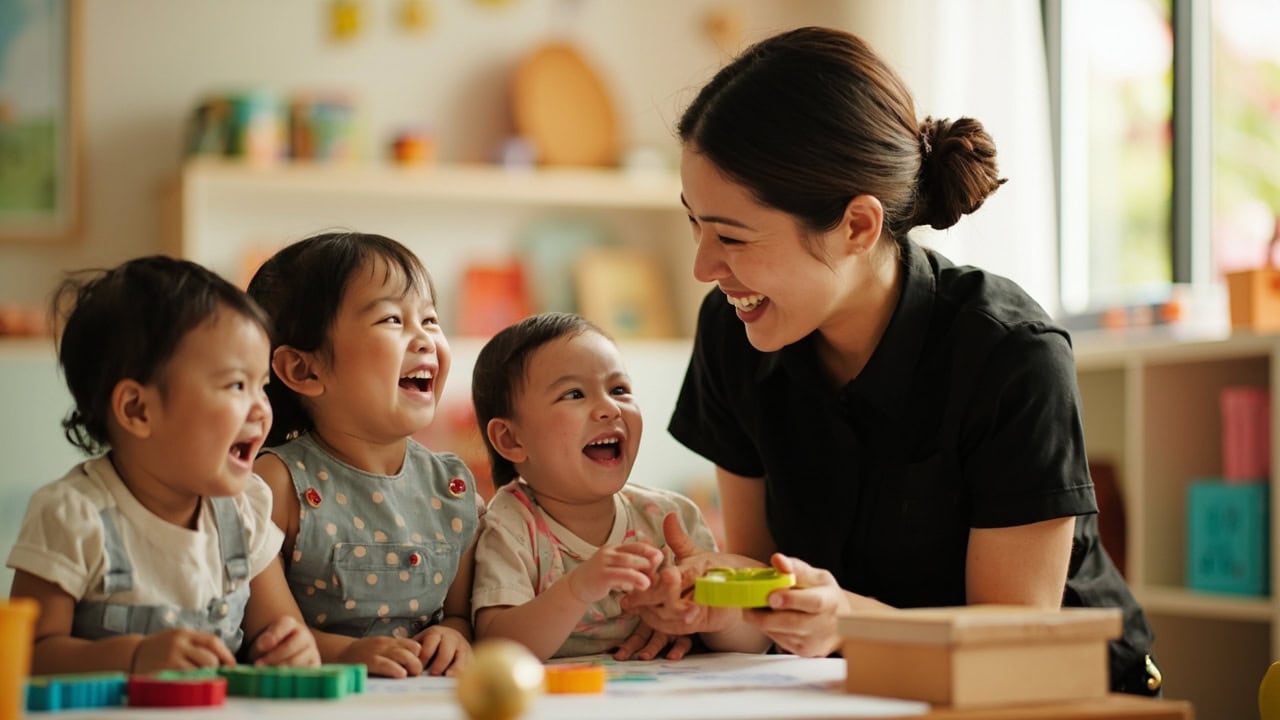
Tended Not Just Minded: What Your Child’s Care Is Building
The Question Every Singapore Parent Carries
There is a question that most Singapore parents carry quietly. It surfaces in the moments before they leave for work, or in the afternoon when they are caught in traffic wondering what their child is doing at that precise moment.
It is not a question of doubt or guilt. It is something deeper, more searching:
What is actually happening to my child when I am not there?
Not what they are eating. Not whether they are safe. You trust that, or you would not have made the choice you made. The question is subtler than that. It is about what is taking shape inside them—the patterns forming, the connections building, the small quiet growth that no photograph can capture and no end-of-day report can fully convey.
It is the question of a parent who wants more than supervision. It is the question of a parent who wants to understand.
And yet, when you search for answers, what do you find? You find language about trust. About warmth. About qualified caregivers and safe environments and partnerships with families. All of that matters. You would not dismiss it.
But somewhere beneath those assurances, you sense a gap—a space where the explanation should be. Where someone should be able to tell you not just that your child is well cared for, but what that care is actually doing.
What is the work? What is the practice? What is the thinking behind the way your child’s hands are being held, the way their eyes are being met, the way their curiosity is being offered to them in small, purposeful doses throughout the day?
This is the question we built EduNanny Singapore to answer. Not instead of trust, but alongside it. Not instead of warmth, but informed by it. Not in generalities, but in specifics. Not in reassurances, but in practices you can observe, understand, and trust because you can see the thinking behind them.
Beyond Safety: What Your Child Actually Needs
When Singapore parents evaluate childcare options, they encounter a familiar vocabulary: safe environments, qualified caregivers, warm relationships, open communication. These are not empty promises. They represent real standards that any responsible childcare provider should meet.
But here is what many parents intuitively sense, even when they cannot articulate it: these standards describe the minimum viable experience. They tell you that your child will not come to harm. They do not tell you what is happening to your child’s developing brain, nervous system, and emerging sense of self during the hours you are apart.
The difference between quality childcare and developmental care is the difference between a container that holds your child and an environment that actively shapes their becoming. Both may look similar on the surface. But only one asks the question: What is this specific child needing right now, in this moment, to grow toward everything they are capable of becoming?
EduNanny Singapore was built on the conviction that developmental care is not an add-on to childcare. It is the core of what childcare should be—especially during the first three years, when the brain is building its fundamental architecture at a speed it will never match again.
Why the Early Years Matter Most
Consider what this means in practice. A child’s ability to sit still in a Primary One classroom, to attend to a teacher, to modulate their own energy, to feel secure enough to explore—all of this traces back to the quality of experiences they accumulated in infancy and toddlerhood.
The sensory world is the classroom, and the child’s nervous system is the student, recording, integrating, building the architecture of perception itself. Every sensation that moves across their skin, every texture their fingers encounter, every sound that arrives from an unexpected direction—these are not background experiences. They are the curriculum.
Movement is not what happens after learning is complete. Movement is how learning happens in the first years of life. When an infant kicks their legs against a soft mat, they are discovering cause and effect, building hip flexibility, developing the proprioceptive feedback that will later support balance and coordination.
The brain that learned to integrate sensation well, and the body that learned to move with purpose, can learn anything.
Sensory and Motor Development: The Foundation of Early Learning
Let us speak about what is happening beneath the surface—because what matters most in early childhood is often what you cannot see.
Understanding Sensory Development
When a caregiver lifts a six-month-old from a cot, the child’s proprioceptive system—the sense of body position and movement—receives information about being held, about vertical orientation, about the rhythm of footsteps. When that same caregiver narrates what they are doing, the auditory system receives language input mapped directly to physical experience. When the child reaches for a wooden ring and grasps it, their visual-motor coordination refines itself in real time.
None of these moments are accidents. In a developmentally attentive environment, none of them are accidental at all.
At EduNanny, sensory development is not a scheduled session. It is woven into the texture of every day. It might look like a caregiver who notices that a toddler is becoming overstimulated in the play area and gently redirects them to a quieter corner with different materials—soft fabric, wooden shapes, a different quality of light. The child is not just being moved; their nervous system is being supported to regulate.
It might look like an infant being held in different positions throughout the morning, because different postures activate different sensory channels. The body learns through its relationship with gravity, with support, with the quality of held versus supine positions.
Motor Development in Everyday Moments
When a toddler climbs a low structure and pauses at the top, they are not just playing. They are calculating risk, integrating visual-spatial information, strengthening the postural control that will later allow them to sit at a desk and attend.
In most childcare settings, motor development is something that happens when children move freely—on the playground, in the playroom, during designated activity times. Free movement matters. But it is not enough.
Genuine developmental care understands that motor development can be woven into the fabric of the entire day, including the routine caregiving moments that many people assume are purely functional.
Consider diapering. When a caregiver places an infant on a changing mat and gently guides their legs into different positions, stretches them slightly, narrates the movements, they are providing proprioceptive input and supporting hip development. This is not extra work. It is a different way of doing the same task—one that recognizes every moment as an opportunity.
Consider dressing. When a toddler is encouraged to assist with pulling up their pants, to step into clothing rather than simply being dressed, they are building the coordination and body awareness that will serve them for years. The extra thirty seconds this takes are not wasted. They are invested.
Consider feeding. When a child is seated properly, given appropriately textured foods at developmentally appropriate stages, and encouraged to self-feed even when it is slower and messier than a spoon would be, they are developing oral motor skills, fine motor control, and the independent agency that feeds their sense of competence.
This is what we mean when we say motor skills and physical development are daily practice, not afterthought. At EduNanny, we have trained our caregivers to understand the motor demands of each developmental stage and to integrate supportive practices into every routine interaction. This does not require special equipment or isolated activities. It requires knowledge, attention, and the conviction that no moment is too small to matter.
What Developmental Care Actually Looks Like
You might be wondering how you would actually know if this is happening. How do you verify that the care your child receives is developmentally attentive rather than simply warm and safe?
What EduNanny Provides
Transparency matters. We believe that parents should not have to take our word for it.
Where CCTV measures are deployed, they are deployed not just for security but for shared visibility—a window into the daily experience your child is having. Regular updates, narrative reports, developmental observations—these are not add-ons. They are part of how we account for the trust you place in us.
What You Can Learn to Recognize
Beyond these mechanisms, there are signals you can learn to recognize in any quality childcare environment:
- Watch how caregivers interact with children during transitions—when children are being moved from one activity to another, one space to another, one state of alertness to another. A developmentally attentive caregiver will use these transitions as opportunities rather than obstacles. They will narrate, they will connect, they will modulate the child’s energy rather than simply directing it.
- Watch how children are handled during feeding and diapering. These intimate, routine moments reveal a great deal about the philosophy of care. Is there engagement? Is the child’s participation invited? Is the child’s body being supported in ways that promote development?
- Watch for the language caregivers use, not just with the children but around them. Is there a sense that the child’s inner life is being attended to, not just their outer behavior? Is there evidence of individualization—of a caregiver who knows this child’s specific rhythms, preferences, and emerging strengths?
These are the markers of developmental care. Not a curriculum on the wall. Not a list of activities on a schedule. The quality of attention itself.
Questions to Ask During Your Visit
- How do you support a child who is overstimulated or dysregulated?
- What does a typical day look like from the child’s perspective, not just the routine?
- How do you individualize care for each child’s developmental stage?
- How do you communicate with parents about what is happening beyond “they had a good day”?
Red Flags to Notice
- Routine caregiving moments (diapering, feeding, dressing) treated as purely functional tasks
- Little eye contact or verbal engagement between caregivers and children
- Children left to entertain themselves without responsive interaction
- No explanation of developmental philosophy beyond safety and warmth
The Real Meaning of School Readiness
Parents in Singapore are right to think about school readiness. It is not a pressurefad. The early years do matter, and the transitions children make into preschool and then primary school carry real consequences for their sense of capability, their relationship with learning, and their social-emotional wellbeing.
But school readiness is not what most people think it is. It is not the ability to recite alphabets or count to twenty. These are skills that can be taught, and they will be taught.
What Genuine Readiness Requires
Real school readiness is the readiness of the whole child:
- The child whose sensory systems are integrated and can filter out distraction
- The child whose motor skills support posture and energy modulation
- The child whose emotional regulation allows for the frustration of learning something new
- The child whose language is rich enough to access instruction
- The child whose curiosity has been preserved rather than dampened by anxiety
This is what EduNanny’s approach ultimately serves. Not the short-term performance of readiness metrics, but the long-term capacity for learning.
When we tend to sensory development throughout the day, we are building a nervous system that can attend. When we support motor development in every routine moment, we are building a body that can participate. When we attune to emotional states and model regulation, we are building a psyche that can cope.
These are the foundations of genuine school readiness—the kind that endures, the kind that grows, the kind that a child carries with them not just into Primary One but into the years beyond.
Why EduNanny Singapore Exists
We did not build EduNanny to be another name in a crowded childcare market. We built it because we saw a gap that mattered—a gap between what parents were being offered and what their children actually needed.
Too many families in Singapore were caught between institutional care that could not individualize and informal arrangements that could not assure quality. Too many parents were making choices based on proximity and availability rather than developmental philosophy. Too many infants were spending their most critical developmental years in environments that met their safety needs without ever reaching their potential.
The ECDA Childminding Pilot
The ECDA Childminding Pilot represents something different. It represents an official recognition that childminding is not merely a substitute for parental care. It is a developmental practice with its own standards, its own knowledge base, its own dignity.
When EduNanny was established under this pilot, we made commitments that reflect our convictions:
- Small ratios—up to one caregiver to three infants, because the quality of attention a child receives is not a luxury. It is a prerequisite.
- Home-based and community pathways—because childcare should be accessible, not just to families who can afford centre fees, but to any family who wants developmental care.
- Affordable fees—within pilot structures, with CDA and Baby Bonus usability, Monday to Friday care blocks that respect working family realities. Developmental care should not be gated by socioeconomic privilege.
Answering Your Concerns
“How do I know this isn’t just marketing?”
It is a fair question. The early childhood sector is full of beautiful language and compelling promises. What sets developmental care apart is specificity—not a philosophy statement on a website, but observable practices in daily routines.
Ask to see a day in the life. Ask how caregivers are trained. Ask what they understand about sensory integration and motor development. Ask how they would respond to a specific situation—a child who is struggling to settle, an infant who is not yet mobile, a toddler who is refusing food.
“My child seems fine. Why does this matter?”
Children are remarkably resilient. A child who appears fine may still be developing sensory systems that struggle to filter background noise in a crowded classroom. A child who appears fine may still be building postural control that will affect their ability to sit and attend in Primary One.
The goal is not to create anxiety about hidden problems. The goal is to recognize that the early years are a once-and-for-all window for building foundations. What is laid down now cannot be fully rebuilt later. This is not a reason for panic. It is a reason for intentionality.
Your Child’s Quiet Growth Matters
Let us return to that quiet question with which we began.
What is actually happening to my child when I am not there?
The answer, at EduNanny Singapore, is this:
Your child is being held in a world designed for their becoming. They are encountering sensory experiences that build their perception. They are moving through a day that develops their body alongside their mind. They are being responded to with attunement, because their caregiver knows their name, their needs, their emerging self.
They are being prepared not just for school, but for life—not through pressure, but through the patient, purposeful tending of everything they are and everything they are growing toward.
When you choose childcare, you are making a decision about what will be happening to your child during the hours you are not there. You are choosing an environment that will shape their sensory systems, their motor development, their emotional regulation, their relationship with learning.
You cannot be there to see it. That is the nature of the choice. Which is why understanding what to look for—and what questions to ask—matters so much.
You deserve more than assurances that your child is safe and happy. You deserve to understand what is actually happening to their developing brain, their emerging self, their capacity to learn and grow and become.
This is what we mean when we say your child is not merely minded at EduNanny. Minded means supervised. Tended means known.
And we believe that every child in Singapore deserves to be known—fully, carefully, and with the intelligence that their earliest years demand.
We are EduNanny Singapore. And we are here because your child’s quiet growth matters.
Curious about what developmental childminding looks like in practice? Learn more about EduNanny’s approach and the standards behind our care. We welcome conversations with families who are looking for something more intentional.