Teaching Your Child That New Rooms Are Safe
The Moment Every Singapore Parent Dreads
There is a moment in every parent’s childcare journey that arrives quietly, often announced by an email or a conversation at pick-up: “It’s time for your child to move to the next room.”
For a heartbeat, nothing has changed. Your child is still the same child. The sun is still coming through the same windows. But something inside you tightens. You smile and nod and say the right things. And then, somewhere between the car park and the dinner table, the questions begin.
Will my child cry? Will she feel abandoned? Will the new caregivers understand her the way the current ones do? Will this disrupt everything we’ve built—the trust, the security, the developmental momentum that has taken months to cultivate?
You are not being irrational. You are being a parent.
And that moment—the transition between rooms—is precisely where the difference between childcare and developmental care becomes most visible. It is where trust is either honored or quietly broken. It is where your child either feels held through change or simply processed through it.
The Emotional Truth About Room Transitions
When a child changes rooms, parents experience something profound. It is not simply logistics. It is not merely a new schedule or a different teacher-to-child ratio. It is the first significant handing over of your child’s world to people you did not choose, in a context you cannot fully observe, at a developmental stage when your child’s brain is building the architecture for trust, attachment, and emotional regulation.
The first thousand days of life—and the years immediately following—are when children develop their foundational sense of security. Attachment research consistently tells us that young children who experience consistent, responsive caregiving develop what researchers call “internal working models”—internal maps of how the world responds to their needs.
When those maps are reliable, children grow into people who expect the world to be generally safe, predictable, and responsive. When those maps are disrupted without sensitive reconnection, children can experience regression: increased clinginess, disrupted sleep, changes in appetite, heightened separation anxiety.
What parents intuitively understand, and what the science confirms, is that a room transition is not simply administrative. It is relational. It is neurological. It is deeply personal.
And yet, in most childcare conversations, this moment is treated as routine. “Your child is ready to move up.” The email arrives. The handovers happen. Parents are told their child is “adjusting.” Sometimes adjustment is smooth. Often it is not. And when it is not, parents are often left wondering whether they should have intervened, whether they chose the right centre, whether their child is fundamentally okay.
The anxiety is real. And it deserves more than reassurance. It deserves understanding.
There is also a particular guilt that attaches to room transitions. It whispers that if you were home more, this disruption would not be necessary. That your child is paying a price for your work, your circumstances, your choices. This guilt is familiar to many Singapore parents, and it is worth addressing because it can distort your judgment about what your child actually needs.
Children are not harmed by group care. They are harmed by insensitive, unresponsive, or unstable care. The quality of caregiving matters far more than the quantity of parental presence. A child who experiences warm, consistent, developmentally supportive care will not only survive room transitions—they will move through them with resilience.
Your child reads you. When you approach transitions with calm confidence—not because you do not care, but because you trust the process and the people—the message your child receives is that change is safe, that new people are safe, that moving through the world is something they can do.
What Quality Transition Care Actually Requires
Let us be honest about the gap between what most arrangements provide and what children actually need during this time.
The Careless Transition
A room transition done carelessly looks like this: a date is set, a child is moved, a new caregiver receives a brief verbal handover, and the family is sent a note saying “Your child has settled in well.” The child’s emotional experience—the quiet withdrawal, the changed sleep patterns, the regression in speech or toilet training—is noted as “a phase” or attributed to unrelated factors. The parent’s concern is acknowledged with patience but not addressed with depth.
This is not malicious. It is often simply the result of centres managing dozens of transitions simultaneously, with caregivers who are dedicated but overextended, and with communication systems that prioritize efficiency over emotional precision.
The Developmental Transition
But there is another way. A quality transition is not an event. It is a process. And it begins long before the move itself.
When transition care is done with developmental intentionality, you see something different:
- Caregivers in the current room deliberately prepare your child for what is coming—not with a single conversation, but with repeated, age-appropriate exposure to the new environment
- Your child visits the new room, not once but several times, at first playing alongside the children who will become their new peers
- The new caregivers visit your child in the familiar room, becoming known faces before the physical transition
- The transition becomes a bridge, not a gap—gradual reorientation rather than sudden displacement
Instead of waking up one morning to find that everything familiar—the faces, the routines, the rhythm of the day—has been replaced, the child experiences gradual reorientation. The new room becomes a place of excitement, not disorientation. The new caregiver becomes a person already known, already trusted, already associated with safety.
This is not intuitive. It requires training, intentionality, and time. It requires a team that believes transitions matter as much as curriculum. And it requires communication systems that keep parents close to the process rather than leaving them outside it.
The EduNanny Approach: The Handoff That Never Ends
At EduNanny Singapore, transitions are handled as what our caregivers describe internally as “the handoff that never ends”—meaning that the transition from one room to another is not complete when a child physically moves spaces. It continues until the child has not just arrived, but settled. Not just met new caregivers, but formed a relationship with them. Not just entered a new environment, but made it home.
How This Works in Practice
Observation Precedes Movement: Before any child transitions, their current caregivers have documented—not in general terms, but with specific, developmental precision—where that child is in their learning journey. What soothes them when they are upset. What frustrates them. What makes them laugh. What they are working on—language, motor skills, social negotiation, or emotional regulation. This documentation travels with the child.
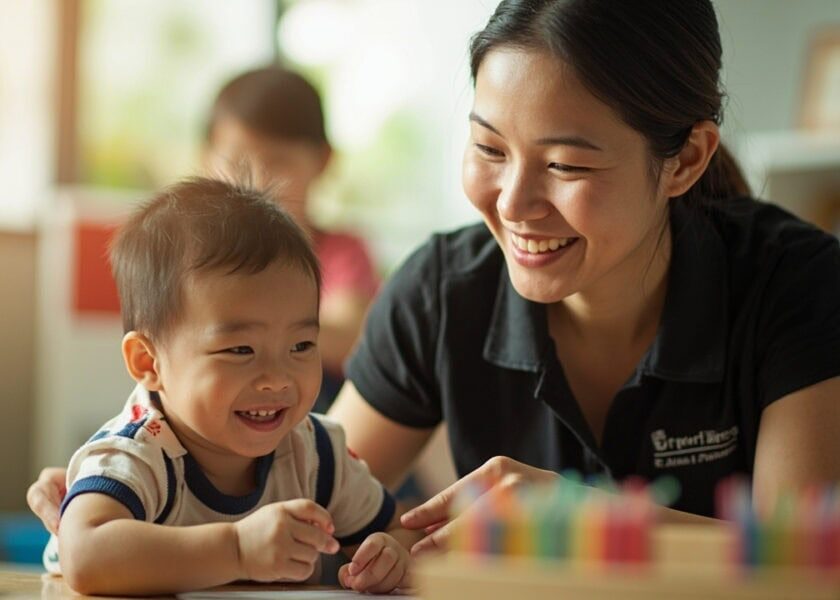
Receiving Caregivers Receive a Relationship, Not Just Information: Caregivers in the new room spend time in the current room, not as observers but as participants, playing with the children who will soon be in their care. They learn to read individual children’s cues before those children arrive in their room. By the time the transition happens, the caregivers are already familiar faces in a familiar context.
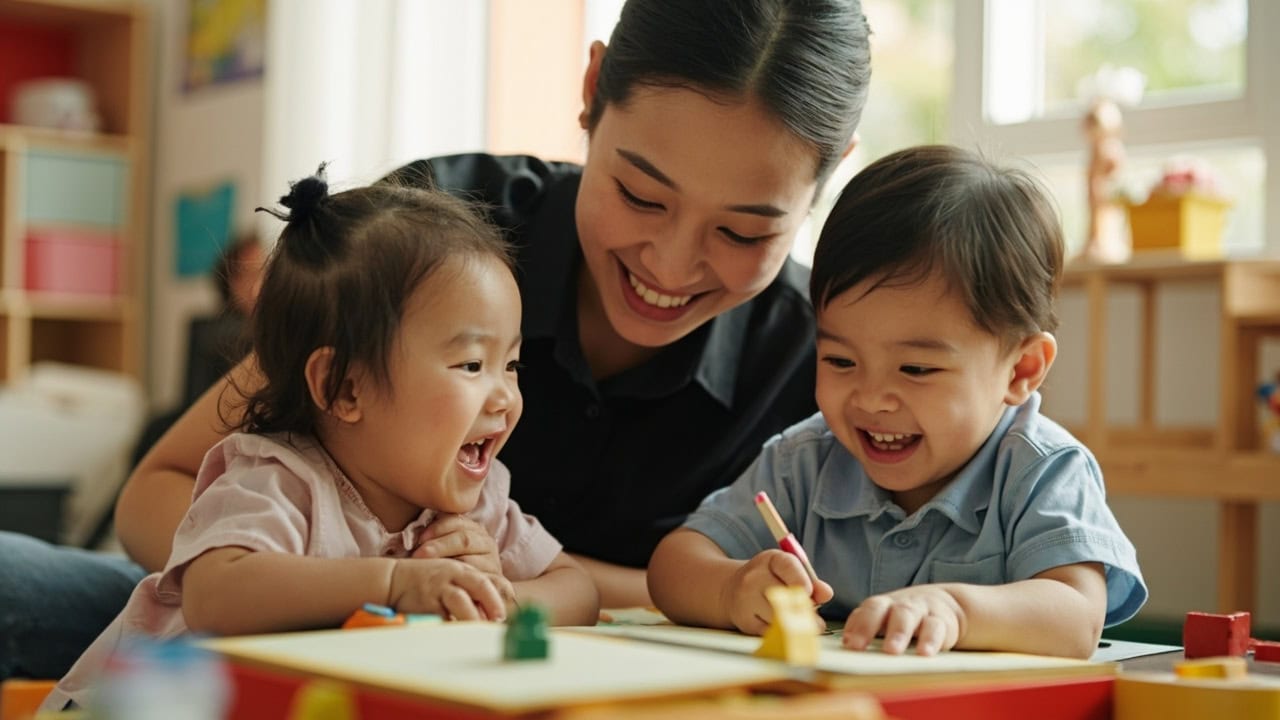
The Transition Itself Is Gradual: Children do not move all at once. The first visits are brief and always followed by return to the familiar. Gradually, the visits lengthen. The child begins to develop a sense of the new room as an additional home, not a replacement. This process is paced according to the individual child, not the calendar.
Parents Are Partners, Not Observers: Before the transition, parents are informed not just that a move will happen, but why—from a developmental perspective—what the timeline looks like, and what they can expect to observe in their child. During the transition, communication intensifies. If a child is struggling, parents hear about it not as an afterthought but as an active conversation. Caregivers in both rooms coordinate. The goal is always a child who feels secure, not a transition that has simply been logged.
This is the difference between childcare and developmental care. Childcare manages logistics. Developmental care manages the emotional and relational architecture of change.
The Foundation: ECDA Childminding Pilot
EduNanny Singapore operates under the ECDA Childminding Pilot, reflecting a philosophy of childcare rooted in one-to-three ratios for infants. For every three infants in care, there is one dedicated caregiver whose attention is not divided across a room of twelve. When your infant signals a need—through movement, expression, or vocalisation—that signal is seen, heard, and responded to with developmental intentionality.
This ratio is foundational to the kind of observation, responsiveness, and individualised care that makes transitions possible without disruption. A caregiver who truly knows your child can hand that child over with confidence because the receiving caregiver will receive not just information but context—the texture of who this child is, what this child has been through, what this child needs to feel safe.
The pilot also brings affordability into clearer reach for families navigating the genuine financial pressures of quality care. Within the pilot fee structures, and with the usability of CDA and Baby Bonus payments, the question of whether your child can access this quality of care becomes less about resources and more about recognition of what your child deserves.
The EduNanny model operates across both home-based and community pathways, meaning families across Singapore can access this approach regardless of location or preference for care settings. Whether your child is in a home-based arrangement or a centre-based environment, the principles of developmental care and intentional transition remain the same.
Signs Your Child’s Transition Was Handled Well
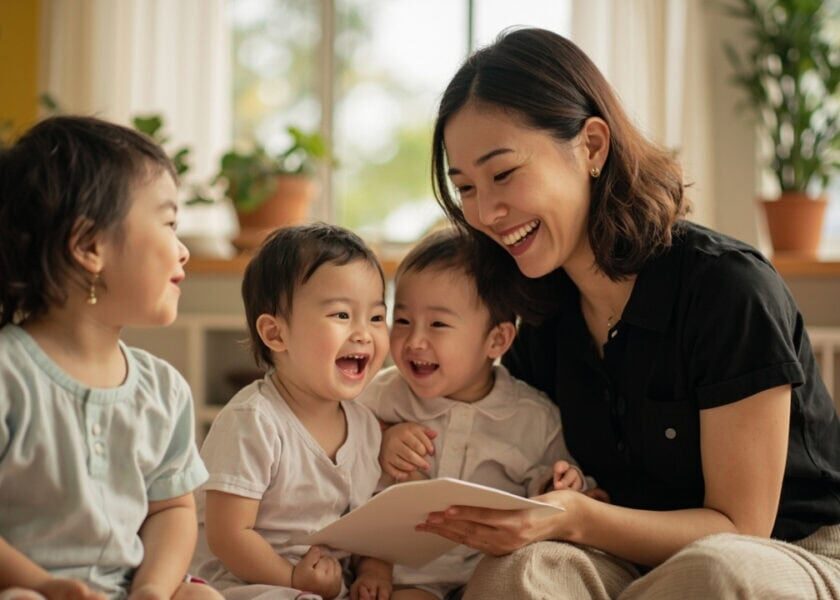
When a transition is handled well—when your child moves to a new room and you see them settling with confidence, when they speak about their new caregivers with warmth, when developmental progress continues rather than stalls—what you are witnessing is trust being preserved.
The security your child built in the first room was not broken. It was extended. The attachment they formed was not disrupted. It was transferred with sensitivity.
This is the highest aspiration of quality care: Not just to keep your child safe, not just to nurture them, but to build in them an internalised sense that the world is generally trustworthy. That new people can be safe. That change can be navigated. That they can move through new rooms, new schools, new stages of life and carry their sense of self with them intact.
This is what we are preparing your child for. Not just the next room. The next twenty years.
- Your child runs into your arms with a smile that says “I missed you but I was okay”
- Your child mentions their new caregiver unprompted, with the casual warmth of someone they feel safe with
- Developmental progress continues—toilet training resumes, sleep patterns re-establish, language continues to bloom
- You receive consistent, specific communication about your child’s adjustment—not generic reassurances
These are not coincidences. These are evidence that somewhere, the adults in your child’s life were paying close enough attention to hold them through change.
Questions to Ask When Evaluating Childcare in Singapore
When you are researching infant care or childminding options, room transitions may feel like a distant concern—something that will matter later, when the time comes. But the approach a centre takes to transitions reveals something fundamental about their philosophy of care.
About Transition Philosophy
- How do you prepare children for room changes? Is it a single event or a gradual process?
- Do caregivers from the new room spend time with children before the transition?
- How do you document and share information about a child’s developmental progress, preferences, and routines before a transition?
- What does a successful transition look like to you? How do you measure it?
About Communication
- How will I be informed about my child’s transition—before, during, and after?
- What should I expect to see in my child during the adjustment period?
- How will you tell me if my child is struggling? What does that support look like?
- Can I visit or observe during the transition period?
About Caregiver Relationships
- What is the caregiver-to-child ratio in each room?
- How long have the caregivers in my child’s room been with the programme?
- How do you support caregivers during transitions—both yours and theirs?
When That Email Arrives
We live in a time of genuine complexity for Singapore families. Parents are navigating economic pressures, social expectations, extended family dynamics, and the constant pull between presence and provision. The decision to place your child in care—even in the highest quality care—can be accompanied by a kind of low-grade grief, a sense that something is being traded that cannot fully be named.
What EduNanny Singapore believes, deeply, is that we do not replace parents. We work alongside them. The caregivers in our programme are not substitutes for parental presence; they are extensions of parental intent. Every observation we make, every transition we manage, every conversation we have with you about your child’s day—it is all in service of the same goal: a child who thrives, a family that feels supported, and a relationship between family and caregiver that is built on genuine trust.
So when that email arrives—when the conversation happens at pick-up, when you hear the words “It’s time for your child to move to the next room”—I want you to know that what you are feeling is not weakness. It is wisdom. You are feeling the weight of loving someone completely, and the recognition that loving someone completely means entrusting them to others, in settings you cannot fully control, during moments you cannot fully witness.
That is brave. And it is also necessary.
But you do not have to do it without support. You do not have to do it without information. You do not have to do it without partners who will walk with you and your child through that transition—not as a logistical exercise, but as a developmental act of care.
Your child will move through many rooms in their life. Classrooms. Schools. Workplaces. Relationships. Cities. The skill they are building right now—the skill of moving through new environments with a sense of security intact—is a skill that will serve them for the rest of their lives.
And the people who help them build that skill—who teach them that new rooms do not mean starting over, that change can be navigated, that the world has trustworthy people in it who will see them and respond to them—those people matter.
We know they matter. And we will treat every transition as if we know it too.
Because we do.
If you are a parent in Singapore exploring infant care or childminding options, we invite you to learn more about how EduNanny approaches transitions—and early childhood care—with the intentionality your child deserves. You are also welcome to connect with our team or read more about our approach.