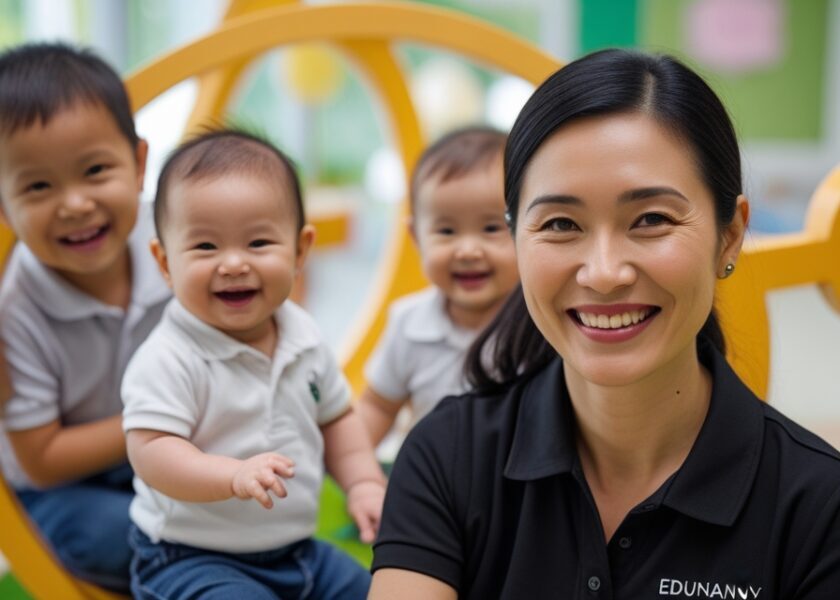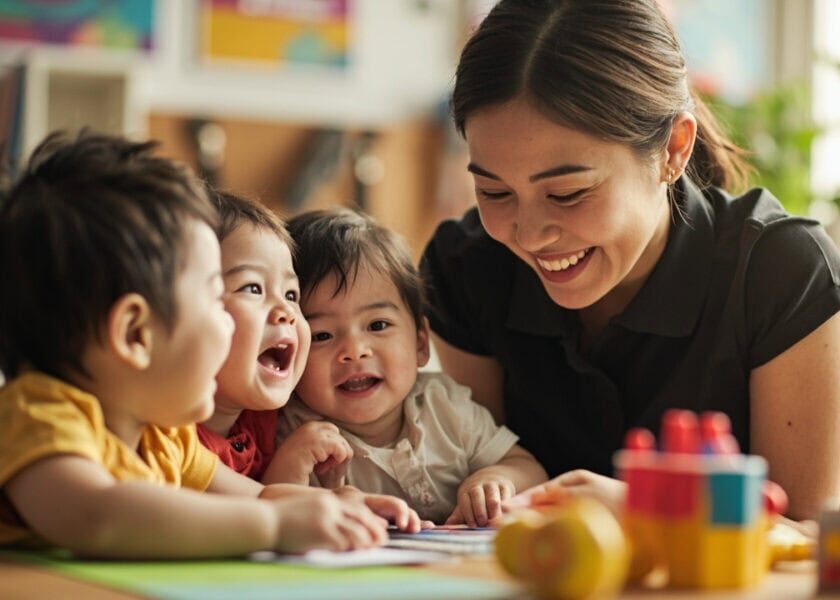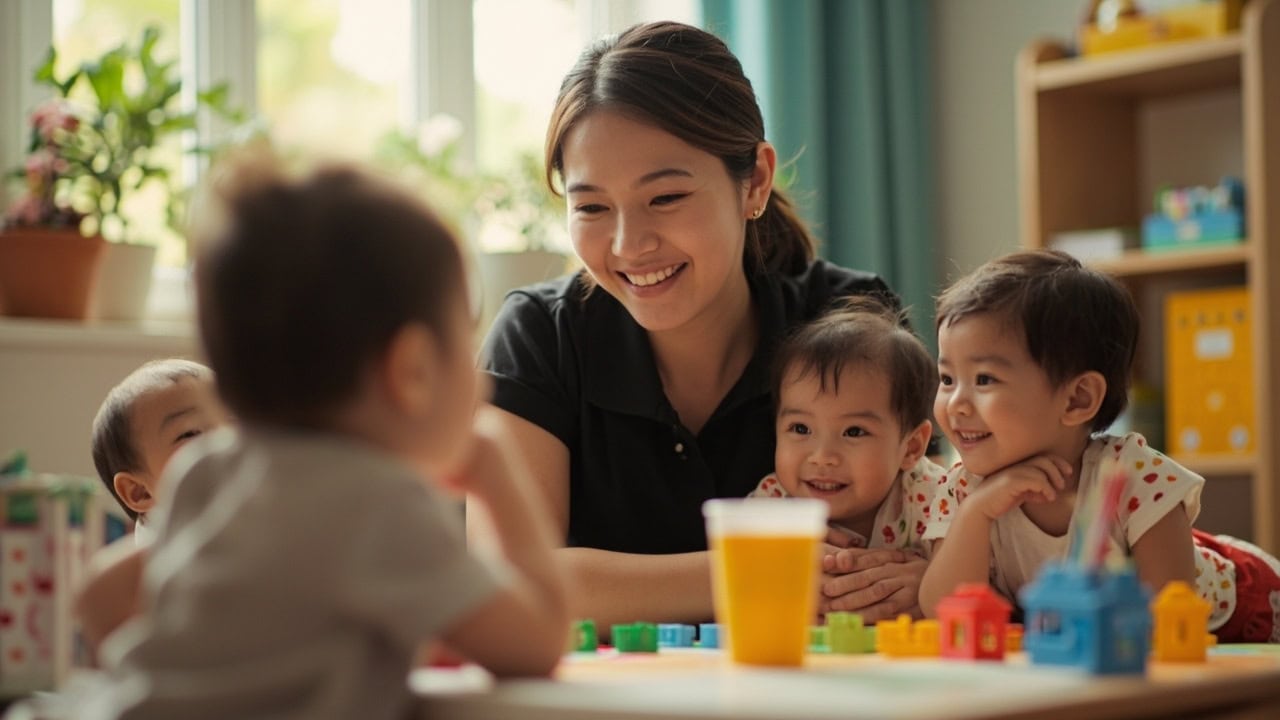
Singapore Childcare Built for the Bond Between Brothers and Sisters
The Question Beneath Every Childcare Decision
You are at the playground. Your older child is showing your younger one how to stack a block. You watch, and something in you softens. The thing you have been hoping for, quietly feared might not happen, is already taking place. Your children are not just coexisting. They are teaching each other.
And almost immediately, alongside that softening, comes the other feeling. The one that lives just beneath the surface of every parent with two or three children. The worry that in the rush of managing a household, each of your children is known individually. That each one is seen not as a member of a sibling unit but as a singular person with their own pace, their own temperament, their own quiet needs that might slip through the cracks of a shared childhood.
This is the unspoken tension that lives in Singapore families. Not because parents are doing anything wrong. But because the world of childcare has rarely paused long enough to take it seriously.
Most conversations about choosing childcare centre on credentials, ratios, and facilities. The checklist matters. But beneath every practical consideration, there is a question that parents rarely hear asked out loud:
Will the people caring for my children understand that they are not just siblings living in the same house? Will they recognize that the bond between my children is one of the most powerful developmental forces in their lives? Will they tend to it, the way I would?
Today, more parents in Singapore are beginning to ask this question honestly. And the answer matters more than most childcare conversations suggest.
What Siblings Actually Do for Each Other
Consider what siblings do in the early years when the environment supports them.
An older child becomes a model. Not because anyone has instructed them to be, but because they are wired to be imitated. A toddler watches her four-year-old brother hold a crayon and something unlocks. A three-year-old listens to his sister negotiate a turn on the slide and files it away in a part of his brain that no adult can reach quite as efficiently.
Younger siblings do not just learn from older siblings. They stretch toward them. And in that reaching, they grow in ways that no structured lesson could engineer.
Now consider what a younger sibling does for an older one. A six-year-old who has been the sole focus of parental attention suddenly finds herself in a role she did not audition for. She becomes a guide. A protector. Sometimes, unintentionally, a role model for behaviour she has not yet fully mastered.
When this role is supported rather than left to navigate on its own, it becomes one of the most profound sources of emotional development a child can experience. The older sibling learns responsibility, patience, the beginning of empathy in its most practical form. Not by being told to be kind. But by being trusted to be a big brother or a big sister, and by having adults around who recognize what that trust is teaching them.
This is the sibling effect. And it is one of the most consistently underestimated forces in early childhood development.
When Shared Care Supports Rather Than Divides
Here is what most parents quietly worry about. They fear that shared childcare will dilute individual attention. That in a group setting, one child will thrive while another recedes. That sibling rivalry, which exists in every family, will be amplified rather than mediated by the care environment. That their children will be supervised together but not truly growing together.
These fears are not irrational. In many childcare settings, they are legitimate.
When a caregiver is managing six, eight, or ten children at once, there is simply not enough attention to go around. Sibling interactions become noise to manage rather than dynamics to support. The older child who is acting out because she needs individual reassurance is grouped with the younger one who has a fever and the whole morning becomes triage rather than care.
But here is what changes when the ratio is different. When there are not ten children and two adults, but one, two, or three children with a caregiver whose attention is not fractured into fragments.
What you begin to see, what parents start to notice at pickup time, is something quietly remarkable:
- Your older child looking out for your younger one in a way that feels natural rather than performed
- Conflict that used to escalate resolving itself because there is an adult close enough to intervene with a word, a redirection, a gentle model of sharing that actually lands
- Your children seeking each other out during free play, choosing proximity, building something together that you cannot quite name but that makes your heart feel full
That is what intentional sibling support looks like in practice. Not a program. Not a module. A presence. An environment where the sibling relationship is treated not as a logistical challenge to be managed but as a developmental partnership to be observed, respected, and gently strengthened.
Your older child explaining something to your younger one, not because a teacher asked her to, but because she has internalized that this is what she does. This is her role. And it feels good to be the one who knows.
When conflict arises, and it will arise because that is what siblings do, there is an adult nearby who does not immediately solve it but asks the right questions. Who gives language to what each child might be feeling. Who helps them find words before they find fists.
You might notice your younger child trying to keep up in a way that is stretching him, not straining him. There is a difference. Stretching happens when a child is motivated by genuine admiration and proximity. When he watches his sister hold a conversation with a caregiver and wants to be part of that world, not because he has been pushed there, but because it looks like the most interesting place to be.
The social skills, the conflict resolution language, the habit of turning to a sibling before turning to a parent, the sense of being part of a team rather than rivals in a competition for attention—these are habits that, once established in quality care, travel home with your children. They show up at the dinner table. They show up on long car rides. They show up in adolescence and adulthood, in the relationship your children will have with each other when you are no longer in the room.
The sibling bond is the longest relationship most people will ever have. And it begins, in its most formative years, in the environment where your children spend their days.
Quality Childminding That Sees the Whole Family
For families in Singapore navigating the early years, finding care that takes sibling dynamics seriously has historically been harder than it should be. Singapore parents carry a particular weight: the cost of living, the demands of dual-income households, and the high expectations that begin even before your child can walk.
For parents with multiple children, there is the added layer of wanting to do right by each child individually while also honouring the relationship between them. It is a tension that does not have easy answers. But it deserves an honest one.
Quality childminding is not about dividing attention equally between children. It is about understanding that families are ecosystems, and a quality childcare environment is one that understands and respects that ecosystem, not just the individuals within it.
What to Look For
- Small ratios that allow for observation: When a caregiver can watch not just individual children but the relational dynamics between them, sibling interactions become opportunities rather than interruptions.
- Caregivers trained to read relational cues: Understanding when an older sibling needs reassurance versus when a younger one needs to be stretched. Knowing when to intervene and when to let sibling problem-solving unfold.
- Space for sibling-led play: Not just structured activities where children are neatly divided by age, but room for siblings to negotiate, cooperate, and discover each other.
- Individual attention within group settings: Each child seen for who they are, not just as part of a sibling unit.
EduNanny Singapore: Built for Sibling Development
EduNanny Singapore operates under the ECDA Childminding Pilot, which means it is grounded in a framework that takes childminding seriously as a profession and as a developmental practice, not as a stopgap solution for busy parents.
This matters because it means your child’s caregiver is not improvising. She is part of a program that values training, observation, and intentional care. Whether your family chooses a home-based pathway or a community or centre-based pathway, the principles remain consistent: small ratios, attentive observation, and a genuine understanding of how children grow within families.
The Ratio That Changes Everything
Up to one to three infants with a caregiver. Not one to ten. Not one to fifteen.
Which means when your older child is having a moment, there is capacity to be fully present to that moment. When your younger one is reaching a new milestone, there is someone to witness it and to create space for your older child to witness it too, so that sibling pride becomes part of the experience rather than an afterthought.
For families with multiple children, this is the difference between care that manages and care that nurtures.
Accessibility and Practical Support
The fee structures within the pilot are designed to be accessible. There are families who have quietly ruled out quality childcare because the numbers seemed to add up in ways that did not work.
Within the EduNanny framework, that barrier is addressed. You can use your Child Development Account and your Baby Bonus contributions toward your childcare fees, which removes a layer of financial stress that no Singapore parent should have to carry alone.
Monday to Friday care blocks give families the structure that fits real work lives, and Singapore-wide relevance means that wherever you are on this island, the question of quality sibling care does not have to remain unanswered.
Trust, Transparency, and Partnership
When your children are in a care environment, trust is not optional. It is the foundation.
Trust, in this context, means that you know what is happening in your children’s day. Not in the abstract sense that they are safe, which is assumed, but in the specific sense that you can see how they are interacting, how their sibling bond is being supported, how conflict is being navigated, how each of your children is doing as an individual.
EduNanny builds this through open communication, regular updates, and transparency measures including CCTV where deployed. These are not marketing features. They are the practical expressions of a simple belief: parents who are informed are parents who can partner in their children’s development.
For the modern Singapore parent, there is also Thomas, the AI Chatbot available through EduNanny. It gives parents a way to ask questions, seek guidance, and navigate the small and large uncertainties of raising multiple children without feeling like they have to have all the answers.
Parenting is not a performance. It is a daily practice, and the people who support you in that practice should make you feel more capable, not less. Thomas is there for the midnight question, the midday worry, the quick check-in that helps you feel connected to your children’s day even when you are not in the room.
Questions to Ask When Choosing Childcare
As you evaluate your options, here are questions worth asking beyond the standard checklist:
- How do caregivers observe and respond to sibling interactions? Quality care means someone is watching not just individual children but how they relate to each other.
- What is the actual ratio, and what does it allow? Ask specifically how sibling dynamics are facilitated when attention is being given to individual children.
- How is conflict between siblings handled? You want mediation and language-building, not just supervision.
- Are siblings ever separated, and when does that happen? Understanding when and why siblings might be in different spaces helps you know what to expect.
- How do you receive updates about each child individually? Sibling care should not mean that one child’s day gets reported while another’s is assumed to be fine.
You Are Already Raising Children Who Love Each Other
Your children who annoy each other, yes. Who fight over toys and steal each other’s snacks and sometimes, in the raw honesty of sibling life, say things that break your heart a little.
But who also look out for each other in ways that no adult taught them. Who find comfort in each other’s presence that is unlike any other relationship they will ever have. Who are, right now, in this very moment, teaching each other things that will shape who they become.
Your job is not to manufacture that bond. It is already there. Your job is to find an environment that protects it, that leverages it, that understands that the sibling relationship is not a logistical inconvenience to be managed alongside everything else.
It is one of the most powerful developmental assets your children have. And it deserves to be cared for with the same intentionality, the same attention, the same love that you bring to every other dimension of raising them.
EduNanny Singapore is built for families like yours. Not families with perfect children, because no such children exist. Families with siblings. Families with the beautiful, exhausting, irreplaceable reality of multiple children who are learning, every single day, how to be people together.
The kind of people who will text each other when they are grown. Who will show up for each other in ways you cannot yet predict. Who are, even now, teaching each other how to be human.
That is the work. And it begins with finding a place that understands what your children are already giving each other, and pays attention.
EduNanny Singapore. For families who know that siblings are not just sharing a childhood. They are building one.
Explore how EduNanny supports sibling development in your family