Seven Quiet Signs Your Child Shares After Childcare Every Day
The Uncertainty Every Singapore Parent Carries
It is 4:45 on a Tuesday. You have just arrived at the childcare centre to collect your child, and the caregiver smiles warmly, hands you your little one, and says the words you have heard a hundred times: “She had a great day.”
You nod. You smile. You say thank you.
And then you look down at your daughter, and you wonder—what does that actually mean?
Was she engaged? Was she frustrated? Did she cry when you left and recover? Did she explore the sensory table or hang back at the edges of the room? Did she eat well, sleep well, interact with other children?
Did she feel safe?
You ask your daughter on the drive home. She is two. She tells you, “Good.” And you are left with the same quiet uncertainty you have carried since you first handed your child to someone else—that persistent, unspoken question that lives somewhere beneath your ribs:
How do I really know?
This is not a failure of trust. This is not a lack of faith in your childcare provider. This is the most ordinary, most reasonable, most human question a parent can ask.
The answer has too often been something like you just have to hope or trust the centre or children are resilient. None of these answers are wrong, exactly. But none of them give you what you actually need.
What you need is this: the ability to read your child.
In this article, you will learn seven signal systems to observe after childcare, understand why children communicate through behavior rather than words, and discover what quality childminding looks like in everyday moments. Most importantly, you will learn how to become an active, informed partner in your child’s care—not an anxious outsider hoping for the best.
The Seven Signals Your Child Is Already Showing You
When a child returns from a day of quality care, she carries that day in her body. She carries it in the way she moves, the way she speaks, the way she attaches to you or bursts toward independence.
A trained caregiver learns to read these signals because she has watched hundreds of children, in thousands of moments, and has learned to see the difference between a child who is thriving and a child who is simply surviving.
But this is not a mysterious gift. It is an observable, learnable skill. Here are the seven signal systems that trained caregivers read—and that you can learn to read too.
1. Physical Presentation
When you pick up your child, notice how she holds her body. A child who has had a secure, stimulating day often arrives back in your arms with a particular quality of ease. Her muscles are relaxed. She might lean into you, or she might push away and want to walk on her own—the key is that her body language matches her temperament.
A child who has been stressed, under-stimulated, or left to cry for extended periods may arrive rigid, or conversely, strangely limp and passive.
What to look for: congruence. Does her physical state make sense given her age, her temperament, and the time of day?
2. Social-Emotional Tone
This is the quality of her engagement with you and with the world in the hours after pickup.
Does she seem genuinely glad to see you, or is her greeting perfunctory in a way that feels like she has learned not to expect much? Does she initiate play, or does she only respond? Does she bring you things, show you things, seek your eyes?
A child in quality care has been seen all day. She has had responsive adults reflecting her emotions back to her, helping her name what she feels, staying with her through frustration. That child arrives home radiating something I can only describe as emotional warmth—a quiet confidence that says, I am held.
A child who has been cared for in a more transactional way may be oddly self-contained, or she may fall apart the moment she sees you, because she has been holding herself together all day and only now feels safe enough to let go.
Both responses are information. Both tell you something about what your child’s day was actually like.
3. Language and Communication Patterns
Listen to what she says, and how she says it.
A child who has been in a rich language environment—where adults narrate her actions, name her emotions, sing with her, read to her, engage her in back-and-forth conversation—will often show a subtle but measurable difference in her verbal expression.
She may use more complex sentences. She may reference things that happened at childcare in a way that feels vivid and present, not distant and rehearsed.
This is not about acceleration or achievement. It is about engagement—the difference between a child who has been talked at and a child who has been talked with.
4. Appetite and Mealtime Behavior
A child who has been appropriately fed at childcare will arrive home hungry but not ravenous, ready for a snack or a light dinner, able to enjoy food as a pleasurable social experience.
A child who has been pressure-fed, or conversely, left to graze without structure, may arrive home with distorted hunger patterns—unable to eat at all, or unable to stop eating, or anxious around food in ways that feel new.
How your child approaches mealtime after childcare is a remarkably reliable indicator of how mealtime felt at childcare.
5. Sleep Patterns
Every child’s sleep is different, and disruption after a childcare day is common and not necessarily concerning. But pay attention to the quality of sleep over time.
A child who is genuinely safe and regulated at childcare will often sleep more soundly at night—not because she is exhausted, but because her nervous system has been calm all day.
A child who has been in a state of low-grade stress, even without overt crying, may sleep restlessly, wake more frequently, or resist naps in ways that feel like a short circuit of her normal rhythms.
The body keeps the score. Sleep does not lie.
6. Play and Exploration
After dinner, when your child is winding down, watch how she plays.
A child who has been encouraged to explore, to problem-solve, to engage in open-ended play at childcare will often bring that spirit home. She may initiate imaginative play, build elaborate structures, persist at a challenging task.
A child who has been passively entertained all day may not know what to do with free play time. She may look to you constantly for direction, or she may become destructively hyperactive in a way that signals her nervous system is dysregulated.
The way your child plays in the evening is a window into the quality of her play during the day.
7. Morning Separation Response
Notice what happens when you drop your child off at childcare.
A child who is genuinely secure in her environment will still have some morning tears—they are normal, they are developmentally appropriate—but those tears should subside within minutes. The caregiver should be able to engage your child, redirect her attention, and help her settle.
If your child cries for an extended period, if she escalates rather than de-escalates, if the caregiver seems unable to reach her emotionally—this is important information.
A quality caregiver does not just manage separation. She understands it. She knows how to be a secure base for your child in those first vulnerable moments.
These seven signals—physical presentation, social-emotional tone, language patterns, appetite and mealtime behavior, sleep quality, play and exploration, and morning separation response—together form a picture that no single observation can provide. Individually, each signal is a data point. Together, over days and weeks, they tell a story.
Why Behavior Is Your Child’s Most Honest Language
You may be wondering: why do children communicate through behavior rather than words? This is not an accident. It is developmental reality.
Before children have language—and long after they acquire it—behavior is their most honest medium.
A toddler cannot tell you she felt invisible all morning. She can only show you by withdrawing, or by acting out, or by melting down in ways that seem disproportionate to the trigger.
A baby cannot tell you she was left to cry for twenty minutes. She can only show you in her body, in the quality of her attachment, in the way she looks at caregivers or flinches from them.
The behavioral signals children give us are not inconvenient barriers to the truth. They are the truth.
There is solid science here. Decades of developmental psychology, attachment research, and neuroscience have established that young children process and express their experiences through behavior because their prefrontal cortex—the seat of verbal articulation and logical reasoning—is still under construction.
The limbic system, which governs emotion, is fully online. So the child feels deeply, organizes her experience through felt sense and behavior, and only later, if ever, translates that into words.
This is why a trained caregiver’s ability to read behavior is not a soft skill. It is a form of neurological literacy.
What Quality Childminding Actually Looks Like
Now that you understand what to look for in your child, let us talk about what creates those signals in the first place.
Quality childminding is not about flashy facilities or impressive curricula. It is about the everyday responsiveness of a caregiver who sees your child as a full human being, not a task to be managed.
Here is what that looks like in practice:
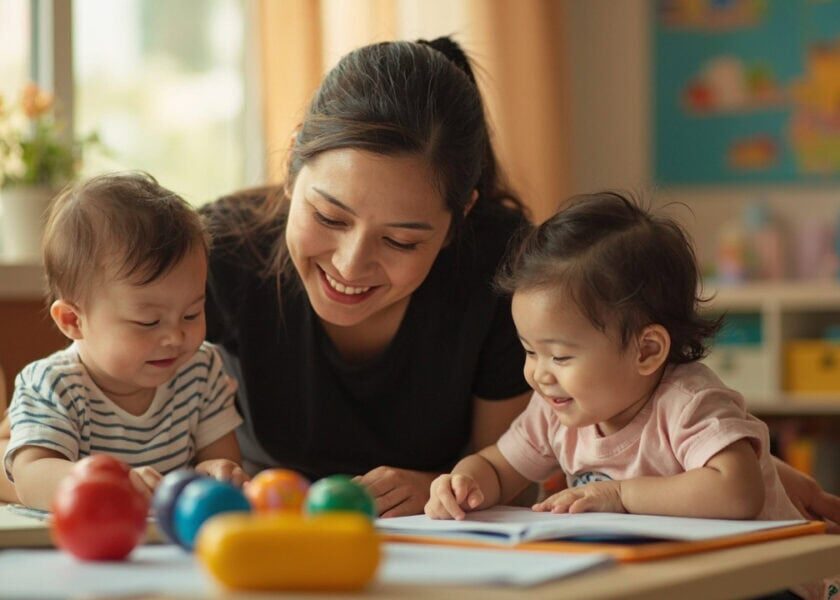
- Responsive interaction: The caregiver narrates your child’s actions, names her emotions, engages in back-and-forth conversation. Your child is talked with, not just talked at.
- Emotional attunement: When your child is frustrated, the caregiver stays with her. She does not just redirect—she acknowledges the feeling first.
- Respect for rhythms: Meals and naps happen in alignment with your child’s natural patterns, not on a rigid centre-wide schedule.
- Encouragement of exploration: Your child is given time and space to problem-solve, to try and fail, to persist.
- Warm, consistent presence: Your child has a primary caregiver who knows her, who she knows, and who shows up predictably day after day.
In a home-based setting with a ratio of up to one to three infants, this kind of responsiveness is structurally possible. In a large centre with twelve toddlers and two caregivers, it becomes mathematically difficult—even with the best intentions.
The EduNanny Difference: Trained Caregivers, Real Partnership
All of this observation, all of this skill, does not live in a vacuum. It lives in people. And it lives in a programme designed to elevate the entire profession of childminding in Singapore.
EduNanny operates within the ECDA Childminding Pilot—a deliberate, structured effort to professionalise home-based childminding in Singapore. This creates a pathway where trained caregivers are not just available, but systematically developed, supported, and held to standards that give parents real assurance.
Here is what that means for you as a parent:
- Trained caregivers: EduNanny’s caregivers are part of this pilot. They are trained in developmental observation and committed to practices that align with what developmental science tells us about quality infant and toddler care.
- Protected ratios: In home-based settings, EduNanny maintains a ratio of up to one to three infants—meaning your child receives responsive, individualised attention rather than being one of many.
- Affordable access: Fee structures within the pilot are designed to be accessible. Many families are surprised to learn that CDA and Baby Bonus funds can be used toward EduNanny care.
- Transparent partnership: Modern parents need more than a daily verbal assurance that things are fine. Depending on the arrangement, families may have access to communication platforms, regular updates, and in some settings, CCTV measures that give you direct visibility into your child’s day. This is not about surveillance. It is about partnership.
EduNanny also offers the Thomas AI Chatbot—a tool designed to help parents interpret what they are seeing, answer questions that arise at odd hours, and offer guidance grounded in the same trained observation framework that EduNanny’s caregivers use. It is not a replacement for human expertise. It is an extension of it—a tool that puts the language of observation into your hands.
What EduNanny offers is not just care, or qualified caregivers. It is a philosophy of partnership that says: We are teaching you to see what we see.
Addressing Your Real Concerns
“Am I overthinking this?”
No. The anxiety you feel at pickup, the uncertainty you carry, the longing to know—these are not weaknesses. They are evidence of how much you love your child. Every parent in Singapore carries them.
The difference is that anxiety without skill becomes helplessness. Skill without confidence becomes doubt. What EduNanny builds is a bridge between those two places—not by telling you to trust more, but by giving you the actual tools to observe, interpret, and understand what your child is showing you every single day.
“What if I misread the signals?”
You will not become an expert overnight, and you are not meant to replace trained caregivers. But even a basic understanding of these seven signals will sharpen your instincts and give you language for what you are already noticing. Think of it like learning a new language. You will not be fluent immediately. But even a few key phrases will change how you hear what your child is saying.
“How do I bring this up with my caregiver without seeming like I don’t trust them?”
Quality caregivers welcome engaged parents. The best childminding relationships are partnerships, not hierarchies. You might say something like: “I’ve been trying to notice how she seems after pickup—does that match what you’re seeing during the day?” This opens a dialogue rather than an interrogation. If your caregiver becomes defensive or dismissive when you ask questions, that itself is information.
Choosing Infant Care in Singapore: What Actually Matters
If you are currently researching options, here are the questions that matter most:
- Ask about ratios. How many children per caregiver? In infant care especially, lower ratios mean more responsive attention.
- Ask about consistency. Will your child have a primary caregiver, or will different staff rotate? Consistent relationships matter for attachment.
- Observe a pickup. If possible, watch how children behave in the last hour before parents arrive. Are they settled, engaged, regulated?
- Ask how they handle separation. A quality programme will have a thoughtful approach to morning goodbyes—not just distraction, but genuine support.
- Trust your gut after visits. Did the environment feel warm? Did the caregivers seem genuinely interested in your child as an individual? Did you feel seen as a parent?
- Use your CDA and Baby Bonus. These funds can be applied toward EduNanny care, making quality childminding more accessible than many families realise.
Your Child Is Telling You Everything
Here is what I have learned, watching thousands of children across years of this work: when parents develop this skill, something changes.
Not just their confidence in their childcare arrangement—though that changes too. Their relationship with their child deepens.
They begin to see their child not as a mysterious bundle of needs to be met, but as a full human being, already trying to communicate, already making meaning of her world, already telling you everything if you know how to listen.
This is the invitation. Not to hover, not to anxiously dissect every moment, but to show up with open eyes. To notice. To wonder. To ask better questions—not just at pickup, but in the quiet moments at home, when your child is playing, eating, sleeping, being herself.
The first thousand days of a child’s life are not just a developmental window. They are a relationship window. And the quality of that relationship depends, in part, on how well you can read the person you are building it with.
Singapore parents deserve more than fine. They deserve excellent. And they deserve to know—truly know—what excellent looks like, not in an inspection report, not in a centre’s marketing materials, but in the real, observable, everyday signals their child brings home.
The gap between wondering and knowing is not as wide as you think. It is built from seven signals, observed with care, over days and weeks. It is built from understanding why your child speaks in behavior, and learning to listen.
It is built from partnership with caregivers who see your child as fully as you do.
EduNanny Singapore exists to walk this path with you—not by promising certainty, but by giving you the tools to find your own confidence.
Your child is telling you everything. I hope you will let us teach you how to listen.
EduNanny Singapore offers trained, supported caregivers within the ECDA Childminding Pilot. Speak with our team to learn how home-based childminding with individualised ratios can give your child the responsive care she deserves—and give you the peace of mind you need.
Find out more about who we are or return to EduNanny Singapore.