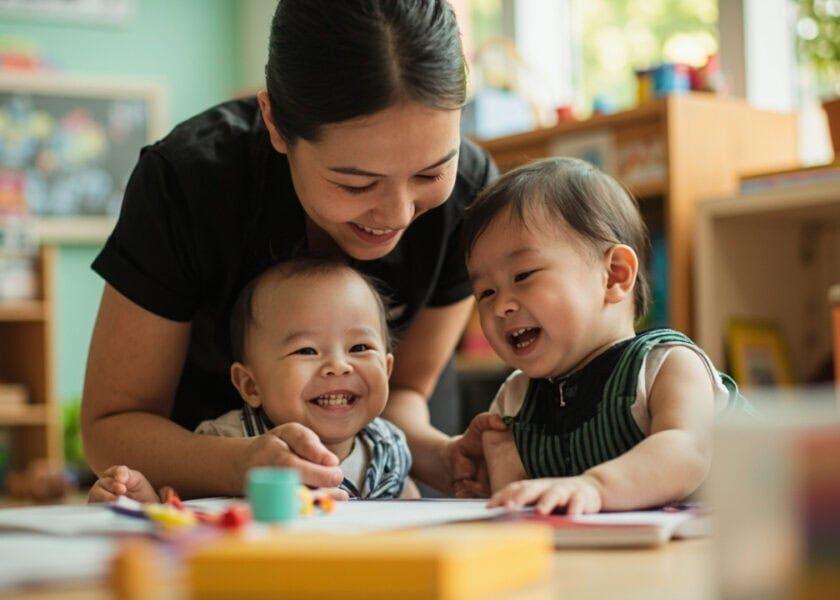
Seven Quiet Signals of Quality Childcare for Singapore Families
Reading the Rhythm: How Quality Lives in a Childcare Day
Before we walk through the full day together, here are the key signals that reveal quality childcare:
- Arrival: Children are welcomed with warmth, not rushed through the door
- Free Play: Children choose their activities and receive just enough support to extend learning
- Mealtimes: Children eat together, serve themselves, and practice independence
- Rest: Transitions are gentle, and sleep is treated as essential to development
- Pickup: You receive meaningful updates, not just “she was fine”
- Communication: You feel like a partner, not a passive observer
If these elements feel familiar when you visit a setting, you are likely looking at quality. If they are missing, that is useful information too.
What Arrival Reveals About Everything
The door opens. There are toys and soft voices and the particular smell of a room where children have been. Your child, who may have been drowsy in the car, suddenly stiffens. This is a new place. These are new people. The backpack on the hooks looks the same as twenty other backpacks, and none of them belongs to anyone here.
In a setting without intentional structure, this moment passes quickly—children are greeted, redirected, settled as best they can. But in a setting where quality is deliberate, you will notice something different.
The caregiver does not immediately ask your child to put away the figurine she brought from home. She does not rush toward the hand sanitizer station. She kneels down. She speaks in a voice that is calm and warm and unhurried. She acknowledges your daughter as a person who has just arrived somewhere new.
“You came a long way in the car, didn’t you? I’m glad you’re here. Your friend Maya is playing with the blocks. Would you like to see?”
What seems like simple kindness is actually something more precise. This caregiver is bridging the gap between your daughter’s internal world and this external environment. She is saying, in a dozen different ways: You are seen. You belong here. You are not alone.
For Parents of Infants: The Hardest Goodbye
If your child is younger—eight months, perhaps nine—she cannot yet say “I don’t want you to leave.” She can only cry. And you, at the door, have to make a choice that no one prepared you for.
Quality looks like a caregiver who does not rush you out. Who gives you space to say goodbye in whatever way you need to. Who does not shame you for your child’s tears, or yours. Who takes your child into her arms and speaks to her with the same tenderness you would use.
A quality caregiver has been trained to understand that this small person’s nervous system is flooded, and that what she needs is not distraction but attunement. This is not a soft skill. It is a discipline.
How a childcare program handles arrival reveals how it handles everything else. Because arrival is hard. It requires the most from both children and caregivers. And a program that does it well is a program that has thought deeply about what children need when they cross a threshold.
The Learning Hours: Play, Meals, Rest, and the Rhythms Between
By mid-morning, the room is alive with activity. Children are engaged. There is movement and sound and the particular chaos that is the sound of learning. And if you were watching, you would notice something that might surprise you: the children are not all doing the same thing.
The Dance of Free Play and Guided Activity
In quality childcare, there is free play and there is guided activity, and the rhythm between them matters enormously.
Free play is when children choose. They build with blocks, negotiate roles in pretend games, experiment with how things fit together and come apart. They concentrate with an intensity that would impress any university professor. They fail and try again without anyone telling them to.
Guided activity is when the educator introduces something—a new song, a story that stretches vocabulary, a sensory experience that teaches concepts words cannot yet convey. The educator observes, waits, and enters the child’s play at exactly the moment when her presence will extend the learning rather than interrupt it.
You can tell quality by watching what happens when a child struggles. Does the caregiver step in immediately, removing the obstacle and the learning? Or does she offer just enough support—a word, a question, a slight adjustment—that allows the child to solve the problem herself?
The second response takes more patience and more skill. It is also the response that builds a child’s sense of capability.
When children have both kinds of play in their day, they are learning to be independent and to be supported. They are learning that their choices matter and that the adults around them have something valuable to offer.
Play Is Not What Children Do When They Are Not Learning
When your three-year-old builds a tower of blocks higher than her head and then deliberately knocks it down and builds it again, she is learning about gravity, cause and effect, persistence, and the nature of experimentation.
When she negotiates with another child over who gets the red truck, she is learning the hardest skills of human life—how to want something, how to ask for it, how to accept not getting it, how to try again.
When she plays pretend, she is building the capacity for abstract thought, for empathy, and for understanding that one thing can stand for another.
Play is not what children do when they are not learning. Play is how they learn most profoundly. The children who have the most unstructured play time in the early years do not lag behind in school. They lead.
Mealtimes: Where Values Become Visible
Move forward in the day and you will find mealtimes—and this is when a childcare program’s values become visible in ways that facility tours never reveal.
How do the children sit? Together, at a table, or scattered and fed individually? Are they encouraged to serve themselves, to make choices about how much to take, to sit with others and share conversation—even if their conversation is mostly “my favorite color is purple” and “I have a cat at home”?
Mealtimes are curriculum. They teach children about nourishment and autonomy. They teach social skills, language, and the pleasure of eating together. In a quality setting, children are not merely fed. They are fed in a way that respects their dignity and growing independence.
Rest: Essential to Learning
In Singapore especially, many parents worry about rest. When can a child nap? For how long? What if they don’t sleep?
Quality childcare has thought about this carefully. The rhythm of the day is designed so that children are fed before they rest, so that their bodies are not working hard on digestion during sleep. The room is dimmed. There is calm.
And when children wake, the transition is gentle—because waking is vulnerable, and a child who wakes to a jarring noise or an abrupt demand is a child who begins the afternoon already dysregulated.
You can tell quality in the wake-up. Whether caregivers sit nearby before calling children, whether the transition to the next activity is gradual. These small moments are where attunement lives.
Rest is not a break from learning. Rest is part of learning. Children’s brains consolidate new information during sleep. Their bodies grow. Their emotional regulation resets.
Pickup: Reading What Your Child Tells You
And then there is pickup. This is the moment you have been waiting for all day. You walk through the door and you see your child. You look at her face. You read her body language. And something inside you assesses, instantly, what kind of day she had.
Your child runs to you, or does not. She is calm, or she is melting down. She has things to tell you, or she is quiet. Each of these responses tells you something.
The Truth About Pickup Behavior
A child’s behavior at pickup is not a simple verdict on the day.
A child who cries at pickup may be showing you that she had a wonderful day and does not want it to end. A child who clings to you may be processing a lot of feelings and needs your comfort. A child who runs to the caregiver to show her a drawing may be showing you that this place feels like home.
The rhythms matter more than any single moment.
When you begin to understand the rhythm of your child’s childcare day, something shifts. You stop looking for proof and start looking for patterns. You begin to notice that on days when your child sleeps well at childcare, she sleeps better at home. That when the caregiver reports your child ate well, she is in a better mood in the evening. That the transition to childcare, which was rocky at first, is now something your child looks forward to.
This pattern recognition is powerful. It is how you build trust—not blind trust, but earned trust, the kind that comes from understanding.
What Quality Childminding Looks Like in Singapore
Let me be concrete about what distinguishes quality childcare from adequate childcare in Singapore’s landscape.
The Ratio That Changes Everything
For infant care specifically, the caregiver-to-child ratio is perhaps the most important structural feature. In quality settings, this ratio is one to three—or better. This means your child is not one of fifteen. She is one of three. She can be known. She can be responded to. She can be seen.
Communication Systems That Build Trust
Quality programs invest in communication—not just for marketing, but because transparency builds trust. This might include daily updates about what your child ate, how she slept, what activities engaged her. Open channels for questions. In many settings, visibility measures like CCTV allow parents to see what is happening in real time.
Some parents feel uncertain about these systems, like they suggest distrust. Consider this differently: these systems are not there because parents do not trust caregivers. They are there because trust is built through visibility. When you can see what your child is doing, you can stop imagining the worst.
Consistency Across Settings
For families navigating Singapore’s childcare options, whether home-based or centre-based, the rhythm and standards should travel with you. Quality is not location-dependent. It is about intentional design and trained caregivers who understand child development.
EduNanny’s Approach Within the ECDA Childminding Pilot
EduNanny by BUTLER operates within the ECDA Childminding Pilot, which means it is part of a deliberate national effort to expand quality childcare options in Singapore. This matters because it means the program is held to standards. Caregivers receive training. There is oversight, structure, and a commitment to quality that goes beyond good intentions.
For parents, this translates into practical relief. The pilot fee structures are designed to be affordable. CDA and Baby Bonus funds can be used, which means childcare costs do not have to feel like a crisis.
EduNanny works across both home-based and centre-based pathways because they understand that Singapore families are not all the same. Some families need care in their own homes, where the environment is familiar and the schedule is flexible. Others want the social richness of a centre, where children learn alongside peers. Both are valid. Both can be excellent.
EduNanny’s caregivers in the ECDA Childminding Pilot are trained in responsive care. Not merely to keep infants safe, but to meet them in their distress with patience and warmth. This is not a soft skill. It is a discipline.
Addressing the Concerns Singapore Parents Actually Have
“Will my child feel abandoned?”
Your child’s attachment security does not depend on constant parental presence. It depends on whether the adults in her life—across home and care—are consistently warm, responsive, and attuned. A quality caregiver does not replace you. She extends the circle of trust your child can draw upon.
“How do I know what’s really happening?”
You learn to read the rhythm. When your child says goodbye easily in the morning and returns to you calm in the evening, that is not luck. That is a day designed with intention. When your child speaks about her caregiver with warmth, when she mentions activities that clearly delighted her, when she shows you the songs she has learned or the friends she has made—this is not just charming. This is data.
“What if something goes wrong?”
Quality programs have protocols, training, and oversight. They are not places where anything can happen. Ask about training, ask about ratios, ask about communication. The answers you receive will tell you whether this is a program that takes responsibility seriously.
“Am I a bad parent for doing this?”
No. You are providing for your family. You are trusting others with a part of your child’s upbringing—which is not the same as outsourcing your love. The question is not whether someone else will care for your child. The question is whether the hours you are not there are hours your child is thriving. And that is a question you can learn to answer.
Finding the Right Fit: Practical Guidance for Your Search
Here is what to look for, what to ask, and what to trust when evaluating childcare options.
Questions to Ask on a Visit
- How do you handle the arrival and separation transition?
- What does a typical day look like for a child my child’s age?
- How much time is free play versus guided activity?
- What is the caregiver-to-child ratio?
- How do you handle a child who is distressed?
- What does rest time look like, and what if my child does not sleep?
- How will I know what my child did during the day?
- What training have your caregivers received?
- How do you handle feeding and mealtimes?
What to Watch For
- Do caregivers kneel to children’s level when speaking?
- Do children seem engaged, or listless and directed?
- Is there a predictable rhythm to the day?
- Are transitions gentle or abrupt?
- Do caregivers respond to distress with patience or impatience?
- Do children have choices, or is everything scheduled and commanded?
What to Trust Over Time
- Your child’s behavior at pickup—not one day, but the pattern over weeks
- Whether your child mentions the caregiver or activities with warmth
- The quality of communication you receive
- Whether the caregiver remembers details about your child’s preferences and needs
- Your own instinct, informed by what you now know to look for
You Are Not Handing Your Child to a Stranger
You are entering into a relationship with a program that has designed its days around what children need to grow. You are becoming, over time, fluent in reading your child’s experience. You are learning to trust, not blindly, but wisely.
And your child, in the meantime, is learning that the world can be a safe place even when you are not there. That there are people who will welcome her, teach her, rest with her, and play with her. That each day has a rhythm she can predict, and within that rhythm, she is free to explore.
This is not small. This is everything.
Childminding is skilled, intentional, necessary work. And for the families in Singapore who rely on it, it is a partnership.
You love your child. You want to be present for every important moment. And you cannot be, because life requires you to work, to provide, to build a future for your family. This is not a failure. This is most parents in Singapore, and indeed, most parents everywhere.
The question is not whether you can be there for every hour. The question is whether the hours you are not there are hours your child is thriving. You can know. You can learn to read the rhythm of your child’s day. You can ask the right questions. You can notice the patterns. You can trust what you see, because you now understand what to look for.
Your child deserves a day full of small moments that tell her: You are seen. You belong here. You are not alone.
And when you find a place where children are welcomed, where play is respected as the work of early childhood, where caregivers are trained in attunement and respond to your child’s distress with patience—you will recognize it. Because you have learned the rhythm.
If you are ready to explore what quality childminding looks like for your family, EduNanny by BUTLER welcomes the conversation. Visit the program, ask your questions, and trust what you see. You now know what to look for.
EduNanny is part of the ECDA Childminding Pilot, offering trained caregivers, transparent communication, and a rhythm designed around your child’s flourishing. Learn more about our approach.