Restored Parents, Present Children: How Singapore Families Choose Better Childcare
The Moment Every Parent Knows
There’s a moment most parents know, even if they’ve never spoken it aloud. It’s the evening when you’ve been with your child all day—feeding, soothing, chasing, cleaning up the same mess four times—and by the time the sun goes down, you realize you’ve been present in body but absent in everything else.
You’re there. But you’re not really there.
Your child reaches for you and you feel the exhaustion in your chest before you feel the joy in your arms. The love is still there, fierce and unwavering. But the capacity to express it? That has quietly emptied out over hours of logistics, interruptions, and the relentless weight of a day that began before dawn.
This is not a failure of love. This is what happens when love runs up against the limits of a single human being trying to do everything, all the time, without running dry.
And it is precisely here, in this quiet exhaustion, that most conversations about childcare begin.
The Fear Beneath the Decision
Childcare conversations often begin in guilt. They begin with parents wondering whether choosing help means choosing away from their child. Whether the hours spent apart will calcify into a distance that can never be closed. Whether a child in someone else’s arms will somehow learn to love that person more than the parent standing at the pickup gate.
Here is what needs to be said clearly: that fear is not a sign that you are doing something wrong. That fear is a sign that you care so deeply about your child that the mere thought of anyone else meeting their needs feels like a threat.
That fear is, at its root, a declaration of love.
And love like that—love so fierce it makes you doubt your own choices—deserves to be met with honesty, not empty reassurance.
Proximity Is Not the Same as Connection
Being in the same room as your child is not the same as being with your child.
When a parent is running on empty, when the reserves of patience and attention have been spent on logistics and lists and the accumulated weight of a day, something changes in the quality of attention they can offer. The child feels it before the parent does.
A child knows when the arms holding them are tired. A child reads the tone in a voice that is trying hard to sound patient. A child adjusts to the emotional weather of the room.
So, paradoxically, the parent who is there all day—who has given everything to staying present—sometimes delivers less presence than the parent who has been restored by time away.
This is not about blame. It is about understanding what presence actually requires.
Why Your Reserves Matter
Presence is not a posture you can maintain through willpower alone. Presence is a state that depends on the reserves behind it—the reserves of rest, of perspective, of emotional space, of being known as a person beyond the role of caretaker.
When those reserves are full, a parent can sit on the floor and truly see the tower their child has built. They notice the deliberate choice of blue blocks. They ask about the door at the bottom. They see the child’s pride.
When those reserves are empty, the tower is just blocks that need to be picked up before dinner.
Children are not just learning facts in these early years. They are learning what it feels like to be seen. They are building their internal model of relationship, of attention, of whether the people who love them can actually meet them.
When a parent returns from time restored—time to breathe, to eat a meal without interruption, to have a real conversation with another adult who reminds them who they are outside of parenthood—they return differently. They return with more patience. More attention. More emotional availability that makes a child feel truly seen.
The Biology Behind It
Parents who are exhausted, stressed, or emotionally depleted are less able to engage in the sensitive, responsive interactions that build secure attachment. The brain systems that support warmth and responsiveness require rest to function well.
This is not weakness. This is biology.
The solution to a biological limitation is not to push through it until you break. The solution is to build the infrastructure that supports parents in being sustainable—day after day, year after year, through the long arc of raising a child.
What Singapore Parents Actually Face
Singapore families face pressures that are unique to this city. Longer working hours. Multi-generational expectations. The cost of living. The relentless logistics of dense urban life.
Parents here are not simply caring for children. They are navigating a particular version of modern life that demands much and often offers little in the way of village support. The extended family that once surrounded new parents has often scattered across neighborhoods, across generations, across the pressure of careers and mortgages.
What many families have lost is the village. And into that gap, parents are expected to be everything to their children—comforter, educator, playmate, nutritionist, emotional regulator, schedule manager—without the village that once helped carry the weight.
Here is a different conviction: what Singapore parents need is not more sacrifice. What Singapore parents need is support that honors the depth of their love and gives them the room to express that love at its best.
What Quality Childminding Looks Like
Not all childcare arrangements are equal. Here is what good childminding actually looks like in practice:
- Ratios that allow genuine attention. One caregiver to a small number of infants, so that each child is truly seen, not just supervised.
- Consistency and warmth. A child learning that the world is reliable, that the people in it can be trusted, that care is something given by competent, valued adults who chose this work because they believe in it.
- Communication and transparency. Parents knowing what is happening in the hours apart, because that knowing is part of what allows restoration to work.
- Training and accountability. Caregivers who are vetted, supported, and treated as professionals—not interchangeable hired hands, but people who are part of your child’s world.
- Environments designed for children. Spaces that feel like home rather than institutions—warm, safe, appropriate for development.
The EduNanny Difference
EduNanny exists as infrastructure for parents. Not a replacement. Not a compromise. A support system that allows parents to show up as their best selves, day after day.
EduNanny by BUTLER is part of the ECDA Childminding Pilot—a framework designed to set standards for quality and safety in home-based and community childminding across Singapore. This is not a casual arrangement. It is a recognized pathway, with structure, with accountability, with the backing of a system that takes the trust parents place in caregivers seriously.
In practice, this means:
- Ratios that allow genuine attention. One to three infants at most, in care settings designed to feel like home.
- Trained, vetted caregivers supported within a system that values their role as part of your child’s world.
- Communication and transparency. Parents receive structured updates about their child’s day. Where deployed, CCTV measures provide additional visibility—not to surveil, but to trust.
- Affordability by design. Pilot fee structures are designed to make quality care accessible. Your Child Development Account can be used. Your Baby Bonus can be applied. These are not afterthoughts—they are design choices that reflect a belief that every family deserves this kind of support.
- Care blocks Monday through Friday, because life in Singapore runs Monday through Friday, and parents need reliable, predictable support that integrates into real lives.
- Multiple pathways. Home-based care, where your child grows in familiar surroundings with dedicated attention. Community and centre-based options where your child builds early social experience in structured, safe environments. Not one-size-fits-all solutions—a range of pathways designed to meet families where they are.
There is also the Thomas AI Chatbot—a tool designed to help with the constant low-level cognitive load that fills a parent’s mind. Schedules, questions, updates, the logistics that drain attention even when you are not actively thinking about them. When some of that administrative weight is lifted, parents have more mental space for what matters: the quality of attention they bring home.
A Note on Dignity
Beyond structures and systems, EduNanny is built on a conviction that caregivers—the childminders, the trained professionals who stand in the gap for parents—deserve dignity. They are not background figures. They are not interchangeable. They are the people who spend hours with your child when you cannot be there, who notice the new word, who witness the first step, who hold your infant when they are fussy at the end of a long day.
Their role is not lesser than yours. It is different, and it matters.
When EduNanny invests in training, in support, in a system that treats caregivers as professionals rather than hired hands, it is an acknowledgment that your child’s world is shaped by everyone who holds them—and that those hands deserve to be held with the same care they offer.
Common Questions, Answered Honestly
Will my child bond more with the caregiver than with me?
Children are capable of multiple secure attachments. What matters is consistency, warmth, and the quality of responsiveness. A well-trained, consistently present caregiver does not replace you—they support the attachment you have by helping you return to your child in a state where you can be fully present.
Does choosing childcare mean I am stepping back from my parenting?
The opposite. Seeking support is stepping forward into your full capacity as a parent—with patience restored, with attention replenished, with the emotional resources to meet your child exactly where they are. That is not a compromise. That is restoration.
Is this really necessary? Can’t I just push through?
Exhaustion is not a badge of honor. The brain systems that support warm, responsive parenting require rest to function. Pushing through until you break serves no one—not you, and not your child. Building sustainable infrastructure into your parenting is not a luxury. It is wisdom.
The Moment You’re Waiting For
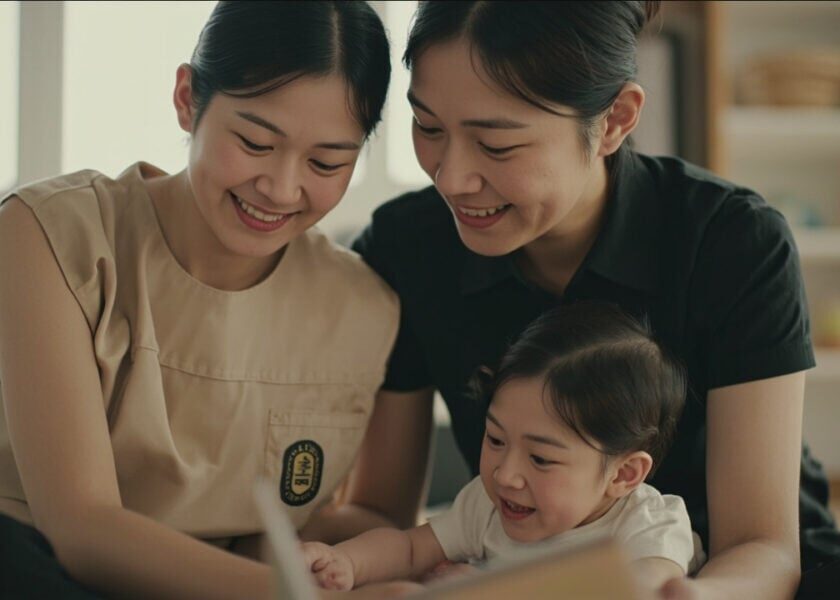
Here is the image that captures what we are really talking about.
Imagine a parent at the end of a care day, walking through the door. The child runs. The parent kneels. And there is a moment—brief, ordinary, unhurried—where the parent’s face lights up with genuine, unforced joy.
Where the hug is not a relief that the day is over, but a celebration that they are together.
Where the parent has the attention to notice the new thing their child wants to show them, and the patience to sit and look, and the warmth to laugh at the small joke that only makes sense to a two-year-old.
That moment is not a luxury. That moment is what parenting is for.
And it is available to more parents than are currently experiencing it—not because they love their children less, but because they have not yet found the infrastructure that allows them to show up for that moment the way they want to.
If you are a parent in Singapore, researching infant care, weighing your options, feeling the weight of the decision—this is an invitation to consider what support would actually give you back.
Not just hours. Not just logistics. The patience to listen. The attention to notice. The emotional availability to be truly present.
EduNanny is one pathway. There are others. What matters is finding the infrastructure that lets you return to your child more fully—more patiently, more attentively, with greater presence—day after day.
The decision to seek support is not a step back from your child. It is a step forward into your full capacity as a parent.
That is not compromise. That is restoration.
And it is available to you.
EduNanny is a Singapore childcare and childminding service built on warmth, trust, and developmental care. Learn more about our approach or connect with our team to explore what support could look like for your family.