Reading the Evidence: What Your Child’s Homecoming Tells You
The Morning Handover: A Parent’s Quietest Dilemma
There is a moment, every morning, that deserves your attention. Not the alarm you hit before sunrise, not the commute you have learned to time like a surgeon, not even the bag you pack the night before—checking and double-checking, because leaving anything behind feels like leaving part of yourself behind too.
I am talking about the moment after that. The moment when you walk through a door and hand your child to someone else. The moment when you have to trust—really trust—that the hours between now and when you return are hours of growth. Not just supervision. Not just keeping safe, though that matters. Hours that are actively, quietly shaping who your child is becoming.
That moment happens in Singapore every single morning. Thousands of times, in homes and centres and community spaces across this island. And yet, if we are honest with ourselves, it is one of the most emotionally complex moments any parent can have.
You have made a thoughtful choice. You believe in what you have arranged for your child. And still, something in you wonders: what happens in the hours I am not there?
That question is not a failure of confidence. It is the mark of a parent who cares deeply about what their child’s world is actually like. And that question deserves a better answer than “trust us.” It deserves an answer that helps you understand what you are actually trusting when you trust quality childcare.
Beyond Service: Reframing What Childcare Actually Is
We tend to speak about childcare as a service. We choose a service, we evaluate a service, we pay for a service. In one sense, that is accurate. But here is the problem with that language: it puts childcare in the same category as a utility, a convenience, a logistical solution to the problem of work and schedules. It frames childcare as something you use rather than somewhere your child goes.
That distinction matters more than we might think. If childcare is just a service, then it feels separate from your child’s real life. The hours spent there feel like hours subtracted from the life you are trying to give them. And that is what makes those morning handovers so heavy.
But quality childcare, when it is truly quality, is not a service you use. It is a world your child lives in. It is the third environment of their daily life, alongside home and eventually school.
What “Environment” Means for a Young Child
Think about what “environment” means for a child in those formative early years. Home is an environment. It has its own rhythms, its own relationships, its own textures of feeling and learning. Your child knows the particular way light falls in your living room in the morning. They know the sound of your voice when you are calm, and the different sound when you are hurried. They know which chair is theirs at the table, which book you read before sleep, the exact order of your evening routine.
Home is not just a place. It is a world that has been built around them, and they have learned to read it fluently.
School, for children who are old enough, becomes another world. It has its own architecture of meaning. New relationships, new expectations, a different rhythm of the day, different kinds of learning. Children learn to carry themselves differently in that space. They are not the same child at school as they are at home, and that is not contradiction—it is adaptation. It is the normal and healthy work of becoming a person who can belong in multiple worlds.
Quality childcare is that kind of environment. Not a waiting room between home and school. Not a gap to be filled. A world with its own texture, its own relationships, its own learning architecture. A world where your child is not merely looked after, but where they are growing.
When we understand childcare this way, the morning handover changes in meaning. You are not outsourcing care. You are expanding your child’s world.
The Developmental Reality: What the Third Environment Offers
In the first years of life, children are building the foundations of everything. Not just vocabulary and motor skills and cognitive abilities—though all of that matters—but the foundations of trust, of curiosity, of how they understand themselves in relation to other people and to learning itself.
The brain is extraordinarily receptive during this period. Every experience is wiring something. Every interaction is teaching your child something about what the world is like and where they fit in it.
Home does extraordinary work in these early years. The bond between a child and their primary caregivers is the template for all future relationships. The security of that attachment, the language spoken in that home, the values lived out in daily life—these are not replaceable, and no childcare environment should try to replace them.
But children are not limited to one environment’s worth of development. They are not a cup that fills up and then stops. They are hungry for more worlds, more relationships, more textures of experience.
The Unique Gifts of Quality Group Care
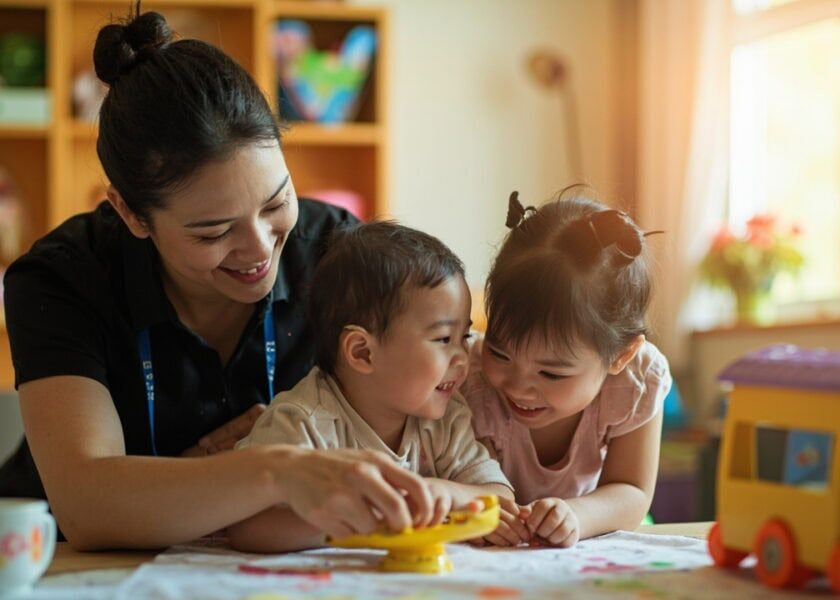
In quality childcare, your child encounters something they cannot get at home, no matter how rich that home is: peers. Other children who are also learning to share, to negotiate, to read social cues, to navigate the complexity of being together. This is vital developmental work that happens differently in group settings.
They encounter a caregiver who is not their parent, which is its own essential developmental experience. Not a replacement figure, but a secondary attachment figure in a healthy, supported relationship. Research in child development has long shown that children can form multiple secure attachments when those relationships are warm, consistent, and responsive.
They encounter a different rhythm of the day—structured play, group activities, quiet moments, transitions—each of which teaches them something about how to move through the world with confidence.
And critically, they encounter learning that is designed with intention. In the best childcare environments, play is not random. The materials available, the way activities are set up, the way the day is paced—these are choices made by people who understand child development, who have thought carefully about what this age needs and how children at this stage actually learn.
Home and Care Working Together
Research in child development has long shown that when children have quality experiences in multiple environments—when those environments are consistent in values, warm in relationships, and thoughtfully designed—their development is richer, not fractured. The skills and security built at home are not weakened by quality time elsewhere. They are extended, practiced, and given new opportunities to grow.
This is not about replacing what happens at home. It is about complement and supplement. A second environment that works in partnership with the first, expanding what your child is capable of experiencing and learning.
Reading Your Child’s Homecoming: The Evidence That Travels Home
This all sounds good in theory. But how do you actually know? How do you know that what you have arranged for your child is this kind of environment and not just a place where they are kept occupied and safe until you return?
Here is what I have learned from working with families: the evidence is not only in the childcare environment itself. It is also in your child. You can read your child’s homecoming as evidence of what happened in that third environment.
Signs of a Rich Day in Quality Care
You may notice a particular kind of ease. Not exhaustion—though young children do tire—but a kind of settledness. They have been in an environment where their needs were met with responsiveness, where they felt known and valued, where the rhythms of the day were predictable and warm.
That experience does not evaporate when they walk through your door. It stays with them. It shows up in the quality of their play, in the way they engage with you, in the ease with which they can transition into the home environment.
You may notice curiosity. Children who have spent the day in a rich, stimulating environment often come home with language they did not have that morning. A new word. A reference to something they did or saw or thought about. The learning that happened in that third environment did not stay there. It came home with them. It is part of their growing understanding of the world, and they want to share it with you.
You may notice social ease. The child who has spent the day navigating relationships with peers and caregivers in a supportive setting has been practicing skills that travel with them. The ability to share, to negotiate, to read emotional cues—these are portable. A child who is growing in social confidence at childcare will often show that growth at home as well.
You may notice something subtler: growing security. Not that they need you less—they need you just as much, and that bond is irreplaceable—but that they seem able to trust the world more broadly. That they can be apart from you and still feel held. That the experience of being well-cared-for by someone other than you has taught them something true about the world: that there are good people out there, that they are lovable, that they can venture out and come back.
The Warning Signs That Matter
Conversely, if the childcare environment is not meeting your child’s needs—if it is understaffed, if the relationships are cold or inconsistent, if the day lacks warmth and intention—you will often see signs at home. Your child may be more clingy than usual, more easily distressed, less curious, less engaged in play. They may show signs of fatigue that goes beyond physical tiredness. They may not have new language, new stories, new evidence of a day that challenged and grew them.
The homecoming tells a story. And as a parent, you are already fluent in your child’s language. You already know how to read them. The question is simply whether you trust that reading—and I think you should.
Speaking to the Anxiety You May Be Feeling
I want to pause here and speak directly to the anxiety that may be sitting in some of you right now.
If you have doubts about your childcare arrangement, if something feels off, if your child comes home changed in ways that worry you—that feeling is not irrational. It is data. Trust it. The fact that you notice, that it registers with you, that you feel something is wrong—this is not neurosis. This is the wisdom of a parent who is paying attention.
But if you have made a thoughtful choice, if you have done the work of evaluating and re-evaluating, if your child shows signs of thriving—then the anxiety you still sometimes feel is not telling you something true. It is telling you that you love your child deeply, and that love makes the invisible hours feel dangerous.
Here is an important distinction: the invisible hours are not inherently dangerous. They are simply invisible. And understanding that difference matters enormously.
You are not failing your child by not being present for every moment. You are not failing by needing to work, or by needing space, or by wanting to be a whole person yourself. You are doing what millions of parents have always done: you are entrusting your child to other good people, in environments designed to support them, while you do the work of building the life you want for your family.
That is not a compromise. That is a choice made in love, and it deserves to be spoken of without shame.
What Quality Looks Like: Structure, Support, and a Pathway Worth Considering
Not all childcare is created equal, and this matters enormously for your child’s development. There is a meaningful difference between an environment that merely keeps children safe and one that actively nurtures their growth. Understanding what that difference looks like can help you make choices with clarity rather than guesswork.
The Adult-to-Child Ratio
One of the most significant factors in quality care is the ratio of caregivers to children. In smaller, home-based settings, this ratio can be meaningfully lower than in larger centres. When caregivers have the capacity to truly see each child—to notice their rhythms, their preferences, their emerging interests, the subtle shifts in their mood and development—something different becomes possible.
This is not about surveillance or ticking boxes. It is about relationship. And relationship, in the early years, is the medium through which everything else happens.
The Caregiver as a Person
When we talk about quality childcare, we are ultimately talking about the quality of the people who are present in that third environment. The training matters. The support matters. The structures matter. But what matters most is whether these are people who genuinely love children, who find joy in watching them grow, who bring warmth and intention to every interaction.
These caregivers are not substitutes for parents. They are companions in your child’s development. They are part of the village that humans have always needed to raise their young.
EduNanny Singapore: A Pathway Worth Considering
In Singapore, families are increasingly recognizing that there is not just one approved way to provide quality care. Different children thrive in different settings, and thoughtful options matter.
EduNanny, a service by BUTLER, is part of something significant: the ECDA Childminding Pilot. This is a government-supported initiative that recognizes home-based and community-based childcare as a legitimate, high-quality pathway for families. It acknowledges that children can thrive in smaller, more intimate settings—not just in large centres, but in carefully supported home environments where the ratio of caregivers to children allows for deeper relationship and more individualised attention.
EduNanny’s approach reflects a philosophy that aligns with what developmental research tells us about how young children learn and grow:
- Thoughtful ratios that allow caregivers to truly know each child as an individual
- Trained caregivers who are supported through ongoing guidance and clear frameworks for developmentally sound care
- Predictable care blocks (Monday to Friday) that give young children the consistency they thrive on
- Transparent communication options that help parents feel connected to their child’s day without creating dependency
- Accessibility support including use of the Child Development Account and Baby Bonus where applicable
For families who want it, there are measures in place that help parents feel connected to their child’s day. When you know, even in small ways, what your child’s day was like—when you receive a note, a photo, a piece of news about something they did or learned or enjoyed—you are not intrusive or anxious. You are involved. And involved parents are one of the best predictors of positive child outcomes.
This is the closed loop that matters. Home and quality childcare, talking to each other. Your values and theirs, aligned. Your child’s experience in one environment informing your relationship in another. The three environments of childhood—home, childcare, school—becoming not three separate worlds but one coherent system, one integrated developmental world, built by people who all have your child’s best interests at heart.
Questions to Ask When Evaluating Childcare in Singapore
If you are in the process of researching options for your child, here are questions grounded in what actually matters for your child’s development:
- How many children does each caregiver look after? Smaller ratios mean more individualised attention and deeper relationships.
- What does a typical day look like? Quality environments have intentional rhythms—not just fill-in time, but thoughtfully structured play, rest, and learning moments.
- How do caregivers respond to children’s emotional needs? Listen for answers that emphasize relationship, patience, and attunement rather than rule-following or rigid schedules.
- What training and ongoing support do caregivers receive? Quality matters in who is doing the caring, and ongoing development signals commitment.
- How does the environment communicate with families? Transparency and partnership with parents indicates a mature, confident approach to care.
- What do you observe when you visit? Watch how children move, how caregivers interact, whether the space feels warm and alive.
- What does your child tell you when they come home? Their homecoming is diagnostic. Trust what you observe.
Carrying That Thread Through Your Day
Every morning, in Singapore, parents hand their children to someone else and step into their own day. They go to work, to meetings, to the thousand responsibilities that make up adult life. And for most of that day, they are not thinking about their child in explicit, conscious ways. They are busy. They are functional. They are doing what needs to be done.
But somewhere underneath all of that, there is often a quiet current of wondering. A thread of love that cannot quite rest. And that thread says: I hope they are okay. I hope they are growing. I hope whoever is with them understands how extraordinary they are, how worthy of care, how much potential is packed into that small body.
Here is what I want you to know, as you carry that thread through your day.
Your hope is not wishful thinking. The hours your child spends in quality childcare are not lost hours. They are hours of genuine growth, genuine relationship, genuine learning. Hours in which your child is building skills and capacities and a sense of self that will serve them for the rest of their life. Hours that are worthy of your trust, not because you have no choice but to trust, but because you have made a thoughtful, informed choice—and the evidence of that choice is written in your child’s thriving.
You are not choosing between being a present parent and having a career, or a life, or a self. You are giving your child the gift of multiple worlds. And the security you build at home is not fragile. It is strong enough to travel. It goes with your child into that third environment, and it comes home with them, and it is the foundation on which everything else is built.
EduNanny exists to be worthy of that trust. Not perfect—because no one who promises you perfect is being honest—but present, thoughtful, trained, warm, and committed to the same thing you are committed to: your child’s wellbeing and development.
We are here for the hours that complete your child’s day. For the caregivers who become trusted figures in your child’s world. For the families across Singapore who are doing the brave, ordinary, extraordinary work of raising the next generation.
The next time you walk through that door in the morning and hand your child to someone else, I hope you can do so with something like peace. Not because the worry disappears entirely—it may not, and that is human—but because you know what is actually happening in those hours. And what is happening is good.
Your child is in a world designed to help them grow. And you made that world possible by the choice you made in love.
If this article has resonated with you and you would like to learn more about home-based and community-based childcare options in Singapore, EduNanny welcomes the opportunity to start a conversation. No pressure, no obligation—just an open dialogue about what your family needs and how we might support your child’s development.
Because the third environment your child deserves is possible. And you are already doing the most important thing: caring enough to ask the right questions.