Raising Siblings Together: The Architecture of Family-First Childcare
When the Question Changes: Understanding Sibling Care for Singapore Families
There is a moment every second-time parent recognizes. It arrives quietly, often in the weeks after the second child comes home, when you realize the question has changed.
The first time, you asked which care would be best for your child. Now, holding a newborn in one arm and watching your older child build a tower that will inevitably crash, you ask something different: how does care work for my family?
This is the question no checklist answers. It sits beneath the logistics of enrollment and pickup schedules and fee structures. It is the question that keeps parents awake—not because they doubt their love, but because they wonder whether loving two children equally means caring for them the same way.
If you have found yourself in this moment, you are not facing a problem. You are facing a transition. And understanding what is actually happening in that transition is the beginning of making a decision that serves your whole family, not just one child at a time.
Siblings are each other’s first real relationship outside the family—a bond where difference is built in and learning is constant. When they co-regulate together in quality care, they build neural pathways that serve them for life. The real question is not what each child gets, but what they are building together.
What Siblings Give Each Other That No Caregiver Can Replicate
The truth is that siblings change everything. Not just your heart, though they do that profoundly. They change what care can do. They change what children need from it. And they change what children become within it.
In our work with families across Singapore, we have watched thousands of sibling pairs move through early childhood together. What we have come to understand is that siblings are not simply two children sharing a space. They are, in the deepest developmental sense, each other’s first real relationship outside the family—a relationship where neither party chose the other, where difference is built in, where the learning is relentless and the emotional stakes are immediate.
When children have siblings in quality care, they become something together that neither becomes alone.
The Observation That Changes Everything
There is a moment that stays with you after watching many sibling pairs in care. A four-year-old and her baby sister, just over a year old. The older child had been in care for eighteen months before her sister arrived, and she had settled beautifully. But when the baby joined, something shifted.
The older girl began what can only be described as teaching. Not in the formal sense. She would sit near her sister during floor time and narrate what was happening. She would model how to hold a book, how to offer a toy, how to express frustration without hitting. She did this without being asked.
She did it because something in her recognized that her sister needed to learn the world she already knew.
And the baby, still learning to crawl, would watch her sister’s face with an intensity that creates neural pathways for social referencing. The baby was learning from her sister something she could not yet learn from caregivers, because the emotional register was different. The stakes were personal.
The older child was not a teacher. She was a sibling. And that distinction is everything.
Why Parallel Individual Care Misses the Point
Here is where honesty matters, because this is where the conversation often turns away from what is true toward what is comfortable.
When we treat siblings in care as individuals who happen to share a surname, we flatten what is actually a dynamic system. We see two children instead of a relationship. We focus on what each child receives instead of what they are building together.
This does not mean siblings should never be separated in care. There are valid reasons—developmental and practical—for different arrangements. But when we make the decision purely on individual terms, when we ask only what each child gets, we are asking an incomplete question.
The more complete question is: what are these children building together, and does this care arrangement support that building?
What siblings give each other in quality care is not parallel attention. It is relational scaffolding. They hold each other’s developmental edges with a patience and persistence that no caregiver, however excellent, can replicate—because the motivation is fundamentally different.
Children do not help siblings because they are told to. They help because the sibling is real to them in a way that transcends the situation. A caregiver can teach a child how to take turns. A sibling can teach a child how to wait for someone they love, even when waiting is hard. These are different lessons, and children need both.
When siblings co-regulate in early childhood—when they learn together how to manage big emotions, how to navigate conflict, how to read each other’s cues—they are building neural pathways that will serve them for life. Siblings are uniquely positioned to be each other’s co-regulation partners in those crucial early years because the relationship is constant, voluntary in its emotional engagement, and deeply personal.
How Siblings Help Each Other Transition and Thrive
There is another dimension to this that is perhaps the most underappreciated benefit of sibling care: the way siblings help each other transition into and within childcare.
When a child enters care alone for the first time, the transition is significant. Everything is new. The faces, the routines, the sounds and smells. The child must build a sense of safety from scratch.
But when siblings enter together, or when a second child joins a sibling who is already settled, the transition is different. There is a familiar presence. Someone who speaks the same family language, who has the same relationship to parents, who can validate that this place is safe because they are here too.
We have watched a three-year-old take a new two-year-old by the hand on the first morning and show her where the water bottles are kept. We have watched an older child explain the routine in terms the younger one could understand, and in doing so, strengthen his own understanding. We have watched siblings develop what can only be called a shared fluency in their new environment—a language of reference that is entirely their own.
This is not something caregivers create. It is something siblings create, given the right conditions.
What Quality Sibling-Aware Care Actually Looks Like
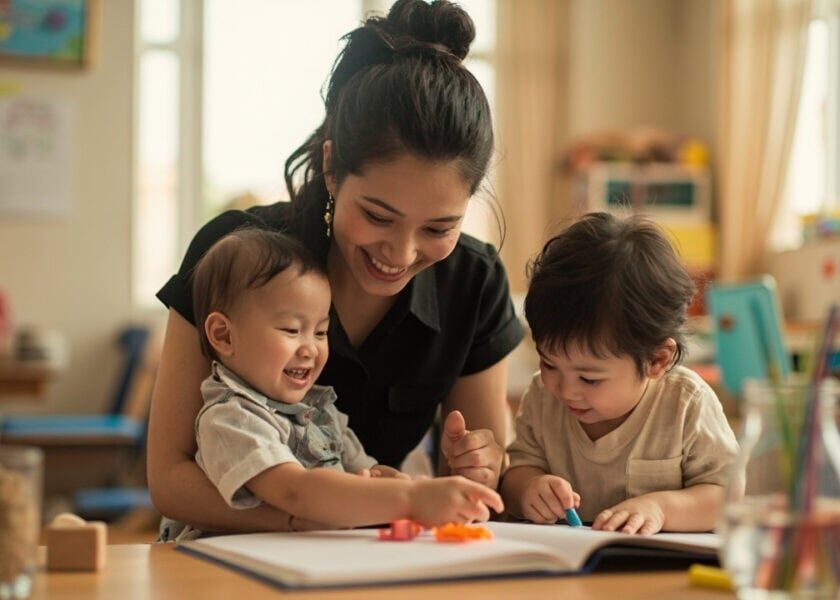
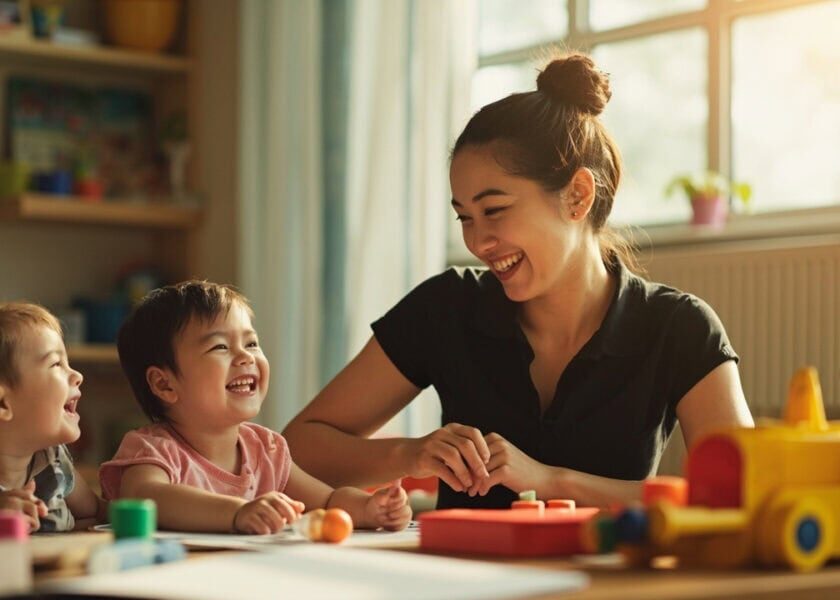
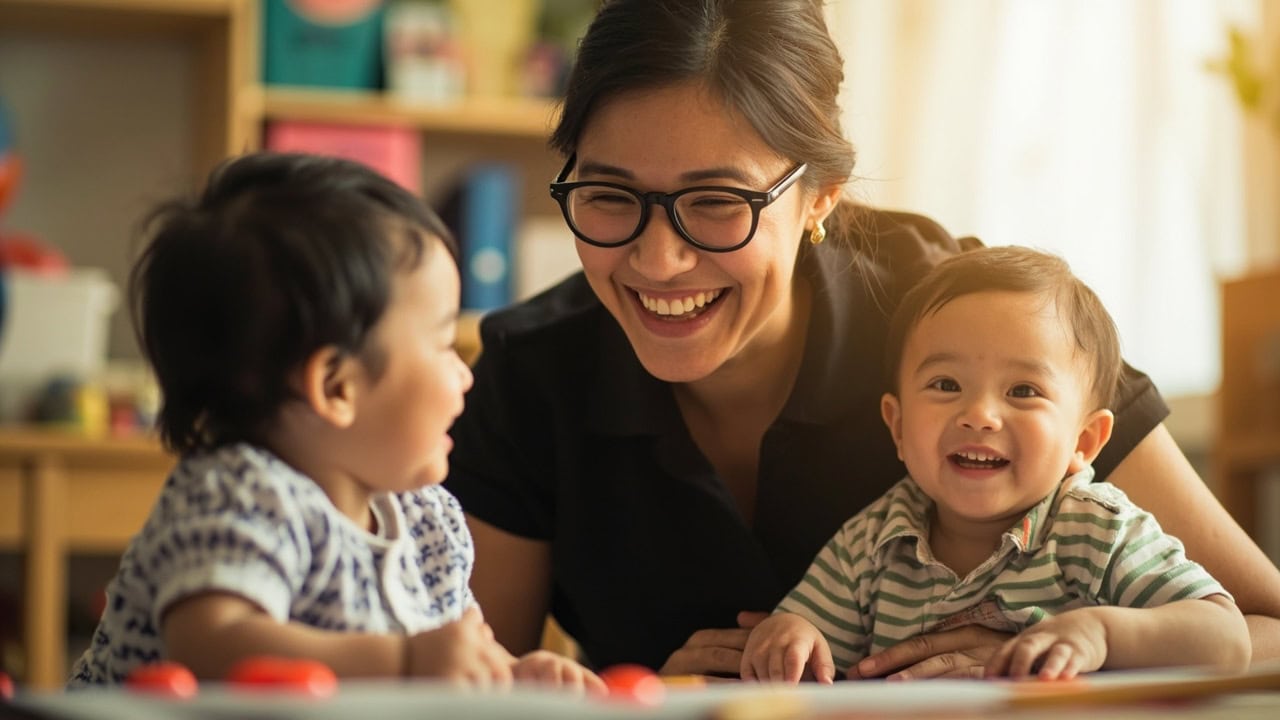
In a sibling-aware programme, caregivers observe the pair as a unit. They notice who leads and who follows, who provokes and who calms, where the tenderness lives and where the friction lives.
They understand that conflict between siblings in care is not a problem to be eliminated but a developmental opportunity to be supported. They know that the older sibling’s adjustment when a baby enters care is as important as the baby’s adjustment—and that these adjustments are interconnected.
The conditions that allow sibling bonds to deepen include physical space that allows siblings to be near each other when appropriate, routine structures that include sibling time alongside individual activity time, caregiver attention to the sibling bond as a developmental asset, and consistency—because sibling relationships deepen with repeated, predictable interaction.
Navigating the Guilt and Complexity of Raising Siblings
There is a tension that many parents know intimately. It is the guilt of loving multiple children equally but differently through childcare. You may have felt this when you enrolled your second child and watched your first child’s face as the baby received the same care he once received alone.
This guilt is real, and it deserves acknowledgment. It is not a sign that you are doing something wrong. It is a sign that you are paying attention to something important. That awareness is a form of love.
If your firstborn was in your care, or with a family member, or in a different arrangement before the second child arrived—and now both children are here together—you are navigating a specific and tender challenge. Your older child must grieve a certain kind of access to you while also gaining something new: a sibling who will be there in ways you cannot always be.
Your job, in partnership with your care provider, is to hold space for that grief while also helping your child see what is being given, not just what is being taken.
This is not easy. It is one of the most complex emotional tasks of parenting. And the difficulty of it does not mean you are failing. It means you are in the middle of something important.
When this is navigated well—when care is structured to acknowledge the older child’s experience and to include her in the sibling relationship rather than simply making room for the baby—something remarkable happens. The older child becomes a protector of the bond, not a rival for attention. She becomes someone who has stake in the sibling relationship, who has contributed to it, who sees herself as part of its architecture.
And that older sibling’s sense of role and contribution is one of the most powerful protective factors we know for sibling relationships that last.
The EduNanny Singapore Approach to Sibling Care
At EduNanny Singapore, we approach sibling care with family systems in mind—not just individual child development. As a participant in the ECDA Childminding Pilot, our programme was designed to make quality care accessible to Singapore families.
Our caregivers observe sibling dynamics as a core part of what they do. They support sibling co-regulation, not just individual emotional regulation. They help siblings navigate conflict as a learning opportunity, not a disruption. They communicate with you about the sibling relationship, not just individual milestones.
We maintain ratios that allow for real observation and responsiveness. We build in time and space for siblings to be together. We understand that your family is not a collection of individuals who happen to share an address. It is a system—and what we do in care either supports that system or ignores it.
We choose to support it.
Questions to Ask and the Long-Term View Ahead
Whether or not you choose EduNanny, these are the questions that matter when evaluating care for your family:
- Do caregivers observe my children as a pair, not just as individuals?
- Is there physical space and time structured for siblings to be together?
- How does the programme support the older child’s adjustment when a new sibling joins?
- How is sibling conflict handled—as a problem, or as a learning opportunity?
- Will I hear about how my children’s relationship is developing, not just their individual milestones?
- Are ratios sufficient for caregivers to observe and respond to sibling dynamics?
The sibling bond that develops in quality shared care is not a consolation prize for divided parental attention. It is not a byproduct of good logistics. It is a primary developmental achievement—and it is available to your children precisely because you chose care that recognizes siblings as more than individuals.
What your children are building together in quality care is not separate from what you are building as a parent. It is part of the same architecture.
- When your four-year-old comes home from care and tells you about something her sister did today, that conversation is part of the architecture.
- When your toddler wakes from a nap and calms more quickly because her brother is nearby, that co-regulation is part of the architecture.
- When your children carry shared memories of care into their adult lives, that shared story is part of the architecture.
You are not choosing between giving your children individual attention and giving them a sibling relationship. You are choosing whether your childcare supports the architecture that holds both.
The Question Was Never About Division
The question you asked when your second child arrived—the question about how care works for your family—is not a question you will answer once and move past. It will evolve as your children grow, as the sibling relationship deepens and shifts, as your family identity changes.
What you are giving your children when you choose care that sees them as siblings first is not just a daily experience. You are giving them a relationship that will teach them about difference and similarity, about conflict and repair, about loyalty and boundary, about what it means to be known by someone who shares your beginning.
You are giving them a developmental partner who will be there when you cannot be, who will remember with them, who will challenge them, who will—in the best outcomes—become a lifelong friend.
That is not a small thing. That is everything.
And it begins not with choosing between your children, but with understanding that they were never meant to be chosen between. They were meant to be raised together. To build together. To become together.
The question was never how to divide your love. The question was how to build an architecture that holds it all.
We are here to help you build.
Ready to explore how EduNanny Singapore supports sibling relationships in care?
Learn more about who we are or schedule a consultation to discuss how our childminding services work for your family.