Raising Rooted Children in Singapore’s Cosmopolitan Landscape
“`html
The Window That Cannot Be Reopened
Here is what developmental science tells us, and it is worth sitting with: the period from birth to around six years old is the most formative window in a human being’s life for identity formation.
The brain is building its architecture at a speed it will never match again. Language pathways are being carved out. Emotional patterns are being set. And crucially — cultural patterns.
The way a child understands family hierarchy. The way they relate to food and celebration. The way they make sense of music and story and belonging. These are not things that arrive when a child is old enough to learn about them in a classroom. They arrive now, in the textures of daily life — in the language spoken at the dinner table, in the songs sung at bathtime, in the way elders are greeted, in the smell of something cooking that connects them to a place they have never even visited.
This is the window. And if you are a working parent in Singapore — and most of us are — then a significant portion of your child’s waking hours during this window are spent in the care of someone other than you.
That is not a failure. That is the reality of modern life, and it is one we can approach with honesty rather than guilt. But it does mean that the question of what kind of care your child receives during these hours is not a logistical question. It is a profound one.
What Culturally Intelligent Childcare Actually Looks Like
You want the best for your child. You want them to thrive in Singapore’s competitive, cosmopolitan, fast-moving world. You know that English fluency is important. You know that social skills, emotional regulation, curiosity, confidence — these matter.
But you also carry this other, deeper aspiration, one that is harder to quantify and even harder to evaluate when you are touring childcare centres on a Saturday morning: you want your child to know who they are. Not just what they can do, but who they are. You want them to carry their heritage the way you do — not as a burden or a duty, but as a source of strength, of rootedness, of quiet confidence in a room full of people.
So what does culturally intelligent childcare actually look like? It lives in the details of daily life, not in formal lesson plans.
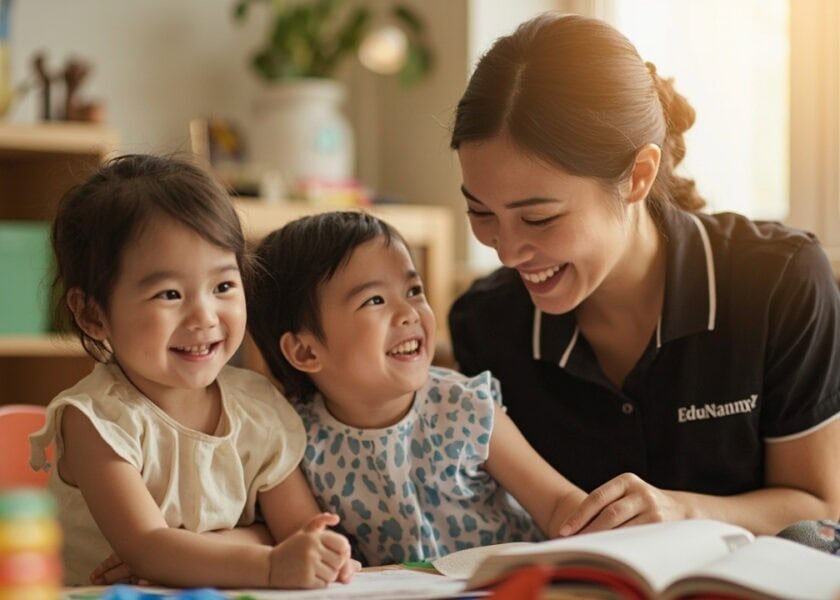
It looks like a caregiver who notices that one child speaks Mandarin at home but is beginning to lose confidence in it, and who gently responds in Mandarin without making a performance of it — who simply speaks to the child the way a family member might, weaving the language into the rhythm of the day.
It looks like Tamil songs played alongside English ones during circle time, not as a token gesture, but because the caregiver understands that hearing your mother tongue in a nurturing space makes a child feel held in a different way.
It looks like Deepavali decorations going up not as a photo opportunity but as a quiet acknowledgment that this festival matters to someone in this room, and that mattering is part of what we are teaching.
It looks like food. This is one that is particularly powerful, because food is culture made tangible. When a child in a Singapore childcare setting is served something familiar — something a grandmother might make, something that carries the taste of home — that child receives a message that cannot be put into words: you belong here. Your world is real here. We see all of you.
And when a child from a different cultural background encounters a food they have never tried before and is welcomed into that experience with curiosity rather than discomfort, they receive a different but equally important message: the world is larger than your own home, and that is a good thing.
These are not extras. These are not nice-to-have cultural activities bolted on to a curriculum. These are the living texture of identity formation, and in the best early childhood environments, they are not planned so much as breathed — they are simply part of how the day unfolds, because the people caring for your child understand that culture is not something you teach in a lesson. It is something you inhabit.
The Difference Between Adequate and Excellent
Most childcare, even good childcare, operates on the principle that it will keep your child safe, love them, and prepare them for the next stage. That is not nothing. That is genuinely important.
But culturally intelligent childcare operates on a deeper understanding: that during these foundational years, your child is not just growing — they are becoming someone.
The someone they are becoming is shaped by every language they hear, every story that is told, every festival that is acknowledged, every moment in which they are told, in one way or another, that their particular combination of roots and wings is exactly right.
What to Look for When Choosing a Childcare Provider
In Singapore’s childcare landscape, parents face real trade-offs. Large centres offer structure and curriculum. Home-based care offers warmth and individual attention. Both can be excellent. Both can fall short. The question is not which model is inherently better — it is which environment will actually see your whole child.
Here are the factors that genuinely matter when you are making this decision:
- Language exposure — Will someone speak to your child in the languages your family uses, not just in English?
- Cultural presence — Do the songs, stories, food, and daily rhythms reflect the world your child comes from?
- Caregiver consistency — Will your child have a primary caregiver who knows them deeply, or rotate through many faces?
- Ratio and attention — In infant care especially, how many children does each caregiver look after?
- Communication — Will you know what your child’s day looked like, or wonder?
- Values alignment — Does the provider understand that you are handing them something precious — not just a child to be supervised, but a person being formed?
These are not superficial checklist items. They are the conditions under which your child’s cultural confidence either takes root or quietly erodes.
EduNanny: Built Around the Whole Child
EduNanny was built with an understanding that quality childcare cannot be separated from cultural intelligence. This is not a marketing position — it is a genuine commitment to the kind of care that sees your whole child, including the parts of them that are still forming, the parts that have to do with where they come from.
EduNanny is part of the ECDA Childminding Pilot, which means it operates within a framework designed to bring quality, accountable, home-based and community-based childcare to families across Singapore. This structure reflects a real understanding that every family’s situation is different, and that one-size-fits-all institutional care is not always the answer families need.
EduNanny combines the warmth and individual attention of home-based care with the rigour and oversight that parents quite reasonably expect.
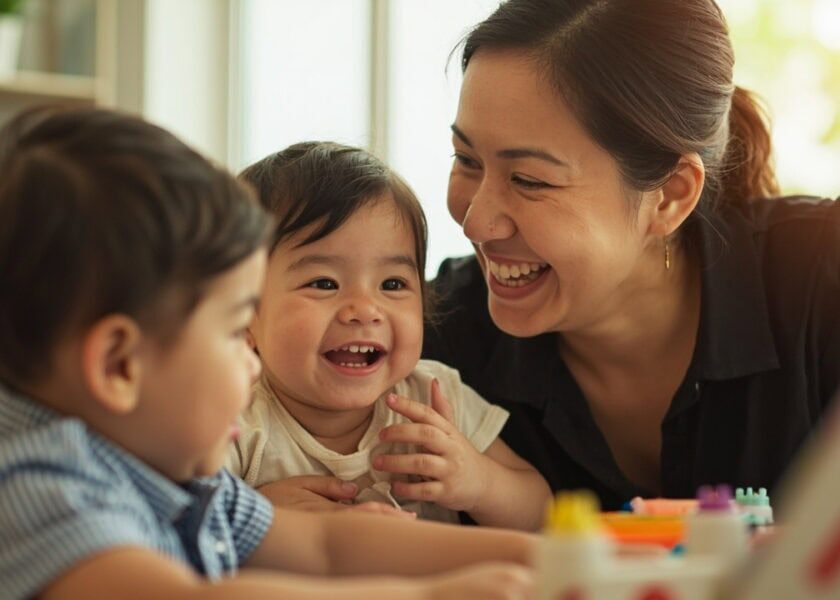
In infant care, ratios are kept to a maximum of one to three — which means your baby is not one of twelve in a room, but one of three at most, receiving focused, responsive care that mimics the attentiveness of a dedicated caregiver in a home environment. This is not a luxury talking point. It is a developmental reality. Babies in lower-ratio care environments show stronger attachment security, more consistent language exposure, and greater emotional stability — because they are seen as individuals, not as a cohort.
Care is available across Monday to Friday blocks, aligned with the rhythms of most working families in Singapore. Fees within the pilot are structured to be affordable, and the use of the Child Development Account and Baby Bonus where applicable means that for many families, the financial piece is more manageable than they expected.
Because trust sits in the room whether anyone says it or not: the transparency measures in place, including communication practices and CCTV deployment where applicable, are designed to give you sight into your child’s day. Not surveillance, but partnership. You should know what your child ate, how they slept, what made them laugh, and what they are learning — without having to wonder.
EduNanny also offers the Thomas AI Chatbot — a thoughtful, responsive resource available at any hour for parents navigating the complexity of infant care, childminding options, developmental milestones, and the everyday realities of raising a young child in Singapore. This is a recognition that modern parenting is demanding in ways that did not exist a generation ago, and that the support you need should be as immediate as the questions you have.
Addressing the Concerns You Might Not Have Voiced
“Will my child lose their mother tongue in a childcare setting?”
This is the concern that sits deepest, and it deserves an honest answer. The risk is real, but it is not inevitable. It depends entirely on whether your childcare provider treats heritage language as something to be preserved or something that can be left to chance. Culturally intelligent care weaves heritage language into daily interactions — not as a formal lesson, but as a natural part of how a caregiver speaks to and with your child.
“Is home-based care really as good as a centre?”
The evidence on this is clearer than the debate suggests. For infants and toddlers, the consistency of a primary caregiver relationship matters enormously for attachment security and language development. Home-based care, when it maintains appropriate ratios and qualified caregivers, offers advantages that large-centre settings structurally cannot: fewer faces, more individual attention, and a domestic environment where cultural warmth can breathe more naturally.
“Can I really afford quality care?”
This is a practical concern that deserves a practical answer. The Child Development Account and Baby Bonus subsidies make a meaningful difference for many families enrolled in the Childminding Pilot. The question to ask is not just the monthly fee, but what the total cost looks like after subsidies — and whether the quality of care justifies the investment in your child’s formative years.
“How do I even evaluate whether a provider is culturally intelligent?”
Ask to see a typical day. Notice what languages are spoken. Ask what songs they sing, what stories they tell, what festivals they mark. Ask how they would respond if your child began answering in your home language. These are not strange questions — they are exactly the right questions. A provider that understands cultural identity as foundational will welcome them.
The Decision You Are Actually Making
You are not choosing a childcare provider the way you choose a service. You are, whether it feels that way or not, making a decision about the environment in which your child will spend the most formative years of their identity development.
You are choosing who will speak to them when you are not in the room. You are choosing what songs they will hear and what stories will be told and what languages will feel natural around them. You are choosing whether your child’s cultural roots will be tended to with intention — or left to chance.
And here is the thing: chance is not neutral. In a society where English is dominant, where global culture flows through every screen, where the pressure is always toward the new and the cosmopolitan, leaving cultural grounding to chance means it will quietly erode. Not because Singapore is trying to erase anyone’s heritage. But because the default current flows in one direction, and someone has to actively hold the other direction open for your child.
That is what great childcare can do. Not replace you. Not dilute your family’s influence. But extend it — create a space in which your child’s bilingualism is a strength rather than a casualty, in which their heritage language is spoken back to them with warmth and competence, in which festivals from every background in this beautiful, complex, multicultural city are not obstacles to be managed but threads in a rich tapestry that your child is learning to weave.
This is what the childcare decision is, at its heart: not a choice between modern Singapore and your family’s heritage. It is about raising a child who holds both fully — who is rooted enough to know where they come from and brave enough to go wherever they are called.
If you are standing at that crossroads, trying to decide where to place your child’s care, look not just at the facilities or the curriculum or the food menu — though those matter. Look at whether the people caring for your child will see them as a whole person. Look for whether your child’s culture, your family’s language, your heritage’s way of seeing the world is welcomed into that space, not as a special programme, but as a natural part of the day.
Because your child is not just yours. They belong to a lineage, a language, a history that stretches back further than any of us can trace. And in these few short years before they go off to school and the world expands around them, the question is simple:
Will they know where they stand before they learn how to fly?
Ready to Learn More?
EduNanny was built for this moment, for these parents, for this generation of Singapore children who deserve to grow up confident in every dimension of who they are. Learn more about EduNanny and how thoughtful, development-oriented childminding can support your child’s cultural confidence and bilingual growth.
If this resonates with you — if you are looking for childcare that sees your whole child, including their cultural identity — EduNanny welcomes the conversation. You can learn more about the Childminding Pilot, infant care options, and how home-based care can support your child’s bilingual confidence and multicultural grounding.
Sometimes the most profound decisions are the ones we make quietly, with our hearts as much as our heads. You are already asking the right questions. Reach out to EduNanny and find a partner who will ask them alongside you.
“`