Raising Children Together: A Singapore Guide to Modern Village Building
The Silence in Singapore Homes: An Honest Conversation About Grandparents, Nannies, and Raising Children Today
There is a silence that lives in certain Singapore homes. You have probably heard it. It is the silence between a grandmother adjusting a child’s blanket and a caregiver straightening a highchair. It is the pause before a question is asked, when both adults look to the other, waiting to see who will answer. It is the weight of a parent’s gaze, caught between gratitude and something they do not have a name for yet.
That silence does not mean anyone is failing. It means something more interesting is happening. Something that millions of Singapore families are quietly navigating, and something that deserves to be spoken about honestly.
Let us begin there. In that living room. Because this is where modern Singapore parenting often lives: in the tender, complicated space between honoring those who raised us and trusting those who will help raise our children. And it is not a failure of love. It is the sound of a culture evolving.
When Two Generations Raise One Child
When my grandmother was alive, she would tell me about raising her children in a different Singapore. The one where extended families did not just live near each other but under the same roof, where one grandmother’s wisdom was not questioned, where the village was small and immediate and everyone knew their role. She spoke of it with warmth and with the quiet exhaustion that often hides behind such warmth. “We did not have a choice,” she would say. “We had to do it all.” And in that sentence was both pride and a kind of grief she never named.
Today, something has shifted. Singapore parents love their parents deeply, and they want them in their children’s lives. But they also know things their parents did not know about early brain development, about secure attachment, about the way a child’s first thousand days shape the architecture of who they become.
They read, they ask questions, they think carefully. And they find themselves in a position their own parents never faced: they want help, they need help, and they are not always sure how to accept it in a way that does not feel like rejection.
This is the unspoken tension. Grandparents who want to be involved, who feel sidelined when a professional caregiver enters the home, who quietly wonder if their years of raising children have been rendered somehow insufficient. Parents caught between the sacred obligation to respect and include their elders and the equally sacred desire to make their own choices about how their children are fed, rested, comforted, and loved.
And in the middle, a child receiving mixed signals about who is truly in charge, feeling the undercurrent of adult anxiety even when no harsh words are ever spoken.
This Tension Is Not a Family Problem. It Is a Cultural Moment.
It is the sound of old structures meeting new understanding. And it is solvable. But only if we stop pretending it does not exist.
Here is what I have learned from sitting with Singapore families through these conversations. The families who navigate this terrain most successfully are not the ones with perfect relationships or the most patient grandparents. They are the ones who made a deliberate choice to stop framing this as a competition and start framing it as a collaboration.
They stopped asking, “Who does the child belong to?” and started asking, “What does this child need from each of us?”
This reframe changes everything.
Why Competition Never Works
When we frame grandparent involvement against professional childminding, we create a zero-sum game where someone always loses.
Grandparents feel replaced. Parents feel guilty. Children feel the divide. The grandmother who used to hover anxiously over the caregiver’s shoulder becomes someone whose presence creates tension rather than warmth. The grandfather who felt diminished by not being the primary caretaker withdraws into silence or criticism.
But when we reframe it, when we look at what each adult in a child’s life is uniquely positioned to give, something remarkable happens.
The grandmother who used to hover anxiously over the caregiver’s shoulder becomes the grandmother who sits on the carpet and plays. The grandfather who felt diminished by not being the primary caretaker becomes the one who teaches a child to harvest kangkung from the pot at the back of the condo. The professional caregiver stops being a threat and becomes a collaborator.
Children are exquisitely tuned to the emotional weather of the people around them. When they sense that the adults in their lives are aligned, they breathe differently. They play more freely. They test the world with more confidence because they sense, even at a pre-verbal age, that the adults around them are not at war.
A child whose caregivers are in harmony has a secure base from which to explore. A child who senses division, even when both sides love them fiercely, is a child who spends emotional energy managing a tension they should never have to carry.
The Grandparent-Nanny Partnership: A Different Model
So how do we build this? How do we move from the silence in the living room to the laughter?
It begins with a conversation. Not the one where you explain your parenting philosophy in detail while your mother-in-law nods politely but has already decided you are being unnecessarily complicated. Not the one where your father looks out the window and says, “In my days, we did not have all these rules.”
The conversation that actually works is a different kind. It is the conversation where you begin not with what you want to change, but with what you are grateful for. Where you say, “I know how much you love this child. I know you raised us, and I know the sacrifices you made. This is not about replacing that. This is about making sure you get to be what you were always meant to be in this child’s life: not the exhausted primary caregiver, but the grandmother, the grandfather, the person who gets to love this child without the weight of every feeding and every nap resting solely on your shoulders.”
When you give a grandparent permission to be a companion rather than a caretaker, you give them a gift. You give them back their grandchildren in a way that feels like joy instead of obligation. You give them weekends free to play golf or have dim sum with friends or simply rest. You give them the chance to be the person the child runs to with delight rather than the person the child associates with discipline and routine.
Two Roles, Both Irreplaceable
The most effective model I have seen in Singapore families is what I have come to think of as the grandparent-nanny partnership, and it works precisely because it honors both roles.
In this model, the professional caregiver handles the developmental architecture: the routines that support infant brain development, the responsive feeding, the sleep hygiene, the intentional play that builds neural pathways. This is not about being a strict authoritarian. It is about understanding, in a way that our own parents could not have without access to the research we have today, how the early years literally shape the brain.
The grandparent, in this model, becomes the keeper of something irreplaceable. The carrier of family stories, cultural rituals, the specific warmth of a grandmother’s voice reading the same nursery rhyme she once read to your own mother. The one who introduces a child to the taste of lor mai gai and the sound of Teochew opera. The one who builds the bridge between the child’s immediate family and the wider web of cousins, uncles, aunts, great-grandparents who give a child their sense of belonging to something larger than themselves.
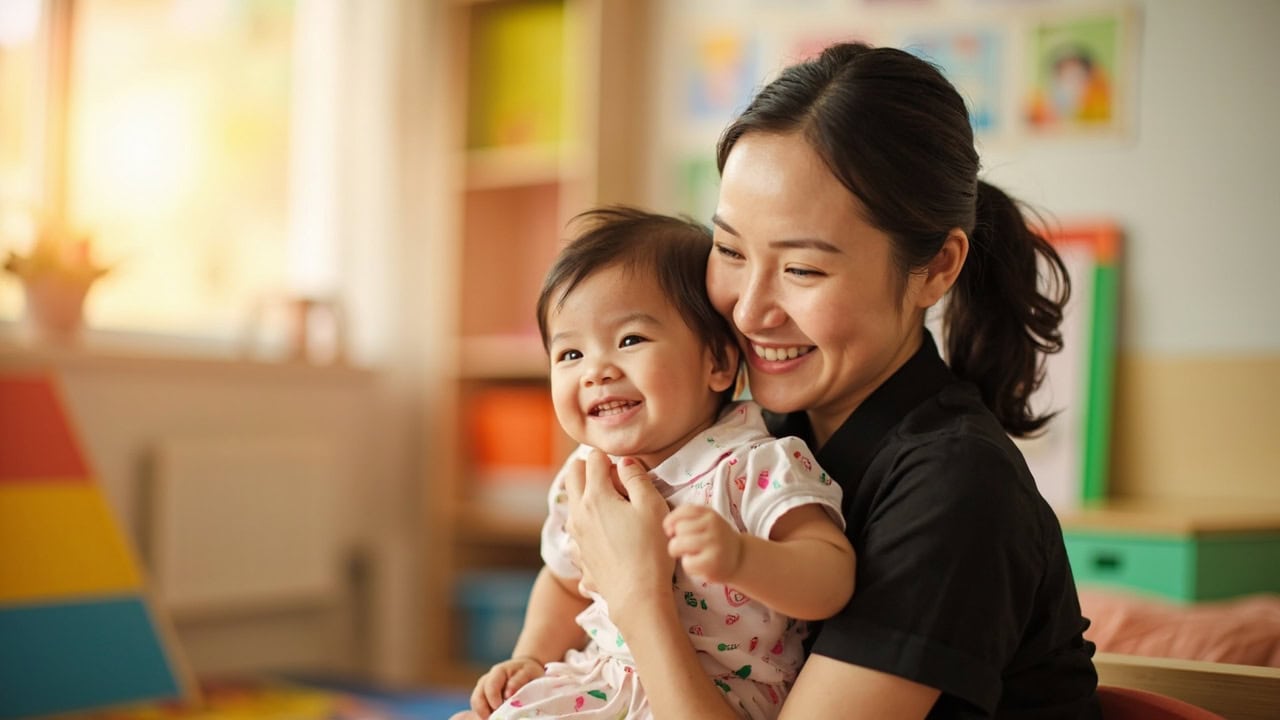
Children need both. They need the structure and intentionality of professional care that understands how to support their development. And they need the embodied love of generations, the particular smell of their grandfather’s shirt, the way their grandmother hums without thinking.
This is not diminished care. It is different care. And it is care that a professional caregiver, no matter how skilled, cannot replicate. Because what grandparents give is not a technique. It is a lineage. It is the knowledge, held in the body, that you came from somewhere. That you belong to a people.
Understanding Quality Childminding in Singapore
Let me address something directly here, because I know it lives in the hearts of many who are reading. The guilt. The quiet, persistent guilt that says you are somehow betraying your parents by hiring help. That you are choosing strangers over family. That you are failing at the most fundamental task of adulthood.
That guilt is a lie your culture has taught you, and it is not serving your family. Your parents raised you in a world with different possibilities, different constraints, different knowledge. They did the best they could with what they had. You are doing the same. The fact that you are even having this conversation, the fact that you care enough to think carefully about who cares for your child and how, is itself a form of love.
Hiring a professional caregiver is not rejection. It is not abandonment. It is the recognition that raising a child in twenty-first century Singapore requires more than one person, more than one set of skills, more than one village as it used to be. You are not replacing your parents. You are expanding the village.
For your parents, if they can hear this message: The love you have for your grandchildren is not measured by how many naps you supervised or how many bottles you warmed. That love is visible in the way you look at them. It is audible in the way your voice softens when you speak their names. It is present in every story you tell about who they come from.
There is a freedom in this that many grandparents do not know they are being offered. The freedom to simply be with a grandchild without being responsible for everything that child needs. To arrive and play, to leave and rest. To be the person who makes memories rather than the person who manages schedules.
What Professional Childminding Actually Offers
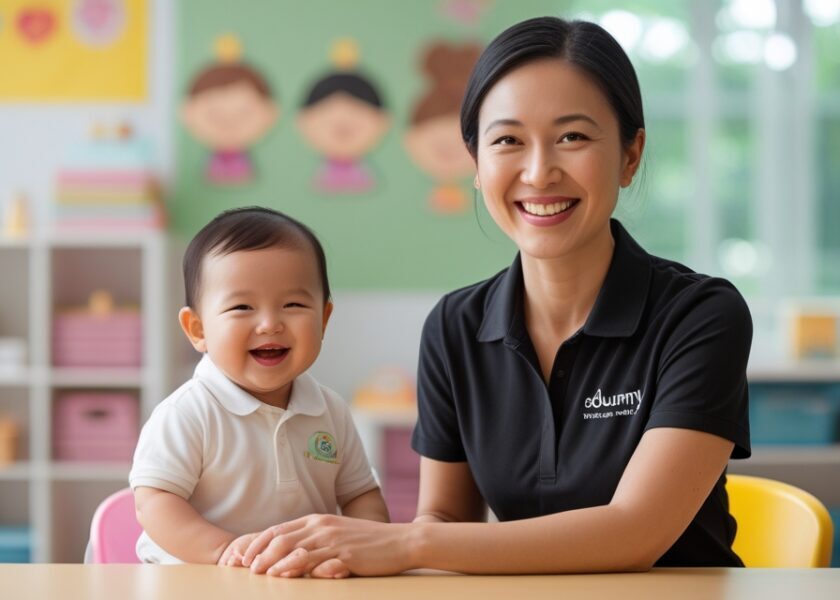
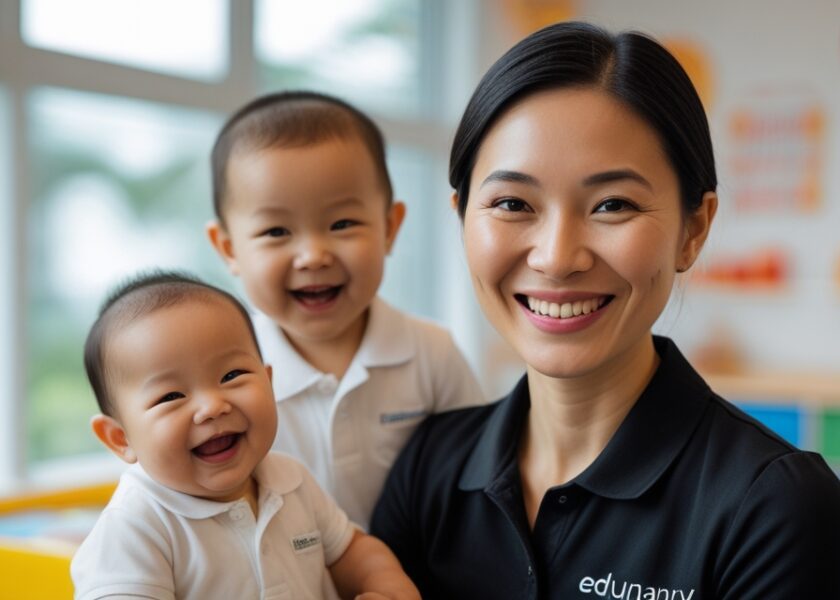
EduNanny by BUTLER is part of the ECDA Childminding Pilot, which means they operate within a framework designed to ensure quality, safety, and accountability. This is not an unregulated arrangement where you are simply hoping for the best. This is structured care with oversight, with standards, with a commitment to the kind of professionalism that Singapore parents deserve and should expect.
Their home-based childminding service offers something that centre-based care cannot always replicate: the intimacy of care in your own home, on your child’s own schedule, with one-to-one or small group attention that makes a genuine difference in those critical early years. The infant ratios they maintain mean that your child is not one of twenty in a room. They are known. They are seen.
The practical arrangements are designed with real Singapore families in mind. Monday to Friday care blocks that cover the working week. Fee structures within the pilot framework that aim to be accessible rather than exclusive. And the ability to use CDA funds and Baby Bonus contributions, because Singapore has designed systems to support families and this should actually be usable by families.
There are also elements that address something every parent thinks about but not every parent says out loud: trust. The fear of not knowing what happens when you close the door and leave for work. EduNanny addresses this with communication protocols and transparency measures, including CCTV in deployed environments, because they understand that trust is not built on hope alone. It is built on the kind of openness that allows a parent to check in not from anxiety but from genuine confidence.
They have also built Thomas, an AI chatbot that offers parenting and childminding support. Not as a replacement for human guidance, but as a resource that sits alongside it. Because parents have questions at 11pm when the baby will not sleep. Parents need quick answers to small concerns that do not warrant a phone call but deserve a response.
Addressing the Concerns That Keep You Up at Night
These questions come up again and again in Singapore families. They deserve honest answers.
“Will my parents feel replaced?”
Only if you let the narrative become about replacement. The families who navigate this best never position the caregiver as coming in to do what grandparents were doing, only better. Instead, they introduce the caregiver as someone who handles the developmental and routine work so that grandparents can be freed for something more joyful.
When your mother-in-law arrives on a Sunday and the child runs to her without the exhaustion of “you’ve been here all week, you must be tired” hanging in the air, she will feel the gift you have given her. When your father no longer has to defend his parenting choices against modern standards he was never taught, the relief will be palpable.
“What if my child gets confused about who is in charge?”
Children are confused when they sense conflict, not when they have multiple loving adults with clear roles. When the caregiver handles meals, sleep, and developmental activities, and grandparents handle play, stories, and cultural rituals, children learn that different people have different joyful things to offer. This is not confusing. This is enriching.
“How do I even start this conversation?”
Begin with appreciation, not explanation. Before you outline your parenting philosophy or the research you’ve read, tell your parents what they have meant to you. Tell them what you want for your child that they gave you: the sense of being deeply known, the family stories, the cultural roots. Then explain that you want to protect that. That you want them to be grandparents, not nannies. That you want your child to run to them with delight, not association with discipline.
Most grandparents, when presented with this framing, realize they have been given something precious: their grandchildren without the burden.
“What if my parents refuse to accept this?”
Some families need more time. Some grandparents need to see the caregiver in action before they relax into the new arrangement. This is normal. The key is to remain firm in your conviction while gentle in your delivery. You are not asking for their permission. You are informing them of a decision you have made out of love for them as much as for your child.
And remember: you are not asking them to disappear. You are asking them to show up differently.
Practical Steps for Building Your Village
If you are ready to move from concept to action, here is where to begin.
- Clarify your own values first. Before talking to anyone else, get clear on what you believe about early childhood development and what kind of care you want for your child. This clarity will give you confidence in conversations that might otherwise feel threatening.
- Start with gratitude, not philosophy. When you speak to grandparents, begin by acknowledging what they gave you and what you want your child to receive from them. Frame professional care as the thing that protects and enhances that relationship, not replaces it.
- Define roles explicitly. The grandparent-nanny partnership works when everyone knows what they are responsible for. Create clarity about who handles what, and revisit these boundaries as your child grows.
- Build in communication systems. Regular check-ins between caregivers and grandparents prevent small misunderstandings from becoming family friction. A shared chat group for daily updates, for example, keeps everyone informed without anyone feeling excluded.
- Protect grandparent time. Ensure that grandparents have regular, unhurried time with your child that is not about logistics. This is where the relationship deepens. This is where the stories get told, the songs get sung, the cultural knowledge gets passed down.
- Give it time. The shift from competition to collaboration does not happen overnight. There will be moments of awkwardness, misunderstanding, and adjustment. Be patient with everyone, including yourself.
A Letter to Every Parent and Grandparent in This Position
Perhaps you are a parent who has felt the silence. Who has watched your mother and your child’s caregiver orbit each other with careful politeness and wondered how long it could last. Who has lain awake at night wondering if you are failing everyone.
Let me tell you something. You are not failing. You are navigating one of the most complex dynamics of modern family life, and you are doing it with more thoughtfulness than most. The fact that you are asking these questions means you care. And care, even when it feels clumsy, even when conversations go badly, even when the silence returns, care is the thing that ultimately heals these situations.
Perhaps you are a grandparent who has felt the shift. Who has felt, perhaps for the first time, that you are not needed in the way you once were. That your experience, your wisdom, your hands that have held so many babies, are somehow no longer the most important hands in the room.
Let me tell you something. Your experience is not obsolete. Your wisdom is not irrelevant. But the wisdom you now have the chance to offer is different. It is the wisdom of love without obligation. It is the gift of presence without performance. And it is, I would argue, the wisdom you always hoped you could give but were sometimes too exhausted to access.
There is an old saying that it takes a village to raise a child. It is true, but it is incomplete. What the saying does not capture is that the village itself must evolve. That what a village looked like fifty years ago cannot be what a village looks like today. That the village must grow to include new roles, new knowledge, new structures, while holding onto the irreplaceable human threads that no institution can replicate.
That is what EduNanny is trying to build. Not a replacement for your village. A village that includes your grandmother’s stories and a caregiver trained in early childhood development. A village where your father can teach your daughter to say “jialat” with perfect pronunciation and also benefit from communication systems that tell him what she ate for lunch. A village where your mother can spoil your son with angpows and attention without being responsible for his sleep training.
This is not the end of family. This is family growing up.
And if you are ready to build this, to have the conversations, to make the choices, to trust that you are not betraying your parents by expanding your village, then I want you to know that you are not alone. There are professionals who understand this. There are frameworks designed to support this. There are families who have walked this path and emerged not fractured but strengthened.
The silence in the living room does not have to be permanent. It can become the foundation for a different kind of sound. The sound of adults who have done the hard work of communication. The sound of a child who feels secure in the harmony around them. The sound of a family that chose honesty over pretense, collaboration over competition, and love over obligation.
That sound is possible. And it starts with the decision to stop pretending the tension does not exist, and to start building something better in its place.
The village is changing. It always has been. And this version, this expanded, honest, thoughtfully structured village, might just be the one your children remember most fondly. Not because it was perfect, but because it was real. Because the adults in their lives were brave enough to work it out. Because they grew up feeling not divided loyalties but the full weight of being loved by many.
That is the gift you are building. And it is a gift worth every difficult conversation, every moment of discomfort, every small act of courage it takes to build something this beautiful.
Welcome to the village. It has room for everyone.
Ready to explore what this could look like for your family? EduNanny offers a complimentary consultation to help you think through your childminding options and how to integrate professional care with your existing family support. Because building a village should not feel like one more thing to figure out alone.
#SingaporeParenting #GrandparentNannyPartnership #ChildmindingSG #ModernFamily #EduNannySG