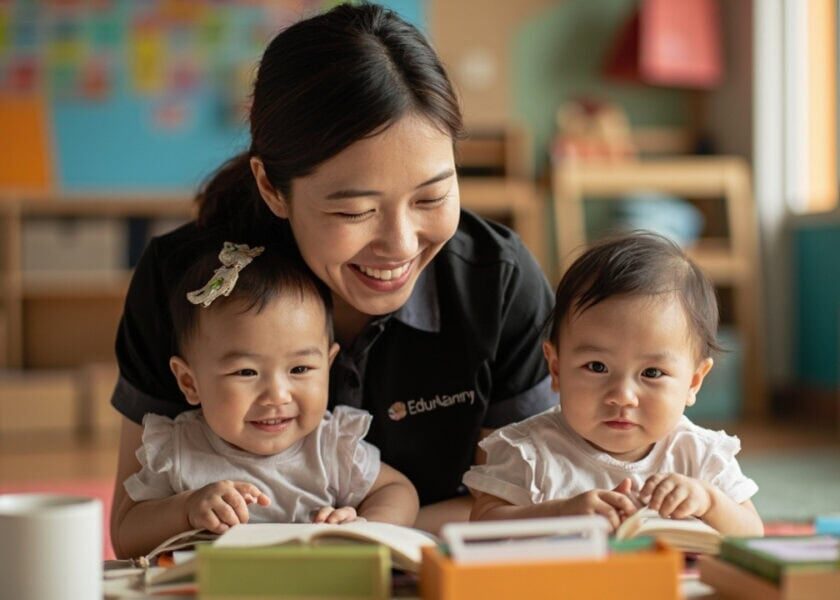
Premium vs Adequate Childcare for Singapore Families
That Moment Every Singapore Parent Recognises
You are sitting at your laptop after the children have finally fallen asleep. You are scrolling through childcare options. And then you see it: the number.
It is higher than you expected. Not outrageously so — not so high that it feels like an obvious mistake. But high enough that your hand pauses on the mouse. You read it again. You think about your household budget. You wonder if what is on the other side of that price is actually worth it.
If this moment feels familiar, you are not alone. You are not uncertain because you are a bad parent. You are uncertain because you are a thoughtful one. And the fact that you are still reading right now tells me you are ready for an honest answer.
Here it is: quality infant care and childminding in Singapore costs more than adequate care. That is true here, and it is true in London, in Hong Kong, in Sydney — in every city where families take early childhood seriously. But here is what nobody tells you in that scrolling moment: the price is not arbitrary, and the gap is not arbitrary. The question you are really asking is not whether premium care is expensive. It is whether the expense is an investment.
Let me show you the difference.
What the Price Actually Reflects
When you see the monthly fee for a premium infant care programme, you are not seeing a number pulled from thin air. You are seeing the cost of specific things, made concrete.
Educator Qualifications and Pay
You are seeing the salary of educators who have trained for years, who understand infant development not as a checkbox but as a discipline. Qualified early childhood educators who understand how and why their work matters are not inexpensive. They should not be. Their work is extraordinary.
In Singapore, the Early Childhood Development Agency (ECDA) sets baseline qualification requirements for early childhood educators. Premium programmes typically go beyond these baselines — investing in continuous training, specialised infant development certifications, and competitive compensation to attract and retain experienced staff. This is not overhead. It is the foundation of quality care.
Small Group Ratios
You are seeing small group ratios — not by coincidence, not as a marketing angle, but because the research on infant attachment, language acquisition, and developing brains is unambiguous.
When one educator is responsible for three infants instead of six, the quality of attention is not twice as good. It is categorically different. It is the difference between a relationship and a rotation.
| Ratio | What It Means for Your Child |
|---|---|
| 1 educator : 6 infants | Standard minimum in many centre-based settings. Rotation-based care. Limited individual attention. |
| 1 educator : 3 infants | Premium ratio. Consistent relationships. Individualised observation and response. Room for genuine attachment. |
That difference sounds abstract until you picture your own child. Until you imagine them crying and wondering whether anyone will notice. Until you consider what it means for a child to feel known versus merely managed.
Environment and Safety Standards
You are seeing environment costs too. The safety standards that exceed minimum requirements. The materials that are not just colourful but developmentally sequenced. The spaces designed for infants to explore safely, to fail safely, to grow safely.
In Singapore’s humid climate, maintaining infant-appropriate environments requires proper ventilation, air quality management, and temperature control. Premium programmes invest in infant-safe materials, ergonomic furnishings, and sensory-rich spaces that cost more to build and maintain. None of this appears in a brochure as a line item, but it appears every single day in what your child experiences.
Developmental Programming
You are seeing programming — not entertainment, not supervision, but genuine pedagogical intentionality. The way an educator reads to an infant matters. The way they respond to a cry matters. The way they scaffold a child’s first attempts at communication, at movement, at trust — it all matters.
Premium programmes are built around evidence-based curricula designed specifically for infants — not adapted from toddler programmes or primary school models. This requires trained educators, curated materials, and intentional daily planning that reflects how infants actually learn and develop.
The Hidden Cost of Adequate Care
I want to be equally direct about the other side of the calculation, because the conversation about premium childcare cost is never complete without it.
There is a hidden cost to adequate care. Not to bad care, not to negligent care. I am talking about care that meets the minimum standard. Care that is fine. Care that your child will survive and from which they will emerge physically unharmed. Care that costs less.
Here is what that care quietly costs, over time:
- Developmental milestones that arrive later rather than sooner. Language readiness that lags behind peers. Motor skills that take longer to develop.
- The confidence a child carries into their first classroom. Quiet uncertainty versus quiet curiosity shapes everything that follows.
- Parental stress. The energy spent wondering, every single day, whether you made the right choice. Managing a childcare situation that is functional but not quite right.
- Future remediation. In some cases, the cost of catching up — intervention programmes, additional support, the compounding difficulty of remediation versus the compounding ease of building momentum from the start.
These costs are not always visible on a spreadsheet. But they are real, and they are heavy. And they tend to reveal themselves at the worst possible moments: at Parent-Teacher Night in Primary One, when your child struggles to focus, when the teacher mentions that they seem behind, when you think quietly about the years you cannot get back.
Why the First Thousand Days Are Different
The first thousand days of a child’s life are not a metaphor. They are a biological reality.
The neural pathways that form in these first years — for language, for emotional regulation, for executive function, for the capacity to learn how to learn — are laid down once and then built upon. The architecture of a developing brain is not infinitely malleable. It is particularly receptive during specific windows, and those windows do not stay open indefinitely.
This is why the investment you make in the quality of care during this window does not simply provide supervision. It shapes the architecture of a mind. And the returns on that investment are not academic. They are life.
Think about it this way: when you invest in a child’s first thousand days, you are not paying for childcare. You are making a deposit into a foundation that every subsequent year will be built upon. The question is not whether you can afford to invest wisely here. It is whether you can afford not to, when the compounding interest on this particular investment begins accruing immediately and never stops.
What Quality Childminding Actually Looks Like
What separates quality care from adequate care is not always visible in a photograph or obvious in a brochure. Here is what to look for when you are evaluating your options:
- Consistent, responsive relationships. Your infant should be known by name by their caregivers — not as a face in a rotation, but as a person with preferences, rhythms, and developing personality. When an educator knows your child, they notice when something is different. They respond to cries with understanding rather than routine. They adapt.
- Developmentally appropriate stimulation. Quality care is active observation and intentional response. Educators in quality programmes notice developmental windows — moments when a child is ready to take the next step — and provide the support that moves them forward.
- Safe, exploratory environments. Infants learn through their senses and through movement. Quality environments provide safe spaces to explore — to touch, to crawl, to fail, to try again. This requires careful design, constant supervision, and materials that invite discovery without posing hazards.
- Transparent communication. Quality care keeps parents informed — not just with daily reports that say “napped well and ate lunch,” but with genuine observations about development, progress, and concerns. You should feel like a partner in your child’s care, not a customer receiving a service report.
EduNanny Singapore’s Approach
EduNanny operates from a straightforward conviction: that Singapore parents deserve to make this decision with real information, not vague quality language and not defensive pricing justifications.
We believe that the families who choose premium care should understand exactly what that premium purchases. And that the families who choose other paths should not feel judged, but supported. Our role is not to shame anyone about cost. Our role is to be transparently honest about what quality costs and why.
We are part of the ECDA Childminding Pilot, which means we operate within a framework designed to expand options for Singapore families. Our fee structures are developed to be accessible, to be honest about what is possible within real family budgets. For eligible families, Child Development Accounts can be applied. Baby Bonus funds are usable. These are not hidden catches — they are part of how we think about the actual cost of care for real families.
Our model offers what we believe is the clearest expression of what premium care should look like. With ratios of up to one educator to three infants — not six, not eight, but three — we ensure that every child in our care receives the attention that early development requires. This is not a number we arrived at for marketing purposes. It is a number that reflects what the science says about quality infant care, and what we believe children in Singapore deserve.
We operate Monday through Friday, in care blocks designed to accommodate the rhythms of working families. Whether your pathway runs through our home-based arrangements or our centre-based programmes, the commitment to quality remains constant.
Safety is what keeps many parents awake at night. We have deployed CCTV measures in appropriate spaces — not as a surveillance mechanism, but as a transparency mechanism. We want families to know what is happening with their children. We want there to be no ambiguity, no uncertainty, no room for doubt that can undermine the trust which is the foundation of everything we do.
One of the hidden costs of premium childcare — a cost that does not show up on any price list — is the cognitive load of parenting. The worrying. The second-guessing. The midnight searches for reassurance about whether your child’s development is on track. Thomas, our AI assistant, is built to carry some of that load. He provides instant, knowledgeable responses to the questions parents have at two in the morning when they cannot sleep, extending the support that quality care provides beyond centre hours.
Evaluating Your Options and Making the Decision
Here is a practical framework for thinking through your decision:
- Define your priorities. What matters most to you? Consistent relationships? Location? Safety standards? Developmental programming? Alignment with your parenting values? These are not all achievable at once — clarify what you will not compromise on.
- Ask specific questions. What is the educator-to-child ratio? What are the educators’ qualifications? What does a typical day look like? How do they handle development? How do they communicate with parents? Quality providers will welcome these questions. If a programme cannot give you clear, specific answers, that is information.
- Consider total cost, not just tuition. Location convenience, hours of operation, food included, materials provided — these affect the true cost of any programme.
- Calculate opportunity cost. What does inadequate care quietly cost in terms of developmental support, parental stress, and future needs? These are real costs that belong in the calculation.
- Trust your instincts. After visiting a programme, pay attention to how you feel. Do you feel informed or pressured? Respected or sold to? The quality of your relationship with the provider is a preview of the quality of care your child will receive.
If premium care feels beyond reach right now, that is okay. Home-based care, family involvement, intentional parenting practices at home — these can supplement and support any care arrangement. The goal is not perfection. The goal is the best possible investment you can make with your resources.
The first thousand days are not a long-term commitment — they are a starting point. What matters is making an informed decision for now, based on what you know now, with the flexibility to revisit as your situation changes.
Ready to Learn More?
EduNanny Singapore is here to earn your decision. Not with promises. Not with pressure. With transparency, with quality, and with the genuine belief that the children of Singapore are worth every dollar invested wisely in their earliest days.
If you are ready to explore what premium infant care looks like — and what it actually costs — we invite you to start a conversation with us. Ask your questions. Request a visit. See for yourself what we believe quality care can look like.
Because the best decisions are made with real information. And you deserve that.
There is a version of this article that would tell you to feel guilty for considering cost at all. That would suggest that any parent who hesitates at a price is somehow failing their child. We do not believe in that version. And we do not think you do either.
You came to this decision honestly. You want the best for your child. You also have a mortgage, or rent, or student loans, or the simple reality of raising a family in one of the world’s most expensive cities. These two truths do not cancel each other out. They coexist. And the task before you is not to ignore one in favour of the other. It is to find a way to invest wisely — in your child’s first thousand days, in their developmental architecture, in the quality of care that will shape who they become.
You already know how to weigh an investment. You do it every day in other areas of your life. The difference here is simply that the returns are measured not in financial statements, but in a child who walks into Primary One unafraid. A child who is curious, not anxious. A child who knows how to learn, and who trusts the adults around them to help them grow.
That is what premium infant care actually purchases. That is what the price reflects. And that is why, when you see the number and feel that familiar pause, you should not interpret it as doubt. You should interpret it as recognition — the recognition that you are not simply buying childcare. You are making an investment in a human being who is yours, and who deserves nothing less than your clearest, most honest, most thoughtful decision.