One Caregiver, One Home, Two Children: Why Sibling Childcare Works Best
When Two Routines Become One Reality: The Real Conversation About Sibling Childcare in Singapore
There is a moment that every parent with more than one child knows. You are holding a glass of water in one hand, a lunchbox in the other, your phone wedged between your shoulder and your ear because the childcare centre for your older child just called to say your son has a low-grade fever. Your younger daughter is tugging at your leg because she wants the blue cup, not the red one.
In that moment, you are not just managing a schedule. You are managing a series of lives — each with its own rhythm, its own needs, its own trajectory. And somewhere beneath the surface of that ordinary Tuesday morning, there is a question that most childcare content never asks: How do you do this well when you are caring for more than one?
That question is the reason this article exists. Not because managing multiple children in care is a crisis. It is not. But because it is a reality that deserves honest, thoughtful attention — the kind that has been largely absent from the conversation about childcare in Singapore.
Where the Complexity Actually Begins
When families grow, the childcare question does not simply double. It compounds.
There is the first child, whose entry into care was a landmark decision — carefully considered, full of visits and tours and questions. And then there is the second, or the third, arriving into a family ecosystem that has already made one major decision and now must navigate something far more intricate: how to weave a new thread into an existing pattern without unraveling what already works.
For Singapore families, this is especially true. We are a nation of dual-income households. We are shaped by cultural expectations that often include grandparent involvement — a gift, and a complexity. We are navigating housing configurations that range from spacious to studio, school schedules that do not always align with work demands, and the quiet understanding that quality care is not a luxury but a foundation.
The Sibling Transition: What Actually Happens
Consider what actually happens in the weeks and months surrounding a sibling’s entry into care.
The older child, who has settled into their routine, their caregiver relationship, their sense of security in the environment — that child now watches as a new person enters the world they have claimed as theirs. There may be pride. There may be regression. There may be small behaviours that seem unconnected — a reluctance to eat, a sudden need for more attention at bedtime — that are, in fact, direct responses to a shift in family dynamics.
Developmentally, this is profound. The sibling relationship itself is being shaped by how the family navigates this moment.
And the younger child — the new arrival — is entering care during a period of extraordinary neurological development. The first thousand days have been written about extensively, and rightly so, because the architecture of the brain is built with remarkable speed and remarkable vulnerability. Every interaction, every responsive touch, every consistent rhythm tells the infant’s developing nervous system: you are safe, you are known, you belong.
When a younger sibling enters care, they need that same deep consistency. They need a caregiver who can hold them in mind alongside their older sibling, who understands the sibling relationship as something to nurture, not just something to manage.
The Fragmentation Problem
This is where most childcare arrangements fall short — not because they are bad, but because they were not designed for this. They were designed for one child at a time.
Sequential enrolments. Separate facilities. Different caregiver teams. Different philosophies of care. The result is fragmentation:
- The older child is at one centre, the younger at another
- Developmental progress is tracked in two different systems
- The caregiver for the toddler has never met the infant
- The routines do not speak to each other
And the parent — already carrying the weight of two children’s schedules, two sets of expectations, two separate relationships with two separate care environments — is doing administrative work that could instead be invested in being present with their family.
The Mental Load Nobody Talks About
The mental load of multi-child childcare is not simply logistical. It is cognitive and emotional.
There is the constant cognitive labour of tracking two developmental trajectories, two sets of preferences, two health records, two teacher relationships. There is the emotional labour of managing sibling dynamics that arise from unequal time, unequal attention, and the very human comparison that children make between themselves and their brothers and sisters.
When a parent drops one child at one place and another child at another place, the fragmented experience does not stop at the door. It travels home with them. The children feel it. The family feels it.
What Quality Childminding Actually Looks Like for Siblings
Before we talk about solutions, it is worth being clear about what we are actually looking for — because not all childcare that sounds similar delivers the same experience.
Quality childminding for siblings means:
- Continuity of caregiver. The same trusted person knows both children over time. They understand the older child’s need for independent play alongside the younger’s need for responsive attention. They can read the family dynamics because they are part of them.
- Developmental coherence. One caregiver holds both children in mind. They understand that a four-year-old’s reluctance to share might be connected to a two-year-old’s new ability to grab the preferred toy. They see the whole picture, not just one child at a time.
- Shared environment. Siblings eat together, play together, nap together, and learn together. The older sibling watches the younger master a new skill. The younger observes the older negotiate, create, and solve problems. These are not passive exposures. They are active learning moments that occur naturally.
- One relationship, not two parallel ones. Parents have one communication channel, one set of updates, one trusted person who knows their family. The administrative simplicity is not a small thing. It is a reclamation of mental space.
Why Small Numbers Matter
When a caregiver holds one, two, or three infants at a time, she can observe, respond, and connect in ways that larger group settings do not permit. She can learn the texture of each child’s cries, the rhythm of each child’s sleep, the specific quality of engagement that each child thrives on.
This is not something that can be manufactured in a large centre with rotating staff. It emerges from consistency, from continuity, from the same trusted person being present over time.
EduNanny: A Model Built for the Whole Family
What families need — what EduNanny has been designed to provide — is a different model entirely.
EduNanny operates within the ECDA Childminding Pilot, and this matters for families with multiple children in ways that go beyond policy. The pilot offers a home-based pathway that is structured, supported, and developmentally grounded.
Reframing Childcare: From Service to Infrastructure
For too long, childcare has been positioned as a service for the individual child. You enrol your daughter because she needs care, and that care is evaluated based on how well it serves her. This framing is not wrong, but it is incomplete.
When a family has multiple children, childcare becomes something more. It becomes family infrastructure.
It is the system that allows the family to function, to grow, to weather the ordinary and extraordinary pressures of daily life. When that infrastructure is fragmented — when each child is in a different arrangement, managed through different channels, with different people — it creates friction. The family has to work harder to hold itself together.
When the infrastructure is coherent — when siblings share a quality environment, when one trusted caregiver understands the whole family, when the routines reinforce each other rather than competing — the family can breathe.
How EduNanny Supports Sibling Relationships
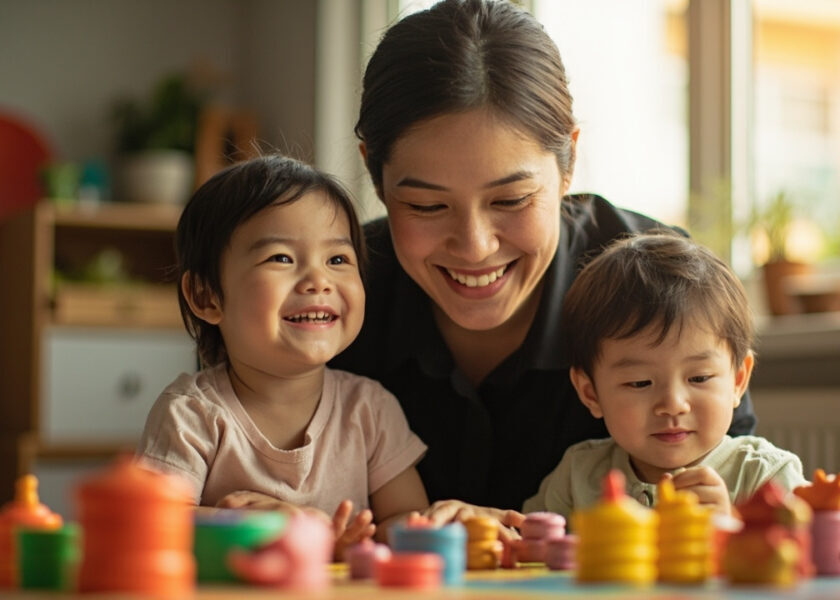
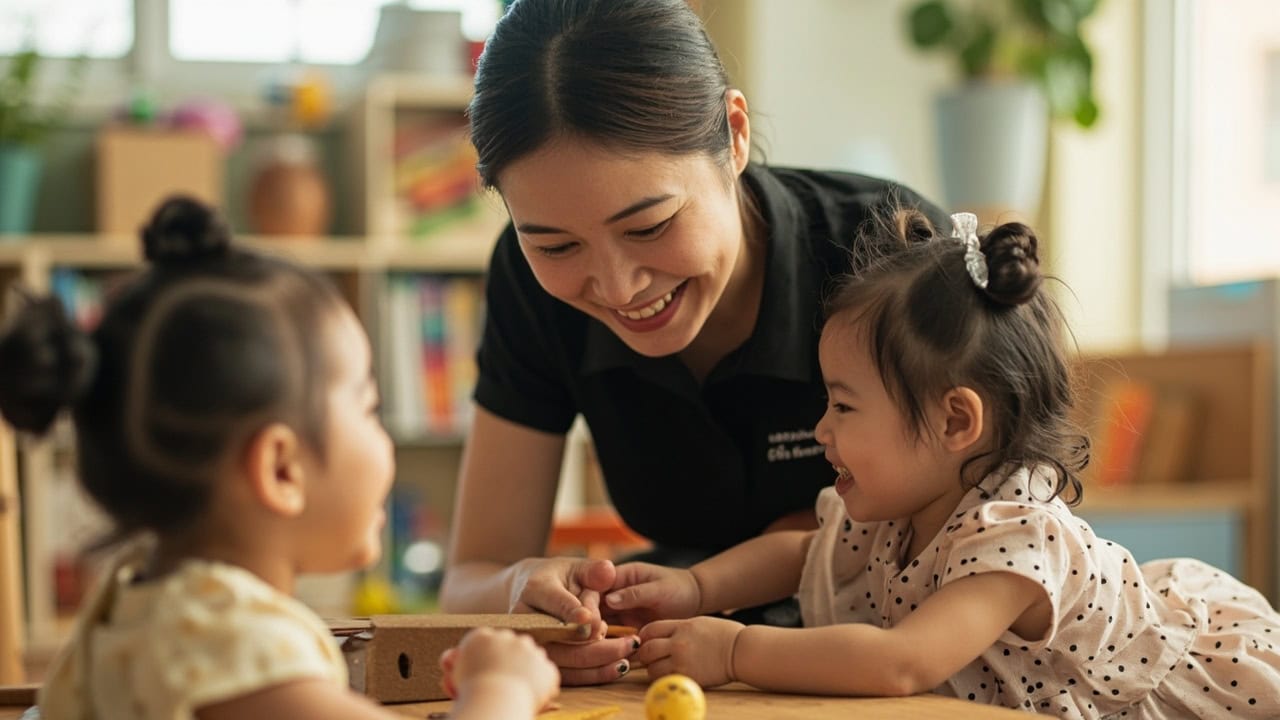
When siblings are in care together through EduNanny, that same caregiver holds the sibling relationship in her hands. She can support the older child’s role as a model, protect the younger child’s space for independent discovery, and notice the moments where sibling interaction is joyful and the moments where it needs gentle mediation.
The home-based environment offers something else that is difficult to quantify but profoundly important: domestic scale. Children in a home setting are not a cohort. They are a small group who share experiences in a way that builds the sibling bond — not just because they are related by blood, but because they are partners in experience.
Developmental Continuity in Practice
Developmental continuity across siblings means the caregiver understands that when a new infant arrives, the toddler may need more independent play opportunities, not less attention — because what the toddler needs is to feel secure in their own role, not replaced by a newer, smaller version. It means understanding that sibling dynamics are not a problem to solve but a relationship to nurture.
These are the insights that transform childcare from supervision into support. And they are only possible when the care environment is stable, knowledgeable, and focused on the whole family — not just one child at a time.
The Practical Dimensions for Singapore Families
For Singapore families, the practical dimensions of this model are significant:
- Monday to Friday care blocks are structured around the rhythms of working parents
- The cost structure within the pilot is designed to be accessible
- CDA and Baby Bonus can be used — financial planning should not be separate from care planning
- When a family has two children in the same EduNanny home, there is one invoice, one relationship, one communication channel
Addressing Real Parent Concerns
We should also speak honestly about concerns that Singapore parents often carry when considering childcare options for multiple children.
“How do I know what is happening when I’m not there?”
Transparency matters. EduNanny has implemented communication practices — regular updates, shared observations, documented developmental milestones — so that parents are not guessing, not worrying, not filling gaps with imagination.
Where visibility measures are in place, they are there because trust is built on openness. Parents should be able to trust their child’s care environment fully, and fully means knowing what is there when you are not looking.
“Is home-based care as structured as a centre?”
The home-based environment offers structure of a different kind — not the rigid scheduling of a large centre, but the responsive structure that comes from a caregiver who truly knows your children. Routines are established, developmental goals are tracked, and care is grounded in early childhood principles. The difference is in the depth, not the rigour.
“What about when one child is sick or has a different schedule?”
Small-group care adapts more easily than large centres. When a caregiver knows three children rather than thirty, they can flex routines without disruption. Siblings can stay together or have separate moments depending on the day. The care model bends to serve the family rather than the family bending to fit the model.
Choosing Childcare When You Have More Than One
If you are currently weighing childcare options for your family, here are some questions worth sitting with:
- Does this arrangement see my children as individuals or as part of a whole family? Quality care understands sibling dynamics and holds the relationship between your children as something worth nurturing.
- Will I have one relationship or several? Multiple children should not mean multiple disconnected care experiences. Ask yourself whether the arrangement creates coherence or complexity.
- Can the caregiver adapt as my children grow? The sibling dynamic shifts over time. A good care model grows with your family rather than requiring you to find new arrangements at each stage.
- What does the daily experience actually look like? Visit, observe, ask questions. Watch how the caregiver interacts with more than one child. Notice whether the environment feels home-like and warm rather than institutional.
- Is the communication built for busy parents? Updates, photographs, milestone tracking — these should feel like a gift to you, not an obligation for the caregiver.
What It Could Feel Like
There is a question that Singapore parents with multiple children rarely get to ask out loud, because the content does not exist to prompt it.
What would it feel like if childcare worked for my whole family?
Not just for my infant, not just for my toddler, but for the ecosystem of relationships and routines that make up our daily life.
What if the same person who cared for my first child when she was a baby now holds my son in her arms with the same tenderness? What if my children remember the same home, the same smells, the same songs, the same gentle voice that greeted them each morning? What if I could describe my childcare situation in one sentence and it would be clear, coherent, and complete — instead of a tangle of different arrangements that I am constantly translating and managing?
The years when your children are small are finite. The sibling bond that forms in those years will outlast your home, your school district, your mortgage, and your current job. It will be there at their weddings, at their crises, at their quiet Sunday dinners when they are forty and fifty and sixty.
The care environment you choose today is not just a solution to a logistical problem. It is a contribution to that bond. It is a statement about what you believe your children deserve: not just to be looked after, but to grow up knowing what it means to be in this together.
You are already managing complexity with skill and grace. You are not looking for someone to tell you that you are doing enough. You are looking for a partner who matches your standard — and that is what thoughtful, development-oriented childminding is designed to offer.
When your children are older, you will look back on these years. You will remember the morning rushes and the bedtime stories, the way your son used to follow his sister around the garden, the way your daughter learned patience from a younger brother who needed more help. You will remember the caregiver who was there for all of it, who knew your family’s rhythms, who sent you photographs of a Tuesday afternoon that you otherwise would have missed.
And what you will remember most is not a single moment of childcare, but a whole experience of family life — coherent, warm, and deeply supported.
Because you deserve a childcare model that matches the care and intention you already bring to your family every day.
If you are considering childcare options for your family in Singapore, learn more about how EduNanny supports families with multiple children — or connect with our team to explore what a coherent, development-focused childminding arrangement could look like for your family.