Inside Your Baby’s Brain: The First Thousand Days
The Architecture of a Brain Built for Love
The science of early childhood development has given us extraordinary answers to these questions — answers that should awaken us to the sheer significance of these first years. More than answers. They reframe what it means to choose care for your child: not as a logistical compromise, but as a defining decision about the architecture of a human being.
Inside the First Thousand Days
By age three, a child’s brain has formed approximately one thousand trillion neural connections — more than it will ever need. This surplus represents not inefficiency but possibility. This exuberance is called neuroplasticity, and it is the brain’s most remarkable feature in the early years.
The young brain is not passively growing. It is actively being shaped by every experience, every interaction, every moment of being held, spoken to, comforted, and challenged.
This building process is not neutral. Consider what each interaction actually teaches:
- Every warm response to a baby’s cry teaches the brain something about whether the world is reliable
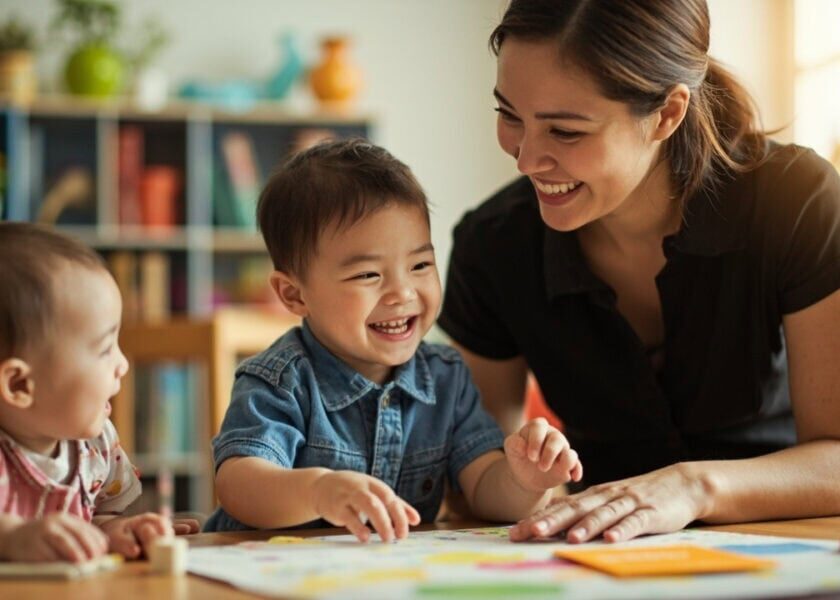
- Every time a caregiver narrates what is happening — look, the ball is rolling, hear the sound it makes — the brain learns that sounds carry meaning, that attention is a gift
- Every safe exploration, every small risk a toddler takes in a supportive environment, reinforces a neural pathway that says: I can do this. The world is interesting. I am capable.
Environments that keep children clean, fed, and safe but do not engage, respond, or extend also shape the brain — differently. The architecture that forms is less dense in certain connections, less practiced in certain responses. This is not a moral judgment. It is simply what the science tells us: the brain is building itself based on what it receives.
Why These Years Are Different
The period from conception to approximately age two and a half — the first thousand days — has become a central focus of developmental science worldwide. More brain development occurs in this window than in any comparable period of life. The circuits that will later support language, emotional regulation, social reasoning, and even academic learning are not waiting to be installed later. They are being installed now, in real time, by the quality of care your child receives.
So when you ask what your child is experiencing while you are away, you are asking something scientifically meaningful. You are asking about the environment in which your child’s brain is wiring itself. You are asking about the people who are, for significant hours each day, co-constructing your child’s capacity for connection, curiosity, and confidence.
The Secure Base: How Children Explore and Grow
There is a concept in developmental psychology called the secure base. It comes from the pioneering work of John Bowlby and Mary Ainsworth, and it describes something children instinctively need and use. A secure base is a caregiver who is reliable, responsive, and warm — someone the child can turn to when the world feels uncertain, and who, because of that reliability, becomes a launchpad for exploration.
Picture a toddler in a room full of interesting things. She looks back at her caregiver — a quick glance, not of fear but of confirmation. Are you there? Is this okay? The caregiver smiles. The toddler returns to playing, more boldly now, more freely.
This small exchange, repeated thousands of times across months and years, is the foundation of secure attachment. And secure attachment is not merely a nice-to-have. It is the emotional operating system through which a child will later approach relationships, learning, and challenge.
What Quality Care Actually Extends
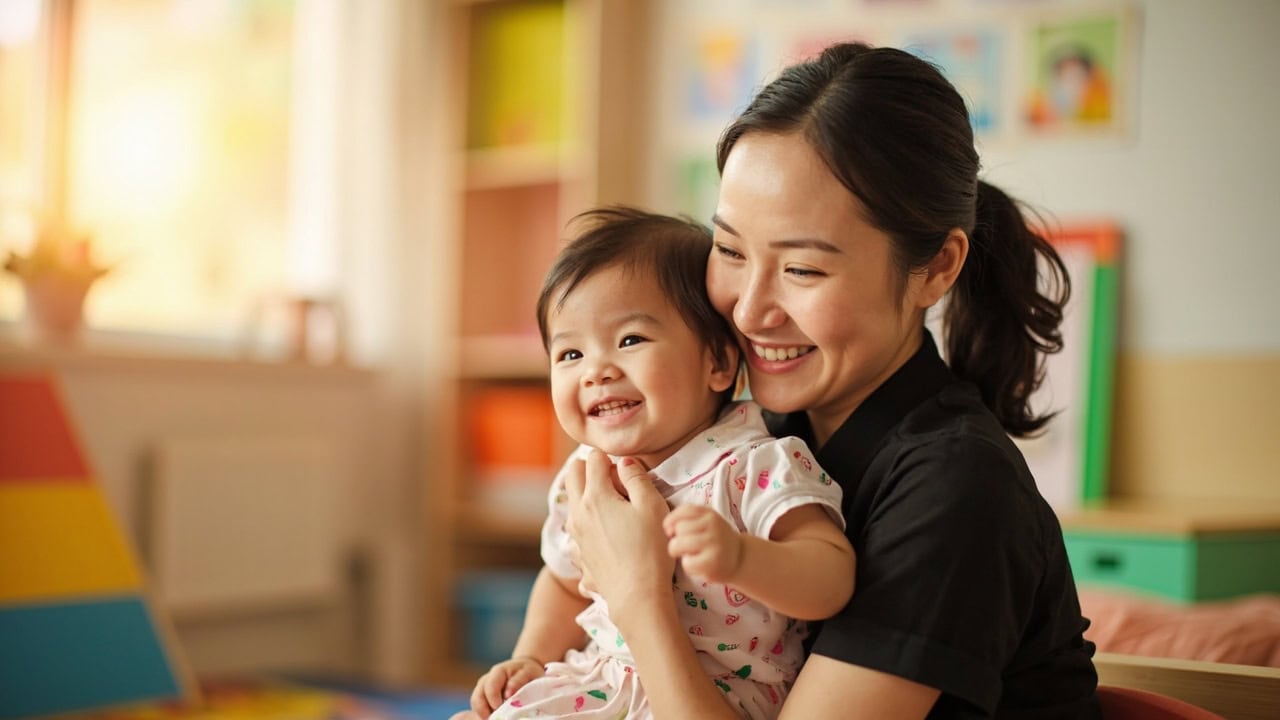
In quality care, the caregiver becomes a secure base for the child. This does not mean the caregiver replaces the parent. It means the caregiver extends the secure base that parents have begun to build, making it available during the hours when parents are working.
A child who has a secure base at home and a secure base in care has a doubled foundation. She learns that the world has reliable people in it, that adults can be trusted to notice her, respond to her, and support her.
You might notice this when you pick up your child and she does not collapse in distress, but instead smiles, gestures toward the caregiver to say goodbye, and walks with you confidently out the door. Or you might notice it when your previously tentative toddler begins, over weeks and months, to approach new things with increasing interest — reaching for toys she once avoided, climbing structures she once refused, babbling in complex strings that start to sound like real sentences.
These are not coincidences. These are the observable signs of a child who feels safe enough to grow.
What Your Child Is Learning: The Four Domains of Development
1. Language Development
Language development offers one of the clearest windows into what quality care produces. The first three years represent a critical period for language acquisition — a time when the brain is especially tuned to absorbing the sounds, rhythms, and structures of language.
Children who are exposed to rich, responsive language during this period do not merely learn more words. They learn to learn language. They develop the neural infrastructure for communication itself.
This is why the caregiver’s role is not incidental. When a caregiver narrates the day — now we are washing our hands, the water is warm, can you feel it? — she is providing language input that the child’s brain needs. When she mirrors the child’s sounds, expands on them, and responds with genuine engagement, she is shaping the child’s sense of self as a communicator.
Studies consistently show that children in language-rich care environments have larger vocabularies, more complex sentence structures, and stronger early literacy skills — not because they are being drilled, but because they are being talked with.
2. Social-Emotional Development
Social-emotional development is harder to measure but equally important. In the early years, children are learning to be in relationship with others:
- That other people have feelings
- That their own actions have effects
- That sharing and turn-taking are possible
- That they can feel frustrated and still be okay
This learning happens in the company of attentive, guided caregivers who help children name emotions, regulate impulses, and practice social skills in a safe context.
You might notice your child beginning to show concern when another child is upset, initiating play with increasing sophistication, or using words like sorry and please with genuine intention. These are signs of social-emotional growth — of a child who is learning to be human in the fullest sense.
3. Motor Development
From the first tentative reaches to the first steps to confident running and climbing, physical development is intertwined with cognitive and emotional development. Exploratory play — crawling under tables, climbing onto cushions, carrying objects from room to room — is not just physical exercise. It is the child’s way of learning about space, causality, risk, and their own competence.
In quality care, children have space and freedom to move, to explore, to test their growing bodies. They are supervised, but not restricted beyond what safety requires. Physical confidence is not separate from the rest of development. It is intertwined with it. A child who trusts his body tends to trust his mind as well.
4. Emotional Regulation
One of the most significant signs of healthy development is a child’s growing ability to regulate emotions — to recover from frustration, to accept limits, to show a widening range of emotions with decreasing intensity of distress.
This does not happen because children are taught to “calm down.” It happens because caring adults consistently help them name, experience, and move through big feelings in a supported environment. The neural pathways for emotional regulation are being laid down right now, in the quality of the responses your child receives throughout each day.
Signs Your Child Is Thriving, Not Just Being Managed
Here is the distinction that matters most: many care settings can keep children safe, clean, and comfortable without actually supporting development. Supervision is not the same as care. Presence is not the same as engagement. The difference is visible over time.
Observable Signs of Genuine Development
- Language growth: New words, new combinations, new understandings emerging over weeks
- Secure attachment: Your child separates without collapse, returns with joy, shows confidence in both your presence and the caregiver’s presence
- Emotional regulation: The ability to recover from frustration, accept limits, show a growing range of emotions with decreasing distress
- Social curiosity: Interest in other children, willingness to approach and engage, emerging empathy and cooperation
- Motor confidence: Physical ease, willingness to try new movements, growing coordination
- Stable wellbeing: Consistent, healthy sleep and appetite patterns — signs that the child is comfortable and regulated
Rather than comparing your child to others, track your own child’s trajectory over weeks and months. Is she picking up new words? Is she combining sounds in new ways? Does she seem to understand more than she did a month ago? Is she engaging with other children differently? Is she moving with greater confidence and curiosity?
If you do not see this growth over time, you have reason to ask questions — about caregiver-to-child ratios, about the level of engagement and interaction, about the philosophy of the care environment.
What Quality Childminding Looks Like in Practice
Research tells us good care looks like this:
- A caregiver who narrates the day in real time, connecting language to what the child is experiencing
- Interactions that respond to the child’s lead — following gaze, interest, or cue rather than interrupting
- A caregiver who mirrors, extends, and builds on the child’s sounds, expressions, and actions
- Environments where children are free to move, explore, and take small supported risks
- Responsive settling routines that help infants and toddlers feel secure when parents leave
- Consistent caregivers who build familiarity and trust over time, rather than rotating staff
- Small ratios that allow for genuine one-to-one engagement, not just group supervision
The difference between a care setting that merely supervises and one that actively supports development is not visible in a photograph. It is visible over time, in the observable growth of the children who spend their days there.
Choosing With Confidence: A Framework for Singapore Parents
You are not choosing a babysitter. You are not choosing a holding service. You are choosing an environment that will, for significant hours each day, participate in the construction of your child’s brain, personality, and capacity for the world.
Questions to Ask When Evaluating Care
- What is the caregiver-to-child ratio, and is it consistent across the day?
- What does a typical day look like in terms of language interaction, play, and exploration?
- How does the caregiver respond to a child’s distress, frustration, or need for comfort?
- What training or experience do caregivers have in early childhood development?
- How does the environment support motor exploration and physical freedom within safe limits?
- How will I know what my child is experiencing and learning during the day?
- Can I observe changes in my child’s language, attachment, and confidence over time?
What You Are Looking For
Look for language exposure — the caregiver talking with your child throughout the day, narrating, responding, extending. Look for secure base formation — your child using the caregiver as a reliable point from which to explore. Look for social-emotional scaffolding — support for emotional regulation, empathy, and relationship skills. Look for responsive interaction — a caregiver who notices, matches, and builds on what your child is doing and feeling.
Addressing the Concerns You Actually Carry
“Will my child feel abandoned?” Separation distress is a normal developmental response, not a sign something is wrong. What matters is how the child is settled, how the caregiver responds to that distress, and how the child recovers over time. A child in quality care will, within weeks, begin to use the caregiver as a secure base — showing brief protest at goodbye followed by engagement, and joyful reunion at pickup.
“How do I evaluate quality?” Through what you can observe — your child’s language growth, attachment behaviors, social curiosity, emotional regulation, and motor confidence over time. These are not perfect measures, but they are meaningful ones. Is my child growing in these areas? If yes, the care environment is likely supporting development. If no, ask questions.
“Is it really that important?” Yes. The first thousand days are not a marketing phrase. They are the window during which the brain builds more connections than it will at any other point in life. The neural architecture being formed now is the architecture your child will carry into school, into relationships, into their capacity to learn and adapt throughout their life.
“I feel guilty for needing to work. Should I?” No. What matters is not whether your child is in care — it is what that care provides. A child who receives quality developmental care, even for many hours, is building the same neural architecture as a child at home. What matters is not the number of hours but the quality of engagement within those hours. You are not failing your child by needing to work. You are making a choice that millions of parents make. What you deserve is a care environment that meets the moment.
EduNanny Singapore: Built on This Understanding
EduNanny Singapore was designed not as a response to parental anxiety alone, but as a response to what children actually need. It is part of the ECDA Childminding Pilot, operating within a framework that recognizes the importance of small ratios, trained caregivers, and developmental focus.
What the Model Provides
The infant-to-caregiver ratio of up to one to three ensures that each child receives the attention, responsiveness, and individual engagement that early development requires. This is not a luxury. It is a developmental necessity — the ratio that makes the secure base possible, the language exposure consistent, the individual attention real.
EduNanny offers both home-based and centre-based pathways, recognizing that families have different needs and that flexibility in how care is delivered does not mean flexibility in the quality of what is delivered. Both pathways share a commitment to the same developmental philosophy — one that sees the child not as a charge to be kept, but as a person to be nurtured, engaged, and supported.
Making Quality Care Accessible
For families navigating this decision, the practical considerations have been thoughtfully addressed. Care is available Monday through Friday, in structured blocks that support both family routine and child development. Fees within the pilot framework are structured to be affordable, and where applicable, CDA and Baby Bonus funding can be utilized — reducing the financial weight of quality care.
Transparency as Partnership
Transparency is built into the model. Where deployed, communication practices and CCTV measures provide parents with visibility into their child’s day — not as surveillance of caregivers, but as a bridge of information that supports parental peace of mind. You should know what your child is doing. You should be able to ask and receive genuine answers. This transparency reflects the conviction that parents are partners in their child’s development, not passive recipients of care.
The Caregiver as Developmental Partner
In the EduNanny model, the childminder is not merely a supervisor. She is a developmental partner — someone trained to observe, respond, engage, and extend. Someone who understands secure base dynamics and language-rich interaction. Someone who knows the difference between managing a child’s behavior and nurturing a child’s growth. The role carries dignity because the work is significant. These are the people who, alongside parents, are shaping the architecture of a human being.
The Choice You Are Actually Making
The choice you make is not between perfect parenting and inadequate care. It is between environments that will shape your child’s brain in different ways, and you now have the language to evaluate those environments for what they actually offer.
EduNanny was built to be that environment. Not because it claims to replace parents — it cannot and does not try. But because it takes seriously its role as a developmental partner during the hours when parents are working. It understands that these hours are not lost time but foundational time. That the brain being built in your child’s first years is the brain she will carry for a lifetime. That the patterns of trust, curiosity, and confidence being formed now will shape how she approaches learning, relationships, and challenge for years to come.
For parents navigating this decision — and many parents find it difficult, not because they lack information but because they care so deeply — this framework is intended to serve you. You are right to ask what your child is experiencing. You are right to want more than supervision. You are right to look for signs of genuine growth rather than mere contentment. Your instincts are sound.
Watch her. Notice her growth. Ask questions. Choose environments where the answers are good ones. And trust that the care you choose, chosen thoughtfully, is one of the most meaningful investments you can make in who she is becoming.
The thousand days begin now.
#EarlyChildhoodDevelopmentSingapore #InfantCareSingapore #ChildmindingSG #SecureAttachmentParenting #QualityChildcareSingapore