Inside the Door Where Every Hour Is Built for Your Child
Walking Through the Door: A Day at EduNanny Singapore
The transition from outside to inside is understood as the first curriculum of the day. Not something that happens while the real learning begins—but the learning itself beginning.
The Moment the Door Opens
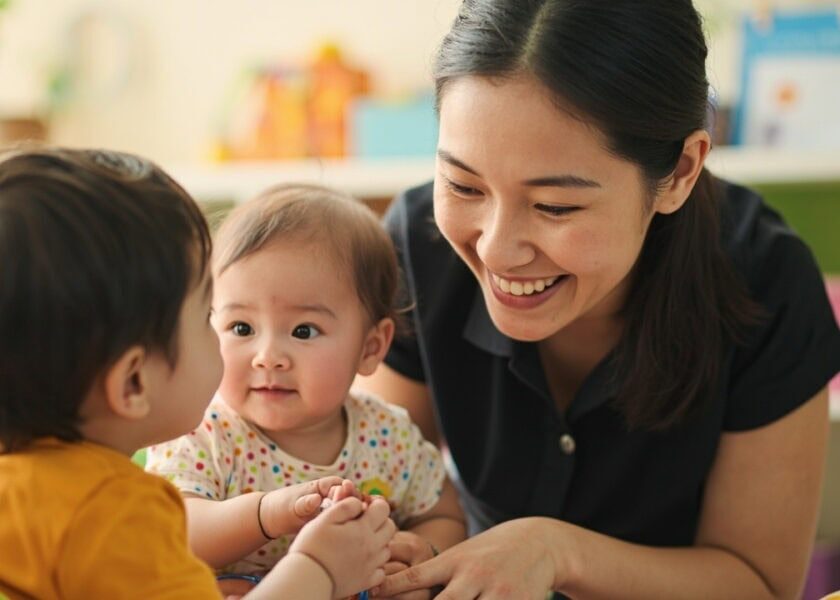
The greeting at the door is warm, unhurried, specific. Your child’s name is spoken. The caregiver kneels—not to look small, but to become your child’s size, to meet those developing eyes at their level.
There is a handoff that is not merely logistical but relational. A brief sharing of information about the morning, about sleep, about any small thing that mattered in the hours before arrival. This is communication made tangible. This is transparency before your child has even been fully received.
The Environment Speaks Before Anyone Does
Inside, the space communicates care before any interaction begins. The colors are soft, grounding—chosen not for aesthetics alone but for what developmental understanding tells us about how young children regulate in space. The materials are arranged with deliberate logic that a visitor might mistake for mere tidiness but that reflects weeks of observation and adjustment.
The placement of a low shelf here. The rotation of a learning provocation there. Everything within sight of a child this age is within intention of a teacher this age.
Parents cannot always articulate what they are sensing when they walk into a quality infant room, but they are sensing something. It is not cleanliness alone, though cleanliness matters. It is the ratio of materials to space. The absence of clutter that overwhelms. The presence of natural elements—a wooden toy, a plant at the child’s level, a texture to touch.
This space was designed for a child.
The Morning Rhythm: Where Routine Becomes Curriculum
The sequence of morning care—how a child is greeted, how their coat is removed, how they are helped into the learning space—is itself a curriculum. It teaches the child that the world has patterns. That transitions have structure. That they can anticipate what comes next.
This predictability is a form of safety.
A child who knows that greeting comes before settling, that feeding comes before play, builds the internal architecture of security that will serve them far beyond these walls.
Feeding: Where Parents Feel the Sharpest Pinch
Who is holding my baby? How? In what position? With what attention?
At EduNanny, the infant-to-caregiver ratio—up to one to three—is not a regulatory line to be met but a design principle to be honored. When a caregiver holds your infant for a bottle, they are not multitasking. They are holding your child the way you would: skin to skin when the room allows, eye contact maintained, pace responsive.
The bottle becomes a conversation. This is not a luxury. This is nutrition as attachment.
Rest: Engineered for Development
Parents often worry that their child will not sleep well in childcare, that the crib will feel foreign, that the nap will be truncated.
What they may not realize is that sleep in a quality infant room is engineered with the same intentionality as play. The room darkens. White noise hums at a frequency that research has shown to calm developing nervous systems. The caregivers have watched your child’s tired cues in the morning—those small tells that you may only know if you have spent weeks learning your child’s rhythms—and they have prepared for this.
The nap is not a pause in the curriculum. It is a continuation of it.
Play: Learning in Its Most Essential Form
When children wake, the afternoon begins. This is where the architecture of the day reveals its deepest intentionality: the play.
Parents sometimes use the word “play” as though it were a placeholder—a way of saying that children are simply kept occupied. But the play inside a quality infant room is the thing itself. Not preparation for learning. Not a break from learning. Learning in its most essential form for a child under three.
Responsive Caregiving in Practice
When a caregiver sits beside your twelve-month-old and narrates what is happening as blocks are stacked and knocked down—when they introduce a new word at the precise moment of a child’s attention, when they wait those three extra seconds after a question to allow a still-forming brain to formulate a response—they are not improvising. They are enacting a curriculum so thoroughly understood that it has become instinct.
This is what the field calls responsive caregiving, and it is the engine of development in the first thousand days.
Every interaction is an opportunity. Every gaze that is returned. Every sound that is echoed. Every small frustration that is acknowledged and helped. This is the material from which a child’s sense of self, their language, their capacity for relationship, is being built.
The caregivers at EduNanny are not babysitters who have been handed a schedule. They are early childhood professionals who understand that the hour between eleven and twelve is not downtime but prime developmental time. The difference between a child who is merely supervised and a child who is genuinely engaged in that hour is the difference between a day that passes and a day that compounds.
Transitions as Narrative
When a group moves from the indoor learning space to the outdoor area, the transition is not a line of children shuffling from one room to another. It is a narrative. The caregiver gathers the small group, speaks about what they will see and do outside, models the walking behavior, and brings the children into the new space with curiosity and structure.
This is how children learn to move through the world: not as objects to be managed, but as participants in a story that has sequence and meaning.
Communication: The Bridge Between Centre and Home
Parents receive not just photographs but narratives—real accounts of what their child did, how they engaged, what they seemed to notice, what seemed to challenge them. This is not obligation fulfilled. This is partnership in practice.
The understanding that you, the parent, are the primary educator of your child, and that the caregiver’s role is to extend and illuminate that work, not to replace it.
Where deployed, open monitoring measures offer transparency—not surveillance, but trust instruments. The visible architecture of a program that has nothing to hide because it has built its practice on openness.
The Research Behind Quality Infant Care
Not in a mystical sense. Not in a way that minimizes the irreplaceable role of family. But in the concrete sense that child development research has established:
- Secure attachment is strengthened by consistent, responsive care
- Language develops faster in environments rich with conversation
- Motor skills emerge through intentional physical play
- Social-emotional regulation is built through the thousand small moments of being understood and helped by a caregiver who knows your child’s rhythms
The hours apart do not diminish your child’s development. When the hours are well-designed, they multiply it.
This is the philosophy that sits beneath everything EduNanny does. It is not a marketing claim. It is an educational position, developed through years of practice, shaped by the ECDA Childminding Pilot, informed by the understanding that Singapore families need care that is not just available but excellent.
The pilot frameworks exist because the government recognizes what families have always known: that the early years are not a waiting room before life begins. They are life, already, and they deserve to be lived with intention.
Addressing What Parents Really Worry About
“Will my child feel abandoned?”
When children are received into an environment of warm, consistent, responsive caregiving—when they are met by the same familiar faces each morning, held with attention during feeding, comforted when distressed—the neurological pathways for trust are being built, not broken. Secure attachment is not threatened by quality alternative care. It is supported by it.
“Will my child just be watched, not engaged?”
The difference between supervision and engagement is the difference between a day that passes and a day that compounds. At EduNanny, the caregiver-to-infant ratios and the training behind each interaction are designed to ensure that every hour is a developmental hour, not just waiting time.
“How do I know what’s happening all day?”
Transparency is built into the program design. Parents receive regular narrative updates—not just images, but accounts of what their child engaged with, how they responded, what seemed to capture their attention.
“Is this financially accessible?”
Fees are structured within the pilot to be affordable. The Child Development Account and Baby Bonus usability mean that financial considerations need not stand between your family and quality care. This is a design decision: to make premium infant care accessible to the families who need it most, across Singapore.
The Caregivers: Not Staff, But the Vision
The caregivers who do this work—the women and men who greet your child each morning, who hold them through the afternoon, who speak to them in the language that will become their own—are not incidental to this vision. They are the vision.
The best infant care is not a system. It is a relationship, mediated by a system that supports, trains, and respects the people who carry it out.
When EduNanny speaks about caregiver quality, it means this: they choose people who understand that the work of holding an infant’s bottle is the work of holding an infant’s future, and they train them and support them so that they can do that work with skill, with warmth, and with the dignity it deserves.
What to Look For: A Practical Guide for Choosing Infant Care
If you are evaluating childcare options, here are the questions that matter most:
- Observe the arrival transition. Is there a deliberate, warm handoff? Does the caregiver kneel to meet your child at their level? Is information shared, or just children exchanged?
- Notice the environment. Is it designed for children—accessible shelves, natural materials, intentional arrangement—or does it feel like a space adapted for adults?
- Ask about ratios. What is the caregiver-to-infant ratio? Is this a regulatory minimum or a genuine design principle?
- Inquire about feeding and rest. How are bottles given? Is it responsive and attentive, or task-based and hurried? How is sleep supported—environmentally, relationally?
- Ask about communication. What will you receive each day? Photographs alone, or narratives that help you understand your child’s experience?
- Watch a reunion. If possible, observe how children look when they see their parents. Regulated? Engaged? Open? This is the evidence of what the day built.
The Fog Lifts. The Picture Becomes Clear.
And then you arrive. There you are, in the doorway, and there is your child.
How do they look?
This is the moment that answers everything.
A child who has spent the day in an environment that was merely custodial will often look flat, overstimulated, or strangely detached. A child who has been kept safe but not engaged.
But a child who has spent the day in an environment of intentional care will often show you something different. They will be tired—the good tiredness of a body and brain that have worked. They will often be settled, regulated, easy in their skin. They may babble with new sounds. Reach for new toys. Show you something they want to tell you about.
They may be hungry in a satisfied way—the hunger of a child who has exerted themselves.
And they will look at you, their parent, with the clear, open gaze of a child who knows that you are their home and that this place was not a substitute but a supplement. A daily community that has held them with skill and warmth until they could be back in your arms.
This is what the day built.
A door opens, and inside there is an architecture of care designed with the same seriousness you bring to choosing it. There is a rhythm that is not rigid but responsive. There are hands that hold with attention. There is a curriculum that does not announce itself but that is present in every gaze returned, every new word introduced, every moment of comfort offered as a child stumbles and needs someone near.
There is transparency, because quality does not need to hide.
And at the end of the day, there is your child, looking at you with the quiet evidence of a day well spent.
The fog lifts. The picture becomes clear. And you can rest in the knowledge that the hours apart were not hours lost. They were hours built—brick by brick, interaction by interaction, day by day—into the child who is now running toward you in the pickup area, arms open, face bright, ready to tell you in whatever way they know how that they are okay.
They are more than okay. They are becoming.
Experience the Difference at EduNanny
If you are exploring infant care or childminding options in Singapore, we invite you to see this approach for yourself. Speak with our team, observe a morning transition, and discover what quality care looks like when every hour is designed for your child’s development.
Because you deserve to see clearly. And your child deserves to be seen.
Learn more about the EduNanny ECDA Childminding Pilot · About EduNanny Singapore · Return to Home