How Your Childcare Choice Shapes Your Children’s Sibling Bond
The Sibling Bond: Why This Relationship Matters More Than You Know
A child will have a parent for, at most, twenty years of daily closeness. A child will have teachers, friends, coaches, mentors—all of them essential, all of them temporary in different ways. But the sibling relationship? That begins before memory and, for most people, lasts longer than any other relationship they will ever have.
Your children will be siblings when they are thirty and seventy. They will be siblings at your funeral and at moments in their lives you will never see. They will call each other in the middle of the night when something goes wrong. They will remember your parents in ways that you, as a parent, never will—because they remember the same stories from a different height.
This is not sentiment. This is developmental reality. And it means that the sibling bond deserves more than a passing mention in a childcare brochure. It deserves intentionality.
Here is what research—and what every parent already knows in their bones—tells us about what siblings give each other:
- Siblings are each other’s first teachers in emotional regulation. Before a child learns to manage frustration with a classmate, she is learning it with her brother. Before a child learns to negotiate with a friend, he is negotiating with his sister over who gets the blue cup.
- The sibling relationship is a rehearsal space for the rest of a child’s social life. For kindness. For conflict. For repair. For the extraordinary vulnerability of loving someone you didn’t choose.
- Siblings give each other something no adult can replicate: a peer in the same world. Someone who grew up in the same kitchen, heard the same family stories, carries the same cultural weight—and sees it all from a different angle.
The Quiet Curriculum: What Siblings Actually Learn From Each Other
Think about what happens when your children are together. Not just playing nicely—though that happens too—but in all the moments in between.
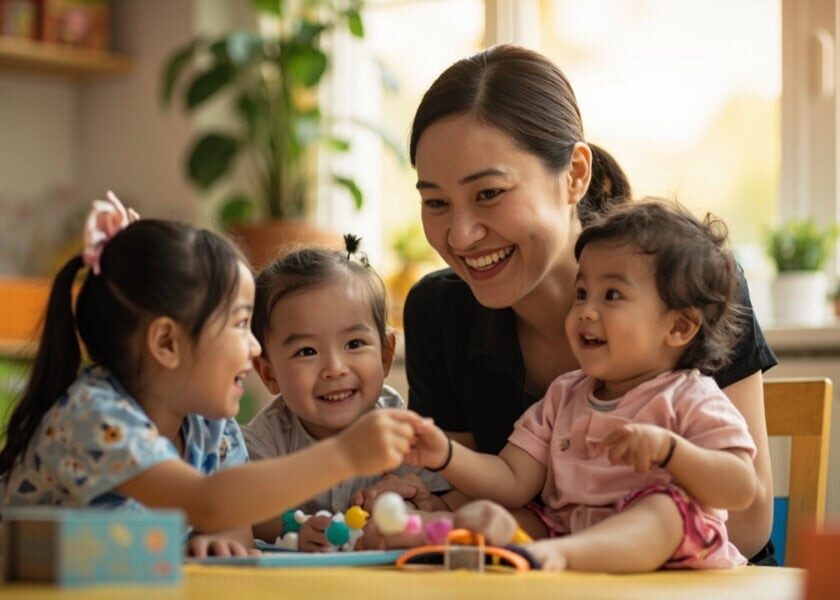
The older sister adjusts her baby brother’s blanket in the stroller without being asked. The two-year-old insists on carrying his baby sister’s shoe to the car. The four-year-old tells the childcare teacher, with absolute solemnity, that his sister does not like the colour green and can she please have the yellow one.
These moments are not incidental. They are the building blocks of the sibling bond. They are learning.
Consider what your children are actually learning in these unscripted moments:
- Emotional vocabulary. When siblings argue and then repair, they are learning the language of relationships: “I’m upset,” “I didn’t mean it,” “Are you okay?”
- Social navigation. Who leads and who follows. When to assert and when to yield. How to read someone else’s mood from their face, their body, their voice.
- Empathy in action. Not abstract empathy—real empathy. “I know this makes you cry because you hate loud noises, and I remember what that felt like when I was small.”
- The reality of imperfection in love. Siblings fight. They hurt each other. And then they come back together. This teaches children something profoundly important: love does not require perfection. It requires repair.
This is what researchers call “sibling teaching”—the informal, unprogrammed learning that happens between children who share a home and a history. It is happening constantly. And it is happening whether or not anyone is paying attention.
The question is not whether this learning is happening. It is whether your childcare arrangement is in a position to notice it—and support it.
Shared or Separate: What Your Childcare Arrangement Means for Siblings
Not every family has siblings in the same childcare arrangement—and that is not a lesser choice. It is a different one, and it deserves the same thoughtfulness.
When Siblings Share a Childcare Setting
When siblings are in a shared childcare environment—whether that’s a home-based setting with a dedicated caregiver or a centre where they move through the day together—they bring their rehearsal space with them.
The older child who is learning to share at home brings that learning into the childcare setting. The younger child who is learning to assert herself in the family room is also asserting herself on a wider stage. They are practicing being siblings in a world that is slightly bigger than your living room.
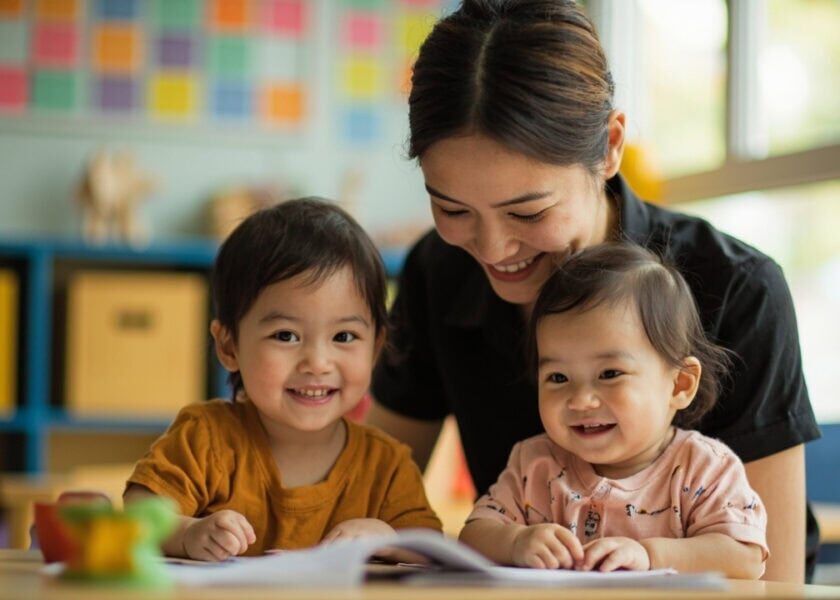
In a small, home-based childminding environment with a low child-to-caregiver ratio, a skilled caregiver can truly know both children. She knows which days your toddler needs more physical comfort and which days he needs more space. She knows the sound that means your infant is about to cry before the cry comes. She sees the sibling dynamic—not as an interruption, but as information. As curriculum.
When Siblings Are in Separate Arrangements
When siblings are in separate childcare arrangements, the sibling bond is still being built—it is simply built in different ways.
It is built in the mornings and the evenings. In the bath and at the dinner table. In the way you talk about one child’s day when the other is listening. In the way they reunite and the way they separate again.
What siblings in separate arrangements need is intentional connection: rituals of reunion, language that holds both of them equally, and the conscious effort to create sibling time that is not just parallel parenting but genuine shared experience.
A Word About Sibling Conflict
Siblings fight. They hit, they snatch, they shriek at each other over things that make no sense to adult ears. And if you have ever picked up your child from childcare and heard that there was a disagreement between them, you know the particular guilt that rises in your chest.
Here is what I want you to hear: sibling conflict is not a sign that your childcare arrangement is wrong. It is a sign that your children are doing exactly what they are supposed to do—learning how to navigate the most complex relationship they will ever have.
The conflict is not the problem. The absence of support for working through conflict—that is what matters.
A good childcare arrangement does not eliminate sibling friction. What it does is surround that friction with adults who model how to repair, how to name feelings, how to move from frustration back to connection.
Think about what a child learns from a skilled caregiver in those moments of sibling tension. She learns that anger is not the end of a relationship. She learns that someone can be upset with her and still care about her. She learns the vocabulary of repair: I’m sorry, I didn’t mean to, are you okay?
What Quality Childminding Looks Like
So what should you be looking for when you are evaluating childcare arrangements for siblings? Here are the markers of a childcare environment that takes sibling relationships seriously:
- Adults who notice sibling dynamics as learning, not disruption. They see the quiet one watching, and they know that watching is learning. They see the older one always leading, and they gently make room for the other to lead too.
- A willingness to let siblings work through their own conflicts. Not abandonment—presence. Adults who stay close enough to intervene if needed, but give children the chance to practice repair before stepping in.
- Attention to both the individual child and the sibling pair. Reports that mention how each child is doing AND how they are relating to each other.
- A low child-to-caregiver ratio. This is not a luxury—it is a necessity for noticing the small moments that make up the sibling bond.
- Physical environments that allow siblings to be together when they choose. Spaces where they can play side by side, watch each other, and also separate when they need to.
The sibling relationship is part of the curriculum. Not a distraction from it.
How EduNanny Singapore Nurtures the Sibling Bond
When you choose EduNanny, you are choosing a childcare partner that understands this reality: every childcare decision you make is also a sibling decision. Every arrangement you choose is quietly shaping the bond your children will carry into adulthood.
EduNanny operates within Singapore’s ECDA Childminding Pilot, and that matters for several reasons. It means EduNanny caregivers are part of a recognised system with standards, oversight, and accountability—reflecting Singapore’s commitment to quality childcare that is accessible to families across the island.
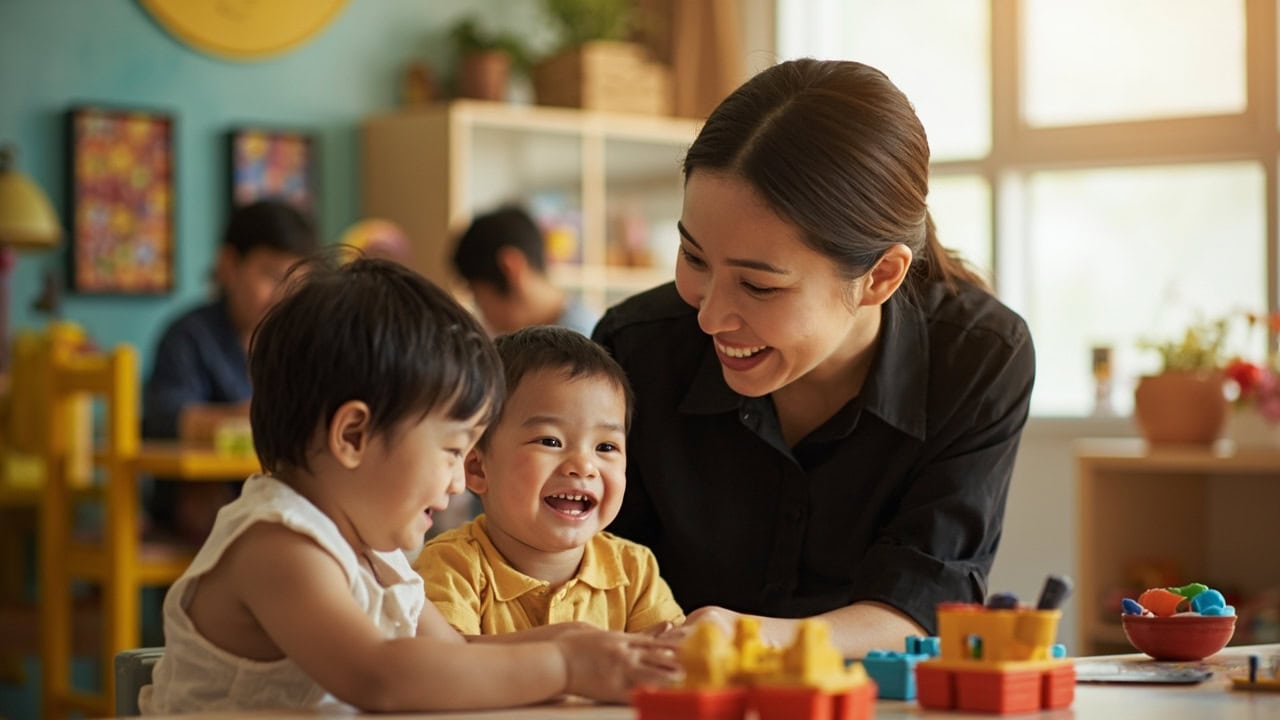
The childminding model is built around small ratios—up to one to three infants—in the earliest years, because the quality of attention a child receives is inseparable from the quality of learning that happens. In a small, home-based or community-based setting, a caregiver can truly know your child. She sees the sibling dynamic—not as an interruption, but as information. As curriculum.
For families navigating the real logistics of Singapore parenting, EduNanny offers care blocks across Monday to Friday, with affordability supported through pilot fee structures and the ability to use the Child Development Account and Baby Bonus schemes.
Where transparency measures such as CCTV are in place, they exist not because trust is absent, but because real trust sometimes benefits from clear structures—and families deserve that clarity.
What You Can Do to Support Your Children’s Sibling Bond
Beyond choosing the right childcare arrangement, there are things you can do to actively nurture your children’s sibling bond:
- Name what you see. When you notice your older child comforting the younger, when you see tenderness between them, name it: “I saw the way you looked after her just then. That was kind.” This teaches children that the sibling relationship matters—and that you are paying attention.
- Create rituals of connection. Bedtime routines that include both children. Sunday mornings where they have unstructured time together. These rituals become the architecture of the sibling bond.
- Hold both children’s experiences equally. When one child is struggling, it is easy to focus entirely on them. But remember to turn to the other child and ask: “And how are you doing with all of this?”
- Trust the relationship. Siblings fight, and siblings forgive. Trust that the bond has resilience. Your job is not to prevent conflict but to be a steady presence as they learn to navigate it.
- Let them see you repair. When you make a mistake—when you snap, when you lose patience—let them see you come back. Model repair. This is one of the most powerful gifts you can give your children’s sibling relationship: the understanding that love includes repair.
You Are Not Getting This Wrong
Before I close, I want to say one more thing directly to you.
You are not a perfect parent. No one is. But you are a parent who cares—fiercely, sometimes painfully—about getting this right. And the fact that you care is already doing more than you know.
Because the sibling bond does not require perfection. It requires presence. It requires a family that keeps showing up, keeps trying, keeps holding both children in view.
When you make a childcare decision for your family, you are not just choosing a place for your child to be fed and kept safe. You are choosing an environment that will witness the most important relationship your children will ever have outside of the one they have with you.
You are choosing whether that relationship has skilled, caring adults around it to guide it. Whether it has space for conflict and space for repair. Whether the younger one is seen when she is watching, and whether the older one is supported when she is leading.
These are not small things.
And you are not getting them wrong.
The sibling bond your children are building right now—in the everyday, ordinary moments that you are mostly too tired to notice—is one of the most extraordinary things that will ever happen in your family. It deserves to be seen. It deserves to be supported.
And that is why what you are deciding matters so much.
If you are exploring infant care or childminding options in Singapore, we would be glad to hear from you. Learn more about who we are and what we believe about the work of caring for children.