How Singapore Working Parents Can Read the Signs of Quality Childcare
Understanding the Weight of the Morning Goodbye
There is a moment, familiar to every working parent in Singapore, that arrives each morning. The hand you hold as you walk through the door. The small fingers that uncurl from yours as you kneel down to say goodbye. The way your child looks back at you from the arms of someone else, and the thousand questions that flicker behind your smile as you turn to leave.
Where will they be at ten o’clock? What will they be doing? Who will notice if they need something? Will they feel safe? Will they feel seen?
These are not anxious thoughts. They are the thoughts of a parent who loves deliberately, who takes the responsibility of raising a child seriously. And yet they are thoughts that can shadow an entire workday, distracting you in meetings, surfacing during your commute, shaping the texture of ordinary hours with invisible weight.
In Singapore, modern parenthood is an act of orchestration. The rhythms of work and family interlock in ways that are often beautiful and sometimes bewildering. We are privileged to live in a society that offers excellent childcare infrastructure—centers and homes and programs designed to support families.
But infrastructure alone does not ease the ache of the hours apart. The child who wakes at six is changed and fed and dressed by hands that are not yours. The child who falls asleep at noon rests in a room you have never seen. The child who laughs at three o’clock laughs in a place you cannot reach.
This is not a failure of modern parenting. This is modern parenting.
The question is not whether you will be present for every moment—you cannot be, and pretending otherwise sets both you and your child up for unnecessary struggle. The question is whether you can develop the confidence to trust what you can observe, to understand what you can learn to see, and to build a partnership with the people who care for your child during the hours you are apart.
The Framework That Transforms Uncertainty
Quality childcare is not a mystery revealed only in formal reports or dramatic moments. It is expressed continuously, in hundreds of small interactions, transitions, and responses that happen throughout the day. And the good news is that you can learn to read these signs.
Consider what a single childcare day actually contains. There is the greeting in the morning, when your child arrives in a space that is still waking up. There is the transition to breakfast or morning activity, when a caregiver helps your child move from the world of home to the world of the group. There is free play, structured activity, outdoor time, meals, naps, and the intricate social negotiations of children learning to be together.
There are moments of frustration and moments of delight, moments of boredom and moments of breakthrough, moments when your child is the focus of attention and moments when they must learn to wait, to share, to be part of something larger than themselves.
Every one of these moments carries information. Not in the sense of a test to be graded, but in the sense of a conversation happening all day long—a conversation between your child and their environment, between your child and their caregivers, between your child and the other children.
As a parent, you have been having this conversation since your child was born. You know the sound of their cry when they are tired versus when they are hungry. You know the way their body relaxes when they feel safe. You know the look in their eyes when they are proud of something they have done.
This instinct is not lost when you leave your child in someone else’s care. It is simply looking for a new place to land.
When parents are given a language for what they are already noticing, they become remarkably accurate readers of their child’s experience. They move from wondering to knowing, from anxiety to assurance, from passive reception of reports to active participation in understanding. This is what we mean by reading the signs.
Three Observable Signs of Quality Care
Transitions: Where Care Becomes Visible
Transitions are the moments when a child moves from one activity or state to another—from sleeping to waking, from play to meals, from one caregiver to another. These moments are often where the quality of care becomes most visible, because they require a child to manage change, and they require caregivers to support that management with patience and presence.
Watch how your child handles transitions. Do they seem braced for each change, tense and uncertain? Or do they move through transitions with a kind of buoyancy, guided by a caregiver who gives them warning, who narrates what is happening, who helps them prepare?
A child who has learned to trust their environment will often show this trust in the ease with which they move through their day. A child who is not yet secure may show hesitation, protest, or withdrawal. Both are information. Both tell you something important.
Engagement: Genuine Presence, Not Just Supervision
This does not mean constant activity or stimulation. In fact, some of the most valuable engagement happens in stillness—in the moments when a caregiver sits with a child and simply pays attention.
Watch whether your child seems genuinely engaged with what they are doing, or whether they seem to be filling time. Watch whether the caregiver’s attention is present or distracted. Watch whether your child seeks out interaction with the caregiver or retreats into isolation.
Engagement also includes peer interaction. For infants and young toddlers, peer relationships are still forming. You might see parallel play, where children are near each other but not yet truly interacting. You might see moments of genuine social delight—children laughing together, reaching for each other, sharing a toy.
What matters is not whether conflicts happen, but how they are handled. Watch whether caregivers intervene with calm, respectful guidance, or whether they ignore tension until it escalates.
Caregiver Responsiveness: The Critical Indicator
Responsiveness means that a caregiver notices when a child signals something—a need, a question, a discomfort—and responds in a timely, appropriate way. It means that the caregiver is tuned in, not just going through routines but actively reading the individual child in front of them.
You can often gauge responsiveness through your child’s behavior at home. Does your child seem to trust adults generally, or do they show signs of uncertainty? Do they seem to understand that their signals matter, that communication leads to response?
A child who has experienced consistent responsiveness will often show greater ease in separating from parents, because they have learned that their needs will be heard and met by the adults around them.
Reading Your Child at the End of the Day
Reading the signs does not mean scrutinizing every moment for evidence of failure. It means developing a posture of informed attention—a way of being present to what you observe without immediately catastrophizing or dismissing.
When you pick up your child at the end of the day, you are receiving a message. Not in words, necessarily, but in the whole body of their being.
The child who runs to you with energy and joy is telling you something. The child who clings quietly and does not want to be put down is telling you something else. Neither message is a complete report card. Both are pieces of information that, gathered over time, create a picture.
What Quality Looks Like Throughout the Day
Quality is not a single dramatic event but an accumulated pattern of small moments. When you observe your child’s care environment, here is what you are looking for:
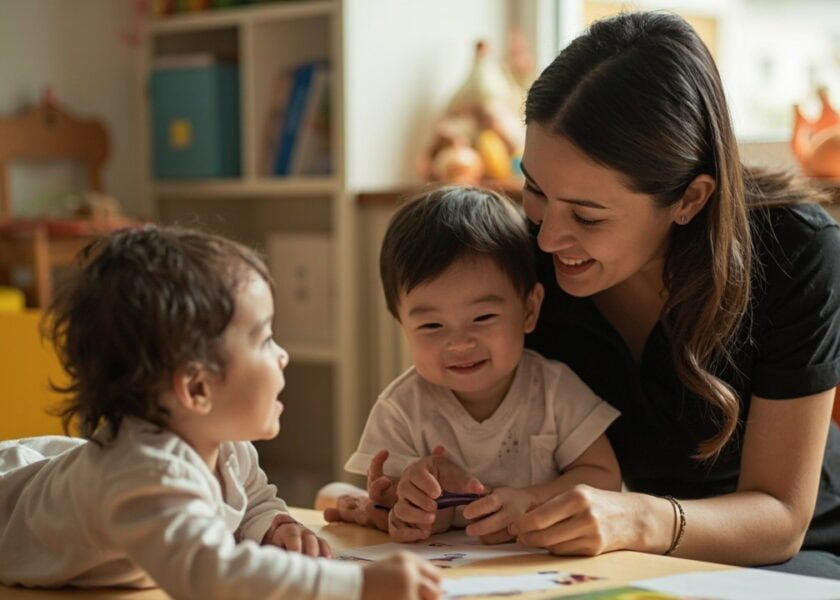
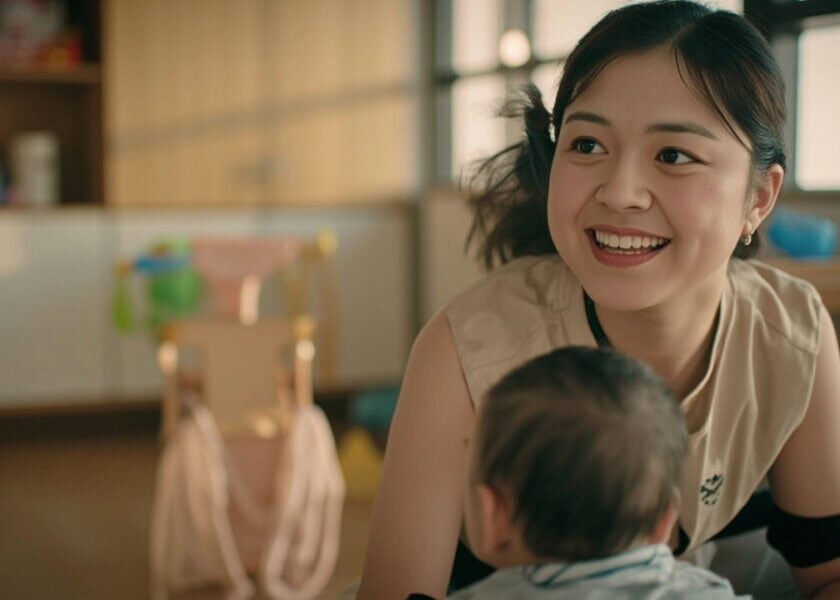
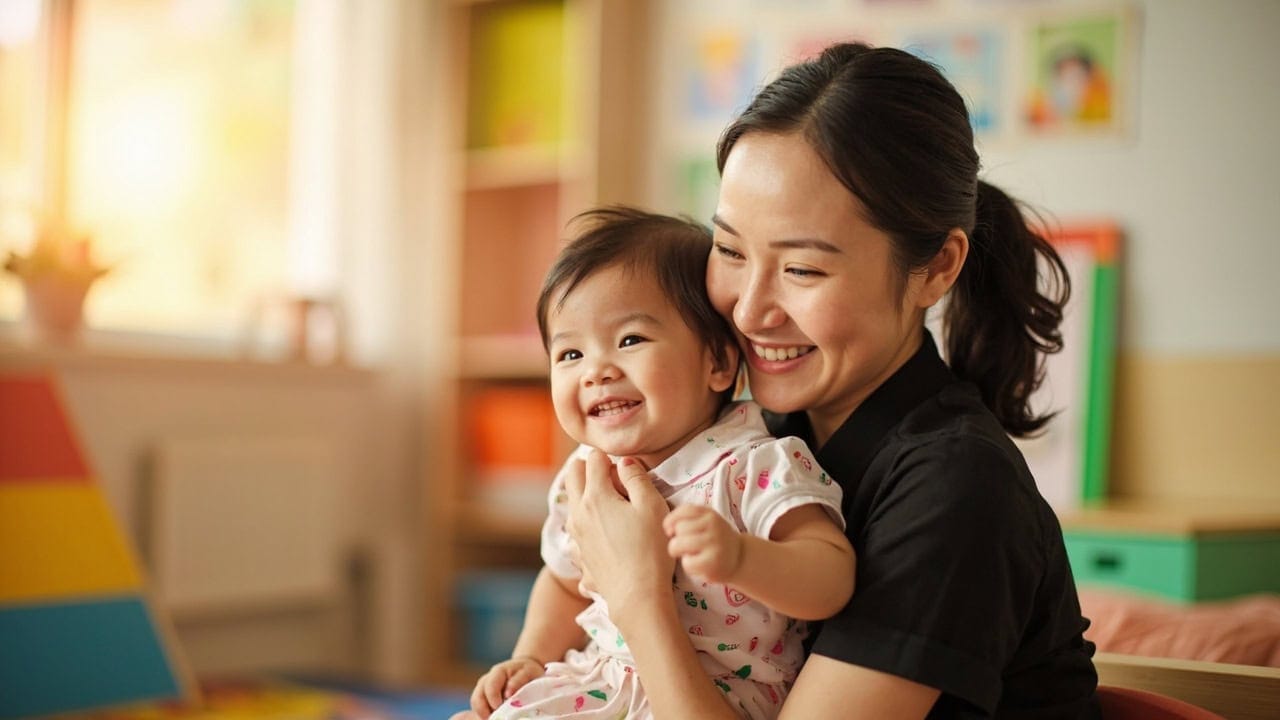
- In the greeting: A caregiver who uses your child’s name, crouches to their level, makes eye contact, and acknowledges their arrival with genuine warmth
- In transitions: A caregiver who narrates what is happening next, gives your child warning before changes, and guides them through shifts with patience rather than haste
- In conflict: Calm guidance that teaches without shaming, helping children express needs in ways others can understand
- In nap time: A prepared environment, consistent routines, and presence that helps your child settle
- In meals: Shared time where eating is not rushed, where children are allowed to explore food at their own pace
- In independent play: Supported autonomy where children are given space to discover while knowing help is available
These are the signs. And now, with a framework for what to look for, you can begin to see them.
Addressing What Parents Actually Wonder
“How do I know what’s really happening during the day?”
You cannot be inside childcare all day—and that is okay. What you can do is learn to read the observable signs of quality that manifest throughout every moment: how transitions are handled, how engagement looks, how caregivers respond to your child’s signals. These signs are present all day long, not just in formal reports.
“What if something goes wrong and I don’t notice?”
Partnership means open communication. When you choose a service built on transparency, questions are welcomed rather than resented. The goal is not to scrutinize every moment but to build a relationship where concerns can be raised and addressed together.
“Will my child adjust okay?”
Separation is hard for both parent and child, and that difficulty is a sign of attachment—not a sign of failure. A child who has experienced consistent responsiveness will often show greater ease in separating from parents, because they have learned that their needs will be heard and met by the adults around them.
“Is this really worth the cost?”
We understand the practical realities of Singapore parenthood—the cost of living, the demands of work, the logistics of getting everyone where they need to be. We have designed our services with these realities in mind. CDA and Baby Bonus usability means the tools the government has provided for your child can actually be used for your child. We are not the cheapest option, and we do not pretend to be. We are the option that takes this work seriously.
The EduNanny Approach
EduNanny’s approach is built on the understanding that parents and caregivers are partners in the same work—the work of raising a child. Partnership requires communication, transparency, and mutual respect.
We have built our service with features that support this partnership: open communication channels that allow you to check in throughout the day, transparent reporting that goes beyond the perfunctory, and where deployed, measures that provide additional reassurance to families who value them.
When you choose EduNanny, you are choosing a service that operates within the ECDA Childminding Pilot, a framework designed to ensure quality and accountability in childminding across Singapore. We offer both home-based and community-based pathways, because families are different and one size does not fit all.
Our infant ratios are kept intentionally small—up to one to three—so that every child receives the individual attention they deserve. Our fees are structured to be accessible within the pilot framework, and we work with CDA and Baby Bonus arrangements to ease the financial planning that comes with quality care.
The Caregivers Who Make It Possible
The word “caregiver” can sometimes reduce a person to a function, and that reduction does a great disservice to the women and men who have chosen this work. Childminding is not a job for people who could not find anything better to do. It is a vocation for people who understand that the early years are not incidental to human development but foundational to it.
Every interaction a young child has shapes the architecture of their brain. Every response they receive teaches them something about the world. The caregiver who holds your infant during their afternoon nap is not just watching them sleep. They are participating in the creation of a human being.
At EduNanny, we honor this calling. Our caregivers are not randomly assigned. They are carefully selected, thoughtfully trained, and genuinely supported. We believe that a caregiver who feels respected and valued will offer better care than one who feels used and invisible.
When you observe your child’s caregiver, notice whether they seem present, whether they seem to know your child as an individual, whether they speak to your child with warmth and respect. Notice whether they seem rushed or overwhelmed, or whether they seem to have the time and resources to do their work well.
Practical Steps for Choosing Infant Care in Singapore
Whether you are beginning to explore childcare options or reassessing your current arrangement, here is what we recommend watching for:
- Observe transitions. Ask to see how children move between activities. Do caregivers prepare children for changes, or do changes feel abrupt and chaotic?
- Watch for engagement. Notice whether caregiver attention seems present or distracted. Look for genuine interaction, not just supervision.
- Ask about ratios. Smaller ratios mean more individual attention. EduNanny maintains ratios of up to one to three for infants.
- Notice how questions are received. A quality service welcomes parental inquiry. If questions feel unwelcome, that is information.
- Look for the small moments. Quality is expressed in hundreds of small interactions, not just in dramatic events or official reports.
- Trust your instincts. You know your child better than anyone. If something feels off, it deserves attention. If something feels right, trust that too.
- Consider partnership. Choose a service that sees you as a partner in your child’s care, not just a parent to be managed.
Seeing the Whole Day
There is a phrase we use at EduNanny that captures something essential about our approach: we want to see the whole day.
This means we want parents to see the whole day—not just the moments they directly observe, but the full arc of their child’s experience in our care. We work to make that full arc visible through communication, documentation, and the kind of relationship where questions are welcomed.
But it also means something deeper. We want to see the whole child. Not just the child who performs well or sleeps easily or eats everything on their plate. The whole child—the one who has hard days and easy ones, who shows us their frustration and their wonder, who is shaped by every experience and who is still, always, becoming.
Let us return to that morning moment we began with. The hand you hold. The small fingers that uncurl. The look back, and the walk away.
What do you carry with you as you leave? Perhaps it is worry. Perhaps it is guilt, though we would gently suggest that guilt is rarely a useful compass and often a misleading one. Perhaps it is simply a heaviness, a sense of the weight of all you are trying to hold together.
We want to offer you something different to carry. Not instead of love—never instead of love—but alongside it. We want to offer you the framework we have been describing. The way of seeing that transforms uncertainty into informed observation. The knowledge that quality is present all day long, in moments you can learn to notice, and that you are not powerless in the face of what you do not see.
Your child is being seen. Throughout their day, in ways large and small, they are being noticed, responded to, held in mind. This is not a hope or a promise. It is the design of our service, the training of our caregivers, the structure of our ratios, the culture of our approach. And now, with the tools we have shared today, you can see it too.
This is what partnership means. It means that when you ask how your child’s day was, you are asking because you genuinely want to know, and because you will recognize the truth when it is given to you. It means that when you observe your child at pickup, you will see the signs of a day well spent, or you will understand clearly if something needs attention. It means that trust is not blind, but informed—not based on faith alone, but on knowledge, relationship, and the consistent evidence of care.
EduNanny exists because we believe that parents deserve more than the anxiety of uncertainty. We believe that every child deserves to be known as a full human being, not a checklist item. We believe that caregiving is noble work, and that those who do it deserve our respect and our support. We believe that the early years are not a phase to be survived but a foundation to be built with intention and joy.
We are grateful for the trust that families place in us. It is not given lightly, and we do not receive it lightly. Every child in our care is someone’s entire world, and we carry that knowledge with us every single day.
So as you go forward from here, whether you are just beginning to explore childcare options or whether you have been navigating this space for some time, know this: you are a capable interpreter of your child’s well-being. You already know more than you think you do.
And when you need support, when you need partnership, when you need a team who will see the whole day with you, we are here.
The early years matter—not in an anxious, pressure-laden way, but in a genuinely profound way. And it is our privilege to be part of yours.
To learn more about EduNanny and how we support families in Singapore, visit our homepage or read about our participation in the ECDA Childminding Pilot. We welcome your questions—get in touch with us anytime.